As I wracked my brain for another topical track to write about, I discarded a few ideas, mostly because I didn’t have anything personal to write about. I looked at lists of songs, but none called out to me. So I decided to find a song that had an interesting story, and I remembered that Kate Bush had written a song called “Π.” This being a Math & Science theme, I decided to do a little research on the song, to see whether there was anything there.
I remember when the song came out, hearing that it consisted of Bush singing π to some large number of digits. But that’s not all it is. It is actually a song about a mathematician who is obsessed with the number, somewhat irrationally (sorry), and Bush, a notorious musical eccentric with a remarkable voice, does sing many digits of π in a way that is not at all boring.
But if that was all I found, I’d probably be looking for another, meatier topic. Instead, guess what? A couple of math types posted stuff about the song.
Let’s start with the less strange. Chris McEvoy, a self-described “rabble rousing programmer who hates technology but loves people” pointed out in a blog post on November 11, 2005, that Kate got it wrong. As he wrote:
All was well for the first 53 decimal places but then Kate sang "threeeeee oneeeee" when she should have sang "zeeeeeeerooo" instead. She recovered for the next 24 digits but then it went to hell in a handbasket when she missed out the next 22 digits completely before finishing with a precise rendition of her final 37 digits. (Note—McEvoy later amended his statement, agreeing that she said “zeeeeeeerooo" and not "threeeeee oneeeee").
Which led to a bunch of somewhat hostile comments, because apparently π, and Kate Bush, are not to be trifled with. On the other hand, there’s also a positive comment from someone identifying as “Kate Bush,” but it’s the Internet, so you never know.
On March 14, 2006, McEvoy took to the blogosphere to point out that while that day is considered “Pi Day” in the United States, in countries that use a “Month/Day” system, “Pi Day” should be April 31 (31/4), a date that doesn’t exist, so he suggested May Day as the solution. Also, he cited to a number of British newspapers and radio programmes (as he spells it) that referred to his π digit “Gotcha!” Apparently in England, Kate Bush and π are big deals.
Now, let’s discuss Steve Luttrell, who has a degree in “theoretical physics and [a] PhD . . . in quantum chromodynamics (QCD).” Luttrell was convinced that Bush’s “errors” were actually a deliberate creation of a number puzzle. He put together an entire website devoted to this puzzle, A Great Big Circle, which sadly appears to be gone, but discussed his findings in a series of blog posts, here. In essence, he “solved” the puzzle, to find the exact location of an “artefact built out of stones to resemble a steam locomotive.” And, of course, “The locomotive theme is part of an extended metaphor that runs throughout π, consisting of tunnels, columns, chimneys, mine shafts, and generally anything and everything to do with sex.”
Me, I’m more of a fan of Occam’s Razor, but not in the way that Luttrell interprets it. Although I don't have a PhD in quantum chromodynamics, which according to Wikipedia is is the theory of strong interactions, a fundamental
force describing the interactions between quarks and gluons which make
up hadrons such as the proton, neutron and pion. I still don't know what that means, but I did wedge a little more science into this piece.
I hadn't planned this ahead, but - digging around - I recalled that Tom Lehrer (in his total output of 37 songs) not only covered the field of Math, but also got around to Science. No surprise - math ... science ... it's all greek to many of us.
As he says at the end - if you can listen all the way through: "Life was much simpler in those days."
14.
(That's it and I could end it there, but that would save me from sharing with you how this remarkable piece of raw garage punk energy came to be so entitled. Or should that be saving you.......)
I was 9 in 1966 when this song came out. Originally an outtake from earlier recordings it was released as a single ahead of appearing on their 2nd album, 'Da Capo'. How I came to be listening to such arcane thrash at such tender years may sound I am bigging up my supercool but sadly, not so, the truth being more mundane. My big sister, upon whom I blame my musical precocity, had a boyfriend with their 1967 masterwork, 'Forever Changes' in his meagre collection. I loved some of the tracks, 'Andmoreagain' principally, disliking others, especially the noisy ones and the trumpety 'Alone Again Or'. (OK, so sue me, I was 10, I have learnt from that error of judgement.) But the name, the concept and the legend stuck with me as I became a teen. At my school there was a a cult of the obscure: you have to imagine nerdy and spotty brits in the UK, which is why, of course, I add an S to MATH, with each of my peer group endeavouring to out-gun the rest by virtue of claiming a love for ever more unlikely west coast bands. Zappa and the Mothers, Beefheart, the Dead, hell, we were entirely the wrong demographic. Remembering my sisters boyf and Love, my street cred was going to be a cert! Provided you accept the street was a quiet suburban cul-de-sac. So I bought 'Love Revisited', belatedly discovering this song, and now old enough to love it! But that's enough of me.
What of the song? Very few chords, frenzied drumming, shouted and incoherent vocals; what's not to love? But in the research for this piece I was astonished to see the association of the Elektra label legends with a song quite so spare, with it being produced by Jac Holzman and engineered by Bruce Botnick. As a later Doors freak, these men are/were legendary to me, but I guess, Love, as their first "rock" signing to this iconic label, it was probably more that there was nobody else. My second astonishment was to recall one of the best named individuals in modern music, step forward one Mr Snoopy Pfisterer on drums, 2nd only to Lowell 'Banana' Levinger of the Lovin' Spoonful. Debate remains as to whether Snoopy actually managed the drums in this song, Arthur Lee, writer of the song, later claiming he may have taken over as Pfisterer faltered. And the explosion at the end of the song? Sadly the sound of atoms splitting were not the first frazzles of Lee's famously sometimes addled mind but from a sound effects LP. Pity. But the best discovery of all was the b.side! Ladies and gentleman, I give you:
Number 14
So, after all that, how was the song so entitled? I still have absolutely no idea.
As a child of the 50s/60s, I grew up with Tom Lehrer albums (along with Mozart, Bach, The Temptations and Jimi Hendrix).
And like JDavid, I made my way through American college life with the minimal requirements - lots of other interests along the way , only to find myself teaching math 20 years later!
About a year ago, I ran across and article about Tom Lehrer, wherein it noted that the man essentially dis-appeared of his own accord - having made it big and facing a critical request to return to the big time. (He vehemently declines. Worse yet: he wishes that his oeuvres become publicly non-monetary)
Lehrer simply stopped performing. His entire body of work topped out at 37 songs. [source]
Among the things that I never did at Princeton, either as a student or alumnus are:
-I never went by the house where Albert Einstein lived from 1933-1955;
-I never visited the Institute for Advanced Study, where Einstein worked (his Institute office was initially on the Princeton campus and he worked in the physics lab, which is now part of the campus student center, but he never was a member of the Princeton faculty, although, according to University sources, he “often helped students with math problems”);
-I never took a math class or any serious science class (I satisfied my distribution requirement through a Psychology lab and credit for a good AP Chem score from high school, which annoyed my freshman advisor, a chemistry professor, who urged me to take Organic Chemistry, an offer I declined. I also took an intro Astrophysics class which was designed for non-scientists and was an excuse to sit in a dark room and look at pictures of stars).
Math and Science are just not what I was interested in studying, and although, at least at the high school level, I could do reasonably well (I survived AP Calculus BC, but when my kids took calculus, I remembered exactly zero about it—and I still count on my fingers). To this day, I’m curious about science, but I knew that it wasn’t what I wanted to spend my time in college on.
So I’m not going to even attempt to explain what E=mc2, which is also the title of a song by Big Audio Dynamite, means. However, if any of my surprisingly large number of friends and classmates who are, in fact, physicists want to weigh in in the comments, feel free. Which is not to say that I don’t know that it stands for--Energy equals mass times the speed of light squared. But knowing that is far from knowing what it “means.”
Instead, I will talk about the song a bit, a job for which I’m somewhat more qualified.
Big Audio Dynamite was formed by Mick Jones with film director Don Letts in 1984 after Jones was tossed from The Clash. The band’s first album, This Is Big Audio Dynamite, fused The Clash’s post-Sandinista!/Combat Rock punk with dance and rap, and liberally used samples from other songs and movies, something which was pretty audacious in that era. It’s actually a pretty great record.
“E=mc2” is one of the real standout tracks. According to Wikipedia, it was the first song to be created all from samples, which either was a great achievement (particularly in the analog age), or was the first step toward the destruction of music. The song is inspired by the films of Nicolas Roeg, particularly Performance and Insignificance (in which Einstein is a character). Roeg’s films are best known for unusual directorial techniques and non-linear narratives that rearrange the time sequence, requiring the viewer to reassemble the pieces. Which, maybe, relates to the whole relativity thing (although maybe not—remember, I’m not a scientist and I’m not a film critic).
Interspersed in the song, whose lyrics reference those, and other, Roeg films, are quotes from Performance, including one snippet featuring Mick Jagger, who starred in the movie. Controversial on its release in 1970, due to its graphic sexual content, drug use and violence, it became a cult classic, and an influence on music videos and films, notably by Quentin Tarantino and Guy Ritchie (which shouldn’t be a surprise, based on the description).
In addition to being a clever, catchy tune, it was a success, hitting 11 on the UK singles chart and 37 on the US Billboard Hot Dance Club Play chart. Einstein, a violinist who loved Mozart and Bach, and whose musical tastes were described as “conservative,” probably would not have liked it.
I thought this had to be done from the get-go of this theme, and hung back with the expectation that someone else was going to latch on to it. Heading down to the theme expiration deadline, I guess it's up to me.
The song itself, I know well. The Magneto/Titanium Man comic book heroes: only through this song. Of all possible comic book heroes, Mr McCartney .. why this one? There must be some story lurking behind the choice that I can't fathom - even after some Internet research. Guess I'm not much of a Marvel fan.
.
Of the various YouTube versions available, this version seemed the most appropriate: itself a cartoon that helps explain the song. A bit. All said and done, the song is a classic example of the Wings/McCartney genre. All due respect aside, most other YouTube versions show the band for what it's worth (sorry, Linda).
I’m a little obsessed with baseball right now, on the verge of Game 1 of the World Series. As a Mets fan, this has really been an unexpected and exciting playoff run. I’ve already discussed this in my Future post, and I’ve also written about tonight’s Game 1 starter, Matt Harvey, the Dark Knight of Gotham.
Which brings me to today’s discussion of Batman. I was utterly unaware of the Batman comics that predated the TV series that ran from January 12, 1966, to March 14, 1968. I have a pretty strong memory of watching maybe the first episode as a young child, and watching many more episodes, either during the initial run, or after school in syndication. I’m sure I knew that it was silly, even before I understood the concept of “camp.”
I never read any of the later Dark Knight stuff, or any of the later Batman comics, and while I remember seeing the Tim Burton/Michael Keaton Batman movie, I can’t remember whether I’ve seen any of the sequels or reboots (although I’m pretty sure I saw the one with George Clooney). Because I really don’t care all that much.
In fact, after all these years, it is probably the great theme song from the TV series that I remember the most. Written by the great musician, composer and arranger Neil Hefti (who also wrote the Odd Couple theme), the version that played during the credits is faster, and was arranged by the great composer and arranger Nelson Riddle. And I’m obviously not the only one with the song stuck in my brain, because the “Na na na na na na…..Batman!” meme is pretty much ubiquitous on the Internet. (There are, apparently 80 “nas” in the theme.) You can even buy shirts with it.
R.E.M. submitted their reimagining of the theme for inclusion in the soundtrack of Batman Returns, the sequel to the first Burton/Keaton film. It was rejected, and instead became the B-side to the “Drive” single, and has been included in a few box sets and anthologies. It actually hit #11 on the UK charts, and was used by the Weather Channel under local weather updates.
My song choice is a no-brainer for this month’s theme; it’s long
been in any number of my personal faves lists—I have a lot of ‘lists’, that
cover any emotional, historic, or aesthetic and are subject to as many,
probably a lot more, criteria for membership. I know—the whole list thing has
been done, thanks very much Nick Hornby…But, I don’t believe there is a true
music fan who does not naturally gravitate towards list making. It’s almost
instinctual—a way of cataloging the music one loves and justifying the
multiverse of songs, bands and genres we love. No reason one can’t have
favorites in multiple arenas of music, and revel in their love of many sounds.
The song I picked for this month’s theme fits neatly under three—probably
more—categories. One: it’s from a band that is at the top my personal Most Influential
list. Two: it is featured on an album that is on my personal Top Albums of all
Time list. And three: it is one the first songs I played live with a band
(another list—bands I’ve played in), and still one of my favorite songs to
play.
So, I present, in honor of “Cartoons and Comics”: REM’s
“Superman”… an obvious choice. The song is originally a cover by ‘60s band, The Clique. They were from Texas, and honestly: I don’t know much more about them.
REM’s version was recorded for the album Life’s
Rich Pageant, and released in 1986. It received some airplay, but not as
much as their breakthrough, “Fall on Me.”
It is also the first time bassist Mike Mills handled lead
vocals—according to the Wikipedia page, lead signer Michael Stipe did not like
the song and wanted little to do with the recording. He handles backing vocals
only on the cut.
Historically, it might be a silly little single, dashed off
and added to the album to perhaps lift the spirit of the thing, add a little
levity in an otherwise somber, yet still emotional driving set of songs.The originally is garage rock at it’s best: sludgy guitars, churning and ditzy rhythm, and full of hippy, 1960’s bounce and
sunshine.
Lyrically, I like the fact
that it takes an iconic story of a guy we all know (Superman), and puts him in
the place of any average love sick dude, pining for a girl he probably has no
chance of getting. Is it really Superman, or is this guy just bragging? I don’t
know; but I do like the very human quality the speaker shows—a lot of bravado
to cover up the very evident self-doubt. But, no one ever won by sitting back
and letting the race come to them, right…? This guy might be a little full of
himself, but, in the end, I think he definitely got the girl…
I love this song, not only for the sense of fun it still has
and the infectious urge to bob along when the hear it, but also for what it
represents to my own personal heritage of music. REM was one of the first
‘real’ bands I listened to: I graduated from Bon Jovi, Cinderella and a lot of
other hair metal crap to their 1987 release, Document, and I’ve always felt they were my introduction to music
that mattered. And certainly, they set me on a path of amazing musical
discoveries. Life’s Rich Pageant is a
collection of songs so integral to my early education that to go back and
listen to it is an exercise equally nostalgic and educational at the same time.
Nostalgic because those songs still make the same spark in me as when I first
heard them and was instantly hooked. Educationally? Probably for the same
reasons—good music has that ineffable sense of importance that it achieves
almost upon first listen. You hear a great song and it immediately finds a
place in your heart, in your personal favorites list. There is time enough for
explication and analysis, to determine where the music actually fits and on which
list. It’s that initial spark, that beautiful chemistry, that defies numbers
and categorization. It is what, as Kant said, makes music the ‘quickening art’—something
that is alive in you for the first time. Loving music brings that quickening
sensation on a near daily basis. I can’t think of anything else more
exhilarating, save for having a few Superpowers of your own…
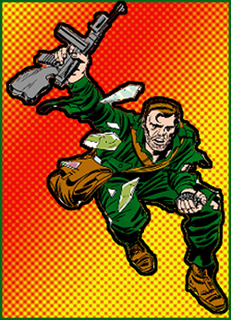
So who is the bigger cartoon? Is it the character in the song, Sergeant Nicholas Joseph Fury, or the singer, the 'Sensational' Alexander James Harvey? OK, easy question, really, but as a teenage Brit in the 70s it was sometimes hard to tell.
Marvel comics reached my consciousness mid 60s, I guess, not in their original multi-hued kaleidoscopes of smudgy ink, collectors items to this day, but as black and white facsimiles in UK comics 'Fantastic' and Terrific', almost entirely consisting of reprints of The Fantastic Four, the X Men and similar. Sgt Fury and his Howling Commandos seemed always unusual bedfellows amongst all these mutants and super-heroes, despite, in hindsight, being equally muscle bound and indestructible. In my somehow more sterile world, the wise-cracking and cigar-chomping irreverence shown towards WW2 appealed, and certainly far more so than the worthier by far UK war comics, populated by far cleaner cut and heroic fictions. Warfare seemed like so much fun........
Alex Harvey was so nearly of that generation, being born in 1935, and almost too old for the generation he became latterly most associated with, in, most famously, the Sensational Alex Harvey Band, their heyday between 1972 and 78. After various dead-end jobs he eventually staggered to his musical feet in 1954, embracing a number of styles in turn, dixieland and big band jazz, skiffle, soul/r'n'b, never quite breaking through, ending up in the pit of the London production of the musical 'Hair.' Rock music now inevitably in his blood, a chance meeting with Glasgow prog rockers 'Tear Gas' led to the end of an abortive solo period and the positively tongue-in-cheek entitled eponymous band. Perennials on the UK touring circuit, unless you are reading this in Cleveland, the chances are that the name will mean nothing to US readers. Bizarrely, they could fill venues in this city, bombing elsewhere. Gloriously and gratuitously Scottish, Harvey enunciating perfect Glaswegian, his band a side-show of grotesques, the songs a mix of Gothic Grand-Guignol with full on hard rock, they were foremost a live band. Harvey, unkempt and gurning, a swashbuckling figure in striped mate lot jerseys and buccaneers boots, with the extraordinary figure of guitarist, Zal Cleminson, in full clown make up and green jumpsuit, leering to his side. The songs, carefully chosen cover versions of anything from 50s rock'n'roll to Jacques Brel, mingling with unpretentiously art school originals, evoking comic books, as at the top of and the title of this piece, or dystopian vignettes of disturbed delusion. 'Sgt Fury' comes from their 1974 album, 'The Impossible Dream', and is a blend of all the styles dallied with earlier, perhaps in keeping with the era of the songs subject.
Stage sets and album covers became increasingly caricatures of themselves, hence my uncertainties as to who was the more or less real. Possibly their most famous moment was in 1975, their top 10 single, a remodelling of Tom Jones' chestnut, 'Delilah', horrifying teatime audiences across the UK as the true murderous menace of the lyric became acted out upon 'Top of the Pops. Magnificent (and still my sole ever performed karaoke piece.) Here it is from late night serious rock show, 'Old Grey Whistle Test':
Sadly, bedecked by alcohol issues, Harvey then left the band, who continued as the 'Sensational Alex Harvey Band without Alex', his absence seemingly little detraction. He joined again briefly before, aged 47, sustaining a pair of massive heart attacks, he died, in 1982. Whilst the band had broken up by then, I can report that, having been voted 5th most influential band in Scotland in 2005, they reformed and remain intermittently on the road to this day.
This has all the songs featured here and might be a safe place to start......
Or you may wish to read more about the band.
The band Soul Asylum
brings to mind a few non-musical things: Dave Pirner's ripped jeans, Winona
Ryder, milk cartons. Musically, the band has never put together a complete
album, one with a balance of their finest assets: driving guitar leads,
nostalgic melodies and graceful nods to their Americana roots. One of their
best songs, "Cartoon" off 1988's "Hangtime" hits on all
three, however, and includes the lyrical gem 'You're in the movies now that I'm
in your cartoon."
Hanna-Barbera literally dominated the American cartoon market during the 60s with a slate of the most popular shows, including (to name just a few) The Jetsons (which see), Tom and Jerry, and Huckleberry Hound. It should be no surprise that mention of some of these characters crops up in popular culture - in all sorts of creative endeavors, including music. Before Pearl, Janis Joplin appeared with backing band Big Brother and the Holding Company. Their first album, while it gave indication of what might come next (Cheap Thrills), wasn't a major success. All the same, with 20/20 hind sight, you can sense what was on the horizon, and Joplin's voice is right there alright.
Easy Rider, written by guitarist James Hurley, fits our bill for this theme - if just barely: his lyrics include the line ..he watches Huckleberry Hound on his TV ...
Thinks I: Who didn't?
For most of us the obvious reference to Easy Rider is most likely the Dennis Hopper/Peter Fonda film. Which came out in 69 - three years after Hurley penned this song. (Among other similar titles is Jimi's Ezy Rider on Cry of Love) But it's probably no surprise to you that the term Easy Rider goes back a ways in (American music)history - as a reference either to someone who rides through life kinda easy like, morals and so on, man or woman. There is suggestion that the phrase is also linked to CC (or See See) Rider, and that those two letters are also linked to all sorts of Americana that might interest you to research, not unlike Huckleberry itself.
A closer look at the complete lyrics and a sense of the 60s/hippies would suggest that the easy rider of this song is the guy who has an rather accommodating hippie girlfriend:
Well, I got a girl with a diamond ring, I'll tell you, boys, she knows how to shake that thing. Oh! Easy rider don't you deny my name
The former
drummer for San Diego progressive rock band Horsefeathers, and L.A. cult groups
Elton Duck and Invisible Zoo, Andy Robinson is now a purveyor of an
experimental Americana sound. His 2004 debut solo album was called Exotic
America. Then in 2011, he released “Music Bucket,” that refers to the pail
lowered into a well and the musical surprises it holds when pulled back up.
Besides some
vocals, the multi-instrumentalist uses an arsenal of tools including mountain
dulcimer, guitar, synthesizer, percussion, lap steel, kalimba, toy xylophone
and harmonica. By far, the most whimsical piece is "Cartoon,"
dedicated to Zal Yankovsky. According to the liner notes, that track even
includes "various junk recorded at the Blue Moon Bunny Farm,"
tastefully incorporated into the mix.
Three other tracks
("The Golden Feather," "Surge," "November Too") use
loops to impart a Zen-like flow and upwelling to the music. Robinson demonstrates
that he not only carries a song inside but that he has found a successful
recipe for unlocking the door and sharing his discoveries.
Music Bucket
features guests Mike Keneally (electric guitar), Carlos Olmeda (vocals), David
Ryan Norgren (vocals), Dennis Caplinger (fiddle, mandolin), Tripp Sprague
(sax), Jamie White (bass), PJ Bovee (bass), Coco Brown (bass), Nicki Elledge
(vocals), and Doug Robinson (bass). Chuck Elledge, Allison Boles, Mick and
Cynthia Garris add voices to the opening cut, "Yeah." Andy closes the
project with "The Open Door," the song's genesis evolving from solo
kalimba to a transcendent statement that seems to encourage exploration,
innovation and adventure. That's the organic nature of his music that resonates
with character and emotion. Tapping his heart's spirit, Andy Robinson's music
bursts forth with a shout from the soul.
You've got to
appreciate any instrumentalist who has fun with his compositions. “Cartoon” is
such a piece that is full of quirky fun and melodic frolic.
On a non-musical note, Robinson is also involved in improv comedy and currently performs on two teams (Coincidence? and Tribal Luminescence) in San Diego. The teams take audience suggestions and make up spontaneous plays based on them, discovering the humor that usually lies hidden beneath all of our ordinary day-to-day human relationships. It will be fun, and you will laugh!
As we transition from The Future to Cartoons and Comics, it seemed fitting to write about The Jetsons, a cartoon that probably had more to do with my generation’s expectations for the future than anything else.
Prepare, now, to have your mind blown. The Jetsons cartoons that we grew up on consisted of a single season of 24 episodes that originally ran on ABC on Sunday nights from September 23, 1962, to March 17, 1963. It was designed to be the futuristic counterpart to the prehistoric Flintstones (which ran 6 seasons), which itself was a take-off of The Honeymooners. One season in prime time, and forever in syndication, which is where I saw it. (More episodes were produced starting in 1985, but I can be certain that I never saw any of those).
In The Jetsons, the future seemed pretty great. People lived in space, had flying cars and robot maids, none of which have yet to really be a common thing. On the other hand, videophones and holograms and moving sidewalks are part of our lives, to varying degrees. And George Jetson’s job, as a “digital index operator” at Spacely’s Space Sprockets only required him to work an hour a day, two days a week. Unfortunately, the future did not end the concept of the tyrannical and clueless boss, and poor George often had to deal with Mr. Spacely’s whims and his constant competition with Cogswell’s Cogs. George, by the way, was voiced by actor George O’Hanlon, who otherwise had only bit parts (with credits like, “Drunk,” “Bear Man,” “Drunk” (a different one), “Parking Attendant” and “Security Guard”), but he was able to voice George again when the series was revived in the 1980s. O'Hanlon died of a stroke in 1989, while recording dialogue for Jetsons: The Movie, which was dedicated to him and the legendary voice actor Mel Blanc (the voice of Cosmo Spacely), who also died that year.
My colleague Andy La Raygun recently linked to an article about The Jetsons from none other than Smithsonian magazine, and it discusses the outsized influence this cartoon has had on our culture. Go ahead and read it. It isn’t long. One interesting point the article makes is that although the show was produced and broadcast in color, in 1962, less than 3 percent of American households had a color television set. So the bright, colorful future that The Jetsons promised was rendered in dull blacks and grays for most people, and that may be why it only lasted a season in prime time. (Maybe The Flintstones’ greater longevity can be traced to the fact that people subconsciously were OK with seeing a prehistoric show in black and white, sort of the opposite reaction that we have today when we see footage of World War II in color, since, you know, it took place in black and white).
This being a music blog, I thought I should mention that the memorable theme song for The Jetsons was written by Hoyt Curtin, and it actually became a hit in 1986. Curtin was the composer of many Hanna-Barbera cartoons' theme songs, including The Flintstones, Top Cat, Jonny Quest, Superfriends, and Josie and the Pussycats, and thus may have been the composer whose music I most listened to as a young child.
When the theme first cropped up, one of my first thoughts was "Future Games." Must have been '73 that Fleetwood Mac first captured me with Mystery To Me. As indicated in the name, the mesmerizing effect of many of the songs fit the times (mild psychedelia) and my own frame of mind. I listened for hours to the album: side A, side B, side A again (of course, on cassette tape- de rigeur).
You check out the song titles of Fleetwood Mac songs from the era, and notice that no small number of them reference time, the future: "Woman of a 1000 Years" ... "Sands of Time" ...
I did check into the archives of SMM - seemed not possible that the song had never been posted afore, and sure enough - back in 2009, it was presented here. Both in consideration of the fact that few of you were likely to have been here then and still here now, but even worse- the fact that the link to that post has deteriorated/gone missing, it would appear to be time to bring it back to life.
Later today, my long-beleaguered Mets will be playing a decisive Game 5 in their division series. Win, and continue on to the league championship series against the even longer-beleaguered Cubs, and be one step from the World Series. Lose, and start booking tee times.
Back when baseball was the unquestioned National Pastime, its major league franchises were mostly clustered in the relatively cold cites of the northeast and Midwest. It wasn’t until the 1950s that baseball expanded to Southern California, and it took until 1966 for a major league team to play south of Washington, D.C. or St. Louis. It isn’t surprising, then, that the start of the baseball season, in the springtime, was often conflated with the return of warmer weather and rebirth. And because every team starts every spring tied with all the others and, theoretically at least with an equal chance to win the championship, the phrase “hope springs eternal,” is often used to refer to baseball. It appears that the phrase was first used by Alexander Pope, in his 1734 poem An Essay on Man. (Pope was well known for his translations of Homer, but he never got to see a homer, although he might have seen cricket or rounders. Nor would Pope have been aware that Ernest Thayer borrowed his line in the most famous baseball poem ever, Casey At The Bat).
Back in the spring, most commentators figured the Mets would be improved over the last season, but would finish behind the Washington Nationals, who were expected to run away with the pennant. In May, when I wrote about Matt Harvey, the starting and winning pitcher in Game 3 of the division series that I had the opportunity to attend (see above), things still looked positive for the Mets, before they swooned in mid-season. But strong pitching and good trades led them back to success, and the collapse of the amusingly dysfunctional Nationals, gave the Mets the National League Eastern Division crown, and at least a shot at moving on, pending tonight’s results.
The Baseball Project was a “supergroup” formed by members of R.E.M., The Young Fresh Fellows, The Dream Syndicate (among other bands) to write and perform songs about baseball. I made the mistake of referring to them as a “novelty act” on another site, which band member Mike Mills took issue with on Twitter. (As a big fan of R.E.M., it was actually pretty cool to have Mike Mills annoyed with me.) They’ve released a whole bunch of good music, covering baseball-related topics as diverse as racism, the mysterious death of Ed Delahanty in 1903, labor relations, wife-swapping, eccentrics, fans, the Hall of Fame, and keeping score.
For the 2010 season, the band recorded for espn.com a series of songs designed to be a real-time commentary on the season. One of them, “All Future and No Past,” took its title from a quote from Indians player/manager Lou Boudreau: “On opening day, the world is all future and no past.” Boudreau, who appears to have been quite a guy, was a rare player/manager (starting when he was 25), also played professional basketball, and while playing major league baseball actually obtained his bachelor’s degree in education and was an assistant basketball coach at the University of Illinois.
The song is, as expected, an optimistic look at the potential that a number of teams could have, if everything broke their way, when “everybody has a chance.” Of course, there is a melancholy undercurrent to the song, because we know that it is unlikely that every team’s future will be bright. We know baseball is a zero-sum game-- every game has a loser, few teams advance to the postseason, only two make the World Series, and one gets to be champion.
As a Mets fan, it is hard to divorce the past from the future. Historically, the Mets have been often terrible, sometimes epically so, and their periods of quality have been few and usually short-lived. To now, things have broken the Mets’ way, and if they can get by the Dodgers tonight, there’s no reason to believe that they can’t beat the Cubs. But I have to admit that the success of the team this season has been a surprise, and even if they lose, I will (eventually) recognize that it was a fun season, one that gave me way more pleasure than I expected on Opening Day.
And beyond that, with their cadre of hard throwing, talented young pitchers, the Mets have a chance at a great future. Of course, as the first Mets’ manager, Casey Stengel once said, “Never make predictions, especially about the future.”
How often have venerable space warriors Hawkwind appeared on this site, I wonder? (Answer: none). From this distance it feels that they, if not inventing the whole genre, have certainly run with the idea of "spacerock" longer than most, celebrating, this year, 46 years on the road. OK, so Pink Floyd have dabbled with this, and the Grateful Dead likewise, but I am sure no other group has dedicated themselves to such dystopian visions with such dysfunctional relish, blending early bleep and booster electronica, with swords and sorcerers sci-fi, Always seemingly on the edges of society, embracing and being embraced by any counter-culture available, moving seamlessly from free-festival hippy culture of the 60s to the rave culture traveller scene of the 90s, their history a maelstrom of departing and returning members, drugs and mental illness, underpinned by the sturdy dictatorship of Dave Brock, sole man standing since their inception in 1969. For a more detailed idea of their chaotic journey look here. It's as their possibly most famous ex-member, Lemmy, sacked, ironically for his drug-usage, put it: "It was like Star Trek, but with long hair. And drugs."
The song "Welcome to the Future" is little more than a spoken introductory piece to "Space Ritual", a multi-media cavalcade of very loud and very heavy rhythmic rock, primitive electronica, lightshows, mime and dance, released in a live format in 1973, after being paraded around the world in the years ahead of that. (Little known fact, Hawkwind were the first UK band to headline a tour in the US, rather than as a support act to homegrown product. They lost money, but it was still the first.) This was largely funded by the UK single success of "Silver Machine", a studio cleaned up "live" performance of a concert favourite, with new vocals over-dubbed by the soon to go Lemmy. I recall this with joy, it being, and the concert footage that went with it on U.K. chartshow Top of the Pops, a delight to my teenaged ears, the dirtiest, greasiest noise I had ever seen or heard.
Exposure to that wholly unholy din (and statuesque dancer, Stacia) sent me to their back catalogue, and I hoovered up, over the next few years, their earlier output.These first few recordings, even the hesitant nearer psychedelia of the first, I think stand up well, and the resonance between what passed for driving rock back then and what would later emerge as techno is striking, and the influence undeniable. Check this recent automobile advert out!
I confess that I eventually lapsed, the procession of rotating door ne'er do wells, including Arthur Brown (Fire) and, bizarrely, Ginger Baker and an over-reliance on spoken word liturgies eventually alienating me, not least as my precocious tastes fled to country and folk pastures. Also I had read some Michael Moorcock, a sci-fi writer with whom they had become involved, and didn't like the books, deciding I didn't like the band any more either. Such was my fickle nature. But that didn't stop them, and the ramshackle circus is till doing the rounds, sometimes with different variations of the name: Hawkestra, Hawwkwind Light Orchestra, and sometimes even rival versions playing much the same: xHawkwind.com, formed by sacked saxist Nik Turner with other ex-members, until sued into changing their name to, no doubt all irony intended, Space Ritual. However, I am beginning to wonder what the live experience may now be like. I did see them once, in 1975, at The Reading Festival, sadly being then as out of it as their reputations for the same might suggest, so, who knows, maybe next years annual shindig, Hawkeaster, may find me back amongst the faithful in front of high priest Dave Brock (age 74), to see who he has with him now.
Ah, the future—flying cars, fully-automated homes, robot
girlfriends…What a time to be alive.
When the information age really started taking off, which I
calculate to be when I got my fist cell phone, I used to like to talk about how we
really were living in age of The Jetsons. All those cartoon-fantastic, whiz
bang inventions that made everyday life something much faster, more convenient
and brought us more in tune with the wider world seemed to be coming true.
Within reason, of course—I still had to sit in traffic, rather than fly over it
on my way to not a pneumatic hive of prodigious industry and lightning fast
tech innovations, but rather a crumbling building without air-conditioning.
But, no worry—I had a cell phone; I could talk to people
while I sat in traffic. I had satellite radio, which meant I never lost the
signal, unless it rained. And, as a teacher, I had this resource called the
internet, so I didn’t really need to do much planning for my lectures—it was
all right there for me, no trip to the library needed…
Strange how the Future ended up. I find myself often wishing
for the days before I had high speed internet service and could stream and
Google and text and Tweet and Snapchat and Instagram—and a whole host of other
common elements of my life. Life seems to have taken not only a semantic shift of meaning, but
undergone a radical revision in action and lifestyle as well. This is the
information age, yes, but things change so rapidly as we trip merrily along to
the future, we might as well dub it the age of Neologism, as well. We're constantly reinventing, in order to achieve this almost undefinable 'better', but we don't stay in one place long enough to think of what the better might entail...
But, let’s go back to get forward, shall we?
When I think of the theme “the Future”, a lot of songs come
immediately to mind, one because of their subject matter, but more for the
sense that, when it comes to music, the future is all well and good, and I’m
sure some great things are coming—but, it’s the past, the pedigree, the
primordial beginnings, that make the future what it is. Rock comes from a
specific well spring, a beautiful, ever-thriving gene pool that keeps
replicating its DNA into new creatures, that look a little different but all
come from the same family. Its like Jurassic Park—the old stuff makes the
new...We never have to go travel too far into the past to find the specific root of not only the modern sense of music, but also to predict where it is headed. Rock 'n roll is very simple--it's a product of its upbringing, and damn, did it have good parents...
My song this month is The Rolling Stone’s “2000 Man”, from
Their Satanic Majesties Request, their 1967 concession to psychedelia, and
psychedelics (that means “drugs,” kids). It’s not a great album—even the band
admits to thinking it was mess—court appearances, drug indulgences, no one to
pull the strings—and it adds up to a collection of silly, flower child ditties,
but overall, the album carries with the same sense of messiness that comes from
over indulgence and the sense of boredom that inevitably follows said abusive
behavior.
They say too much of anything that raises the senses will
eventually dull them. And Request is
just that: dull. And a bit silly.Have
you looked at the cover? It’s like a low-rent version of Sgt. Peppers, without the interesting subtext and treasure chest of
oddities.
Even the band looks a little uncomfortable about what they
are doing.One might guess they are
about 30 years early for one of those midnight Harry Potter Sales…
There are a few exceptions, such as the perfectly-pop She’s a Rainbow, and 2000 Light Years From Home, both of
which listen now as not only what was good about psychedelic rock, but as a
blue print for the sonic architecture of Brit Pop, and bands like Blur, The Stone Roses at their jammy best, and Oasis.
My favorite track on the album—the only other one I like,
aside from the aforementioned two above is 2000
Man. Let’s be honest: it’s the standout track on the album. It starts with
a country twinged guitar stutter and the chorus descends into a drum smashing,
organ grind shout out, something that wouldn’t be out of place in the Three
Penny Opera. The breakdown is pure static, and the song reads like a mash up of
a few genres, steps lively, and relies on those gorgeous twin guitar ripples
that Keith and Brian Jones did so well during their brief tenure as the melody
makers in the Stones.
It’s reminiscent of The Who’s A Quick One While He’s Away or
Medley, fromThe Beatles’ later Abbey Road
in that it is more than one song rolled into a single vinyl track. And while
both of those songs are much longer in scope and more masterful in
instrumentation and riskier in trying to accomplish something grandiloquent and
operatic, 2000 Man makes it mark as a gesture towards taking rock music in a grandly nuanced direction.
Lyrically, which is what brought me to the song for our
theme, 2000 Man is as interesting as it is nonsensical. It’s a confessional
poem of sorts, delivered by a man who identifies himself as the 2000 Man and who
proceeds to confess his misdeeds, his infidelity to his wife, his disconnect
from his children and in a strange nod to horticulture, the strange flowers
he’s growing on his window sill.
In a way, the song talks to the future in the sense that the
narrator just doesn’t fit—perhaps he’s outdated, but when he says don’t you I’m
a 2000 man, he seems to be saying, you don’t get me because I’m well beyond
you. I am the future. When the song switches narrative perspectives and the
speaker’s kids start responding to the conceited claims of their father, they
simply chant:
“Oh daddy, proud of your planet/ Oh
mummy, proud of your sun.”
It’s not necessarily done with the
clearest of intentions, but it does read like a back and forth between two
parties, both insisting they are hipper, more knowledgeable, more
at home in the new paradigm. The insistence at being a 2000 man comes across as
a desperate claim of relevance, which is what happens to those of us who stick
around long enough to see the world change, without our help, perhaps before
we’re ready.
The world morphs at a rapidly accelerating pace and it’s
hard to hold steady sometimes, especially for those of us who work and have to
interact cross-generationally. Nostalgia—looking back fondly, or fiercely or
with bitterness—is simply a self-defense mechanism that helps us to feel
relevant in a place where the only true relevancy is measured by the newness of
the idea or innovation.
The future was not kind to him...
I think, though, to disparage a younger generation is somewhat
pointless. Being grumpy about being 'out if it' won't get us anywhere. And, really, the more things change, the more
they stay the same…No, that’s bullshit. The more things change, the better
things will alwys have been ‘back in the day’. It will just depend on whose day it was. Bands
like The Rolling Stones? It will always have been their day, their party; we
were just lucky enough to get the invite.
At some point—sooner, not later—those that think we’re dinosaurs
will experience the same shame of irrelevance. Such is the pace at which we are
growing. Hold on to the classics—they will be everyone’s classics at some
point. Because, no matter how far we grow and move on, the beginning, the fount
and wellspring of greatness, the firsts—will always be the best. Elvis, The
Beatles, The Stones…all that amazing rock n roll, that was the future at one
point—the future with a capital F and italicized, the ideal. And, because it
was first, it will always be first and won’t fade away.
And if we go back to our stubborn speaker in 2000 Man, who insists he’s not lost his
hipness yet, it’s interesting to compare him to Jagger and the Stones—is there
any other outfit in rock ‘n roll who has the privilege of not having to insist
at all on having stayed relevant, no longer taste makers, but the creators of
the taste and pretty much the judge and jury of rock ‘n roll cool and the ones
who created the measure that everyone else will always have to live up to…?
Star Maker Machine does not accept music submissions from artists or promoters. However, most of the contributors here do accept submissions for our own blogs, listed below. Please visit our blogs, take the time to listen to what we post, and then feel free to contact us if you feel that your music would be a good fit.