












Showing posts with label Anthony Phillips. Show all posts

Monday, February 28, 2022

Weather: Which Way The Wind Blows

Anthony Phillips: Which Way the Wind Blows
[purchase

I’ve been having trouble with this theme (and, based on the lack of posts, I’m not the only one)—not that there is a lack of appropriate songs, because there are tons, but for me, there has to be some reason to write about the song—like a personal story, a political connection, or just because I want to write about the artist or song. So, when this song came up in a search, and I listened to it again (after many years), I realized that this song could actually have worked for our “What If” theme that I enjoyed. Plus it has been nearly two months since I’ve delved into the world of prog-rock obscurity, so why not? 

This song sort of answers the burning question, “What if Anthony Phillips had never left Genesis?” 

I’m pretty sure that I’ve discussed the origins of one of my favorite bands somewhere—original members Peter Gabriel, Tony Banks, Mike Rutherford, Anthony Phillips and Chris Stewart all met in the 1960s at the Charterhouse School in England. Eventually connecting with older Charterhouse alum, the singer, songwriter, producer and convicted child abuser Jonathan King, who named the band and got them signed. Stewart left and was replaced by another Charterhouse alum, John Silver, who was later replaced by John Mayhew. After recording their second album Trespass, Phillips, the guitarist, quit, due to bad health and stage fright, and was eventually replaced by Steve Hackett; Mayhew was sacked and replaced as drummer by Phil Collins. 

So, let’s say that Phillips never left, so Hackett never joined. In the short term, there probably wouldn’t have been much difference because both guitarists, who became good friends, acknowledge that their sound and sensibilities were very similar, but our featured song gives you a sense of what the band might have sounded like after Gabriel left, and Collins stepped up as lead singer. 

After Phillips left Genesis, he wanted to continue a project he had been working on with Rutherford but first decided to expand and improve his musical knowledge and ability, studying classical music, orchestration and harmony, and taking lessons in guitar and piano. Eventually, Phillips and Rutherford returned to their project, which was slowed by the fact that Rutherford’s commitments to the increasingly popular Genesis were taking up more and more time. A push to finish the album came in fall 1974, when Steve Hackett injured his hand, delaying a Genesis tour, and allowing Phillips and Rutherford time to complete the bulk of the recording. In addition to bringing Collins in to sing on two tracks, Hackett’s younger brother John contributed flute on some of the songs. 

The album, The Geese and the Ghost, was finally finished in 1976, but Genesis’ label Charisma refused to release it, so it sat in the vaults until March 1977, just as punk was on the rise, and the sort of lyrical classical/folk influenced prog rock of the album was falling out of favor, and it was a commercial failure. Compare that to Hackett’s first solo album, Voyage of the Acolyte, which was mostly recorded around the same time, and also included contributions from Collins on vocals (and drums), Rutherford and John Hackett, but was released in 1975, and charted in the UK and (just barely) in the US. 

Our featured song, “Which Way The Wind Blows,” is a quiet ballad featuring Phillips, Rutherford and Collins, and would not have sounded at all out of place on Trick of the Tail, the first Genesis album on which Collins served as lead vocalist, released in 1976. Compare it, for example, to “Ripples,” from that album. 

Phillips tried to move toward a more pop direction, but that also was unsuccessful (although I found this track fun), and while he has released other solo albums, Phillips’ focus was more on soundtracks and “library music,” and occasionally guesting on projects with Rutherford, Camel, and Hackett.


Wednesday, September 27, 2017

Down: Geese


Camel: The Flight of the Snow Goose  
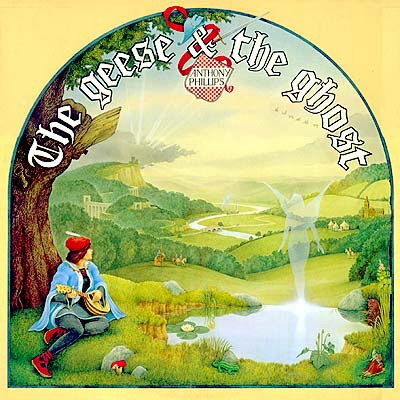
Anthony Phillips: The Geese and The Ghost
[purchase The Snow Goose]
[purchase The Geese and The Ghost]

One of the joys of a theme-focused blog is that it gives you a challenge to wrack your brain and try to think of a related topic. And it can be fun to take the theme to an unexpected place. Clearly, the obvious way to interpret “Down” is consistent with the thumbnail being used to illustrate the theme—“toward or in a lower place or position.” But the word has other meanings, including certain feathers of a bird used for insulation, often from a goose. So, here we are.

Camel is one of those English prog-rock bands from the 70s that had some success, both critically and commercially, but aren’t generally grouped in the top tier of the genre’s acts. Nevertheless, they released a bunch of good albums and have continued to perform and record until the present day, with a dizzying revolving door of members surrounding founding member Andrew Latimer.

After releasing two albums with minimal success, the band decided to try a concept album. Rejecting a few novels to base their work on, they ultimately decided to attempt to create a work based on a 1941 novella by Paul Gallico (a prolific writer probably best known for The Poseidon Adventure), titled The Snow Goose. It tells the very sentimental story of the friendship and love between Philip Rhayader, a disabled artist living in a remote lighthouse in Essex, England, and a local girl, Fritha. A wounded snow goose is nursed back to flight by Fritha, whose friendship with Rhayader grows, while the goose returns over the years to the lighthouse. Rhayader uses his sailboat to rescue hundreds of soldiers in the Dunkirk evacuation, but is lost. The goose finds Fritha on the marshes, which she interprets as Rhayader’s soul leaving her, and she realizes her love for the lost man. The lighthouse is leveled by German aircraft, destroying all of Rhayader’s work, except for a portrait of Fritha, as a child, holding the injured snow goose.

The story struck a chord, and the book won an O. Henry Prize in 1941. It was read on the radio in 1944, turned into a BBC TV movie in 1971 featuring Richard Harris (as the goose—just kidding), and that won a Golden Globe and was nominated for both a BAFTA and Emmy. When Camel announced that it planned to release their musical adaptation of the book, Gallico gallantly threatened to sue the band (yay, lawyers!), so they were forced to call the album Music Inspired By The Snow Goose, and they had to abandon the idea of using lyrics based on the text, rendering the album fully instrumental. Despite these obstacles, the album, released in 1975, was both a critical and commercial success.

It is a beautiful, moving work, featuring rock instrumentation along with the London Symphony Orchestra (and, on one song, a duffle coat, used to simulate the flapping of wings). It is hard to pick a favorite song, but to be theme-appropriate, I picked “Flight of the Snow Goose,” which starts off slowly, but builds to a triumphant end.

In doing my research for this, I found a review which claimed that the Gallico novella also inspired another song, Anthony Phillips’ “The Geese and The Ghost.” Turns out, that isn't true. In fact, the title derives from two sounds on the ARP Pro-Soloist synthesizer which was used on the album.

Phillips was the original guitarist in Genesis, but left after recording their second album, Trespass, ultimately being replaced by Steve Hackett. Phillips left due to a combination of stage fright and other health reasons, and an aversion to being in the public eye. After leaving Genesis, Phillips decided to study music, and didn’t record anything for a number of years. His solo debut, The Geese and The Ghost, featuring some music that he had worked on while still in Genesis with friend and former schoolmate Mike Rutherford, and solo compositions, was released in 1977.  In addition to Rutherford, Phil Collins provided some vocals (recorded before he succeeded Peter Gabriel as Genesis’ singer) and Hackett’s brother John added flute.

In general, the album is somewhat folky, with orchestral flourishes, and the title track is beautiful. Genesis fans could definitely hear a kinship to some of the quieter moments of Trespass. Phillips went on to release music to little commercial success, more successfully create “library music” for use in films and TV shows, and appear on other artists' albums playing guitar and keyboards.

In fact, in 1982, Phillips appeared on Camel’s album The Single Factor, and co-wrote a song with Andy Latimer. That album is utterly devoid of any goose-related material (which unfortunately cannot be said of our local athletic fields).