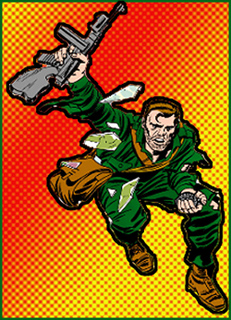
I thought this had to be done from the get-go of this theme, and hung back with the expectation that someone else was going to latch on to it. Heading down to the theme expiration deadline, I guess it's up to me.
The song itself, I know well. The Magneto/Titanium Man comic book heroes: only through this song. Of all possible comic book heroes, Mr McCartney .. why this one? There must be some story lurking behind the choice that I can't fathom - even after some Internet research. Guess I'm not much of a Marvel fan.
.
Of the various YouTube versions available, this version seemed the most appropriate: itself a cartoon that helps explain the song. A bit. All said and done, the song is a classic example of the Wings/McCartney genre. All due respect aside, most other YouTube versions show the band for what it's worth (sorry, Linda).
I’m a little obsessed with baseball right now, on the verge of Game 1 of the World Series. As a Mets fan, this has really been an unexpected and exciting playoff run. I’ve already discussed this in my Future post, and I’ve also written about tonight’s Game 1 starter, Matt Harvey, the Dark Knight of Gotham.
Which brings me to today’s discussion of Batman. I was utterly unaware of the Batman comics that predated the TV series that ran from January 12, 1966, to March 14, 1968. I have a pretty strong memory of watching maybe the first episode as a young child, and watching many more episodes, either during the initial run, or after school in syndication. I’m sure I knew that it was silly, even before I understood the concept of “camp.”
I never read any of the later Dark Knight stuff, or any of the later Batman comics, and while I remember seeing the Tim Burton/Michael Keaton Batman movie, I can’t remember whether I’ve seen any of the sequels or reboots (although I’m pretty sure I saw the one with George Clooney). Because I really don’t care all that much.
In fact, after all these years, it is probably the great theme song from the TV series that I remember the most. Written by the great musician, composer and arranger Neil Hefti (who also wrote the Odd Couple theme), the version that played during the credits is faster, and was arranged by the great composer and arranger Nelson Riddle. And I’m obviously not the only one with the song stuck in my brain, because the “Na na na na na na…..Batman!” meme is pretty much ubiquitous on the Internet. (There are, apparently 80 “nas” in the theme.) You can even buy shirts with it.
R.E.M. submitted their reimagining of the theme for inclusion in the soundtrack of Batman Returns, the sequel to the first Burton/Keaton film. It was rejected, and instead became the B-side to the “Drive” single, and has been included in a few box sets and anthologies. It actually hit #11 on the UK charts, and was used by the Weather Channel under local weather updates.
So who is the bigger cartoon? Is it the character in the song, Sergeant Nicholas Joseph Fury, or the singer, the 'Sensational' Alexander James Harvey? OK, easy question, really, but as a teenage Brit in the 70s it was sometimes hard to tell.
Marvel comics reached my consciousness mid 60s, I guess, not in their original multi-hued kaleidoscopes of smudgy ink, collectors items to this day, but as black and white facsimiles in UK comics 'Fantastic' and Terrific', almost entirely consisting of reprints of The Fantastic Four, the X Men and similar. Sgt Fury and his Howling Commandos seemed always unusual bedfellows amongst all these mutants and super-heroes, despite, in hindsight, being equally muscle bound and indestructible. In my somehow more sterile world, the wise-cracking and cigar-chomping irreverence shown towards WW2 appealed, and certainly far more so than the worthier by far UK war comics, populated by far cleaner cut and heroic fictions. Warfare seemed like so much fun........
Alex Harvey was so nearly of that generation, being born in 1935, and almost too old for the generation he became latterly most associated with, in, most famously, the Sensational Alex Harvey Band, their heyday between 1972 and 78. After various dead-end jobs he eventually staggered to his musical feet in 1954, embracing a number of styles in turn, dixieland and big band jazz, skiffle, soul/r'n'b, never quite breaking through, ending up in the pit of the London production of the musical 'Hair.' Rock music now inevitably in his blood, a chance meeting with Glasgow prog rockers 'Tear Gas' led to the end of an abortive solo period and the positively tongue-in-cheek entitled eponymous band. Perennials on the UK touring circuit, unless you are reading this in Cleveland, the chances are that the name will mean nothing to US readers. Bizarrely, they could fill venues in this city, bombing elsewhere. Gloriously and gratuitously Scottish, Harvey enunciating perfect Glaswegian, his band a side-show of grotesques, the songs a mix of Gothic Grand-Guignol with full on hard rock, they were foremost a live band. Harvey, unkempt and gurning, a swashbuckling figure in striped mate lot jerseys and buccaneers boots, with the extraordinary figure of guitarist, Zal Cleminson, in full clown make up and green jumpsuit, leering to his side. The songs, carefully chosen cover versions of anything from 50s rock'n'roll to Jacques Brel, mingling with unpretentiously art school originals, evoking comic books, as at the top of and the title of this piece, or dystopian vignettes of disturbed delusion. 'Sgt Fury' comes from their 1974 album, 'The Impossible Dream', and is a blend of all the styles dallied with earlier, perhaps in keeping with the era of the songs subject.
Stage sets and album covers became increasingly caricatures of themselves, hence my uncertainties as to who was the more or less real. Possibly their most famous moment was in 1975, their top 10 single, a remodelling of Tom Jones' chestnut, 'Delilah', horrifying teatime audiences across the UK as the true murderous menace of the lyric became acted out upon 'Top of the Pops. Magnificent (and still my sole ever performed karaoke piece.) Here it is from late night serious rock show, 'Old Grey Whistle Test':
Sadly, bedecked by alcohol issues, Harvey then left the band, who continued as the 'Sensational Alex Harvey Band without Alex', his absence seemingly little detraction. He joined again briefly before, aged 47, sustaining a pair of massive heart attacks, he died, in 1982. Whilst the band had broken up by then, I can report that, having been voted 5th most influential band in Scotland in 2005, they reformed and remain intermittently on the road to this day.
This has all the songs featured here and might be a safe place to start......
Or you may wish to read more about the band.
The band Soul Asylum
brings to mind a few non-musical things: Dave Pirner's ripped jeans, Winona
Ryder, milk cartons. Musically, the band has never put together a complete
album, one with a balance of their finest assets: driving guitar leads,
nostalgic melodies and graceful nods to their Americana roots. One of their
best songs, "Cartoon" off 1988's "Hangtime" hits on all
three, however, and includes the lyrical gem 'You're in the movies now that I'm
in your cartoon."
Hanna-Barbera literally dominated the American cartoon market during the 60s with a slate of the most popular shows, including (to name just a few) The Jetsons (which see), Tom and Jerry, and Huckleberry Hound. It should be no surprise that mention of some of these characters crops up in popular culture - in all sorts of creative endeavors, including music. Before Pearl, Janis Joplin appeared with backing band Big Brother and the Holding Company. Their first album, while it gave indication of what might come next (Cheap Thrills), wasn't a major success. All the same, with 20/20 hind sight, you can sense what was on the horizon, and Joplin's voice is right there alright.
Easy Rider, written by guitarist James Hurley, fits our bill for this theme - if just barely: his lyrics include the line ..he watches Huckleberry Hound on his TV ...
Thinks I: Who didn't?
For most of us the obvious reference to Easy Rider is most likely the Dennis Hopper/Peter Fonda film. Which came out in 69 - three years after Hurley penned this song. (Among other similar titles is Jimi's Ezy Rider on Cry of Love) But it's probably no surprise to you that the term Easy Rider goes back a ways in (American music)history - as a reference either to someone who rides through life kinda easy like, morals and so on, man or woman. There is suggestion that the phrase is also linked to CC (or See See) Rider, and that those two letters are also linked to all sorts of Americana that might interest you to research, not unlike Huckleberry itself.
A closer look at the complete lyrics and a sense of the 60s/hippies would suggest that the easy rider of this song is the guy who has an rather accommodating hippie girlfriend:
Well, I got a girl with a diamond ring, I'll tell you, boys, she knows how to shake that thing. Oh! Easy rider don't you deny my name
The former
drummer for San Diego progressive rock band Horsefeathers, and L.A. cult groups
Elton Duck and Invisible Zoo, Andy Robinson is now a purveyor of an
experimental Americana sound. His 2004 debut solo album was called Exotic
America. Then in 2011, he released “Music Bucket,” that refers to the pail
lowered into a well and the musical surprises it holds when pulled back up.
Besides some
vocals, the multi-instrumentalist uses an arsenal of tools including mountain
dulcimer, guitar, synthesizer, percussion, lap steel, kalimba, toy xylophone
and harmonica. By far, the most whimsical piece is "Cartoon,"
dedicated to Zal Yankovsky. According to the liner notes, that track even
includes "various junk recorded at the Blue Moon Bunny Farm,"
tastefully incorporated into the mix.
Three other tracks
("The Golden Feather," "Surge," "November Too") use
loops to impart a Zen-like flow and upwelling to the music. Robinson demonstrates
that he not only carries a song inside but that he has found a successful
recipe for unlocking the door and sharing his discoveries.
Music Bucket
features guests Mike Keneally (electric guitar), Carlos Olmeda (vocals), David
Ryan Norgren (vocals), Dennis Caplinger (fiddle, mandolin), Tripp Sprague
(sax), Jamie White (bass), PJ Bovee (bass), Coco Brown (bass), Nicki Elledge
(vocals), and Doug Robinson (bass). Chuck Elledge, Allison Boles, Mick and
Cynthia Garris add voices to the opening cut, "Yeah." Andy closes the
project with "The Open Door," the song's genesis evolving from solo
kalimba to a transcendent statement that seems to encourage exploration,
innovation and adventure. That's the organic nature of his music that resonates
with character and emotion. Tapping his heart's spirit, Andy Robinson's music
bursts forth with a shout from the soul.
You've got to
appreciate any instrumentalist who has fun with his compositions. “Cartoon” is
such a piece that is full of quirky fun and melodic frolic.
On a non-musical note, Robinson is also involved in improv comedy and currently performs on two teams (Coincidence? and Tribal Luminescence) in San Diego. The teams take audience suggestions and make up spontaneous plays based on them, discovering the humor that usually lies hidden beneath all of our ordinary day-to-day human relationships. It will be fun, and you will laugh!
As we transition from The Future to Cartoons and Comics, it seemed fitting to write about The Jetsons, a cartoon that probably had more to do with my generation’s expectations for the future than anything else.
Prepare, now, to have your mind blown. The Jetsons cartoons that we grew up on consisted of a single season of 24 episodes that originally ran on ABC on Sunday nights from September 23, 1962, to March 17, 1963. It was designed to be the futuristic counterpart to the prehistoric Flintstones (which ran 6 seasons), which itself was a take-off of The Honeymooners. One season in prime time, and forever in syndication, which is where I saw it. (More episodes were produced starting in 1985, but I can be certain that I never saw any of those).
In The Jetsons, the future seemed pretty great. People lived in space, had flying cars and robot maids, none of which have yet to really be a common thing. On the other hand, videophones and holograms and moving sidewalks are part of our lives, to varying degrees. And George Jetson’s job, as a “digital index operator” at Spacely’s Space Sprockets only required him to work an hour a day, two days a week. Unfortunately, the future did not end the concept of the tyrannical and clueless boss, and poor George often had to deal with Mr. Spacely’s whims and his constant competition with Cogswell’s Cogs. George, by the way, was voiced by actor George O’Hanlon, who otherwise had only bit parts (with credits like, “Drunk,” “Bear Man,” “Drunk” (a different one), “Parking Attendant” and “Security Guard”), but he was able to voice George again when the series was revived in the 1980s. O'Hanlon died of a stroke in 1989, while recording dialogue for Jetsons: The Movie, which was dedicated to him and the legendary voice actor Mel Blanc (the voice of Cosmo Spacely), who also died that year.
My colleague Andy La Raygun recently linked to an article about The Jetsons from none other than Smithsonian magazine, and it discusses the outsized influence this cartoon has had on our culture. Go ahead and read it. It isn’t long. One interesting point the article makes is that although the show was produced and broadcast in color, in 1962, less than 3 percent of American households had a color television set. So the bright, colorful future that The Jetsons promised was rendered in dull blacks and grays for most people, and that may be why it only lasted a season in prime time. (Maybe The Flintstones’ greater longevity can be traced to the fact that people subconsciously were OK with seeing a prehistoric show in black and white, sort of the opposite reaction that we have today when we see footage of World War II in color, since, you know, it took place in black and white).
This being a music blog, I thought I should mention that the memorable theme song for The Jetsons was written by Hoyt Curtin, and it actually became a hit in 1986. Curtin was the composer of many Hanna-Barbera cartoons' theme songs, including The Flintstones, Top Cat, Jonny Quest, Superfriends, and Josie and the Pussycats, and thus may have been the composer whose music I most listened to as a young child.
Star Maker Machine does not accept music submissions from artists or promoters. However, most of the contributors here do accept submissions for our own blogs, listed below. Please visit our blogs, take the time to listen to what we post, and then feel free to contact us if you feel that your music would be a good fit.