








Showing posts with label Phil Ochs. Show all posts

Saturday, October 2, 2021

COPS: OF THE WORLD

I thought there was another week in this theme, so ye'll be spared one of my monster posts of obtuse verbiage and arcane detail: this is, therefore a short piece of obtuse verbiage and arcane detail. The song featured above is not new and may be little known, but says as much as us today, nearly sixty years on, as it did then. 

Sadly, despite the suggestion it might, the lyrics are not actually spoonfed out to you in the video, and will need a listen. Thankfully, that is not so hard, given the clear singing diction of the singer, and writer, Phil Ochs. Can you guess what it's about? Who might be the Cops of the World he refers to? The flag, of course, is the giveaway, the term a derogatory phrase attached to Uncle Sam and his finest, dispatched at a moments notice to prop up democracy and the free world, whenever it looks as if trade may be hindered by the actions of nasty foreign types. To be fair, it has been a model that largely seemed to work arguably well, only of late running into the awkward detail that other nations have sussed how it works, and then play differently. Modern warfare just is what it wasn't, with armies and all that a little redundant, as the model morphs into different values and different strategies. That sort of emerged as Vietnam ended rather than was won, with Afghanistan altogether more embarrassing. At least Korea is still undecided, the astonishing fact that, officially, the war is still ongoing. Still, I'll shut up now about the politics. As a Brit, and a goddam pinko one at that, what do I know?
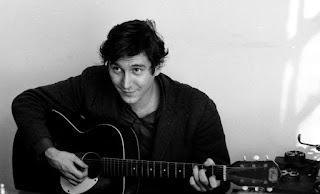
Phil Ochs, who wrote the song, was probably another goddam pinko, although he described himself more as a left social democrat, and was had aims to be a journalist ahead of becoming known as a singer; he later called himself a singing journalist. As the son of a war-scarred doctor, he had a peripatetic childhood, his father struggling to find permanent placements, as his mental health declined. As, initially, a prodigy on clarinet, Ochs developed an interest in politics, and gravitated toward the folk scene in the 1960s Greenwich Village. Guitar was a more appropriate weapon and he swiftly made a name for himself with his songs, laden with a sardonic wit that fitted well with that of his contemporaries, including the young Bob Dylan. Unfortunately, like his father, he suffered with his mental health, eventually taking his own life in 1976, his later years marred by alcoholism and bipolar disorder, itself undiagnosed for some time before, which explained his increasingly bizarre behaviour. Now he is little more than a name, a remnant of the past and of his Dylan associations, like a loopier Rambling Jack Elliott. But he has an interesting legacy: with around 200 songs to his name, many cast a shadow longer than his memory, with lyrics just as prescient as this featured song. Worth checking out, together with this biography.

Above is the version of the song that led me to Ochs and this piece, the song being covered by Michael Weston King, an all round good egg and, currently, one half, with his wife, Lou Dalgleish, the other half, of the retro country duet celebrants, My Darling Clementine. Once also of the coals to Newcastle (UK) americana outfit, the Good Sons, in 2010 he released a song of seven covers and five songs of his own, all protest songs in the best sense of the word, which included, also, songs by Tim Hardin, Bob Dylan and Bobby darin. It's called 'I Didn't Raise My Boy To Be a Soldier', the Ochs song a highlight.

Ochs

King


Friday, November 10, 2017

Train: Talking Vietnam

[purchase]

Our fearless leader made it clear when announcing this theme that we should consider all of the meanings of the word “train” when posting. I’m always game to try jumping the tracks, so I wanted to write about something other than a mode of transportation before this theme left the station. Now, I know that they say that people don’t want to know how the sausage gets made, but here are some behind the scenes secrets about how I (and I suspect most of the writers here) approach a theme. First, you hope that something jumps out at you immediately. Failing that, you pore over your music collection hoping for inspiration. Finally, there are sites that allow you to search for words in song lyrics. That’s how I decided to write about Phil Ochs’ “Talking Vietnam.”

I’ve been watching the Ken Burns/Lynn Novick documentary The Vietnam War recently, and I’m still in the relatively early years of the conflict—at the point that the United States is poised to go all in, and send hundreds of thousands of soldiers to fight a war that most of the American leadership privately believed was unwinnable. So, writing about a song about the war made sense. I also wrote my senior thesis back in the Stone Age about television’s coverage of the war, so it is something that has interested me for years. I was almost 14 when Saigon fell, and was against the war, but was just a few years too young to really have remembered the details of the fighting or the protests. But by the time the US involvement ended, I was certainly aware of what was going on. Another thing about writing these posts is that I do research.

Turns out, Ochs’ “Talking Vietnam” is considered to be the very first protest song that specifically mentioned Vietnam. It was released in 1964—months before the Tonkin Gulf Resolution, which was probably the first time that a significant number of Americans found out that our country had been involved in that obscure, far away country for years.  In fact, a slightly different set of lyrics to the song were published in Broadside's September 20, 1963 issue! So, it is pretty remarkable that Ochs was already so pissed off, and so well informed, that he could write such a powerful, detailed protest song.

The first stanza of the song is:

Sailing over to Vietnam, 
Southeast Asian Birmingham. 
Well training is the word we use, 
Nice word to have in case we lose. 
Training a million Vietnamese 
To fight for the wrong government and the American Way. 

Ochs recognized that while at that point, the American mission was officially “training,” in a war, trainers by necessity fight alongside their trainees. In 1964, Ochs also already recognized something that took our leadership years to understand—if they ever did—that the South Vietnamese government wasn’t at that time, or ever, one that in any way inspired its people. And while the failure of the war was, of course, caused by many different things, I think that there is a fair argument that the lack of a government in the south that had the loyalty of its people was the root cause that doomed anything that was tried.

Stanza three:

Well the sergeant said it's time to train 
So I climbed aboard my helicopter plane. 
We flew above the battle ground 
A sniper tried to shoot us down. 
He must have forgotten, we're only trainees. 
Them Commies never fight fair. 

Again, Ochs points out the disingenuousness of the position that the American soldiers were there (at that point) for training, not combat.

The final mention of training is in the next stanza:

Friends the very next day we trained some more 
We burned some villages down to the floor. 
Yes we burned out the jungles far and wide, 
Made sure those red apes had no place left to hide. 
Threw all the people in relocation camps, 
Under lock and key, made damn sure they're free.

Again, Ochs is somewhat prescient, referring to soldiers burning villages. Clearly, this was not unknown, but it wasn’t until 1965 that Morley Safer’s report on CBS showing this actually occurring became a sensation. Of course, American troops remained for another decade.

As a student of history, I believe that the world today is affected by the past. I’ve written here and elsewhere about how this country is still dealing with issues from the Civil War, and how the whole world is still affected by World War I. I also think that you can draw direct lines from the Vietnam War era to problems that we are facing today.  Remarkably, Phil Ochs seemed to see it coming before almost anyone else.