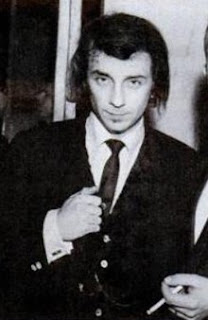
Phil Spector left behind a number of things he'll be remembered for.
For most people who follow music, the first would be the Wall of Sound. The Wall of Sound method is in itself an interesting study. Wikipedia enlightens us: combine and discretely mix acoustic, electric and ninstruments poreviuously unconventional in rock music so they sound as if they are a single instrument to provide a fuller tone: a wall of sound.
There are of course, the many musicians who he produced - despite his mostly unproductive last 30 years. This first 30 years included production credits with Ike and Tina Turner, the Ronettes and the Beatles.
What most of us don't know (or choose not to) is his demise in prison serving a 19 year murder sentence. Maybe a murder conviction is not so outrageous for a man who lived what was essentially an outrageous life: an immigrant family, mother working as a seamstress after his father's suicide, a move to LA where he began to immerse himself in music.
Also known for his in-house Wrecking Crew band of LA session musicians who played on hundreds of hits in the 60s and 70s - backing anything from the Monkees to Cher to Bing Crosby. A side trip into members of the band is an education in itself (Barney Kessel, Dr John, Leon Russell, Jim Keltner, Glen Campbell and many more)
The Lana Clarkson murder in 2003 put him in prion for the rest of his life (he died in prison this past year). The evidence and circumstances were not very clear but the jury convicted him - after several trials- of second degree murder.
As an aside, Spector's Wall of Sound is not to be confused with the Grateful Dead's wall of the same name: a wall created literally by a wall of equipment (amps and speakers) that was devised by Owsley Stanley.
There are two ways to look at a non-sense song:
(1) it makes no sense to anyone, but that's the whole point of it
(2) it makes no sense to you and me, but it had meaning to thems that wrote it
The story goes that Phil Spector chose the nonsense lyrics "da doo ron ron" because they were "dumb enough" not to interfere with the actual lyrics telling the girl-meets-boy story (and that Sonny Bono was there to give his approval).
Among the various options to the <non-sense> theme, this one seemed particularly appropriate because ... welp ... we need some diversionary non-sense to help us survive these days of gibberish from all corners of the world, and <da doo ron ron> makes as much sense as everything else we are hearing. And because the song just brings bouncing happy feelings whenever I listen to it.
I wonder if I have an element of the Trump "things were better back in those days" virus, or if things really were better back then (just see how many "old" songs are still covered)
The Crystals were no one-hit group; Phil Spector made sure of that. Wikipedia reminds us that they were "one of the defining acts of the girl group era in the first half of the 1960s". Another of their hits you probably know is <Then He Kissed Me>.
Speaking of non-sense, Phil Spector's tactical games flip-flopping the Crystals and the Blossoms is one step short of non-sense and likely would not fly far these days.
So, looking ahead to next year, how can I and how will I serenade my significant? Of course, I wouldn't dream of singing myself, my Funny Valentine would be decidedly more funny peculiar than ha-ha, but all this kerfuffle has had me thinking time for a mixtape. (Don't panic, not here.) Browsing my cache I can find nine different songs entitled Valentine, in all styles and genres. Expanding that search into wiki and there are hundreds. Too much choice. Way too much choice. But, brainwave, how about bands? Ditching the Valentines, the band, as too obvious (and too kitsch, Bon Scott or not), I suddenly realised what could be more romantic than Kevin Shields and My Bloody Valentine?! But, sez you, MBV never sang a song about Valentines, read the brief. When do I ever, sez I, but, clever dick, what about this? Well, sort of.
Cupid Come (Isn't Everything) 1988
Cupid Come, from their first album, 1988's Isn't Everything, epitomises the paradox of the band, the meld of coruscating guitars, all a sonic maelstrom of dissonance, with angelic vocals and ethereal melody floating over and through the storm. Is that shoegaze, then? I quite never got that term, it seeming always to suggest more a winsome introspection and shyness. Only now, the shame, do I understand it was less the avoidance of audience eye contact it referred to, more the necessary concentration of the array of footpedals, the integral tools of distort. Me, I aways just saw this style as a natural transition from Phil Spector and the Beach Boys, a bit of Byrds even, through to the Ramones and, later, the Jesus & Mary Chain and Teenage Fanclub, the tunes never more pop as the backing goes progressively post nuclear. That works for me.
You Made Me Realise (lead single from Isn't Everything) 1988
It could never be said the band were prolific. With, so far, but three long players to their name, their legacy, influence and allegiances cast a longer shadow. Coming together in Dublin during the early 80s, primarily lumped around Shields and karate buddy Colm O Cíosóig. A fairly fluid line up and a string of releases on minor labels gradually built up their name, ahead of catching the ear of Creation records boss, Alan McGee, he and his label then the pinnacle of the indie scene. A clutch of EPs followed, the sound and the membership still evolving, ahead of that 1988 release. The critical response completely overshot the anticipation: the relatively limited initial pressings soon swamped by demand, cementing their move from obscure favourites to cult treasures. (In truth, overall sales were low, outside the aspirational concept of the indie chart. I don't think many copies made their way across the pond at all.)
The main change was the vocals, now almost exclusively female led, this role provided by Bilinda Butcher, also second guitar, with Deb Googe, another woman on bass, alongside O Cíosóig's drums. Shields, writing a majority of the material was second vocals and lead pyrotechnics, on guitar. The dreamy vocal style was, arguably, a by-product of the recording process, working all hours with little sleep, all thus in a state between tired and comatose.
The band followed this with a repackaged reprise of their earlier fare, with some taster EPs then gradually dropping, to fill the unfeasibly lengthy, and expensive, time being spent in a follow-up. Creation bosses were becoming increasingly concerned, not least by the fact that Shields, increasingly troubled by tinnitus, seemed to be the only one much evident in the process, playing all the guitar and bass parts, with pre-recorded drums acting as the click-track. Butcher still added vocals and the band was still nominally a unit, but this was now increasingly Shield's baby. Fearing a dud, it was with no small relief when it came out in 1991. Loveless was acclaimed with even greater praise than its predecessor, if still only denting the UK and Irish markets. And strangely those of Korea and Japan.
Taken on tour, it was a sign of the acumulated tensions that led to both the band promptly imploding and being dropped by the label. It was all too destructive.
Only Shallow (Loveless) 1991
Shields carried on relentless. Rapidly gaining a reputation as a tortured genius, think Brian Wilson or Syd Barrett, most of this come to nought. Constantly working on and revisioning earlier tapes, adding, subtracting, morphing and melding, it was a full 22 years before it arrived at fruition. Entitled m b v, all four band members are credited, but the participation was often either historical, dating back to the early 90s, or later short term drop-ins to lay down some drum parts or add some vocals. The momentum and demand, the reputation of the band having peaked exponentially during the silence, was sufficient to crash the band website, revived especially for the occasion of downloading the new material. The US press were now on board, avidly avowing, if belatedly, the importance of the band in influencing any number of far more successful and far more famous bands, Smashing Pumpkins and Hole, for two, and made it a feature of many best of lists of 2013. They even toured the States that year, following UK and European dates, if their record-buying heartland of SE Asia had the earliest shows. And, yes, it was the trusty four of Shields, O Cíosóig, Butcher and Googe who regrouped in the live delivery.
In Another Way (m b v) 2013
Since then it has, again, been all promises and hope, several releases projected, including a Shields solo, but never quite making it. But spirits remain undashed, after all, 7 years isn't that long by MBV standards.....
In the meantime, here's an interesting 'explanation' from Shields as to the how and why.
If the Band song I wrote about earlier isn’t my favorite holiday song, then maybe “Christmas (Baby Please Come Home)” is. And I’m not the only one—in 2010, Rolling Stone chose it as the greatest rock and roll Christmas song of all time.
There are many things about this song that are remarkable. First, unlike the Band song, it is a wholly secular song. Yes, it mentions church bells, but it is not about anything religious. It is about the sadness of being separated from one’s love during the holidays. Yet despite its sad message it has become a true Christmas classic because of its exuberance. (There is a totally secular version of the song, titled “Johnny (Baby Please Come Home)” which is perfectly fine, but lacks the extra emotion squeezed out of the holiday setting).
Another remarkable thing about the song is the vocal performance by Darlene Love. It was written for a Phil Spector produced Christmas album by legendary songwriting team Ellie Greenwich and Jeff Barry, and it was intended for Ronnie Spector. But she reportedly failed to give the song the emotional punch that it needed, and instead, Spector turned to Love, who nailed it. One of the best movies that I saw in 2013 was 20 Feet From Stardom, about the difficulties that face backup singers, including Love. One of the most poignant parts of the film is Love’s story of hearing this song come on the radio while she was cleaning a bathroom in someone else’s house. According to Love, she realized that music was her calling, which the world can be thankful for. Although Love never became a superstar, she became a well-respected singer and actress and was inducted into the Rock and Roll Hall of Fame in 2011.
Love appeared in a revue, Leader of the Pack, featuring Greenwich's songs, which, in its early, pre-Broadway, incarnation, included Paul Shaffer as Spector. This relationship led to Love performing the song on the last pre-Christmas episode of Letterman’s show each year since 1986 (except for 2007, when a writer’s strike resulted in the showing of a rerun of the 2006 performance). Here’s a video from this year’s show featuring the 72-year old Love belting the crap out of the song, with a band of what looks like hundreds.
Not only did Love give an incredible performance on the original, the backing musicians are amazing. Spector’s trademark wall of sound is clearly in evidence, with massed background vocals from The Blossoms, The Crystals and The Ronettes, as well as a teenaged Cher. The band included members of the legendary Wrecking Crew, including drummer Hal Blaine, Leon Russell on piano, guitarist Barney Kessel, along with Sonny Bono on percussion.
“Christmas (Baby Please Come Home)” is one of the most popular holiday songs to cover, by artists as diverse as KT Tunstall, Joey Ramone, Death Cab for Cutie, Jon Bon Jovi, Michael Bublé, Anberlin and Lady Antebellum, to name but a few. Maybe the most famous cover, though, was by U2, which fittingly included Darlene Love as one of the background singers.
Star Maker Machine does not accept music submissions from artists or promoters. However, most of the contributors here do accept submissions for our own blogs, listed below. Please visit our blogs, take the time to listen to what we post, and then feel free to contact us if you feel that your music would be a good fit.