It is the early to mid '70s, an awkward time for the awkward young men with a penchant for the music of the day and earlier. Probably a bit young for prog and still at school when the full hippie vibe was the freak flag of the day, earnest young men with spotty faces and serious record collections already under their belt. With developed tastes already embracing country, folk and other roots genres, they were a large and restless tribe, seeking a brand, seeking a label. No, I am not talking about the assault of punk rock; they were already just a tad too old and learned for that. And, anyway, we are ahead of ourselves, it being yet to ignite. I was there. I was (am) one of those boys wanting to be men. And pub rock was our saviour, whether we were old enough to go into pubs or not.
This is not the place for a discourse in this overlooked yet influential musical movement, beyond an understanding that it provided the loosening of the established masonry that punk would later pull down, if for however briefly. But, via Brinsley Schwarz, Chilli Willi & the Red Hot Peppers, Dr. Feelgood and many others, a melting pot of styles and influences were put into the mix, thrown up in the air and allowed to land, with a ramshackle 4/4 beat and a cheeky smile, short and tuneful songs to put you on your feet. Out of the movement came many of the now established names of current music, Nick Lowe and Elvis Costello being probably the best known, as well as the germination of what then did beget punk, Joe Strummer being a member of the 101ers ahead of forming the Clash. Resolutely tending to be avoidant and ambivalent of style or uniform, pub rockers were of all shapes and sizes, fashion often thrift shop, hair allowed to be long or short, styled or merely as nature intended, facial hair optional rather than a then spurned accessory. Proudly uncool, even. Eddie and the Hotrods fitted well that template. But, in front of the motley bunch of urchins on instrumental duties, they had a cataclysmic and archetypal angry young man in singer, Barrie Masters. They had been around for a while by the time of their break through, chugging out covers of 60's garage rock.
Do Anything You Wanna Do
I was too young to go into pubs, and whilst, yes, occasionally I did, these were not the London pubs that celebrated and created the movement. That came later. I had to rely on the inkies, the musical press, NME and Melody Maker, and the TV, Top of the Pops and Old Grey Whistle Test. And they provided me plenty. TOTP was the weekly chart show, Whistle Test more for the serious (and insomniac) polymath. I devoured both. I remember my first sight of the Hotrods, probably at home, half past seven on a thursday night. Crammed between dross like David Soul, I recall being so bloody excited. They were fast, they were passionate, they were exciting, making my head whirl. Instantly my favourite band, I bought not only the single, 'Do What You Wanna Do', but the album, 'Life on the Line', too. It being 1977, punk had begun, and whilst they certainly sounded punky, there was a touch more melodicism in the undercurrent of bass and the choppy rhythms. But they didn't look it, flared trousers may even have been involved, plus they had a singer called Barrie. Apart from Clive, there can be fewer less rock'n'roll names. And that, I guess, became the problem. A flourish of singles and they were gone, overtaken and subsumed by altogether rougher looking lads. Like the Damned and the Clash. The Sex Pistols, to all intents and purposes, had, by then, been and gone. (Although, for their infamous near debut, in February 1976 at the Marquee Club, guess who the Pistols were supporting? Yup, the Hotrods.) Because of all this and despite all this, for those brief moments and for that summer they were my favourite band.
Ignore Them
Of course, the band never went away. Sure, they broke up, reformed, broke up, reformed, Masters the only constant, and looked to be going on forever, the oldest teenager in town, and still looking good. (Well, quite good.) So it was a shock when, suddenly and perhaps unexpectedly, he died, probably a heart attack, aged 63. 2019 had been an eventful year, with a successful tour in support to similar 70s refugees, Belfast's Stiff Little Fingers, followed by a celebratory gig, drawing back a legion of ex-members to play a "Done Everything We Wanna Do" concert in April. Was this a warning that the show couldn't go on forever? I don't know, but should anyone even be surprised that it probably will, the residual members of the last band, continuing into this year, first performance tonight? Somehow the Hotrods, as they will be, won't be quite the same without Eddie. And completely different without Barrie.
It is a complete coincidence that our Punk theme follows our Jokes, Pranks & Fools theme, since one of the meanings of being punked is being the victim of a prank. Although people may go there, I suspect that most of the posts over the next couple of weeks will be about punk music (or songs with the word in the title).
As I think I’ve mentioned somewhere before, when I showed up in college in 1978, I had begun to dip my toes into “New Wave” music, but found “punk” music, such as The Ramones and The Sex Pistols, to be basically unlistenable. It didn’t take too much time working at WPRB before I did a full 180 on that, and began to appreciate much of what is called punk. That being said, my tastes have always leaned toward punk bands that could write good tunes, and still have problems with some of the more hardcore bands that sound like a bunch of screaming. But that’s me.
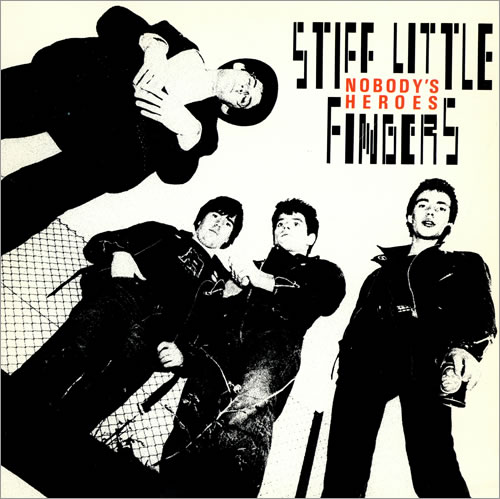
Stiff Little Fingers was a band that I fell hard for, and fast. My introduction to them was their second album, Nobody’s Heroes, which came out in 1980. It was only later that I discovered their excellent debut album, Inflammable Material, and the song that vaulted them to prominence, “Alternative Ulster.” It was clear that SLF were a political band—the first album was mostly about the “Troubles” in their native Belfast, and I learned, much later, that the advance that they got from Chrysalis Records before recording Nobody’s Heroes allowed most of the members to flee to the relative safety of London.
“Fly The Flag” was the song that stuck out to me then, and I still like it today, despite the fact that it doesn’t seem to be one that gets mentioned much in discussions of the band or its music (and it doesn’t even make some of their “best of” collections, which is crazy). It is anthemic and stirring, but its energy, and singer Jake Burns’ gruff vocals, place it clearly in the punk style. The song is also, from start to finish, sarcastic. It appears to be sung from the viewpoint of an ultra-conservative super patriot, similar to the rhetoric advanced by the fascist National Front in Britain at the time. But because the message of the song seemed so contrary to the band’s other music, it was clear that they were mocking that position, not supporting it. (You had to be careful, because other punks at the time did support racist and nationalist policies). If anything was a giveaway, though, it was the repeated “gimme gimmes” that made it clear that they were pointing out the selfishness of the ostensible narrator and his ilk.
Burns has written that the song was a response to the Thatcher generation, and “the whole ‘me, me, me’ attitude and the naked greed that was around at the time.” But he was horrified when National Front supporters took the song at face value.
When I started writing this, I just wanted to discuss a band that I haven’t written about, and a song that I like. But when I listened to it again, it struck me that it works today (with a minor change of venue) as a satire of Trumpism, with its cruel anti-immigrant and nativist sentiment, its greedy social Darwinism, and mocking of the “helpless.” I mean, here are just some of the lyrics:
Gimme a nation where people are free Free to do and free to be Free to screw you before you screw me
And
Gimme a Britain that's got back the Great A race of winners not cramped by the State And only the helpless get left at the gate.
SLF put out an excellent live album and another studio album, both of which I played the crap out of on the radio. They released one more studio album in late 1982, which I have no recollection of, before disbanding. They reformed in the late 1980s, with former Jam bassist Bruce Foxton replacing original member Ali McMordie, and have put out albums and toured, with some lineup changes, on and off since then. I admit to not being aware of any of this music.
By the time new wave rockers like Elvis Costello showed up in the late 70's, commercial radio stations were run by middle manger types beholden to distant suits at corporate headquarters. Disc jockeys were losing the power to play what they wanted so disco and "corporate rock" ruled the radio.
That meant the most exciting music getting made... wasn't getting played.
As Elvis C. sang in "Radio, Radio":
Radio is in the hands of such a lot of fools
Here's what a few more new wavers had to say about radio
Cos he can play crap on the radio You can play crap on the radio Be careful what you say And you can play shite all day You can play crap on the radio
-Stiff Little Fingers "You Can't Say Crap On the Radio"
It's just the same old show on my radio It's just the same old show on my radio It's just the same old show on my radio It's just the same old show on my radio
-The Selecter "On My Radio"
Who listens to the radio? Who listens to the radio? That's what I'd like to know Who listens to the radio?
-The Sports
And from the one guy who did have a big radio hit, a different perspective:
Don't you know you can't get near me You can only hope to hear me on your radio
On your radio You're gonna hear me on your radio.
It´s an easy step from last weeks theme to the current one, as two polar opposites from Northern Ireland released their excellent full-lenght debuts in 1979. Stiff Little Fingers from Belfast took the political route, commenting ferociously on all that was rotten in their troubled country. Meanwhile in Londonderry, the Undertones opted for escapism and sang perfect punkpop songs about anything but politics. Clever punters simply enjoyed both.
Star Maker Machine does not accept music submissions from artists or promoters. However, most of the contributors here do accept submissions for our own blogs, listed below. Please visit our blogs, take the time to listen to what we post, and then feel free to contact us if you feel that your music would be a good fit.