












Showing posts with label The Doobie Brothers. Show all posts

Tuesday, January 3, 2023

In Memoriam: Drummers Part II


We continue featuring drummers who died in 2022. Part I featured Jet Black (Brian Duffy), Jerry Allison, and Dino Danelli, and you can read that here, if somehow you haven’t read it already. We’re proceeding oldest to youngest, and Part III should be posted soon. 

Alan White—White was best known as the drummer for Yes, although I admit that I always think of him as “the drummer for Yes who replaced Bill Bruford.” Bruford is my favorite rock drummer, so White was never going to measure up, but he was a fine drummer in his own right, and played on many great Yes songs. 

Born in 1949, White joined his first band at 13, turning pro at 17. In 1969, White received a call from someone claiming to be John Lennon, looking for a drummer for the Plastic Ono Band. White thought that someone was yanking his chain, but it turned out to be a genuine offer. White, given three days to prepare, performed with them for a show, and later played on Lennon’s Imagine album, the song “Instant Karma,” and George Harrison’s All Things Must Pass. This led to a brief enlistment in Ginger Baker’s Air Force, and work with Steve Winwood and Terry Reid. 

White shared a London flat with Eddy Offord, who worked as an engineer and producer for Yes, and occasionally hung out at the studio with the band. Once, when Bruford had to leave a rehearsal session early, White sat in. Later, after Bruford left Yes to join King Crimson in 1972, White was asked to join the band, and again was given three days to learn their repertoire before the Close to the Edge tour started. You can see and hear White playing on “Roundabout” from that tour here:


White played drums and percussion on more than 40 studio and live Yes albums, and occasionally added piano parts and collaborated on songwriting. He also released one solo album and had a few side projects. 

White was one of 8 of the myriad members of Yes inducted into the Rock and Roll Hall of Fame in 2017 (as was Bruford, who is not also in as a member of King Crimson, because that band has somehow never been inducted. Don’t get me started.) 

After what was described as a “brief illness,” White died on May 26, 2022 at the age of 72. Sadly, two months before his death a large number of personal items, including musical instruments (the drum set he played with the Plastic Ono Band, for example), and platinum records, were stolen from a storage unit. 

John Hartman-The original drummer for The Doobie Brothers, John Hartman died on September 22, 2022. Hartman originally moved to Northern California at the request of Skip Spence, who wanted him to participate an a revival of Moby Grape. That never happened, but Spence introduced Hartman to Tom Johnston, and eventually they, along with Pat Simmons, formed The Doobie Brothers. Here’s Hartman playing “China Grove” on the BBC in 1974:


Hartman drummed with the band, sometimes with a second drummer, until 1979, straddling their early days as funky, bluesy rockers fronted by Johnston, to the smooth purveyors of “yacht rock,” led by Johnston’s replacement, Michael McDonald. He returned for a benefit tour in 1987, and two more Doobies albums (with Johnston and not McDonald) but retired from the band for good in 1992. 

After that, Hartman attempted to become a police officer, but the drummer, described by the band at his death as a “wild spirit,” found it hard to break into law enforcement due to his previous drug use, despite having graduated from a police academy. Hartman was inducted into the Rock and Roll Hall of Fame as a Doobie Brother, but because of COVID, plans for a performance by the original members were scotched. Interestingly, Hartman was the only living major figure from the Doobies not interviewed for the 2021 biography documentary, Let The Music Play

Ric Parnell-You know how the drummers in This Is Spinal Tap! all died in strange ways? Remember how Mick Shrimpton spontaneously combusted? Real drummer Ric Parnell was Mick Shrimpton. When Spinal Tap recorded its two albums, and did TV performances and live shows through 1992, it was Parnell who handled the drums. But, you ask, how did he do that if Mick Shrimpton was dead? Turns out, Mick had a twin brother, Rick Shrimpton, who was also a drummer! 

Spinal Tap was not Parnell’s only claim to fame. Born in London in 1961, to a drummer father and with two drummer brothers, percussion was basically the family business. In 1968, due to one of his father’s jobs at a TV station, Parnell got to see Jimi Hendrix perform on Dusty Springfield’s TV show. 

Parnell had two stints with Atomic Rooster, initially briefly replacing a pretty fair drummer, Carl Palmer, and then rejoining and playing on their last two albums. You can see Parnell’s Bonham-influenced drumming here, on Atomic Rooster’s “A Spoonful of Bromide Helps the Pulse Rate Go Down” from 1972:


After that, Parnell played in some Italian bands before becoming a sideman for artists including Michael Des Barres and was the drummer on Toni Basil’s hit “Mickey.” He was offered a chance to join Journey, but declined, which probably cost him a ton of money. But if he had joined that band, I would not have written this, because I really do not like Journey. So, he clearly made the right call. 

Parnell settled in Missoula, Montana, where he would gig locally, and for a while Parnell hosted a radio show called, yes, “Spontaneous Combustion,” where he played basically whatever he wanted and told stories. (Boy, I miss doing that on the radio....) 

On May 1, 2022, Parnell died at the age of 70 from a blood clot in his lungs that led to organ failure.
Friday, October 4, 2019

Strange/Weird: Stranger In The House


Elvis Costello: Stranger In The House
[purchase the expanded My Aim Is True]
[purchase My Very Special Guests]

I’m still being influenced by watching the 16 plus hours of Ken Burns’ Country Music, so here’s another post that sort of ties into it. One of the ways that Burns breaks up the flow of narration over still pictures or showing snippets of films and videos is through brief commentary by a number of different talking heads. And while seeing Marty Stuart, or Rosanne Cash, or Willie Nelson, or Merle Haggard discussing the music—or even lesser known figures such as Ray Benson or Jeannie Seely—didn’t seem strange because they were from the country world, it was initially a surprise when Elvis Costello popped up. Until I quickly remembered the Costello had long been a country music fan.

Despite the fact that Costello was, from the start, marketed as an “Angry Young Man,” and as part of Stiff Records new wave sound, his debut, My Aim is True had some very country-ish sounds—starting with the fact that the backing band was made up of members of country-rock band Clover, including future Doobie Brother John McFee playing lead and pedal steel guitar. But they decided to keep the two most country sounding songs off the album—“Radio Sweetheart” (which was the b-side to the “Less Than Zero” single and “Stranger in the House,” which was included as a bonus single in the early pressings of Costello’s second, and much less country sounding, album, This Year’s Model.

Only a few years later, Costello released “Almost Blue,” a collection of country covers which seemed shocking at the time, but has probably aged better than anyone thought.

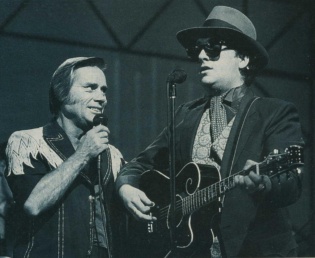
“Stranger in the House” could pass for a classic country song—it has all of the right themes, and it was written by Costello with George Jones in mind. Jones is someone who I was aware of, understood that his voice was legendary, and knew that he had a serious alcohol problem. But watching Country Music, it became clear that Jones was country music incarnate. Born in Texas, he started playing guitar as a child, and fell in love with country music listening to the Grand Ole Opry on the radio. His father was an abusive alcoholic, and he left home at 16 to be a musician.

Married four times, his third wife was country superstar Tammy Wynette, who had her own issues, and their relationship, while commercially successful, was “stormy,” as Jones’ alcohol and drug use spiraled out of control and led to mental illness. And yet, his talent was such that as bad as he got, he kept making comebacks—sometimes even with Wynette, even after they D-I-V-O-R-C-E-D.

Jones recorded “Stranger in the House” as a duet with Costello for a 1978 album, My Very Special Guests” which featured duets with singers from country and other genres.


It set the stage for another #1 hit in 1980, “He Stopped Loving Her Today,” and more recordings, despite continuing substance abuse issues. But in 1981, Jones met the woman who would become his fourth wife, Nancy Sepulvado, and she helped him (mostly) clean up his act. He continued to record and perform (and complain about the state of country music), until his death in 2013.

When you listen to the duet version of the song, it is striking how good a song it is, while Costello tries mightily, it is clear that vocally, Jones was at a completely different level.

Saturday, April 21, 2018

Jokes, Pranks & Fools: What A Fool ...


purchase [What a Fool ..]

Fools abound. Make your pick.

Your perception of the fool may range from the benign to the malevolent - no names mentioned.

Praise be, you have a wide selection to choose from. You can start at the low end of the chart with your least favorite SMM blogger or move all the way up to your least favorite Tweeter -  your choice. Especially in the Internet age -the fool  just types away - often without considering th repercussuions. Once done, your foolishness might as well be everywhere.

My choice of the Doobie Brothers. .. Doobie... a what?

I wonder if I would have chosen that as my band's name? Maybe so? Maybe not. Maybe they  wanted to make a statement 40+ years ago. Maybe they weren't such a bunch of fools,because they saw the future of the doobie.

Heck .. I don't know ... but doobie people are generally portryed as ... well ... fools who are wasting their lives.

But compared to you and me, Jeff Baxter, Michael McDonald, Kenny Loggins and the rest wouldn't be portayed as wasting their lives away - doobies aside or not.

Song written by M McDonald and K Loggins.


Thursday, October 19, 2017

LISTEN: TO THE MUSIC/DOOBIE BROTHERS

This has to be one of the most magical bits of riffing in music, I sooooo love this simple sounding casual wrist action, as patented by the Doobie's Tom Johnston, singer and guitarist, of many, in the early incarnation of the band, as well as the writer of this song. It was clearly a sound he enjoyed, as it reprises often in other songs, notably the big early other song they are famous for. And, does it remind you of anything? Let me give you a clue, here's Nile Rogers explaining his style. But that doesn't matter, so glorious a sound it is, in any hands.


But it isn't just the guitar, it is the subtle appearances of what sounds like some mandolin after the first chorus, the banjo slowly leaking through during and after the second, and all the flanging/phasing effects so beloved of the time. (God, I miss flanging. Or is it phasing......) Did I say it had two drummers? Surely the first two drummers on a big hit single in history. Or my memory It is the sound of joy on a plate.

Over to Johnston, who later explained his inspiration, in a never more 70s way:

"The chord structure of it made me think of something positive, so the lyrics that came out of that were based on this utopian idea that if the leaders of the world got together on some grassy hill somewhere and either smoked enough dope or just sat down and just listened to the music and forgot about all this other bullshit, the world would be a much better place. It was very utopian and very unrealistic (laughs). It seemed like a good idea at the time." 

Who could argue with that?

I always felt a bit sad about the Doobie Brothers, this earlier raw and less polished aspect of their sound sometimes a little airbrushed out by the smoother Michael McDonald years. Sure, a terrific and gifted singer and interpreter, but why were my beloved hippy band singing philly soul, something I couldn't embrace until a new century beckoned. Did Johnston feel the same? Having started the band and been the main focus, from their tentative start in 1970, breakthrough album, 'Toulouse Street', in 1972, from which this song comes, he left in 1975, nominally from a hospital bed, suffering from what was called road stress. Actually a duodenal ulcer. But the die had been cast, the band slowly seeping in soul and smooth jazz music sounds ahead of that, as ex-Steely Dan-ner Jeff Baxter joined the band. With Johnston in hospital, his Dan alumnus, McDonald, was invited in. (I accept this may be a slightly unfair stance to take, one part of the Doobie style always being the contributions of all, but the Johnston bits were my favourite. )

Since then Johnston has been in and out of the band a couple of times, initially rejoining a near-original line-up in 1989, stimulated by an almost accidental reunion of the by then legion of ex-members available two years earlier. Officially he remains, with Patrick Simmons, singer and guitarist, alongside him at the beginning, and the only permanently present member during the band's on-off history. I guess, for me, they are the two true siblings of this fraternal band. (Is here the place to state I once thought all these contemporaneous bands of brothers just had funny american names, imagining, as well as Mr and Mrs Doobie and their sons, so also Mr and Mrs Burrito, let alone Mr and Mrs Freak, that most hirsute of families? Thought not.)

Back to the song, such is the catchiness of the beat that it is no surprise it captured a few covers. However, fascinatingly, both the two I enjoy most come, arguably, from artists who probably picked up and on the band in their blue-eyed soul phase. So, the Isley Brothers (who were):


and Candi Staton:


I still prefer the original. Here!

Wednesday, April 5, 2017

steel: pedal steel


purchase [Take It Easy]
purchase [These Days]
purchase [Sleepwalk]

I've had a lot of work to do to put this together. More than I anticipated. Quite some time back in this blog, I commented that covering a theme sometimes requires that you educate yourself: read, listen, dig around.

I'm still wet around the ears. Some day I would like to own and learn how to play the pedal steel guitar. It's a pretty intimidating instrument - and this from a guitar player who doesnt have first hand experience except for listening. But I have been doing a little background reading and listening, both of which only further my previous conviction about the contraption. Contraption in that  -if it is your stage instrument, you need to know how to set it up. It's not an instrument you pull out of its case, tune and go (like a guitar or a flute): you'll need a tool kit to put it together before your gig - tightening bolts, attaching legs and pedals in addition to the sound cables. There are various configurations (2 necks, 10 string or more), and then there are the pedals:  for volume and several others that bend combinations of strings - best, apparently, in combination. So, you've got one hand sliding the steel bar, the other picking combinations of strings and then your feet (and knees) controlling volume and bending.

While the pedal steel features in country music (and was birthed in the 30's out of an interest in the Hawaiian slide), it was a variety of 70's music that initially got me interested. The deeper I looked into that 70's sound, the more I saw that there were a handful of pedal steel players that got around, sort of a shared community of the skilled. . Many of the famous names end up doing session work for others, partly because the good are so few and far between.

The 70's music that turned me on to the sound include the following:

One of the Doobie Brothers steel players was John McFee. McFee also played on The Who's The Kids Are Allright. He has also played with Elvis Costello, Hewey Lewis, the Grateful Dead and more.


Jeff "Skunk" Baxter also played with the Doobie Brothers. Before that, he played with Hendrix. He played with Steely Dan up through Pretzel Logic before moving to the Doobie Brothers.


Sneaky Pete Kleinow (RIP 2007) similarly got around, playing with Steve Miller, the Rolling Stones, Stevie Wonder and others. Sometimes credited as the man who brought the pedal steel to rock.

Sunday, May 1, 2011

Deep Album Tracks: Livin' On The Fault Line

livin-on-the-fault-line


The Doobie Brothers: Livin' on the Fault Line

[purchase]

Underneath us all
There's a world that we always forget 'til it moves us,
Where the moon on the bay dances all alone.
Ramone, he draw the razor swift, it slice the air,
No more lovely dreams of those summer nights
Down in Santo Domingo.


Livin' on the Fault Line was the second album in the Michael McDonald era of the Doobies, and is considered a sleeper, only in that it didn't sell a bajillion copies like their next album, Minute by Minute, did. Unlike the rest of their stuff, this 1977 album saw no single hits, even with the Carly-Simon-penned "You Belong To Me" and a Marvin Gaye cover, "Little Darlin' (I Need You)".

The unheralded title song is probably the jazziest of any Doobies tune, on what is a pretty jazz-rock-y LP in toto. Written and sung (mostly) by guitarist Pat Simmons (although there's no mistaking McDonald's vocals in there, too), it features noted jazz vibraphonist Victor Feldman (of Seven Steps to Heaven fame).

I think the reason this album carries such affection with me is that I listened to it pretty much nonstop when I was road-tripping alone in SoCal in the summer of 1978. It's got that nostalgia thing going for it, you see, so if I were indeed stuck on that fabled desert island, I'd be playing this with memories of being young and cruising through California.

Dammit man, the Doobie Brothers broke up! Sheee-it! When did that happen? (Jack Colton, Romancing the Stone, 1984)