I’ve written before about my admiration for Hole’s album Live Through This, and in that piece, I summarized Courtney Love’s difficult life, so I won’t repeat the details here, except to note that if her life has been marked by addiction, wild behavior and anger, she came by it honestly. She is someone that I have found fascinating but not always in a good way. But I think that she has produced a bunch of good music over her career. There has been a lot written by young women who identify with her anger, her pain, and her attitude, and as an older man, I can’t understand her music the same way, but I don’t think you can listen to Live Through This without being moved by it.
“Softer, Softest” is a song that I really hadn’t paid much attention to, but in researching this piece, I think that it is one of the most poignant songs on the album. Introducing the song on MTV Unplugged in 1995, Love stated that it was “about the girl that always smelled like pee in your class, and she was me," so clearly it is autobiographical. The song’s lyrics appear to be about an abused girl, likely with the knowledge of her mother (or, at least, a female caregiver), because the litany of abuse is interrupted with the following lines:
Burn the witch The witch is dead Burn the witch Just bring me back her head
This is, of course, heartbreaking, and I don’t really think that there’s much more to say, other than, listen to the song.
Instead, let’s discuss whether Courtney Love is a witch, an issue which has a certain amount of currency on the Internet, with a number of sites claiming that she definitely is, although others point out that she has publicly discussed Buddhist chanting. I don’t know enough about witches to know whether you can be one and be a Buddhist.
At the same MTV Unplugged show, Hole covered Donovan’s “Season of the Witch,” although it wasn’t televised at the time, and was only released later. (That would be a good song to discuss in this theme, but Seuras Og already did so a couple of years ago, linking to Hole’s version). Love is friendly with Stevie Nicks, who has written songs about witches (and Love has covered “Gold Dust Woman,” Cover Me's No. 1 Fleetwood Mac cover of all time), but I’m not sure that is really evidence. Also, when she performed on Later... With Jools Holland in 1995, Love introduced a song by mentioning that she had “hexed” a “jerk” who was now losing his hair (probably former boyfriend Billy Corgan). No one, to my knowledge, has tried to determine whether she weighs as much as a duck. Although she has dressed up as Donald Duck.
Love’s daughter, Frances Bean Cobain has been pictured wearing what appears to be a Wiccan moon necklace, her Instagram user name is “space_witch666, and her Twitter handle is “The_Space Witch.” Of course, her daughter’s beliefs aren’t necessarily those of her mother’s, a distinction that Love, considering her childhood (and the lyrics to “Softer, Softest”), would probably agree with.
purchase [Electric Ladyland] because the whole album is one you should own if you are into owning your music
When I think back on it, my first listen to Electric Ladyland was one of a few musical experiences where I can remember most of the 5 Ws. I was maybe 14 and I had an invite to a limited audience, listening studio to hear the work. I left the room changed. In truth, I had already been "experienced" a year or so earlier when a friend played the Are You Experienced album, and I recall an even more abrupt awakening then - never had I heard anything remotely like this before. But even with that experience behind me, Electric Ladyland was ... stunning. electric. different. The sound system in the "auditorium" was pretty good: we are talking about the days when "stereo" was still cutting-edge, and good stereo with decent Hz rates and quality speakers even more esoteric - all of which meant that the phase-shifting and Hendrix's cross channel effects were pretty novel.
If I don't insert too much of my current perspective into this, Little Miss Strange was one of the weaker cuts from the album. I prefer the more melodic Rainy Day, Dream Away and 1983 ... A Merman [...]
When I listen to Little Miss Strange in 2019, it now seems obvious that it wasn't a Hendrix composition (indeed it wasn't: it is a Noel Redding piece) Curiously, by the time recording on Electric Ladyland had begun, Bassist Redding wasn't playing much of the bass on the album - Hendrix himself and the Jefferson Airplane's Jack Cassady were taking on some of the bass playing. Although I do believe the liner notes say that Redding did play on LMStrange.
The 1968 Rolling Stone review of the album calls this song the most commercial of the songs on Electric Ladyland. Hmmm - I guess I am not terribly representative of the commercial market: I would have chosen something more melodic, like the above (Rainy Day or even All Along the Watchtower). But the overdubbed guitar tracks (in 5ths is it?) work pretty well to provide an element of harmony to a song that comes across to me as kind of raucous overall.
'Charlatans UK', that is, one of those raggle taggle of bands having to append their country of origin to their name, at least in the states, to differentiate themselves from some earlier same-name who could sue. Thus we also have the 'UK Squeeze', at least initially, 'The Mission UK', 'The English Beat' and 'London Suede'. Strangely not ever in reverse, with no Skid Row USA or Outlaws USA, to differentiate from their british forbears, let alone the nonsense of prime 60s psychedelicists 'Nirvana' having to add UK when some Seattle upstarts, previously named 'Fecal Matter', stole their name decades later.....
Weirdo/Between 10th and 11th; 1992
Hey ho, rant over, and as good a way to start this piece as any, by commenting on that strangeness. But, you know these guys anyway, they got to a Billboard number 1 with this very song. OK, it was one of the Billboard subsets, Best Modern Rock, lasting in that spot for a full week in 1992. Modern rock doesn't seem such a bad title, as more accurate definitions struggled. Lumped in with Madchester, or Baggy even, in the UK, they were neither from Manchester nor particularly comparable with those that were, the Stone Roses and the Happy Mondays, not least in the emphasis on a driving hammond organ led sound and a distinct northern soul and mod influence. I think it this, for then, retro sound that caught my ears, largely unenamoured by the rest of the pack. From their second album, Between 10th and 11th, itself named after the the venue they played their first US gig, perhaps suggesting this was where they were setting their sights. (The venue? New York's Marquee, or as we call it in this country, the Marquee US.) Sadly the momentum was lost somewhat when the keyboard player, Rob Collins, was arrested and imprisoned for his involvement in an armed robbery, arguably a foolish move when on the cusp of breaking america. Stories vary.
One to Another/Tellin' Stories; 1996
However, he was still there for their next three records, for even if US sales were next to no more, they were gradually building up ever a bigger name at home. The fifth record, Tellin' Stories, went platinum, arguably bolstered by the injection of some dance/electronica tropes courtesy Tom Rowlands (Chemical Brothers) and Martin Duffy (Primal Scream). The latter had became involved as Collins had only managed half the album, ahead of driving off the road at speed, without his belt belt and with excess alcohol. He died.
A Man Needs To Be Told/Wonderland; 2001
I felt the band were never quite the same again, never as cohesive, becoming more under the influence of the undoubtedly charismatic singer, Tim Burgess, even if, keyboards aside, the guitarist and rhythm section remained largely constants. Album number seven, Wonderland, even tried a change in focus, as Burgess steered a country influence, triggered perhaps by his longstanding Dylan fixations. Guitarist Mark (no relation) Collins even added pedal steel to his repertoire, even if it is Daniel Lanois on the record. Next came a backflip toward dance again, with the appearance of more of Burgess's previously guarded falsetto. Whilst the critics poured admiration on these releases, I personally felt a sense of desperation creeping in, and although their popularity as a live draw remained, sales were receding. Simpatico, number nine,wasn't even given the opportunity of a US release. It actually took a web giveaway to kick things back into gear, although You Cross My Path did get a more formal hard copy release later in the same year, 2008. Much more like it, this was a blunt reminder of who they were and what they were capable of, blending their original sound with a host of bolder ideas, but with a swagger and confidence missing over much interim output.
Oh Vanity/You Cross My Path; 2008
Bad luck returned to their ranks a few years later, their drummer, Jon Brookes, collapsing on stage during 2010, later receiving chemotherapy and surgery for the subsequently diagnosed brain tumour, only playing with the band again briefly ahead of succumbing three years later. Two albums, in 2015 and 2017, have followed, the band playing on, a soulful older statesmanlike hue beginning to appear, if the second of these trades arguably too heavily on the presence of guests, Paul Weller and Johnny Marr. So, what now and what next? Their website shows only they are still sporadically on the road, with no signs yet of any new material, give or take this year's record store day release of old and variations.
Talking In Tones/Modern Nature; 2015
Plastic Machinery/Different Days; 2017
Postscript: I toyed with putting up the lyrics of the featured song, as much as anything to see if I could make it fit my own view that it was the song that provoked one Thom Yorke and his band, Radiohead, to respond with this. Sadly the lyrics couldn't give me that indulgence, I finding it impossible to guage quite what or who the weirdo in question might be, possibly even Burgess himself. But, and without checking to see if the chronology makes it even possible, nice idea, innit!
The longer SMM continues, the harder it gets to be original. Be it chosing a theme or nailing a song (harder still ... a band) that hasn't been previously posted. SMM has done a couple of Supertramp's before, but it looks like this is the first appearance of this song here.
There isn't much that's weird about Supertramp (far as I know) except for a strange conspiracy theory espoused by a Daily Mirror contributor that links 1979's Breakfast in America to 9/11 (read all about it here). In general Supertramp didn't particularly aim for the weird - certainly not in their musical style: it ws mostly designed to "hit")
Along that path, <Goodbye Stranger> is straight down the third-base line: probable base-hit into the charts. The album contains a number of top hits that - at the time - cemented Supertramp's place in history: The Logical Song, Take the Long Way Home as well as this one and the title track. Roger Hodgson and Rick Davies wrote hit after hit throughout the 70s and 80s before disbanding.
In a way, 1979 seems like a strange dream now: Breakfast in America. What a difference 40 years makes. Back then, breakfast in America was a popular destination. Strange how time and events change our values. For those of us outside the US, is a trip to the US such a major goal? For those of us inside, do we still want all those people coming to have breakfast with us?
I suppose there is some assumption that strange and weird are the same. Perhaps the easiest way to dispel that is with a substitution. The idea of the comfort of strangers is a long held balm, having companionship without any knowledge or judgement of your back story. The comfort of weirdos is just wrong, I think. Usually, anyway.
Beth Orton has had a long career, only fleetingly making her way into these pages. Probably a bigger name on this side of the pond, she has had quite a game with the avoidance of genre typecasting, making her idiosyncratic way between electronica, folk and, even, a brief dabble with neo-soul.
Don't Wanna Know (About Evil)
Early work was almost exclusively in dance/electronica, collaborating first with William Ørbit ('Ray of Light'), and later with Andrew Weatherall ('Screamadelica'). However, her future direction was defined possibly more by the Japan only single she made with Ørbit, released under the name Spill, and shown in the clip above, a cover of one of John Martyn's better known songs. Her first work under her own name came 4 years later, in 1996, with Trailer Park, led ahead by the single, another cover, this time, demonstrating an eclecticism of source material, of the Ronettes. However, it was her own songs that were the more noticed, a heady mix of plaintive and faltering vocals, underpinned by thoughtful electronic sounds and beats. First featured in her superpinkymandy album, collaborating still with Ørbit, see how the song below has shifted from its initial sound, to how it reappeared on Trailer Park, with Weatherall now at the controls.
She Cries Your Name
Touring the U.S. with the near all female festival collective, Lilith Fair, brought her into contact with american audiences for the first time, as she made influential links with soul man Terry Callier and with country stateswoman, Emmylou Harris, who appeared on her 2nd album, Central Reservation, and 3rd album, Daybreaker, respectively. Gradually she was making an imprint, with Daybreaker selling north of 150k in the states.
Comfort of Strangers
And so to 2006 and the album that heads this piece, it finding her forsaking, largely, the electronica aspects for a more organic sound. Perhaps the title is apt, as, yet again she has another producer, Jim Rourke, both Ben Watt (EBTG) who produced much of the earlier two albums, having been ditched, along with her record company. Likewise, in the same way as Johnny Marr and Ryan Adams had writing co-credits on earlier albums, this time M.Ward just happened to be on hand for a share of the title track.
Magpie
A prolonged delay then followed, as she was preoccupied both with parenthood and the ravages of auto-immune gut affectation, Crohn's disease. Nonetheless, having spent some of the intervening time picking up guitar techniques from no less than Bert Jansch, 2012's Sugaring Season, was heralded as her best, and features contributions from Laura Veirs and, by now, her husband, Sam Amidon. Again, this is predominantly espousing her earlier style, more folk than 'tronica. So quite why she went back full circle for her next outing is anyone's guess. Whilst lauded at the time, Kidsticks I found lacklustre in songs and glib in the simplicity of the synthesised backing tracks. It made more waves by upsetting Joshua Tree lovers, the original video for song, 1973 having to be withdrawn. Thankfully, when I caught her live, in 2018, she was back to the simpler relative acousticity, herself, a battered six-string and solitary additional backing from (electric) guitar. I wrote about it, she getting but a fleeting mention. I await with interest as to her next magpie step and to which strangers will give her comfort.
I’m still being influenced by watching the 16 plus hours of Ken Burns’ Country Music, so here’s another post that sort of ties into it. One of the ways that Burns breaks up the flow of narration over still pictures or showing snippets of films and videos is through brief commentary by a number of different talking heads. And while seeing Marty Stuart, or Rosanne Cash, or Willie Nelson, or Merle Haggard discussing the music—or even lesser known figures such as Ray Benson or Jeannie Seely—didn’t seem strange because they were from the country world, it was initially a surprise when Elvis Costello popped up. Until I quickly remembered the Costello had long been a country music fan.
Despite the fact that Costello was, from the start, marketed as an “Angry Young Man,” and as part of Stiff Records new wave sound, his debut, My Aim is True had some very country-ish sounds—starting with the fact that the backing band was made up of members of country-rock band Clover, including future Doobie Brother John McFee playing lead and pedal steel guitar. But they decided to keep the two most country sounding songs off the album—“Radio Sweetheart” (which was the b-side to the “Less Than Zero” single and “Stranger in the House,” which was included as a bonus single in the early pressings of Costello’s second, and much less country sounding, album, This Year’s Model.
Only a few years later, Costello released “Almost Blue,” a collection of country covers which seemed shocking at the time, but has probably aged better than anyone thought.
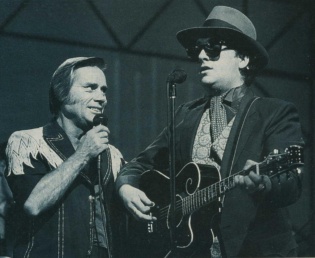
“Stranger in the House” could pass for a classic country song—it has all of the right themes, and it was written by Costello with George Jones in mind. Jones is someone who I was aware of, understood that his voice was legendary, and knew that he had a serious alcohol problem. But watching Country Music, it became clear that Jones was country music incarnate. Born in Texas, he started playing guitar as a child, and fell in love with country music listening to the Grand Ole Opry on the radio. His father was an abusive alcoholic, and he left home at 16 to be a musician.
Married four times, his third wife was country superstar Tammy Wynette, who had her own issues, and their relationship, while commercially successful, was “stormy,” as Jones’ alcohol and drug use spiraled out of control and led to mental illness. And yet, his talent was such that as bad as he got, he kept making comebacks—sometimes even with Wynette, even after they D-I-V-O-R-C-E-D.
Jones recorded “Stranger in the House” as a duet with Costello for a 1978 album, My Very Special Guests” which featured duets with singers from country and other genres.
It set the stage for another #1 hit in 1980, “He Stopped Loving Her Today,” and more recordings, despite continuing substance abuse issues. But in 1981, Jones met the woman who would become his fourth wife, Nancy Sepulvado, and she helped him (mostly) clean up his act. He continued to record and perform (and complain about the state of country music), until his death in 2013.
When you listen to the duet version of the song, it is striking how good a song it is, while Costello tries mightily, it is clear that vocally, Jones was at a completely different level.
Most of us when we think about power, we look at the outcome: heat, light, government. Let's now look briefly at the flip and the mess left behind. With tiny Greta now bestriding the world, I think it only fair. The main thing the industrial revolution showed us was soot. And this hit home hard here in UK, arguably the first home for the coal fires of industry, and certainly first to take it for granted.
Ewan MacColl
Ewan MacColl is a name of some importance in the world of folk music. I'll bet you know at least one of his songs, even if it is just this one. A complicated and seemingly difficult man, he was born James Henry Miller, in Salford, near Manchester in England. Of scottish stock, his father was a passionate trade unionist who had been drummed out of Scotland for his firebrand workplace politicking, these views etched deep into MacColl's psyche. Looking for work at the time of the great depression, street singing provided as much income as early jobs. A member of the Young Communist League from his teens, agit-prop theatre became his home up to, during and after the war, writing, directing and acting. A brief spell in the army ended in either his deserting or being dismissed, depending on whose story you heard, but it seems his political persuasions had brought him to the attentions of the power that be.
Industrial Landscape: L.S.Lowry, 1955
Whilst the theatre provided his home and most of his activity and income, it is his music that has had greater posterity. Increasingly drawn to folk music in the 1950s, he was instrumental in the success of the still extant record label, Topic, releasing a slew of albums for them over the next few decades. And this was not folk as in trad.arr., old songs sung sweet, these were his own songs, fiercely opinionated and anti-establishment, if in the folk tradition. Think Woody Guthrie. Or, perhaps even, Billy Bragg. As well as offering a pointer to more of his music, here is a link to something I wrote a year or two back, which offers also some greater insight on the man.
'Dirty Old Town' is no call to arms, being one of the love songs he was more than capable of writing. But the words also reflect, if casually, the reality of most northern UK cities, the fumes and stench of pollution providing the backdrop to lives stunted thereby. Yes, the situation is better now, some might say as a result of knowledge and changes of practice. Or is it merely by the fact that the factories have all closed?
The song has had a fair few covers over the years. Here are a few of my favourites. I think it no surprise that both the Pogues and the Specials should find something of resonance in the song, their experiences, disaffected youth in post-punk London and Coventry perhaps not that changed from MacColls dirty old Salford of two decades earlier. Quite how or why LaVette chose the song remains uncertain, but the first few comments under the youtube clip suggest a recognition within any post industrial town anywhere,
There are probably few people on Earth who have never heard <A Whiter Shade of Pale> in some variation, and most of those listenings would be the Procul Harum original. Curious that that is probably the only Procul Harum song most people could name. (File under "one-time wonders". 10 million copies sold. Bing Crosby's <White Christmas> has sold 50 million.)
If, like myself you were actively listening to rock music back then (~1970), you likely would have listened to more of the band's work. Aside from <Broken Barricades> where the song was originally released, you might have listened to/owned copies of <A Salty Dog>,the eponymous <Procul Harum> and if you continued beyond ...maybe some more because they kept the show going for some time. At present, they're planning tours into 2020. With some of the original members!
Life on earth has come to where a power failure means a near total collapse of everything. No lights, no freezer, no internet. You're aware that 100 years ago it wasn't this way. But how many of us today would know how to survive/deal with this calamity: make your own candles? Preserve your food beyond a day or two? Communicate with anyone beyond your (shouting) immediate circle?
Probably not possible without power (of the electric variety).
There are a number of reviews of Power Failure, but probably none better that this (link), where the authors detail most everything you can imagine: specific choice of lyrics, recording situations and much, much more.
I recommend you visit the link, but if you choose not to, a few hi-lites (highlights?):
- the lyrics make extensive use of gerunds: climbing, crashing, falling ...
- the original (live) conceit was centered around a lengthy drum solo (as in: the power goes off and only the drum is able to make sound)
This is going to be one of those posts that tries to create a fusion of different things. Let’s see if it works, or if it turns out to be like “cold fusion.”
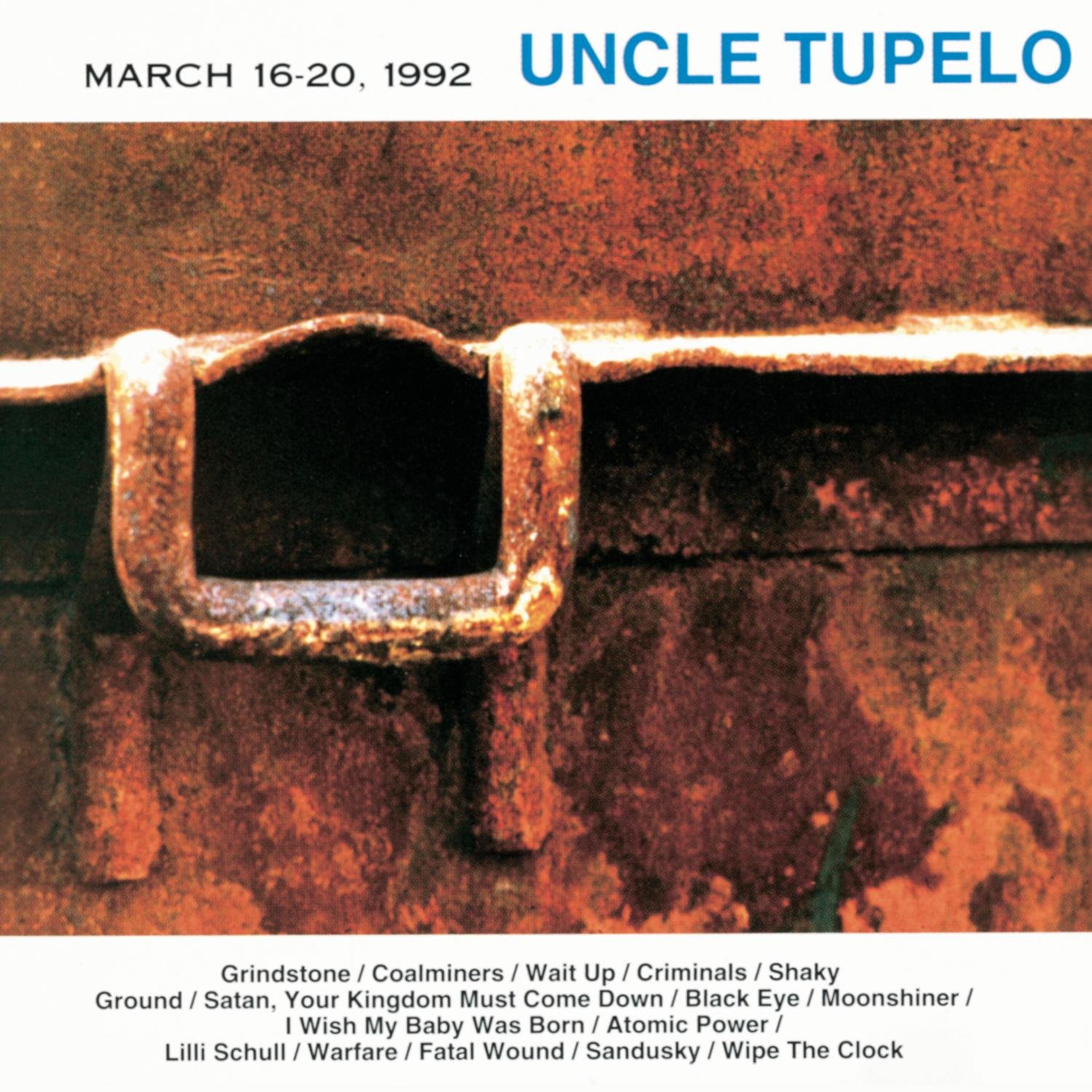
Remarkably, although I’ve mentioned them in writing about Jeff Tweedy, Jay Farrar, and Wilco, I’ve never written a post on this site about Uncle Tupelo (although I did a long one at Cover Me). I wasn’t aware of the band during their existence, and learned about them after discovering Wilco and Son Volt, the two bands that were formed when childhood friends Tweedy and Farrar could no longer coexist. I wrote in detail about Uncle Tupelo’s history in that Cover Me piece, so, if you are really interested, go check it out, and come back here when you are ready.
R.E.M.’s Peter Buck heard Uncle Tupelo perform a cover of the Louvin Brothers’ song “Great Atomic Power” at a concert, and contacted the band after the show. The three musicians found a great deal of overlap in their musical interests, including bluegrass, and decided to do an acoustic project together. The band’s prior album, Still Feel Gone was, for the most part, a rocker, so it was a bit of a risk to follow it up with an acoustic album, and their record company was pressuring them to move to an even more rock-oriented sound, to compete with the emerging grunge movement. But Farrar and Tweedy were, as always, headstrong, and pissed at their label’s failure to pay them royalties, so they must have figured, “Fuck it,” we’re going to work with Peter Buck, and do an acoustic album.
That album, March 16–20, 1992, mixed classic country tunes with originals that fit seamlessly with the older songs. Roadie Brian Henneman, who later founded the Bottle Rockets, even got to play the mandolin that was used in “Losing My Religion.” Uncle Tupelo’s cover of “Great Atomic Power” is very faithful to the Louvin Brothers’ original, and it is a very, very odd song.
It mixes the imagery of a devastating nuclear explosion with Armageddon, and asks the question—when that horrible time comes, will you be ready to meet your savior? As the lyrics inform us:
There is one way to escape and be prepared to meet the Lord Give your heart and soul to Jesus, He will be your shield and sword He will surely stand beside and you'll never taste of death For your soul will fly to safety and eternal peace and rest
The Louvin Brothers, Ira and Charlie, were popular in the 1950s and 1960s, and came from the gospel tradition, as many country singers did, so the fire and brimstone is not all that surprising. Charlie seemed to be the stable brother, while Ira was an alcoholic, who engaged in erratic and often abusive behavior, including toward his brother. Ira was married four times, and wife number three shot him four times in the chest and twice in the hand after he allegedly tried to strangle her with a telephone cord. Ira once made a racist remark that so angered Elvis Presley that Elvis refused to record any Louvin Brothers’ songs, probably costing the duo significant royalties.
Ultimately, Charlie had enough, and the brother act broke up in favor of separate solo careers. Ira and wife number four died in a car accident in 1965, when a drunk driver hit their car; Charlie lived until 2011, and recorded and performed until close to the end.
The Louvin Brothers make a brief appearance in Episode 4 of the Ken Burns documentary, Country Music, before the documentary moves on to a more popular act, The Everly Brothers, which is ironic because a suggestion that the Louvins change their sound to be more like the Everlys reportedly depressed Ira and contributed to his alcoholism.
As I write this, I’ve watched four episodes of Country Music and am enjoying it immensely. I really know little about the history of country music—it was not something that I listened to growing up in the NY suburbs. Like the blues, much of my knowledge of the genre has come from listening to covers, like “Atomic Power,” and going back to listen to the originals. And as I have become increasingly interested in Americana music, I find myself more interested in the music’s roots.
I’m someone who finds how things start to be fascinating, so it has been interesting learning about the long background and history of country music. One of the things that I have found striking is that even in its earliest days—going back to the 19th century—one of the hallmarks of country music has been nostalgia for older, simpler times. And I get that, although it often seems that there’s a real fear of trying anything new and radical. Which is why Elvis Presley, who came from a country and gospel tradition clearly scared the crap out of, and was rejected by, the establishment.
And it is interesting, too, that when the Louvin Brothers, who were traditionalists, chose to write “Great Atomic Power,” about something new and scary, rather than write about the potential of the new technology, they (and co-writer Buddy Bain, a musician and DJ) focused instead on its destructive power, and tied it to traditional religion.
For what it is worth, what made Uncle Tupelo stand out from the crowd was the way that they fused the tradition of old time country music with the new energy of punk, so it is also interesting that March 16–20, 1992 sounds so traditional. It is a bit of an oversimplification, but as time went on, it seems like Farrar (and Son Volt) has more often followed the country tradition of looking backwards, while Tweedy (and Wilco), have tended to look forward, including more rock and experimental influences in their music.
Of course, the potential of atomic power was touted by many, and numerous nuclear plants were built in the US and elsewhere, because of the desire to move away from depleting and polluting fossil fuels, until, at least in this country, the tide turned against them due to the danger of accidents and the difficulty in safely storing the radioactive waste. However, there seems to be some attempt to revive the industry, as it becomes clear that use of carbon based fuel continues to damage the environment, although its serious risks continue to be an obstacle.
The risks, of course, are real, as Chernobyl and Fukushima, among others, remind us. And I recall, that during my sophomore year in college, one of my roommate's friends stayed with us when his college was closed because of the partial nuclear meltdown at Three Mile Island.
A few years later, when I was a very junior associate at a very large Wall Street law firm, I was mostly working on two cases. One was the representation of Drexel Burnham, in the various investigations arising from the Mike Milken/junk bond issues. The other was representing Public Service of New Hampshire in proceedings to determine whether the costs involved in constructing the Seabrook nuclear power plant were reasonable, and could thus be passed along to the ratepayers. For the first one, much of my work revolved around gathering and reviewing Drexel Burnham documents to see whether they were responsive to an ever growing number of government subpoenas. The second one had me and a slightly more senior lawyer traveling regularly to Philadelphia to prepare our clients and monitor extremely dull hearings about arcane engineering issues.
Neither of these were particularly interesting, and I did have some qualms about representing a nuclear plant, but that’s the way it goes as a young lawyer at big firms.
One day, though, the senior partner on the Drexel case offered me the opportunity to spend a week (with other lawyers) at Drexel’s office in Beverly Hills. This was during the winter in New York, so it seemed like it would be fun. And, in those days, we all flew first class and stayed in fancy hotels. I was excited. Shortly after that, the senior partner on the Seabrook case offered me the opportunity to spend the same week in the small town in New Hampshire where the plant was, doing work in a makeshift office on the construction site. I, not at all regretfully, told him that I couldn’t, because I was going to Beverly Hills. A little while later, I got a call informing me that I was going to fly to California, spend half the week there, then take a redeye to Boston and drive to Seabrook. I will never forget that one day, I was staying at the Biltmore Hotel in Beverly Hills and walking around Rodeo Drive in warm weather and the next day I was tramping through the mud in the cold, and staying at the Hampton Falls Inn, a motel near the plant. At that point, I was no fan of atomic power, great or not.
IMHO, Clapton's first solo album stands above most of his other solo work. It was a break-out production - away from Cream and a first step towards his "god" status. Clapton supported himself with friends new [to us] (Bonnie and Delaney ) and old (Steven Stills, Leon Russell ). His sound was considerably more mellow and more mature than is earlier raw/raucous Cream and equally raw John Mayall fare. In addition to being primarily self-composed.
The <Eric Clapton>/solo album includes more than one piece that I would place in my pantheon of top rock songs: -the no-vocals <Slunky> -the cover of <After Midnight>, bringing (not for the only time) J. J. Cale to a larger audience -<Bottle of Red Wine> [see this] but more generally, this was a different kind of rock guitar for that day and age. Along with- but on a different planet from Jimi - the style "bent" our perceptions of electric guitar rock.
But, for the purpose of the <Power> theme, there's only one from that album that seems to fit: Blues Power. Co-written by Leon Russell.
I wonder if the song is really blues. Clapton hints at my doubts in the lyrics: "Bet you didn't think I knew how to rock and roll...." But the lyrics also include: "...no matter if it's fast or slow"
I've scoured the Internet in search of an answer: "Must a blues song be slow"? I always assumed as much. There's also the question of the sound/environment: even if the tempo is right, if the guitar is too raucous, can the song still fit the "blues" bill? Doesn't it have to "cry"? I don't have the answer. But this song has the power.
Something a little different with the same name: (Albert King)
I'm sort of sick of power at the moment, and, were you in the UK, you'd know why, with our parliament having to take our prime minister to court over his actions. You know. I'm guessing a degree of schadenfreude must apply, gratitude due to our nation, that we may have an even bigger clown at the helm than yours, and you're welcome. A race to the bottom. So any contribution I make to this theme will resolutely steer clear of that sort of power, sticking instead to gas and electric. (Who knows, maybe even a hint of wind or, in a twofer, solar.)
The Delines arose from the ashes of Richmond Fontaine, a group that achieved more adulation than fame, perhaps more in the U.K,. where they were favourites of the music monthly, Uncut, forever a champion of americana. Led by songwriter Willy Vlautin, also a writer of superb southern gothic noir, they brought joy to my life over many years, from the mid 90's over the next two decades. Always interested in the underside of society, there was, and is, a seamlessness between where his songs end and the novels begin. I guess the band didn't make such a grand living, lauded in Europe, little known at home.
I loved the ramshackle tightness of the band, the lowlife tales perfect for his plain but perfect vocal stylisations. So, sort of underwhelmed by the idea of another singer, a female singer, becoming the preferred mouthpiece for his work, initially I thought to give the Delines a pass. Big mistake.
Singer Amy Boone has one of those country voices that just epitomise the best of the genre, a slightly less abrasive Bobbie Gentry. What I didn't know was that she had had form in the dying days of Richmond Fontaine, her sister Deborah (Kelly) having sung female vocals on their last album, Amy reproducing them on the live tour. So when the first album, 'Colfax', came out in 2014, any doubts became immediately extinguished. However, in a twist even more grisly than any Vlautin lyric, not so long after, following a round of touring, Boone was involved in a car accident, in 2016, significantly and seriously damaging both her legs. End of the band? Thankfully no, Vlautin having sufficient faith to wait the 3 long years for recovery. Earlier this year saw their 2nd release, 'The Imperial', consolidating on the earlier sound, less steel, but with added mariachi-tinged trumpet. The featured song, at the head of the pice, comes from the debut, and carries gorgeous evocations of 'Midnight Train to Georgia.' Here is a song from 'The Imperial' with that added joy of trumpet.
All the same thing, aren't they? All have hooves and tails, and the why-the-long-faces, so, yes, they must be. OK, I know, they aren't, but can you all recall the differences? I will assume that you know horses, the odd-toed ungulate mammal, whether cart, race or just a plain old Dobbin, so, moving swiftly on......
Jenny's Got a Pony/Los Lobos
I haven't a clue what this song, by the always excellent Los Lobos, could possibly be about. Is there much of a pony population in East L.A.? Anyhow, this riveting ride, SWIDT, comes from their 1990 opus, 'The Neighbourhood', showing off their best, a fusion of latino, tex-mex and plain good old rock'n'roll. Ponies are horses, in fact, the delineation tending to relate to smaller sizes of beast. Whilst clearly there are tiny ones, whether your steed is a horse or a pony is often as much in the eye of the beholder. In slang a pony might be a small amount of liquor. Is that what Jenny got? Alternatively, in my country a pony is £25, increasingly equal to $25.
Donkey Town/Mark Knopfler & Emmylou Harris
Donkeys are not horses, but are very close. I think they look cuter but traditionally have tended more to be more beasts of burden than for racing. And to be the butt of many an insult, the derogatory opinion being that donkeys are for peasants, horses being only fit for the higher echelons. Hence, I guess, this song, from the, at the time, critically underacclaimed album of duets, Knopfler imagining himself, yeah, right, as a loser in a one horse, sorry, donkey town. If Emmylou were there, chum, I'd stay.
Muleskinner Blues/The Cramps
This is where it all gets a bit surreal, as I explain a muleskinner is ahead of a mule. And, until today, I had the notion that the pelt of a mule might be a useful commodity. Good leather or something like that. Wrongity-wrong, it is the human handler of a mule or a set of mules. So called as you had to be quick witted to outsmart them, or "outskin" them, me, neither, given their stubbornness. No wonder they got the blues, the song originally a hit for Jimmie Rodgers in the 30s, before the Cramps gave it a reverential kick up the, um, ass. We don't feature the late lamented Cramps here enough, I feel.
A mule is the sterile progeny of when a horse, or pony, mates with a donkey, the genetics close enough to procreate but not close enough to prolong the line further. It seems a bit of a long way to go for a somewhat short end to me. But, mule lovers, worry not, they can now be cloned. Mule is also slang for the middle man in a drugs heist, responsible for transporting the illicit material across county lines and continents, often, literally, in their "middles". Why the name? Presumably as such individuals are seen as slow witted carriers of little importance beyond the carriage of the goods. Confusingly, what they carry may often go by the slang of horse. Or, perhaps in a sly dig at its retrieval, shit.
Jack Ass/Beck
Here's where I could get myself into trouble, as in get my ass kicked, mixing and muddling my homonyms. But, I will resist that temptation and stick to the literal, wherein Beck Hansen compares his situation to that of a Jack, or male, Ass, or donkey, the two terms being near equivalent. (See horse/pony). So it is really back to Mark Knopfler and his donkey town, self-esteem apparently quite a rare premium for worldwide superstars. But, in recompense for reading this far, I can't but leave you without just a little horseplay...... (Spoiler: twerk free; have you ever typed ass into youtube?)
In some ways, this could have slipped into the <Slide> theme - slide being a forte of the Allman Brothers since their inception.
The Allman Brothers Band has been around for a number of years in one iteration or another. Among their other contributions to music, there is the off-shoot band named Gov't Mule, formed by Warren Haynes, a later addition to the ABB. Haynes is stage center in the above clip doing the vocals, and might also note Allen Woody, who also joined the ABB when they reunited in the late 80s.
Since the current theme is <Horse> and this post references <Rocking Horse> it wouldn't hurt to take a minute to look down that path: What it is, what it represents/means...
>> A wooden construction that simulates a real horse that you can mount and "ride"
I can think of a number of "rocking" associations that might fit.
Foremost is "rock" .. and you can work your way on down the path of what "rock" embodies on your own.
I guess I can also conjure up images of why you might associate horses within the realm of rock.
The lyrics tell a typical ABB story: on a path that isn't so good and that I just can't leave: "to die in the saddle must be my destiny"
There are different such of possible interest:
Sara Evans with a song of the same name but kinda different
If you have attended or watched a sporting event in the United States in the last few decades, you almost certainly have heard the marching or pep band play “The Horse,” the 1968 instrumental hit single from Cliff Nobles and Co. (I know that I played it at least twice as a member of the Princeton University Marching Band, which, by the way, is celebrating its 100th year of having invented the football marching band, only 50 years after Princeton and Rutgers invented college football.) And, there’s a chance that you might have heard the original, horn-filled song on the radio, or streaming, or however you consume music. But what you didn’t hear was Cliff Nobles. Because Cliff was the vocalist in the band, and “The Horse” is an instrumental.
According to Bobby Eli, guitarist on the track, he, guitarist Norman Harris, bassist Ronnie Baker, and drummer Earl Young created the music jamming in the studio—in fact, neither Nobles, nor Jesse James, the producer who took writing credit, were present in the studio at the time.
“The Horse” was released as the B-side to the single “Love is All Right,” which is essentially the same song, but with Nobles’ fine soul vocals. I have to admit to never having heard that version until I started writing this, and it stands on its own. But, for whatever reason, it was the stirring, if somewhat repetitive, instrumental that piqued the interest of DJs, and it peaked at No. 2 on both the Billboard Hot 100 and R&B charts, before becoming often used as a theme song, or in stadiums and arenas.
The musicians that created and recorded “The Horse” received only a small fee, and producer/”writer” James refused to give them any more, leading to an acrimonious split. Eli, Harris, Baker and Young became part of the “MFSB” collective, who backed many, many groups, and had a hit of their own with “TSOP (The Sound of Philadelphia),” and Baker, Harris and Young were also members of The Trammps. The baritone sax player was Mike Terry, who also played on, among other things, Martha and the Vandellas' “Heat Wave,” and The Supremes’ “Where Did Our Love Go,” and as a member of the Funk Brothers, he performed on thousands of Motown recordings from 1960-1967.
Despite his obvious talents, Nobles never sang on a hit song, and later worked in construction and the electronic generation industry, which is ironic, since “The Horse” is used to generate energy at sporting events (is that too tenuous a connection?)
Over at Cover Me, I wrote a piece defending Dexy’s Midnight Runners, which discussed their excellent covers of both “The Horse” and “TSOP.” (I wrote another defense of them here, too, but it wasn’t as good).
Country music has always had a chequered history over here in the UK, there being an understandable suspicion of the more rhinestones and bouffant hair variety that, for so many years, gave even the genre a bad name outside its immediate milieu. Personally it was always the 'and western' that put me off, only many years coming to know and love quite what that might mean, as in western swing. But country-rock, or perhaps as we now should call it, americana, that's a whole different plate of beans. Us brits have taken to that in a big way, both in terms of growing our own and offering a sometimes more sympathetic audience to visitors as they get at home. Todays piece is decidedly too old for americana, being from the early 70s, when bands like Cochise and Starry Eyed and Laughing were adding influences culled from The Byrds and the Burritos. The pre-punk of pub-rock, the early backlash to the some of the preposterousnesses of prog, saw also a lot of country tropes mixed into the pot, alongside soul and straight ahead rock'n'roll. Brinsley Schwarz, an early home for Nick Lowe, and Chilli Willi and the Red Hot Peppers were frontrunners, influentially if not necessarily in sales. Nowadays there are as many gritty blue collar banjo and steel bands over here as, well, in a short Nashville street. So a few, my favourites being Camden's Rockingbirds. Plus several festivals devoted to the genre.
Home had only a brief window. Resolutely 3rd tier in terms of attainment and success, famous as much for where the members went next as in their own right. The track above comes from their 1971 debut, the sleeve illustration giving a fair idea of where they were hailing from and striving at. I actually bought this at the time, it various surviving culls on my collection, as history re-decided my earlier tastes. However there was clearly a hint of something, the twin guitars of Laurie Wiseman and Mick Stubbs soaring higher than the journeyman songs and vocals, mainly provided by Stubbs. Bass was provided by one Cliff Williams, yes, that one, and was more adventurous, say, than his later job, with drums and background keys courtesy Mick Cook and Clive John.
A second record followed, the eponymous 'Home', by which time they had ditched John and ploughed, generally, a yet more earnest west coast vibe, if more Outlaws than Eagles, winning over fans from the bands they played support to. But those fans weren't putting their hands in their pockets, and the moment called for a prog-rock concept album, echoing similar bands in similar circumstances, Camel and Wishbone Ash, last gasps of the longhairs before punk blew down the doors. (Of course, history also reminds us that the longhairs never actually went away, just having shorter hair and shorter songs, most continuing to this day.) The Alchemist was the 3rd and last album put together by Home. Stylistically different, it isn't all bad, if desperately dated.
Stubbs left and the remainder of the band toured as Al Stewart's backing band, before going their separate ways. Wisefield joined, arguably appropriately, his guitar style being eminently suitable, the above mentioned Wishbone Ash, Cook joined the Groundhogs and, earlier keyboards man, John was by now with Man. Stubbs, surprisingly, as the songsmith and singer, or possibly because of that, struggled the most, largely disappearing from view. The big ticket fell to Williams, filling the AC/DC bassist role for the next 39 years. A waste of his talent, IMHO, but what do I know, as his accountant might remind me.
The early 70s were a bumper time for would be jobbing musicians, record companies falling over each other to give multi-disc contracts to barely out of school buskers, allowing them to build up their skills, hone any talents and, eventually, or so the labels hoped, repay the investment. Bands like Home were everywhere, chock full of musicians often later making a greater inroads elsewhere. Often with back catalogues mostly forgotten, I enjoy looking back and remembering. This piece began musing on country and english. Funny how it seems to have ended elsewhere.
Hell, yeah, in the week, near enough, ol' Shakey reveals the forthcoming of his back to the day job with the Horse, what better time to celebrate this most epochal and emblematic of Neil Young's backing crews. You can have your Stray Gators, your Promise of the New, Pearl Jam and Booker T even, it is with the Horse that the ragged glory of his plaid shirt flaps the most. Never quite as celebrated as they should be, even oft denigrated for their supposedly simplistic backing, they are the perfect frame around which their boss can shine brightest. And it they are so dumb, how come that most attempts to emulate fall so short?
Present in one form or another since 1969, a number of musicians have been included under the banner, the band existing as much in it's own right, gigging, albums, rather than merely, as they are often perceived, waiting at home for Young to revive them from their slumbers. Because such waits can be lengthy. Very. And uncertain. The core, essentially, is the rhythm section partnership of Billy Talbot, bass, and Ralph Molina, drums.
Go back further, to 1963, and the vital spark of the band was in, astonishingly, doo-wop, a capella street corner crooning. A mix of West Side Story and what would now be called a boy band. Along with Danny Whitten and a couple of others, they even got as far as recording, first as Danny & the Memories, later as the cooler entitled Psyrcle, the zeitgeist now clearly barber avoidant. (Sadly I can find no clips of the latter, all the more disappointing, the Psyrcle having one Sly Stone, then a local record store owner, as their producer.)
Land of a 1000 Dances/Danny & the Memories
Appreciating the added value of playing some instruments, Whitten, Talbot and Molina picked some up from scratch, Whitten choosing guitar, and morphed into the Rockets, cautiously adding a couple of real musicians to paper over their deficiencies. And, yes, times were changing fast.....
Pill Song/The Rockets
This is where Neil Young came in, chancing on the band in a bar, OK, the bar, the infamous Whisky A Go Go. After jamming with them, suddenly the Rockets were no more, the core trio of the band absorbed immediately as Neil Youngs backing band for his 2nd solo record, 'Everybody Knows This Is Nowhere.' And what has become his instantly recognisable signature style of melodic chunky scuzz was born. As well as backing Young both in the studio and live, by now christened Crazy Horse, they took off alone, absorbing piano player Jack Nietsche, another Young acolyte, along the way. Boy wonder Nils Lofgren, fresh from his appearance on 'After the Goldrush', also became involved, if not then officially a member. They could have been bigger than they were, Whitten becoming swiftly more accomplished both as a guitarist and a writer. Indeed, the song below was his, and is still, I am sure, a source of royalties, given many successful cover versions. But unfortunately only to his estate, as Whitten was a hardcore junkie. Eventually kicked out both from the band and from Young's circle, he succumbed, living on only in the lyric of 'Needle and the Damage Done'..... (The "another man" was Crazy Horse roadie, Bill Berry.)
I Don't Want To Talk About It/Crazy Horse
So where now for the Horse? After Whitten's demise, and lacklustre responses anyway to their records, the residual duo let the name lie dormant, despite still playing frequently alongside Young, with different musicians and different names for the collective. It was with the recruitment of Frank "Poncho" Sampedro in 1974 that suddenly gave the band a rebirth, his arguably rudimentary rhythm guitar slotting perfectly alongside Neil Young's idiosyncratic lead like a dream, wedged into the loose cement of Molina and Talbot. 'Zuma' is the exemplar and apotheosis of the Crazy Horse sound, and, of course, the song below is that of that record. Equal billing, no less.
Cortez the Killer/Neil Young, Crazy Horse
The last couple of decades of the 20th century saw Young chaotically change style and direction. Sometimes the Horse fitted the requirements, often they didn't, but it always seemed better when they did. When off the pay-roll, they would play occasional shows, with buddies from earlier incarnations, but kept a generally low profile. One exception came in 1994, when arch Young-fan and ex-Icicle Works mainman Ian McNabb hired them for a tour and an album. 'Head Like a Rock' was my album of that year and, yes, I was in the audience for the clip below, with there being little doubt who McNabb was channeling.
Fire Inside My Soul/Ian McNabb, Crazy Horse
It wasn't until the early noughties that I actually caught them with Young, at Birmingham's National Exhibition Centre (UK), usually a soulless arena, that night shaken to the pillars by a the intensity of the fragile yet triumphant powerhouse of the collaboration.
Latterly the pairing has been increasingly intermittent, some fans despairing ever of that call ever coming round again, not least as Young was seemingly so entrenched with Promise of the New, the band of and with two of the sons of Willie Nelson. News had also come of Poncho retiring from performance. So it was with some glee that whispers came, late last year, of a 'Horse of a Different Colour', with a series of concerts following. And more this year. And you can stuff different colour, this was Crazy Horse, with the added attraction of the return of Nils Lofgren to replace Sampedro. OK, so the song comes from the wrong band, but, hell, Long May they Run. And for sure an album is coming.....
My summer sabbatical is over! I’m refreshed, recharged, and ready to rock! Thanks to Kkafa and Seuras Og for keeping the lights on while I was on blogging holiday.
So, about a month ago, David Berman committed suicide, hanging himself in Brooklyn. He was 52. Berman was the driving force behind the band Silver Jews, and more recently Purple Mountains, and his death led to an outpouring of praise for his songwriting and sadness about the circumstances of his death, which makes sense, because he was a talented songwriter, and for god sakes, he was only 52.
I was aware of some of the Silver Jews’ music—I picked up a bunch of tracks when eMusic actually had lots of good music, cheap—originally attracted by the name, but drawn in by Berman’s quirky wordplay and mostly deadpan delivery. But until he died, I really didn’t know much about him.
Berman’s father was a lobbyist for firearm, alcohol and other controversial industries, a fact which later gave Berman much angst. While a student a U Va, he made music with classmates Stephen Malkmus and Bob Nastanovich, and after graduation, they moved to Hoboken and began recording as Silver Jews. Meanwhile, Malkmus started Pavement, which went on to more acclaim, leading to the mistaken impression that Silver Jews was a Pavement side project.
During this period, Berman entered a graduate writing program at U Mass Amherst, and sparked by that, Silver Jews released a number of albums in the late 1990s, and Berman released a collection of poetry. More albums followed, but after 2001’s EP Tennessee, Berman struggled with depression and substance abuse, and in 2003 he attempted suicide.
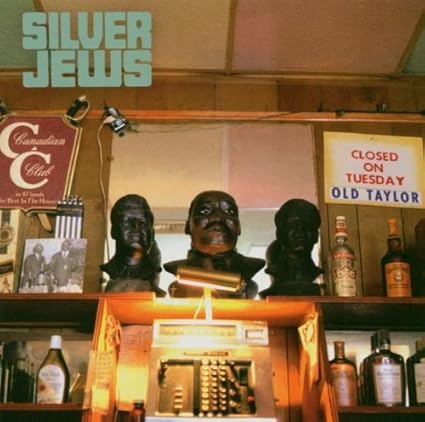
The Silver Jews got back together in 2005 for Tanglewood Numbers, which was, according to Berman, the only album that he was 100% sober for, and which was more polished and rocking than the band’s previous efforts. Our feature song, “Sometimes a Pony Gets Depressed” is from that album, and couples upbeat, uptempo music with lyrics that probe displacement and depression. It is a striking song, and one not easily forgotten once heard. (In any event, who has a pony?)
Berman seems to have had some interest in horses. Silver Jews’ second album, Bright Light, has an album cover featuring a notebook with a horse made out of blank adhesive labels, a song called “Horseleg Swastikas,” and another song with the lyric “my horse's legs look like four brown shotguns.” And there may be more. Is this a reference to horse = heroin? Maybe, but considering the source, it is likely to have many more levels than that.
In 2009, Berman stepped away from music in part to try to make amends for the work of his estranged father, and HBO began production of a series based on Berman’s unpublished book about him, which eventually was scuttled. And earlier this year, Berman began releasing music as “Purple Mountains,” and a tour was planned but never happened.
Heck of an upbeat way to return from summer vacation, right?
I suppose that this could almost have fallen under the <slide> theme. Slide guitar is one area where George Harrison made a name. (See "My Sweet Lord").
It's been pointed out that of all the Beatles, the term "dark horse" probably best applies to George Harrison: someone who keeps their abilities and interests a secret, a surprise. Certainly, in terms of the heydays of the Beatles, Harrison fit the term. Known by name, but not as mediatic. Yes, he penned some of the Beatles' best (myself, I vote for Harrison's Taxman, below).
Then, following on the breakup of the band, Harrison's first two solo albums positioned him as the band's dark horse: <All Things Must Pass>, <Living In the Material World> and even the subsequent <Concert for Bangladesh> proved his dark horse status - all well received and charting well. A hit-generating contender beside McCartney and Lennon.
It was after this that Harrison headed into some real dark days - and not the kind defined by the term "dark horse" unless you twist the dictionary definition by comparing the life of a man to that of a horse. Stuff that's more like Darkest Days of Our Lives material. He tried to start his own recording label. Named Dark Horse no less. And the album of the same name (for which this was to be the hit song) didn't do so well. Perhaps not a surprise, considering the content focus, with songs titled "So Sad" and the classic "Bye Bye Love". As reviewer Nick Deriso said, the album is a "downer". Rolling Stone called it a "shrivelled career", 'awkward", "insufferable" and "hoarse"- pun probably intended. Ouch!
That said: this IS the one and only George Harrison. RIP.
The <slide> theme was deliberately left nebulous enough to allow for slide guitar entries or some pedal steel, and if you happen to follow my personal tastes, you'll know that my favorite musicians include masters of that style: Ry Cooder, David Lindley, Bonnie Raitt, Lowell George.
As I often do, I scratched out a couple of starting lines heading down that path with the intention of letting the idea stew for a couple of days before settling on one of the slide masters. As we are now at the end of the <Slide> theme calendar, it looks like that one will have to wait for our traditional November <Leftovers> theme because (Baby, Baby, Baby ....) I'm out of time.
Yet, as that idea sat on the desktop, I also began work on a song or two with <Slide> in the title. This would have been last week, some time before the Video Music Awards earlier this week. Pure coincidence, since I had no way of knowing the song list for this week's Video Music Awards.
Bono, Oasis, The Verve, Noel Gallagher ... they've all got songs named <Slide Away>. Bono doing the vocals on a Michael Hutchence composition. And Oasis doing the Noel Gallagher song of the same name. And then Miley Cyrus this past week. And then, as a last minute bonus, yet another Slide Away from a group on Muzai Records called Sunken Seas. There's probably more out there.
Not knowing much of anything about any of these, I guessed that they were likely variations/covers of someone's original.
I can't think of too many other song titles of exactly the same name that are distinctly different songs. At the same time, you could surmise that the conceit behind the song name is obvious enough that any could hit on the title for an original: I guess it shouldn't come as too much of a surprise ... how often does love end in one party slip/sliding off down a different path? Slide Away is a quite natural occurrence - whether as an act IRL or as a title for a creative work. The song stories are all "love songs" in one form or another. The Gallagher/Oasis and the Verve's are more centered on sliding away together; Cyrus' and Hutchence's are more about being away.
What to make of James Taylor's musical career?
Myself - having spent a number of formative years in North Carolina ... I kind of embraced his early career. I loved his simple, but crisp, guitar picking: his plaintive vocals and somewhat mournful messages. Lots of loss and sadness.
And then, at what appeared to be a high point in a rising career, comes the Carly Simon story (that - while potentially a win-win affair - didn't seem to bring either career any benefits)
Now, I don't mean to say he has become irrelevant - his music from the 70s (Sweet Baby James, Mud Slide Slim) guarantee him a top spot in the history of rock/pop, but since then, he had slid (slided?) down the list of important musical influences - and you wouldn't have thought he would become so irrelevant if you were living back in 1972 or so. Mud Slide Slim makes for "pleasant listening",but it nowhere near carries the value of Sweet Baby James.
Said Rolling Stone at this point in his career:
"Something has gone askew. James’ career is the lie to his art, for, if he is by nature an introspective reclusive, the effect of his career is the opposite. The discrepancy which makes James’ enormous success grotesque to the outsider is exactly what makes it personally threatening to him. So James himself perpetuates his problems, by releasing a best-selling record which aims at their solution."
The Rolling Stone review of the album back in '71 pretty muchly panned Taylor's effort as no follow-up to the previous.
Star Maker Machine does not accept music submissions from artists or promoters. However, most of the contributors here do accept submissions for our own blogs, listed below. Please visit our blogs, take the time to listen to what we post, and then feel free to contact us if you feel that your music would be a good fit.



























:format(jpeg):mode_rgb():quality(90)/discogs-images/R-3921490-1557509164-6335.jpeg.jpg)