Saturday, June 23, 2012

Trinomials: Hank Williams Junior

Hank Williams Jr.: Mobile Boogie

[purchase]

What a difference a single word can make. Hank Williams: The architect of all that is right with country music, the tortured soul who grabbed listeners with his songs of pain and sorrow, good times and wild times, with an aching voice and a poet's gift for language. Hank Williams Junior....well, not quite in that league.

That's the paradox of the "Junior" suffix. Your dad's name may kick open a few doors for you. But, it dooms you to a life of being measured against your forbearer's legend -- and usually not favorably.

Technically, he's not even "Hank Williams Jr." His real name is Randall Hank Williams (as you may know from the many times he proclaimed "this is rockin' Randall Hank" during the musical introductions to Monday Night Football), dad was born Hiram King Williams.

While Hank Williams Jr. is no Hank Williams, I would argue with anyone claiming that Junior made it solely on his father's name. Certainly, the father's legend helped the son land a recording contract while he was still young. Hank Jr. released his first record at age 15. Throughout the '60s and early '70s, he put together a string of mid-charting hits. Williams the younger's voice doesn't much resemble his father's, nor did his records from this period, which were pure Nashville countrypolitan. But, countrypolitan has its place, and Williams's output compares favorably to what was played on country radio at the time.

Then, in 1975, he suffered a near-fatal mountain-climbing accident in Montana. Williams emerged not only with a new face (replacing the one smashed against the rocks of Ajax Mountain), but a new sound -- influenced by Waylon Jennings, the Charlie Daniels Band and southern blues. As he healed, he recorded sporadically. Those albums were impressive, particularly Hank and Friends -- featuring musicians from CDB and Marshall Tucker -- The New South and One Night Stands. ("Mobile Boogie" is taken from that latter release.)

As Williams recovered and returned to a frenetic pace of recording and touring, that level couldn't be maintained. His records became predictable and, well, dumb. The right-wing form of political correctness seeped into his writing, and he also displayed a predilection for singing songs about himself and the challenges of being Hank Sr.'s son. Hank Williams Jr. still occasionally puts out interesting material -- 2002's Almeria Club Recordings is a fine amalgam of country and blues. But mostly his output for the past three decades is forgettable good ol' boy stuff.

Maybe Hank Sr. would have faced a similar decline had he survived into his 30s and beyond. Or maybe it's a trinomial jinx. The offspring who have followed in the footsteps of Hank Williams Jr. -- Hank III and Holly Williams -- perform with only one space in their names and have put out great music.

Thursday, June 21, 2012

Trinomials: Tony Joe White


Tony Joe White: Did Somebody Make A Fool Out Of You?
[purchase]

You take another shot, but the bourbon has no taste anymore and sure as shit ain't keeping the cold out.  The cluttered, empty room's a mess but you'll be damned if you touch a thing.  A toast, then: to endings.  At least you know where you are with them.  Beginnings are more obtuse: you'll never guess which road they're gonna take you down, sometimes not even while you're walking them.  Endings are concrete.  You can count on them.  So why is it so damn cold?

To endings, then.  And to hope: the hope that you're through with beginnings.  A voice in your head tells you this will pass.  One more ending.  Because you know where you are with endings: at the beginning.  The sun will come out and the cold will be gone.  But not tonight.  You take another shot, and damn if the bourbon doesn't taste just fine.

Tuesday, June 19, 2012

Trinomials: Andy Fairweather Low


Andy Fairweather Low : Dancing In The Dark

[Purchase]

Welsh guitar wizard Andy Fairweather Low is one of the great Zeligs of British Rock And Roll and apparently not a bad tennis player either. Andy has played with just about everybody--from Eric Clapton on his seven million selling Unplugged album to Roger Waters on his 2007 Dark Side of the Moon Tour. Then there's Jimi Hendrix, Elton John, George Harrison, Gerry Rafferty and hundreds more.

Andy came to fame as lead vocalist ( somewhat Sting like) and teen pin-up with the pop band Amen Corner and hit #1 in 1969 with a song called "(If Paradise Is)" Half As Nice".  When Amen Corner split Andy retired for a few years before returning with his 1974 album Spider Jiving, featuring his wah wah driven Top 10 hit "Reggae Tune". From that album we present "Dancing In The Dark" a song championed as "slyly hermeneutic" by critic Robert Christgau. Nearly 40 years later, I don't know what Christgau means by that.

There's still no quit in Mr Low ( and not much in the way of hair these days). He still tours as a solo artist and just last year contributed vocals to a Kate Bush album.

Trinomials: June Carter Cash


June Carter Cash (and Johnny Cash): Jackson


[purchase]

June Carter Cash’s success story actually began two years before she was even born. It was a hot day in August 1927 when two women and a man (A.P. Carter, his wife Sara, and her cousin Maybelle) appeared at the New York studio door of a big-time talent scout for Victor Records. To audition, they’d spent the entire day before driving an old Model A Ford down mountain roads from the small hamlet of Bristol on the Virginia/Tennessee state line. Three flat tires later, they’d “arrived” in the big city. Impressed by their emotion, rusticity, charm and soul, Victor Records launched their career. It wasn’t long before The Carter Family’s music was playing from radios across the U.S. As country music hadn’t even been named yet, Victor simply called its brand “Old-Time Melodies of the Sunny South.”            

Maybelle gave birth to June in 1929, and by 1939 she was appearing on the radio too, playing autoharp and guitar. In fact, all three of Maybelle’s children would sing together as an act. At the time, June didn’t really want to sing, and her mother wasn’t even sure if she could carry a tune. Maybelle told the ten-year-old, “If you’re gonna be on the world’s largest radio station with us, we’ll need some kind of miracle.” The dream materialized, and all the kids found parts on the show that always opened with the upbeat theme song, “Keep on the Sunny Side.”    

The 2-disc album (linked above) comes with a hard cover CD book full of liner notes, historical perspectives, song credits and photographs. After the opening theme, we hear ten-year-old June Carter singing “Oh! Susannah” in 1939. The 1949 cut of “Root Hog or Die” includes her trademark “growl,” and her comic routines until 1948 as Aunt Polly might’ve even included buck-dancing. Onstage, she simply became “Little Junie Carter” when they came to the Grand Ole Opry in 1950.

Just from her tone and inflection, it's readily apparent that June was a good-time fun-loving gal who always kept on the sunny side of life. Although a true entertainer, her success was slow in coming in an era when female vocalists were more of a novelty in country music. June's various antics and hillbilly humor became part of her act presumably as a result of her own lack of self-confidence as a vocalist. After she and Carl Smith divorced in 1956, she studied acting in New York. In 1961, Johnny Cash invited Maybelle and the Carter Sisters to tour with him. June co-authored “Ring of Fire” with Johnny Cash. June and Johnny married in 1968. “Jackson” and “If I Were a Carpenter” both became top 40 hits for them. They toured widely and had a highly-rated television show in the late 1960s and 70s.

June Carter Cash’s music developed with experience, maturity, comedic verve and dramatic aptitude. She also never forgot her mountain soul and roots. She put out a successful album in 1999 called “Press On.” Shortly after she finished recording the album “Wildwood Flower,” June Carter Cash died on May 15, 2003. Check out the 2-CD compilation as a documentation of “her life in music.” Earl Scruggs once stated, “She was always full of energy and a really great show-gal.” And as Johnny Cash once said, “June’s work will live on and on.”

Monday, June 18, 2012

Trinomials: Mary Lou Lord


Mary Lou Lord: I Figured You Out

[purchase]

Mary Lou Lord's rise to semi-fame in the Boston-based grunge scene of the mid-nineties never flagged as high as Juliana Hatfield or the Lemonheads, other-coast Kill Rock Stars labelmates Sleater-Kinney and The Decemberists, or other of her performing peers from that era, but she's always been my favorite anti-folker, whose coverage of Richard Thompson and Shawn Colvin finds periodic placement on my coverblog. This song is not technically a cover, but it is an Elliott Smith composition, one which he decided not to record himself; its bitter cynicism reflects the lyrical sensibility they shared, and her shattered innocence is perfect for the part, even as the strum and production call directly to his studio work.

Hers may nonetheless be a well-recognized name in the indie world, in no small part for collaborations with doomed musicians Kurt Cobain and Smith himself, for her inclusion on several mid-nineties covers albums paying tribute to John Lennon, Van Halen, and Saturday Morning Cartoons, and for the use of her Daniel Johnston cover in a Target ad campaign. But to me, this particular trinomial will always be the girl in the Park St. Station, her delicate busker's voice and gentle punk rocker's attitude echoing through the brick caverns as the trains rush through.

Trinomials: Mahavishnu John McLaughlin


Mahavishnu John McLaughlin: Desert Song
[purchase]


There might have been something in my subconscious that directed me towards my choice this week, but it wasn’t until I had gotten a start on this by ripping the song from the CD that the association hit me; I had already made my decision to bring you something from Mahvishnu John McLaughlin. You see, we are about a week away from the close of the academic year, and although I have a handful of his albums, I was converting track 4 from “School Days” to mp3 format.

School Days is Stanley Clarke’s fourth, a “solo” album that came out in 1976. Track 4 is called Desert Song. Here, we’ve got Stanley Clarke playing a stand-up bass and John McLaughlin (he’s known both by his two-name and three-name appellation) on acoustic guitar. The album (CD) credits list a collection of string personnel, so I’m not sure who it is playing with them. But the album is one of my all-time favorites, partly because it was the first time I had ever heard the innovative slap-style and fretless bass and partly because this was jazz that was funky.

The guitar work, since the focus is on the musician with the three names, is typical “Mahavishnu” from this period: mystic and Eastern. Clarke and McLaughlin complement each other well – in energy and speed. At about 3.20 into the song, you can hear McLaughlin take his solo. It sounds like his guitar is at once a Western and an Eastern instrument.

In the early 70s McLaughlin took Sri Chinmoy as his guru as well as adding the spiritual name given to him by Sri Chinmoy as part of his name.  “Maha” is a prefix that exists in several languages, including Turkish as well as Hindi, and it means “great”, ie: Great Vishnu. McLaughlin introduced Carlos Santana to Sri Chinmoy, whence he got the third name he, too, used for a number years in the 70s until he broke with the guru: “Devadip” Carlos Santana. In 1973, the two of them put out the album Love Devotion Surrender that shows the influence of Sri Chinmoy on their work.

Sunday, June 17, 2012

Trinomials: William Elliott Whitmore


William Elliott Whitmore: One Man’s Shame
[purchase]

For some members of my family, November 12, 2006 is an almost legendary date. On that day, I took my then 16 year old son to a show at the Bowery Ballroom in lower Manhattan. He had been jealous of the fact that I had been to some great shows there, but they were all 18 and over shows, so he couldn’t come. I saw that the Bowery Ballroom was having a 16 and over show on that November night, a Sunday, featuring Lucero, a band from which I had heard maybe one or two songs, with two openers, William Elliott Whitmore and Rocky Votolato, about whom I was completely ignorant. But I got tickets and we went. It was an incredible show, notwithstanding that my wife, trying to display good parenting, called me and insisted that we leave early because it was a school night for my son, meaning that we missed Lucero’s encore. I’m pretty much over that. Really.

Since then, Lucero has become one of my (and my son’s) favorite bands, and Rocky Votolato has become one of his real favorites (he actually won Rocky’s guitar in a contest and has met him a couple of times at shows), but that night I was truly struck by William Elliott Whitmore.

Whitmore is a young guy who sounds like an old guy. He has a deep, weary voice that is accurately described by Allmusic as sounding “like the reincarnation of an old gospel preacher from the 1920s” and “the one Tom Waits has been after for years”. It is distinctive, memorable and, to me, irresistible. He is from, and still lives in, southeastern Iowa and often writes songs set in that area, steeped in death, sin and redemption. Generally, he performs with a banjo, that he often strums more like a guitar, or a guitar (that he also strums like a guitar). Percussion is supplied by his stamping feet or his hand hitting the banjo or guitar. I found his performance on that November night to be enthralling and am disappointed that I haven’t been able to see him again since.

I had trouble deciding what Whitmore song to pick, so first I decided that it would be a song from Song of the Blackbird, which was released a few months before the Bowery Ballroom show, and then this one jumped out at me. It has a feeling of dread and fear, speaks of death, faith and violence, and it is mesmerizing.

Thursday, June 14, 2012

Regional Music: Gogom Ghimili Machuka

Iveroni: Gogom Ghimili Machuka

[purchase]

The Republic of Georgia was in the headlines in 2008, and it wasn't in regards to their music. An album from Iveroni arrived in my mailbox at the very same time that Russia was aggressively invading the small, independent, pro-Western democracy to subordinate it and remove its freely elected President. I immediately put on the album and said a prayer for the refugees who were being forced to flee from their homes in the South Ossetia and Abkhazia regions.

Regardless of the tense situation in their homeland, Iveroni is a group of five young talented musicians (Roman Lashkhia, Gieorgi Chikovani, Davit Batiashvili, Davit Gogitishivili, Beka Tcertcvadze). Their instruments are the panduri, bass panduri, salamuri, and changuri. Their traditional songs emphasize vocals, and they relate stories of love, heroism, and brotherhood. Producer Nathaniel Berndt traveled to the old city of Tblisi to record Iveroni on location. Their album includes 26 different tracks that range in length from one to three minutes each. Additional liner notes would've been nice to explain more about this group, their music and traditional songs. I don’t know what the song “Gogom Ghimili Machuka” is about, but I like its mixture of vocals and instrumentation. And don’t these four guys look cool in those outfits with those Russian dirks and kindjal daggers at their side!

Back in 2008, the war with Russia left Georgia's countryside scorched by bombs and tank fire, and I wonder if Iveroni has songs that would be appropriate in such a circumstance. The war most likely put a damper on their performances. I hope that they are back out singing them now that peace has been restored to the Caucasus Mountains and Russian forces have withdrawn.

Wednesday, June 13, 2012

Regional Music: Loveless Love


Just across the river from New York City lies a small city just two square miles in size but with a musical heritage that rivals some of the biggest metropolitan areas in the US of A. Hoboken, New Jersey--the city where Elia Kazan shot Marlon Brando and Eva Marie Saint in On The Waterfront--is the birthplace of both Frank Sinatra and the polyrhythmic guitar raves of great 80's bands beginning with The Feelies and including The Bongos, The Cucumbers, The Individuals, The dB's and , of course, Yo La Tengo. They all played at Maxwell's, a dark club that can hold no more than 200 people. 


In his book Big Day Coming: Yo La Tengo And The Rise of Indie Rock, writer Jesse Jarnow says Maxwell's owner Steve Fallon really nurtured the Hoboken Sound. He gave The Bongos a place to rehearse and gave Yo La Tengo's Ira Kaplan and Georgia Hubley jobs ( as sound man and DJ respectably). Fallon has since sold the club but Maxwell's is still going strong and there is still a thriving indie rock scene in Hoboken.

Regional Music: Amairam

Malam Maman Barka: Amairam

[purchase]

From southeastern Niger, Malam Maman Barka is a teacher, musician and poet. Barka has been performing on his 2-stringed gurumi for over 20 years. The gurumi's body is a calabash shell, and its skin head comes from an iguana. While his music is deeply rooted in the traditions of the Hausa civilization, Barka has composed over 250 new pieces that document life experiences, address contemporary issues, build bridges across cultures, make political statements, and provide optimistic direction to deal with life's struggles. It's understandable how Malam Barka's captivating vocals and intriguing gurumi have built him a strong fan base among Nigerians.

While the musical ambassador has traveled internationally, this is his first album to be released outside of Niger. Accompanied by percussionist Oumarou Adamou on douma and kalongu, Barka's music is being disseminated through the efforts of the album's producer Nathaniel Berndt who collected these field recordings on location for our education and enjoyment. I may not be able to speak or understand Barka's language, but I appreciate what he's trying to accomplish as a contemporary African bard.

With the song “Amairam,” Barka is singing an ode to a woman who is “very beautiful, beautiful like a gazelle” (from the translation offered at www.beautysaloonmusic.com). The song has many beautiful and heartfelt sentiments, but the recurring theme may be best expressed as follows:

Amairam respects me,
Amairam is respectful,
Come next to me with your smile,
Come next to me with your laugh,
You have taken my spirit
Friend Amairam, darling Amairam, for the love of God trust in me

Regional Music: Gothenburg


Maia Hirasawa: Gothenburg
[purchase]

Ten years ago this week, I lost my grandfather.  It wasn't a shock as he had been ill for some time, but having looked after him for a good few years the aftermath of his passing and the nasty physical minutiae of having to sort through his affairs and possessions found me oddly rudderless.  Over thirty but still living like a first-year undergraduate, staggering from work to pub to off-license and then home again to the house in less-than-sunny Harringay that I shared with friends.  Lather, rinse, repeat - and if I felt any pang of regret or doubt at the aimlessness of it all it didn't last long, especially if my housemate was mixing one of his magic G&Ts.

As I write these words, I can hear my two elder children outside.  They are arguing over the correct deployment of a hula-hoop.  The sunlight, refracted through the leaves both in-and-outside the window, dapples the walls with faint, apt, reminders of yellow and green.  This is no idyll - the baby is screaming and the hula discussion will escalate into war at any second, but it's bliss.  And I owe it to Gothenburg, a city that had it been suggested to me a decade ago that I would choose to visit, let alone emigrate to, would have elicited a shrug at best.

But there's magic to this town, to this country.  I know most miss it, but then that's often the case.  Our eyes can't always see the light to which they are most acclimatised.  I should be thankful for that, at least, otherwise Gothenburg couldn't have given me someone to love, to lead me back here.  In the corner of the room, I see an old ghost smiling.  From the hallway I hear the sound of a hula hoop clattering off a hard object, possibly a cranium.  I hear the sun is shining in London today, but I don't care.  Gothenburg, I really owe you.

Sunday, June 10, 2012

Regional Music: Istanbul's Dolapdere Big Gang


Dolapdere Big Gang: Another Day in Paradise
[purchase]
Turkey – Istanbul in particular – deserves its name as a crossroads of cultures. Half of the city is in Europe, the other half in Asia. And while it isn’t the political capital of the country, it is the cultural and economic center. Noted as one of the coolest cities in the world several years ago, it certainly has a lively music scene. (Madonna was on stage a few blocks away from me a few days ago)
Traditional Turkish music is based on a different style of music than what we listen to – nay –what we in the West can count the beats to: time signatures of 5/8, 7/8, 9/8 and so on. Believe me, if you didn't grow up with it, you can’t keep time. Turkish music also uses a different scale. Whereas western music typically uses a scale of 7 notes (ABCDEFG - well... add a few more with sharps and flats), the Turkish musical scale uses notes that are half-way between (for example half way between B and B-flat).
Combining East and West gives rise to some creative/curious mixtures and the convergence of East and West certainly colors the current Turkish music scene. About 5 years ago, I learned about a musician named Mercan Dede, who fuses East and West: a month later, I saw him perform in Seattle. Of course, two prominent Turks made their mark on music we in the west are familiar with: Arif Mardin (Atlantic records) and Ahmet Ertegun. There are several other examples (MFO, Sezen Aksu, Tarkan..)

About 4 years ago (2008) I was partially responsible for bringing to our stage a band that produced one of these East/West combinations. Their music was an Eastern interpretation of Western songs. Like most of the tracks on "Just Feel" (yes, the title is in English) in the link above, you’ll hear local instruments: among them notably the “kanun”, a version of the autoharp and the common use of the clarinet as the song resolves to a more recognizable format. Unfortunately, the band has not made the international splash I thought they might: personally I love the mélange and thought for sure that their music was destined for international recognition.


The Age of Aquarius --> Regional Music: Life During Wartime


Talking Heads: Life During Wartime
[purchase]

I just finished reading a great book, Love Goes To Buildings On Fire by Will Hermes [purchase], which is about the “regional music” being made in New York City in the mid-1970’s. By that time, much of the optimism of the Age of Aquarius had been turned into pessimism brought on by Watergate and economic crises (particularly the oil crisis). New York is kind of a big region, and Hermes’ book details the many different kinds of music that were being made, improved and cross-pollinated in the city during this time, including rap, disco, minimalism, avant-garde jazz, salsa and, closest to my heart, punk. So the region that I am focusing on here is Lower Manhattan, the nearest thing to the birthplace of punk.

At this time, New York was at maybe its lowest point since, maybe, the British occupation during the Revolutionary War. A vicious cycle of budget and service cuts resulted in increased crime and drug use. The infrastructure was falling apart, which led to cheap housing and performance spaces. The city was on the verge of bankruptcy and the Daily News ran its famous headline, “Ford to City: Drop Dead.” In 1977 there was a huge blackout, followed by widespread looting and crime. I suspect that most readers of this blog are aware of the bands and clubs, both famous and not, that arose from New York during this period, so I won’t waste your time, or expose myself to criticism for leaving out your favorite band, by listing them here.

I graduated from high school in the New York suburbs in 1978 and started college in central New Jersey that fall. My musical tastes at that time were, as careful readers of my posts well know, geared more toward Genesis, Led Zeppelin and Jefferson Airplane/Starship. But I started to become aware of “New Wave” music that was beginning to get played on the radio, such as Elvis Costello and Joe Jackson. I’m sure that I had heard Talking Heads’ “Psycho Killer” and “Take Me To The River,” but I don’t recall much specifically about them.

So, I’m a freshman in college, trying to figure out what the hell is going on, and two concerts are announced—Bruce Springsteen at the big gym on Monday, November 1, 1978, and Talking Heads, at a smaller auditorium the Friday before. I get tickets to Springsteen, which was an incredible show, and decide to pass on the Talking Heads. This is probably my life’s biggest musical regret. But, to be fair, I wasn’t that into them yet and my friends weren’t into them (remember, I’d been at college less than two months, and I was still figuring out my friends’ names, much less being aware if they liked the Talking Heads). I hear it was a great show. (Grrrrr.)

Second semester, I start working at WPRB and begin to immerse myself in the new music that I soon become to love. At some point, I finally “get” The Ramones. And in the fall of 1979, when I return to WPRB, I get to play songs from Fear of Music, which had been released during the summer. One of my favorites is “Life During Wartime,” which encapsulates the paranoia and craziness of living in New York, especially the Lower East Side, during that era. David Byrne has said that the song was written in his loft in that part of the city and that it is about living in Alphabet City, a tough part of downtown. In probably its most famous line, the song name checks two of the most prominent downtown punk clubs, CBGB’s and The Mudd Club. Further, in keeping with one of the themes of the Hermes book—that New York music was full of stylistic cross-pollination—it is a rock song influenced by disco, and produced by Brian Eno, whose own musical influences were myriad.

Saturday, June 9, 2012

The Age of Aquarius: Revolution


Gerry Colvin: Revolution
[it's a creative commons download]

I am writing/posting once again about The Age of Aquarius at this late time just before we move on to a new theme because I felt we haven’t done justice to the topic: if it weren’t for the hippies and their “peace/love” message, we wouldn’t be where we are. Women’s Lib, a better sense of our stewardship of Earth, respect for diversity… would all be further back in our awareness. The Age of Aquarius was a revolution. As boyhowdy put it in an email to me this week “we’re all hippies”. And he’s right (although he was referring to my long hair in the 70s).

Pre-Aquarius music and culture may have flown in the face of previous standards: Elvis’ pelvis, the irreverence of the jitterbug and all that WWII spawned in terms of societal mores. And while it probably set the stage for us hippies, it took the 60s to bring it to fruition. It could have faded like some other fashions. But it didn’t – because, at heart, it was right.

It’s a matter of historical record that has been well researched and documented, and I am far from being an authority about how it all transpired. From what I know, however, in and around 1967, the Beatles’ music changed from the era’s standard 3 minute “Top 10” pop format (Love Me Do) to something different. That’s the year they released both Sgt. Peppers and Magical Mystery Tour. That is also about the time they began exploring different philosophies (think guru from India). But this was the 60s.

Roger Greenawalt and crew (from where this song comes) do a remarkable job of disseminating Creative Commons versions of Beatles songs that include embedded insightful textual comments detailing the conditions and history of the times. The background research is informative – to say the least. The Beatles Complete on Ukulele has almost 150 freely downloadable Beatles tunes.

The song I choose here should speak for itself.  If you don’t see the embedded textual notes (not visible in the default Yahoo player) download the file and play it in Media Player, where you can. Above all, head to the Beatles Complete on Ukulele project web site and grab all 100+ tunes.

Friday, June 8, 2012

The Age of Aquarius: Okie from Muskogee

Merle Haggard: Okie from Muskogee

[purchase]

No compilation of hippie music is complete without acknowledging its counterpart, the anti-hippie song. And no song better embodies the counter-counter-culture than Merle Haggard's "Okie from Muskogee."

Haggard released the song twice in 1969 (as a studio recording and again as a live record), at the height of the anti-war protests. Its lyrics take a broad swipe at the hippie ethos. "We don't smoke marijuana in Muskogee," Haggard boasts in the song's opening salvo. "We don't let our hair grow long and shaggy...Leather boots are still in style for manly footwear...The kids here still respect the college dean."

There's a lingering question as to whether Haggard subscribed to the song's philosophy. It's easy to assume he was being sincere; listen to the introduction he gives the song on his landmark Okie from Muskogee Live record. "Okie" is one of several songs Haggard wrote and recorded at the time tweaking the counter-culture ("Fightin' Side of Me", "Working Man Blues"). And he didn't squawk when Richard Nixon endorsed the song and used it at political rallies.

But, in many interviews over the past two decades, Haggard has claimed he meant "Okie" to be a character study or satire. For example, in an interview with the A.V. Club website, Haggard says the song is merely "documentation of the uneducated that lived in America at the time." In another interview cited by Tom Roland in the book Number One Country Hits, Haggard says, "I didn't intend for 'Okie' to be taken as strongly from my lips as it was." And certainly, Haggard has written many songs that could be considered to be left of center, including Steinbeck-esque portraits of economic injustice in California, where he grew up.

"I always thought everybody got 'Okie from Muskogee' wrong," Bob Dylan told Rolling Stone in a profile of Haggard. "It's one of the funniest satires ever. If Randy Newman had written it, nobody would have thought twice."

Maybe. I suspect that while Haggard may not have fully sympathized with the song's sentiment, he meant for it to appeal to people who aligned themselves with its philosophy. As his politics changed -- and as he came to be recognized by the mainstream music press as one of the finest writers in the history of country music (an assessment I whole-heartedly agree with) -- Hag began engaging in a bit of revisionist history.

Kris Kristofferson, who for years satirized "Okie from Muskogee" in his live act, offers one of the best assessments of the song, suggesting it could be a kind of hippie anthem after all. He told Rolling Stone: "I remember saying...'Maybe that's the only bad song he ever wrote.' I was wrong. That song is saying 'I'm proud to be an Okie from Muskogee.' Coming from his background in California, that's like saying I'm black and I'm proud."

Thursday, June 7, 2012

The Age of Aquarius: Get Together

The Youngbloods: Get Together

[purchase]

Talk about a period piece. It's hard to imagine "Get Together" making a mark in any era but the groovy 1960s. "Come on people now, smile on your brother, everybody get together, try to love one another right now." Those lyrics couldn't be sung in earnest by Sinatra in the 1940s or the Black Eyed Peas today.

In fact, the song predates the hippie movement a bit. It was written by Dino Valenti (later of Quicksilver Messenger Service) in 1960. In the mid-60s, various folkies and rockers took a stab at the song, including Judy Collins, Jefferson Airplane and the Kingston Trio. When the Youngbloods -- led by Jesse Colin Young -- first released the song in 1967, it was not an immediate hit. Two years after its initial release, "Get Together" was used as the soundtrack to a public service announcement, produced by the National Conference of Christians and Jews, advocating for peace, love and understanding. (Ah, the '60s!) The Youngbloods' recording was re-released and became a top 5 hit. "From then on," writes Brian Boone in his book I Love Rock and Roll (Except When I Hate It), "it became an iconic flower-child anthem, mostly after the fact, popping up in countless '60s documentaries, '60s-set movies, Boomer-targeted soda commercials and what felt like every other episode of China Beach."

Wednesday, June 6, 2012

The Age Of Aquarius: Vi Har Bara Varandra


Di Leva: Vi Har Bara Varandra
[purchase]

Funny thing about hippies: they tend to be right.  Oh sure, it's easy to sneer at the earnestness and positivity: after all, sneering is just what we do.  They're so naive.  And those clothes! They probably don't wash!  I'll bet they smell bad...  So we joke and belittle, look down our noses and snort, because we're just so much worldlier than them.  But deep down we know: they're right.

You see, the world would be a better place without hatred and war.  The love of one another and the planet we appear to be trying so hard to ruin may well be the only thing that can pull us all back from the brink.  These ideas aren't really open to debate, but we debate them anyway because that's the only way we can think of to justify our cavalier behaviour.  We're angry people, and we reserve the right not to want to move beyond that anger in order to try to find some positivity in amongst all the gloom and grime.

So it is that here in Sweden, Thomas Di Leva is something of a punchline.  Resolutely hippy, happy in the childlike persona he wears like a comfortable kaftan, he sings about how all we have is each other and how everything is interconnected, and everyone snickers.  Then they join in and sing along.  And perhaps, just perhaps, the joke is on us because in that brief moment that catches us roaring along with the ridiculous, infectious chorus, we might understand the gleam in Di Leva's eye, and the fact that he made believers out of cynical-old us, however fleetingly.

As someone else once sang, Immerse your soul in love.  After all, we only have each other.

Tuesday, June 5, 2012

The Age of Aquarius: Fresh Air


Quicksilver Messenger Service: Fresh Air
[purchase]

In the late 1960’s, Quicksilver Messenger Service was a popular Bay Area band, but it has been overshadowed by its more successful contemporaries like The Grateful Dead, Jefferson Airplane, Janis Joplin and Santana. According to some accounts, the group was to be led by Dino Valenti, who wrote the song “Get Together” (under his birth name, Chet Powers). Unfortunately, before they really got going, Valenti spent almost two years in jail on marijuana possession charges. Instead, the band included David Freiberg, who later was a member of Jefferson Starship, guitarist John Cipollina, and guitarist and singer Gary Duncan, among others. For their fourth album, Just for Love, Valenti finally joined the fold, wrote most of the songs (this time under the name Jesse Oris Farrow), and their sound became more pop oriented.

“Fresh Air,” the single from the album, is Quicksilver’s biggest hit, reaching 49 on the Billboard chart. The song has a nice jam band feel to it, Marty Balin-esque vocals, good harmonies, a great Santanaish guitar solo from Cipollina and a piano solo from Nicky Hopkins, the great session musician, who was a member of the band at the time.

In the song, the singer tells a woman to “have another hit” of:

Sweet air;
Fresh air;
Sweet love; and
Sweet California sunshine

What I think he really is telling her to “have another hit” of:

Marijuana.

I could be wrong, but it was 1970, and considering the musicians involved, I’m going to go with that.

Monday, June 4, 2012

The Age of Aquarius: Do What You Like


Blind Faith: Do What You Like
[purchase]

I happened to be in Seattle in the summer of 69, and although I was just barely a teen (14 counts, doesn’t it?), my parents gave me and my younger brother permission to see Blind Faith. We got mugged on the way back home after the concert, but that’s another story and that was in the days before “terror” carried the meaning it does today.
Like so many others, including boyhowdy, my brother and I wore our hair long. Mine being thin (in more ways than one), I wore it tied back; his was even longer, kind of a cross between Tiny Tim’s and Ginger Baker’s. I kept mine long until I took a full time job after college.
I was schooled in a co-ed boarding school in the Philly area in the early 70s. Although it is a little bit of a stretch to say I was a hippie, there were forays into the culture – to the extent that circumstances allowed (maintaining a passing gpa, staying on the tennis team…). The school was bordered on one side by a river called the Neshaminy, and there were times that we would leave our clothes on the school-side riverbank and cavort nekkid in the field/woods on the other side for an afternoon’s fun. All very “Hair” even if we were only teens.
Do What You Like, from the only album Blind Faith made (the band came together in early 69 and disbanded in late 69), has lyrics that espouse the mentality of the hippy lifestyle:
Do right, use your head (one wonders exactly how)
Get together, break your bread… (peace, man)
The song also has the prerequisite extended jam that the hippie generation loved: nigh on 15 minutes of it, and it ends in a rather spacey ramble of notes.

Sunday, June 3, 2012

The Age of Aquarius: Almost Cut My Hair


Crosby, Stills, and Nash: Almost Cut My Hair

[purchase]

Yes, that's me up there, in 2002: prep school teacher, daddy, and long haired hippie freak. Though I've never identified as terribly liberal or hippie-ish, I managed to avoid cutting my hair from the middle of high school; by the time I turned thirty, I could sit on it. The stories that this brought about are numerous, and include multiple old ladies stroking my head without asking first, a long-standing reputation as one of the "cool teachers" on the faculty, and a long tense standoff with the well-intentioned folks at the Amsterdam airport, who seemed convinced that anyone who looked like one of the Fabulous Furry Freak Brothers was surely trying to smuggle hash back into the United States.

I swear, I only cut it because the changing table was higher than my hair hung down. That, and the sheer weight was starting to cause serious back and neck problems.

David Crosby's freak anthem, written and recorded in the midst of some pretty heavy drug use, has been recorded several times by Crosby and company, but I've always liked the long-form take above, recorded in 1970 but not released until 1991. It was played multiple times to welcome me to parties, in my long and misbegotten youth.

In my defense, I liked having long hair. The way it functioned as a bullshit detector for people carrying the weight of stereotype, and the way it lowered expectations from the universe, leaving room to impress, were a shield against the world as I learned to become a late-blooming adult. Unfortunately, I have no such excuse for the hemp necklace, nor the patchouli vial which hangs suspended from it, which you can see in the picture above.

Wednesday, May 30, 2012

Eating The Animal Kingdom: Catfish Blues

David "Honeyboy" Edwards: Catfish Blues


[purchase]


My wife's diet changes in the past year or so have meant that we are eating a lot more fish than we used to. We live on the water, so fish is plentiful and cheap. Where I live, you don't need no fishing license - you can feed yourself for free. Just dangle a line over the edge (if you are brave enough to eat the fish from a waterway that supports 16 million people!)  But we ain't got no catfish in these parts - far as I know.


The catfish has a venerable heritage. They say it can reach impossible proportions: 150 lbs? They say it was once a staple of the folks who played the early blues. They say that Robert Petaway wrote a song that Muddy Waters adapted and that many others heard and copied. It appears it isn't all that clear who took what and who did what with the conceit, but there are many folk who have a song called Catfish Blues.


Lightnin' Hopkins has a version, B.B. King has a version, Canned Heat has a version and so does Jimi Hendrix. Taj Mahal sings Catfish Blues, too.


Of the many versions I have, "Honeyboy" Edwards, whose version is showcased here above, does the best true blues: just the right number of notes. The wait-time between the notes is just what you want from the blues. You've got the harmonica, guitar and vocals that "hit' it just right to give you the feel - 'most like the catfish itself.

Eating The Animal Kingdon: Ham 'n' Eggs


A Tribe Called Quest: Ham ‘n’ Eggs
[purchase]

So, when was the last time you heard a rapper worrying about cholesterol?  Back in the days when Hip Hop was both funky and fun it was more than okay just to talk about what kind of food was palatable or otherwise, and being a "finger-lickin' winner" just meant that Q-Tip enjoyed his KFC.  No gold, no diamonds, no pretensions toward mafia-chic or the accoutrements of political clout: just beef jerky and asparagus tips.  But by all means, no ham and eggs.  They kind of smell bad, plus, you know, fatty blood.

And I wonder: were we really ever that young?  The hope and fun, the ramshackle sense of enjoyment: all of these things are missing, not just from Hip-Hop but from just about every genre of popular music.  We can do earnest - we're pretty good at that, and nowadays very few 'serious' artists arrive with chins unscratched and navels un-contemplated - and we can certainly still do throwaway, but everything just seems so premeditated, so calculated.  Every rhyme, every run, every Auto-tuned coo has been A&R-ed and focus-groupped to death, even in these days of waning record company power. And who knows, maybe the Tribe were too.  They just sounded like they weren't, and that's all that matters in the end.

Tuesday, May 29, 2012

Eating the Animal Kingdom : Enchanted Pork Fist


Meat Puppets: Enchanted Pork Fist

[Purchase]

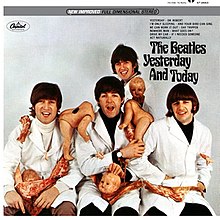
Before Star Maker Machine looks like a series of Yesterday and Today Butchers Cover outtakes, I thought I'd offer some simple cover art with my entry. "Enchanted Pork Fist", from The Meat Puppet's 1985 album Up On The Sun, shows off Curt Kirkwood's Allman-Brothers-at-double-speed guitar chops before the boys sing about pistachios and getting back to bed.

 When the Puppets follow-up, Out My Way , came out in 1986 I got a phone interview with Curt and asked how he learned to move his fingers so quickly. In his laconic drawl, Curt said when you live in the Arizona desert there's nothing to do but jerk off and play your guitar and he's had a lot of practice at both.


Monday, May 28, 2012

Eating The Animal Kingdom: Praying Mantis


Don Dixon & Marti Jones: Praying Mantis
[purchase studio version]

I just finished spending the day smoking a pork butt, creating some delicious pulled pork, so I’m going to head off in a very different direction. There is a sense of recycled-ness to this week’s theme—we are extending last week’s theme, and this blog has already done a food theme, but a long time ago in Internet terms, and in any event before I was part of this community of music obsessives. So, in keeping with this overlay to the theme, I am writing about a song that was posted back in 2009 by Darius, our fearless leader. But to liven things up, so to speak, I am posting a live version.

“Praying Mantis,” by Don Dixon, is a great, twisted pop song, by a performer who is not widely known, and known if at all for being a producer of little known acts such as R.E.M., The Smithereens (the New Jersey band founded in 1980, not the Northampton, Mass. a capella group founded in 1945), Marshall Crenshaw, and his wife, Marti Jones. Dixon, as a songwriter and performer, reminds me of people like Nick Lowe and John Hiatt.

This track is from a live “official bootleg” that was, I believe, available for purchase at some point, but no more. I originally downloaded it from the music blog Popdose, which states that Dixon and Jones permitted them to post the show for download. It was recorded on May 11, 1990 at the 1313 Club in Charlotte, NC. It is still up and you can hear the entire show here: [Live from the 1313 Club]

It appears, however, that the story that the female praying mantis always eats the male after mating isn’t true. [Snopes Article] So, if any male praying mantises are reading this blog, you may be able to rest easily, and should get out of your house, or nest, or wherever praying mantises live, and try to meet a nice girl.

Eating The Animal Kingdom: Pigmeat


Ry Cooder: Pigmeat

[purchase]

A belated start to this week's theme, but not as late as all that, really, given how closely connected it is to our previous conceit - the difference here is, instead of merely celebrating fauna in all its forms, we find ourselves going for the gastronomical. In doing so, we retroactively include this morning's post featuring Little Feat classic Dixie Chicken, or at least the image accompanying it. Expect more of the same lip-smacking imagery as we move forward into June. Vegetarians, we apologize in advance for any distress.

This mess of a tune - originally by Huddie Ledbetter, swung here by master guitarist, composer, and one-time Rolling Stones studio sideman Ry Cooder - is a perfect thematic reboot, and not solely for the barely buried innuendo it hides under its sloppy, juicy performance. Pig meat, indeed. See also Cooder's One Meat Ball (pasted below), a tin pan alley cover from the same self-titled debut solo album, for thematically related though sonically distinct thrills.


The Animal Kingdom: Dixie Chicken


Little Feat: Dixie Chicken
 [purchase]

While we're stuck on the animal kingdom and temporarily focused on fowl (and the plural is fowls?), allow me to once again plug both one of my favorite bands and one of my favorite resources (poignantly appropriate at this point in time)

The original studio version (purchase link goes there) is from the 1973 album of the same name. This embedded link is from the legal/free repository at archive.org where it is labeled as a 1976 live recording from the Warner Theater. I think you'll agree that it is pretty crisp (all around) for a live recording. ( I hear something "funky" happen to the recording at about 9'30", but it doesn't detract much from the overall value. Am I wrong? Do you hear it, too?)

Please pardon my irreverance as to the image choice for "the animal kingdom", but I kind of wish that it might provoke a remark about what it is that we do to our animal brethren.

Saturday, May 26, 2012

The Animal Kingdom: Gallo del Cielo


Tom Russell: Gallo del Cielo

[purchase]

Due to my love of country and folk music, I have 68 horse mp3s in my collection. But since I always wait until the last minute to post on Star Marker Machine, I usually miss my chance to post my first thought on the given subject. I spent the week scouring my brain trying to think of a non-horse animal kingdom song to post. Finally on Thursday, while listening to Outlaw Country on XM radio, it hit me.

Tom Russell's "Gall del Cielo" is the quintessential Americana song. Written near his native Los Angeles in 1979, the song tells the story of Carlos Zaragoza, a Mexican man trying to win enough money via betting on cockfights to buy back the land that Pancho Villa stole from his family. The rooster from heaven, Gallo del Cielo, is the strongest of the cockfighters. Zaragoza steels the rooster from his home in northern Mexico, swims the Rio Grande and travels the southwestern US and California winning money on Gallo del Cielo's fighting prowess. Unfortunately by the time Zaragoza gets to Santa Clara, Gallo del Cielo meets his match. Zaragoza losses all of his money on the fight, and exiles himself so as to not bring his family shame.

Ruseell has recorded several versions of "Gallo del Cielo." This one is from the completion Veterans Day: The Tom Russell Anthology, but the original is from Russell's 1984 album Heart on a Sleeve.

The Animal Kingdom: Will the Wolf Survive?

Los Lobos: Will the Wolf Survive?

[purchase]

Time flies. Los Lobos -- "The Wolves" -- formed in 1976. For a band that's been together for more than 35 years, Los Lobos has aged incredibly well: Los Lobos' founding members (David Hilgado, Conrad Lozano, Louie Perez, and Cesar Rosas) remain, and the new kid (Steve Berlin, who joined in 1983) is still there too. Members even work together on side projects (For example, Hildago and Perez collaborated on the Latin Playboys, as well a wonderful duet album quietly released in 2010). Not only do the band members seem to genuinely like each other, they are also committed to their craft. The breadth of material Los Lobos has recorded is impressive, and each of their 16 full-length albums has something to recommend.

Among mainstream listeners Los Lobos may be best known for two cover songs -- "La Bamba," which appeared in the film of the same name; and a rollicking cover of "I Wanna to Be Like You (The Monkey Song)" from the movie The Jungle Book. Their signature song really is "Will the Wolf Survive?," which echoes both the name of their first full-length English-language album (How Will the Wolf Survive?) and the translation of the band's name. Recorded in 1984, the song seems to sense the challenges the band would face during its long career. Looking back at over three decades as one of America's premiere roots rock bands, the answer to the question "Will the Wolf Survive?" is a resounding "Yes."

Bonus Track: Since it fits in with our animal kingdom theme, here's Los Lobos's fun cover of "I Wanna Be Like You (The Monkey Song)" from the Disney soundtrack tribute album, Stay Awake.

Los Lobos: I Wan'na Be Like You (The Monkey Song)

[purchase]

Friday, May 25, 2012

The Animal Kingdom: The Lion Sleeps (Wimoweh)

The Tokens: The Lion Sleeps Tonight (Wimoweh)

[purchase]

My favorite football team has always been the Detroit Lions. When I was little, my mom told me this song was written about the Detroit Lions. A misstatement I should have seen through -- but I had never heard the song "Wimoweh," and, frankly, the sentiment "The Lions Sleep Tonight" did come awfully close to describing the my team's play on the field. The Detroit Lions appear to finally be contenders, but I still think of them whenever I hear this song.

Wednesday, May 23, 2012

The Animal Kingdom: Cows


The Suburbs: Cows

[purchase]


I lived in Minneapolis back in the 80’s, so I am familiar with the Purple One. The album that includes ”Starfish and Coffee” is one my favorites of his. I never saw him perform except in that movie about Violet Precipitation and the other one which shall remain nameless. During the 1980s several other bands from the Minneapolis-St. Paul area got some critical notoriety outside Minnesota, such as The Replacements and Husker Du. Other groups like the Suburbs (from the Mpls. suburbs, of course) didn’t become as well known, and it seems a mystery to me. They had the dapper 1980s bad haircut look (see here) and performed sweaty, beer-soaked dance punk.

Since I grew up in the Dairy State of Wisconsin, I have some fondness for bovines, and when I was young, my dad was a dairy farmer. He gave it up for a steady paycheck and regular hours before I was old enough to take much responsibility for farm work. The song “Cows” is from the Suburbs first album In Combo, which seems to go in and out of print, but is also available on “best of” recordings. It is short and sweet and to the point: “and like their friends the shaved sheep, they got the skinny feet.”

Guest post by Paul T

The Animal Kingdom: The Caterpillar


The Cure: The Caterpillar
[purchase]

Skittering sticky sweet and sensual from the close confines of The Top, perfect pep deception from an imperfect post-Pornography, post-Pop epiphany Cure curiosity.  Onomatopoeic ticks and clicks scratch as cocoons hatch, new wings stretch and bend, a heart swoons and rends. Lies and disguises belie the truth he can't quite hide - gossamer bears away what gossamer lies hold back, and she was never in his league, not really.  He may be a caterpillar, but she isn't.  Not anymore.

Monday, May 21, 2012

The Animal Kingdom: Tiger Rag


Original Dixieland Jass Band: Tiger Rag
[purchase]

For some reason, this post was out of place, requiring me to delete the original and repost.
In a couple of weeks it will be my 30th reunion at Princeton University, so “Tiger Rag” seemed like the right song for this week. The picture is my class’ logo; our theme is “30 Rocks,” which fits with my participation in this blog and the fact that I worked at WPRB for 3 and a half years. Also, Alec Baldwin’s character on the show “30 Rock,” Jack Donaghy, went to Princeton, and based on clues about his age, could have been in our class, if he were a real person. Fifteen years ago, our theme was “The XV Files,” in reference to David Duchovny, the star of The X Files, who is a real person, and a member of my class (but who I don’t believed showed up at the 15th). Princeton Reunions is a crazy experience that defies easy description. Alumni all wear costumes, the drinking is excessive, and it is a blast. Google it, and you will find embarrassing pictures, and news articles that try to do it justice, but can’t. My kids tease me that it is the only weekend when I am friendly to everybody. Which is probably true.

The tiger became the mascot of Princeton sometime in the 1800’s. In 1867, Princeton started to use orange as its color, in honor of William III, of the House of Nassau, who was Prince of Orange. The oldest building on campus, Nassau Hall, was named for William. Black lettering was used on orange ribbons, and by 1896, the official graduation gowns were orange and black, despite the fact that the official colors of the House of Nassau were orange and blue. Meaning that Princeton came close to being Syracuse. With orange and black the official colors, it wasn’t much of a leap to sportswriters referring to Princeton teams as “tigers”.

“Tiger Rag,” however was not written about Princeton (although my class's 25th reunion theme was Tiger Gras). Its origins are lost in the mists of history, but the original recording was by the Original Dixieland Jass Band in 1917 (that isn’t a typo, by the way). This version, recorded in 1918 by them, after they changed the spelling to “Jazz” was on the Victor label, and therefore has been available from RCA and later owners of the label for years. It has been recorded by everyone from Louis Armstrong, to Billie Holiday to Frank Sinatra to Django Reinhardt to Joe Jackson to Jeff Beck. It is the official fight song of Clemson University, another team of tigers, and I performed it regularly, and inexpertly but loudly, as a member of the Princeton University Marching Band, which has been in existence since 1919, and embarrassing the university since at least the 1950’s. (Quick unrelated aside—my good friend Steve was the drum major in 1981, and we were marching in the streets of Princeton after a football game. Steve was arrested for parading without a license, because we didn’t need no stinkin’ licenses.. New Jersey Governor Brendan Byrne, a Princeton graduate, officially pardoned him. Saludo, Steve.)

Sunday, May 20, 2012

The Animal Kingdom: Boa Constrictor


Johnny Cash : Boa Constrictor

[Purchase]

For his 23rd album, 1966's Everybody Loves A Nut, The Man In Black took his cue from Roger "Dang Me"  Miller and recorded a batch of silly songs that would entertain kids as well as adults. "Boa Constrictor" was written by poet, children's author and the man who would be responsible for Cash's 1969 worldwide hit "A Boy Named Sue" : Shel Silverstein.


As a single "Boa Constrictor" just barely crept into the Country Singles Top 40 in 1966. But my kids love it and I hope yours will as well.

The Animal Kingdom: Starfish and Coffee

Matt Nathanson: Starfish and Coffee

[purchase]

Haddy N'Jie & The Stoones: Starfish and Coffee

[unauthorized & unavailable]

Lest two horsey songs in a row set too narrow a net for our theme this week, I spent a few moments looking for an animal song from the other end of the kingdom, and came up with the first track above - a little number I first encountered on 2004 release For The Kids Too!, the middle child of a three round alt-rock kindie concept which remains a core component of our collection even as our kids come upon their second decade.

The song is actually a cover, but naming the originator runs high risk in a world of blog takedowns and song loss (hint: his name is royalty, and he likes purple), while sharing the song as first recorded would invite disaster. Instead, I'll merely note that Matt Nathanson's version of the song is bouncy and joyful enough for kids of all ages, and that the second of the above tracks is seriously unauthorized, coming as it does from a huge and hugely diverse collection of Norwegian he-who-cannot-be-named covers which I managed to scoop up before it was blocked at the starting gate just a few years back. And that it could just as easily have been posted in our recent Unusual Instruments theme week, given that it features a truly haunting saw as lead instrument in what turns out to be a funky world-beat epiphany once it gains momentum.

The Animal Kingdom: A Horse With No Name


Aemrica: A Horse With No Name

[purchase]


Back in the early 70s,  America was three kids whose fathers were US military stationed overseas: Gerry Beckley, Dewey Bunnell and Dan Peek.  They came together in the London area towards the end of their high school years.  Their 70s hits also included Ventura Highway and Sister Golden Hair. Today Bunnell and Beckley still tour (Dan Peek passed away last year).

Story has it that Dewey wrote A Horse With No Name with thoughts of the desert around Vandenberg AFB, one of the temporary places his family lived and one he would surely have missed in drizzly gray London. The song was first named Desert Song and was apparently additionally inspired by images of horses from Salvador Dali and MC Escher works.

The three-part harmony vocals and the acoustic guitars call to mind CSNY, and in fact Dewey admits the influence; you could be forgiven for thinking it was Neil Young singing. Personally, I have always thought that the song manages to convey a horsey rhythm of sorts and that the lyrics paint images of the desolation of the eastern California desert.

The Plant Kingdom --> The Animal Kingdom: Black Horse and the Cherry Tree

Black Horse and the Cherry Tree was the 2004 breakthrough hit for Scottish singer KT Tunstall. She first performed it live on Jools Holland's British music show, and it was later nominated for a Grammy. It's based on the Bo Diddley Afro-Latin beat (you can hear it clearly in his Who Do You Love), which is related to the earlier hambone rhythm of a traditional African-American dance. So from Africa to America (tinged with the Caribbean) to Scotland, this tune takes us on a worldwide musical journey. Plus the title features both a plant and an animal, making it the perfect transition song.

Note: Things are unsettled in musical blogland since the demise of MegaUpload earlier in the year, and the other file servers are now very twitchy. Very soon I'm going to delete my own music links older than a month or so to hopefully delay a suspension from my host. I think we all feel vulnerable these days, even though we hope that our posts are benefiting artists who may be introduced to new listeners.

Is it ironic that this post is the one that got me permanently suspended from my file server? Looks like I'm on an extended hiatus, folks, but I had a great time while it lasted.

Saturday, May 19, 2012

The Plant Kingdom: Poison Ivy


The Coasters: Poison Ivy

[purchase]


Jim Gill: Poison Ivy

[purchase]

“Leaves of three, let it be.” That’s the old saying about Toxicodendron radicans, or Rhus radicans, “it gives you itchy hands.” A common vine at the edges of woods, in floodplains, and disturbed areas, it give nasty skin rashes to people who are susceptible. It bothers me some, but I can usually avoid it.

The first song was a hit for the Coasters. I’ll let the Wikipedia take it from here.
"Poison Ivy" is a popular song by American songwriting duo Jerry Leiber and Mike Stoller. It was originally recorded by The Coasters in 1959. It went to #1 on the R&B chart and #7 on the Billboard Hot 100 chart. This was their third top-ten hit of that year following "Charlie Brown" and "Along Came Jones." The song discusses a girl named Ivy, calling her "Poison Ivy" because of her reputation with men as a player. The song makes references to other flowers such as a rose and a daisy, and diseases like measles, mumps, chickenpox, the common cold, and whooping cough. In a recently published biography about Jerry Lieber & Mike Stoller, the song's authors, it was revealed that the song's lyrics are about sexually-transmitted disease, not the illnesses previously thought. (Whoa!)
The second tune is kid-folk by a Chicago-area musician named Jim Gill. He doesn’t have Wikipedia entry, so I will mention that he has six CDs, as well as some books and a DVD. Some of the tunes a bit repetitive for the preschool set, but his crack studio band and witty lyrics make him quite listenable for the parents. His tunes are mostly jazz and folk influenced.

Guest post by Paul T

The Plant Kingdom: I Am a Tree; The Trees


Guided By Voices: I am a Tree

[purchase]


Rush: The Trees

[purchase]

Most songwriters are not scientists, and vice versa. It’s probably just as well. But sometimes words get in the way of scientific fact.

Would trees survive “I have the leaves that fall off when winds blow by”? Or “I will break before I bend”? Questions, questions… But it is a great song anyway, originally from the under-appreciated Mag Earwhig, and also included on the “best of” Human Amusements at Hourly Rates. The song is by Doug Gillard, a collaborator of Robert Pollard in this particular iteration of Guided by Voices, after Pollard disbanded the “classic lineup” responsible for Bee Thousand and Alien Lanes.

And I don’t know much about Rush other than the “hits,” but the first song made me think of the second for some reason. This tune recounts a struggle between maples and oaks. Here in eastern North America, many oak species are long lived, but less shade-tolerant than sugar maple, which may replace them in dominating a forest over the long term, given moist conditions and a lack of disturbance. But here the trees “are all kept equal by hatchet, ax, and saw…”

Guest post by Paul T

The Plant Kingdom: Keep Off the Grass


Todd Snider: Keep Off the Grass

[purchase]

Todd Snider: Keep Off the Grass (live in Boston)

I know we already have a post about grass, but I can't come up with anything else. Plus, grass is so vital to everyday life. It covers our yards and public parks, it covers our sports fields, there's even fake grass for indoor sports, we complain about mowing it yet we spend hours making it look perfect. Is there any better feeling than walking on freshly mowed grass with bare feet?

However, there is nothing worse than when THE MAN tells you to keep off the grass. How often do you want to lie down in the sun on a blanket in a park on a beautiful weekend afternoon, but THE MAN has posted a "Keep Off the Grass" sign on a perfectly good piece of lawn. Now, they may have just chemically treated the grass, or they want people to keep their dogs from relieving themselves on it, but most of the time you cannot figure out why THE MAN wants you to keep off the grass.

In this song from Todd Snider's 2000 album Happy to Be Here, Snider laments being told what to do by everyone. He's trying to be his own man, but people keep giving him a list of things he can or can't do, including keep off the grass. If you know anything about Snider's writing, "Keep off the Grass" is probably also a double entendre for "Keep off the Marijuana." But hey, marijuana is a plant too!

I included a live version of this song from a gig in Boston last year. Snider and his people are forward thinking enough to record his shows and offer them as a download a week or so later for $5 per pass code. I go to a lot of shows (2-3 a month), and so far Snider is the only artist I have seen offer this service. This version is particularly fun as he talks about his early songwriting career and his attempts to emulate Bob Dylan.