


























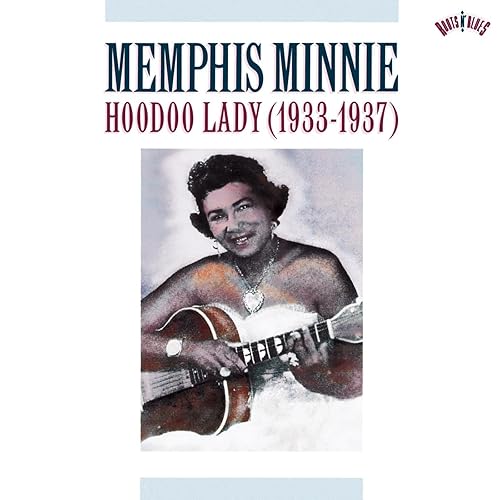
Memphis Minnie: My Butcher Man
[purchase]
There’s a long history in music of songs with double entendre lyrics. Now, Cardi B. and Megan Thee Stallion can go on network TV and sing about their WAP (although it appears that they bleeped out the word “pussy” at the Grammys), and that song, and other sexually explicit ones, are played on the radio, streaming, and wherever popular music is found. But there was a time when sexually explicit songs had to be couched in innuendo and double entendres.
The benefit of this approach is that the song could get wider distribution, those who got the references, felt that they were in the know, and the artist could feel like he or she got over on authority. I understood this well back when I contributed to halftime shows for the Princeton Band, which were censored by the University, and we used to joke that if we ever wanted to play a particular famous folk song, we’d have to call it, “She’ll Be Arriving Around The Mountain When She Arrives.” So we slipped a lot of references past the censors—the first joke I wrote as a freshman was about freshman male social life, and had the band form a shower with water shooting from the spout, as we played "He’s Got The Whole World By The Hand." It was fun, we had lots of laughs, and eventually got in trouble with both Princeton and the United States Army…
This theme, like many I’ve suggested here, was inspired by a song I heard in the car. This time, I had on the B.B. King’s Bluesville station and I heard “My Butcher Man,” by Memphis Minnie, with her then-husband, Kansas Joe McCoy. It became pretty clear that Minnie was not really singing about the man’s butchering skill. The song includes lines such as:
I’m going to tell everybody I've got the best butcher man in town
He can slice your ham, he can cut it from the fat on down
He slice my pork chops and he grinds my sausage, too
Ain't nothing in the line of butcherin' that my butcher man can't do
Butcher man, in the morning, won't you please stop by my house
I've got enough butcherin' for you to do if you promise me you just only hush your mouth?
And finally, if the references weren’t clear enough:
If anybody asks you, "Butcher man, where have you been?"
Show 'em that long-bladed knife, tell 'em you been butchering out in the slaughter pens
Let's go, butcher man, for me
Memphis Minnie was born Lizzie Douglas in 1897 in New Orleans, She ran away from home at the age of 13, and started playing on street corners, eventually moving up touring with the Ringling Bros. Circus and then as a singer and guitarist in the Beale Street blues scene. She was, by all accounts, a tough, street smart woman. One observer remembered: ”Any men fool with her she’d go right after them right away. She didn’t take no foolishness off them. Guitar, pocket-knife, pistol, anything she get her hand on she’d use it.” Apparently, the blues business wasn’t sufficiently lucrative, so Minnie’ reportedly subsidized her income with prostitution, charging the relatively large sum of $12 for her services. Minnie also gained a reputation for partying and gambling. She was an early adopter of the electric guitar, and didn’t shy away from guitar contests against the likes of Big Bill Broonzy, Tampa Red and Muddy Waters, sometimes winning.
Minnie recorded over 200 songs, and wrote many of them, including “My Butcher Man,” “Me and My Chauffeur Blues,” (another song filled with double entendres, originally credited to someone else, and was later recorded by the Jefferson Airplane, who credited yet another different person), and “When The Levee Breaks,” (with Kansas Joe, later re-worked by Led Zeppelin, who actually gave Minnie a writing credit without litigation).
This genre of music was sometimes called “Dirty Blues,” and often featured double entendres. In researching this piece, I found a fascinating article written in 1927, a few years before “My Butcher Man” was written, by Guy B. Johnson, a white “scholar of black culture and longtime advocate of improved race relations,” as his obituary in The New York Times stated when he died at 90, in 1991 (and whose last name, itself, is a double entendre….). One of Johnson’s observations was
that the majority of the expressions in the blues relating to the sex act are sung from the point of view of woman and are mostly concerned with the quality of the movements made by the mail during coitus.
He then goes on to describe many examples, proving clearly that academic writing, even about sex, can be bone-dry.
Johnson concludes,
Double meaning in secular song is after all nothing new. Folk song students know that many standard folk songs have come up out of the slime. But it is doubtful if any group ever has carried its ordinary vulgarities over into respectable song life so completely and successfully as the American Negro. And the ease with which the Negro has put this thing over leads one to suspect that the white man, too, enjoys seeing “the other meaning.”


