












Showing posts with label Buggles. Show all posts

Wednesday, June 22, 2022

Back: Back of My Hand

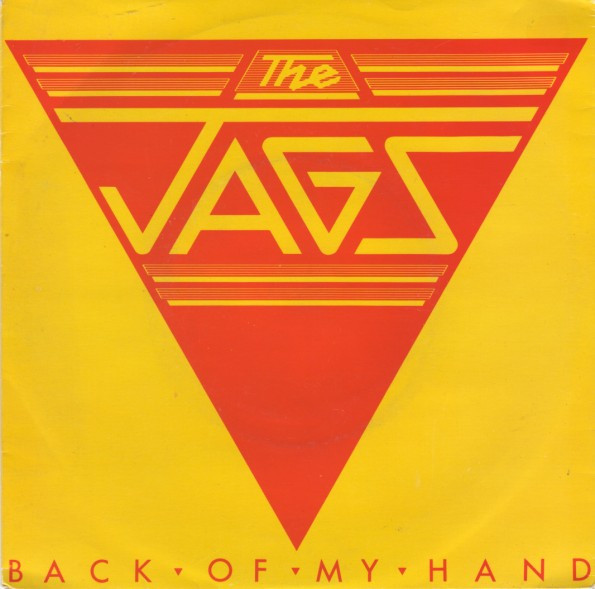
The Jags: Back of My Hand
[purchase

One of the fun things about writing for this blog is that I never really know where the piece is going to go when I start doing my “research.” There are so many songs that have the word “back” in their title (and even more with the word in the lyrics, and even more songs that I could write about, if I took a broad view of the theme). When I saw The Jags’ “Back of My Hand” come up in my search, I thought, “hey, this would be easy—a fun song that I remember from college that has pretty much been forgotten.” And yet, when I started to look into it, it became more interesting. 

The Jags were formed in 1978 by the Yorkshire-based songwriting team of singer Nick Watkinson and guitarist John Alder with Steve Prudence on bass and Alex Baird on drums. In July of 1978, they signed to Island Records and released a four-track EP, which included an early mix of “Back of My Hand.” It’s a great song—catchy, fun, but with a little edge. And no, it isn’t about hitting someone—it’s about the excitement of getting a girl to write her phone number on your skin, since the song long pre-dates cellphones. 

After dealing with the almost mandatory management issues, the song was remixed by Trevor Horn and Geoff Downes (The Buggles), and the resulting single release became a modest hit in both the US (peaking at 84) and UK (hitting 17), at a time when “new wave” music was not common on the charts. It was, I suspect, more popular on college radio (I definitely played it a few times) and more adventurous commercial stations that were beginning to embrace new wave music. That version was on the US release of their first full album, Evening Standards, although a newly recorded version was on the initial UK pressings. Honestly, I’m not 100% sure which version is embedded above, but I kind of think that it was the original version, not the Buggles remix. 

But here’s the rub. When I thought about writing about this song, my first thought was, “The Jags—that band that sounded like Elvis Costello.” And constant comparisons to Mr. MacManus appeared to torpedo the Jags. It’s kind of an interesting phenomenon. I remember that Costello was, initially, compared to Graham Parker, without damaging his career, and early Costello comparisons didn’t prevent Joe Jackson from becoming a star. So, the only conclusion must be that the Jags just weren’t that good. 

That conclusion would be wrong. 

In researching this piece, I found a number of reviews that call the song “a power pop classic,” their output in general as being of “uniformly high quality,” and having “a range of power pop that few—including Mr. Costello—ever achieved.” And I have to agree—the band was tight, and they wrote clever new wave pop songs that deserved better than just being dismissed as knockoffs. Yes, the Costello influence is hard to miss, but there’s also other things there-Thin Lizzy, maybe the Kinks. It’s a similar situation, I think, to the Knack, who were turned into a punch line despite some excellent songs because of, well, because of a bunch of reasons that I wrote more about here

After “Back of My Hand,” the Jags had some personnel changes and recorded a second album. While band members insist that they never tried to copy Elvis, as one member noted, for the second album, they tried not to sound like him. The album was unsuccessful, the band members feuded, there were legal and management squabbles, and the band broke up. As far as I can tell, none of the members appeared to join other known bands, it seems that their music is out of print, and some of it never was even released on CD. In fact, the version that I’ve uploaded is from a compilation, and the Amazon purchase link is from the soundtrack for the 2006 Owen Wilson movie, You, Me and Dupree

Then I found an article from 2013 entitled, Donate to Fund for UK Power Pop Legends The Jags’ Watkinson, in which I discovered that Watkinson had since about 2009, been, as the article put it, “living as a transvestite and performing at select clubs in the greater London area, generally under the name Virginia Plain.” The reason for the funding request was that Watkinson’s home was destroyed by a fire set when a lodger fell asleep with candles burning. And, of course, the flat was not insured, and the culprit fled and never paid a penny. Another article that I found about this situation noted that Watkinson was earning a “living as a gardener.” 

It's kind of a shame that such a talented songwriter isn’t writing songs, and that a talented band never really made it. But it shows how everything has to align for an artist to succeed.

Thursday, May 5, 2022

(PERPETUAL) CHANGE

In a move that feels akin to eating out of Jordan's lunchbox, I'll be quick before he notices I have encroached upon his sole operator territory of the golden age of prog. But ain't this an absolute banger? You see, I too was there, the SMM home for distressed elderly muses a port of solace for me as well, courtesy my life misspent in record shops.

The Yes album was the pinnacle of this venerable band, one of those uber snobby remarks for which I am famous, especially when you consider it was only number 3 in their 22 and still counting number of studio recordings. (And more so if you consider I have never felt it necessary to listen to either of the two albums that preceded it.) The Yes album came to me fully formed, with neither need to get the back story and, even, not that much to take the story further forward. OK, in true I-am-not-that-much-of-a-fan style, I probably only have a handful of their other records: Fragile, Close to the Edge, Yessongs (live) and the Ultimate Yes, the 35th anniversary compendium, the latter being mainly to ensure CD versions (aka unscratched) of the songs I most enjoy. I think it is the relative simplicity of the album I so love, that word, of course, within the context of Yes, relative. So the guitar is noodling majestically all over, especially when Steve Howe picks up acoustic stylings, the bass in challenging, the drums all of a clatter, but the keyboards, c/o Tony Kaye, are pure meat and potatoes. None of yer synthesisers and mellotrons, or very little, so soon to become the band's stock in trade. Largely organ, and a rhythmic punch rather than the look at me bombast that later players brought to the role. Despite being a fan of the Keith Emerson school of keyboard play, I never took to to Kaye's replacement, Rick Wakeman's octopoid filigrees. 

Live in 2000

Perpetual Change is the song that highlights both this iteration of Yes and, thus, for me, the band as a whole. But it is also a good marker for the apparent MO of the band, given the, at best, impermanence of the ranks. With at least 19 members, with, give or take, an additional 4 for live performance, that isn't bad going for a 5 piece band. OK, the countered excuse is their longevity: 53 years on the road now, together with the unhelpful ravage of the grim reaper, taking founder member and pivot, Chris Squire, in 2015, who would almost otherwise still be in the fold. (Altho', to be fair, he did have 4 years out, when the band had a "hiatus", 2004 - 8). The only other "original", which he wasn't, would be Steve Howe, the guitarist, and he looks to have had some rests in the '80s and '90s. Which means there has been no single presence from start to finish. The fact that the members clearly weren't chums didn't help, not least after decades of touring together, with the presence, often at the same time, of bands that had as much claim to the name as the official version, and certainly played the same songs. So, I give you Anderson Bruford Wakeman Howe, who ploughed a parallel furrow, between 1988 and 1990, and arguably with more of the classic line-up than the baton toting newcomers. Or there was the time when there was not only Yes, but Yes featuring Jon Anderson, Trevor Rabin and Rick Wakeman. Complicated and complicating. Wiki here have a good go at trying to unravel it. It is also worth having a look again at Tony Kaye, ousted, after the Yes album. Would that be the end of his career? Well, far from it, but if he was never quite as successful with his own bands, even if Flash also contained another ex-Yesser, in Pete Banks, who preceded Howe in Yes, on guitar, Yes were still there to welcome him back in the fold, 1982 - 1985, his less cluttered style perhaps ideal for their 2nd chart bothering round of hits, as singles became a surprising late string to their bow. (Even if an earlier recumbent of his seat had the fifth of writing credit he might have had. (That fifth was, for me, the most extraordinary ever Yes man, one Trevor Horn, the erstwhile Buggle and later producer of Fairlight heavy magnum opuses for the likes of Frankie Goes To Hollywood and Seal. True, his associate Buggle, Geoff Downes had also joined up, but has gradually become more subsumed into standard erudite muso mode, by re-joining the band again at  later date, where he currently remains.)

Live 2018 (and not the official Yes, being the "featuring Anderson, Rabin, Wakeman.)

I have to say I would not probably cross the road now to see Yes perform, even if it were in my own local Darwin Park, in Lichfield, which I think might, anyway, be a stretch and unlikely. I can sort of get the fact that bass and drums are dispensable within their sound: all the players have been good, even if some better. Despite my above comments, I would accept other than Tony Kaye, and, indeed, the one time I did see the band live, it was Rick Wakeman, who makes for a good show live, even if his flourishes and fandangoes became essentially annoying. I can't really speak for the other myriad keyboard players, but Patrick Moraz had form, replacing Keith Emerson in the Nice (or sort of), ahead of becoming a Moody Blue. (Which, for me, I am afraid, is a minus point.) Singing? Well, why, I wonder, would you even entertain it not being Jon Anderson. It is true I haven't even bothered to find out if Benoit David or Jon Davison cut the mustard, apart from any clip appearing here. I mean, they found David in a tribute band, smacking of how Judas Priest go about replacing singers....

Also 2018, the "official" Yes. 

Who, like me, thought that last the weakest by a mile? Anyhoo, me? I'm off to play my 1971 original vinyl of the Yes Album......


Sunday, May 11, 2014

Radio -->Television: Video Killed the Radio Star

[purchase]

On a basic level, “Video Killed the Radio Star” harkens back to a time when the emergence of television supplanted radio as the primary source of information and entertainment. On a general level, it can be interpreted as a reflection on new technology replacing the old. In the cultural history of the 20th Century, because it was the first video ever played on MTV, the song has come to represent the emergence of the music video and the marginalization of radio.

I’d argue, though, that while music videos and MTV probably didn’t help radio, it wasn’t the only thing that caused the decline of the medium. Even MTV stopped playing videos years ago, I think that two different forces more powerful than video combined to render radio less vital. (Note—these opinions are about rock radio—I would not even presume to opine about the state of urban, Latin, country or other genres).

First, as I alluded to in my prior piece, I think that radio’s success commercially resulted in consolidation of ownership and a homogenization of content. Independent owners, willing to take risks and hire edgy DJs and program directors, were replaced by media behemoths that sanded off the rough edges and used market research to cater to the masses. There has always been a balance in radio programming between leading the listeners and following them—in other words, trying to determine the right mix of music that you think the audience will or should like and the music you know they already like. I think that the balance on commercial radio has shifted way toward playing the known, and avoiding risk. The spirit of adventurous radio still lives on in the occasional independent station and on college/noncommercial stations. Unfortunately, these stations tend to have small listenerships, can swing too far toward the strange and unknown, and often have difficult to listen to student DJs (which I can say, having been one).

The second force is, of course, the new technologies, mostly digital music, and the Internet and satellite “radio,” that allow listeners to create their own playlists, stream music from around the world, download music easily and find stations that narrowcast in limited genres. This allows each individual listener to decide, on a moment to moment basis, the balance between the known and unknown, and how much the listener wants to rely on their own taste, and how much to leave to someone else’s decision. And videos have become a way to circumvent the tight playlists of commercial radio and the small listenership of noncommercial/independent radio by getting the product directly to the consumer.  Videos, however, remove some of the mystery, because they create a codified, unitary version of a song's meaning.  The ability of every individual listener to imagine a personal vision is gone.  I have no memory anymore of what I thought the first time I heard Peter Gabriel's "Sledgehammer" on the radio--now, all I can think of is claymation.

There is nothing inherently wrong with this—it is just reality. It isn’t as easy as when I was a kid, when there was a choice of a few radio stations, you pretty much knew that one station played top 40, another played album rock, and another was “free form.” Or you put on a record. And I lived in the media capital of the world, so I can only imagine that radio was even less varied elsewhere. Now, if you like popular hits, you can find a way to listen to them. If you want to only listen to obscure indie rock, you can do that. And if you want to mix things up, you can do that, too. But all of this choice requires more work than I think most people are willing to do, and can simply be overwhelming. Maybe not to most people who read obscure music blogs, but most regular people.  I wrote this earlier this week, and here's an op-ed from today's New York Times that discusses some of the same issues.

Although I would expect that most people reading this were in fact aware that the Buggles’ “Video Killed the Radio Star” was the first video on MTV, I am willing to bet that a significantly smaller percentage of you knew that it was not the first version of the song released. The song was written by Trevor Horn, Geoff Downes and Bruce Woolley, all members of the Buggles, and it was a demo of the song that helped get the band signed. Apparently, it took the trio about an hour to write. While recording the album, Woolley left amicably, formed The Camera Club and released his somewhat less “produced” version of the song on the album English Garden. Here it is:

Shortly thereafter, the remaining Buggles released their version, which became the huge hit and a cultural icon. And to show there were no hard feelings, Woolley appears in the video. Downes and Horn started to work on another album, but instead joined Yes, in what was at the time a true head scratcher. The second Buggles album was later released, to less acclaim, and Downes joined Asia and has been part of other bands. Horn has mostly made his name as a producer. The Camera Club’s second album went unreleased, and Woolley has become better known as a songwriter, often for movies. One of the other members of that band was Thomas Dolby, who must also have recognized the interplay between TV and radio. His debut album was called The Golden Age of Wireless, and the first track was another early MTV staple, “She Blinded Me With Science.” The second track? “Radio Silence.”