My life is going through some major changes, but that's not where this ostensibly expired theme came from. Those life changes, however, are why this post is squeezing in after the expiration date of the theme: as I wrap up what was my initial draft, I see that I set "pen to paper" on this on May 1st. Good intentions.
Having just returned from a second trip to the US in a month and on my way to pick up our dog from the kennel, what to my wondering ears should "appear" from the car entertainment system - but 3 tracks from Dave Mason's <Alone Together>. Now that's a coincidental guilty reminder to finish what I started if I ever "saw" one.
So, here I am in the car listening to the song I was going to post almost 3 weeks back, and I am listening to it with different ears.
The cue list on the car system is ostensibly random. In fact, alphabetical. So, here comes Traffic's Glad. (Dave Mason cues up after the letter T because the recording was downloaded from YouTube using a site that appends "yts" to all file names.) So, the order is Traffic, some Dave Mason, followed by Clapton 461 Ocean.
Now, by the time Traffic came out with JohnBarleycorn, Mason had moved on to his first solo album. At about the same time that Clapton had also moved on to solo work. The year is 1970.
As I listen to the tracks I have saved - noting the guitar playing in particular, I find myself questioning if that isn't Clapton's guitar I am hearing on Alone Together. It's not, but there's an awful lot that's similar: tone and riffs. When I check the list of musicians, I remind myself that there is in fact a fair amount of cross-over with Clapton associates of that era: Bonnie Bramlett, Rita Cooldige, Jim Gordon, Leon Russell, Carl Radle .. And of course, there's Clapton's later work with Traffic-man Steve Winwood.
And I note that while Mason's vocals are plenty fair enough on World in Changes - and his guitar work fairly comparable to Clapton's, I see that Alone Together is rock that's just Good Enough rocking.
So, here's a more recent variation on the 1970 original:
Well, there's a thing, there I am, trying to see if I have it in me to squeeze out a second post, appreciating the wire is close. So, as per my usual, in goes CHANGE to my i-tunes search, and, bloomin' heck, there's another one. Another one? Well, my last post was very much affirmative related, never realising for a second that there was also the later song.
And despite my mardy earlier remarks, it's OK. So, it's not great but it bears a listen, and, apropos their post punk M.O', it is quite catchy and could cut some rugs. Changes, it is called, By now the band, for it is 1993, and, thus, recent days, consists of, as you can tell, as he doesn't sing lead, Jon Anderson and Chris Squire. Tony Kaye (yay) is back on keyboards, with Alan White on drums, turning out to be their longest sitter on the drum stool. Trevor Rabin is on guitar, as Steve Howe was probably in a huff. The production, obvious in hindsight, is from Trevor Horn, himself an alumnus of the earlier band. Rabin, previously of South African band Rabitt, had a 13 year membership with Yes, and then, with Howe back in his place, with various counter-Yes spin-offs. (No's?) It is basically his song, with additional credits taken by White and Anderson, for later audio fripperies ahead of the album being made. For what it is worth, Rabin later put out versions that "removed" their additions.
And then again, here's Yes featuring Anderson, Rabin, Wakeman, in 2017. Which was as opposed to Yes, the band, which didn't........
As my friend and multi-site blogging colleague Seuras pointed out, I do fly the prog rock flag often in this space, and I also write regularly about Americana music (which is what I seem to listen to mostly these days), and 70s-80s punk/new wave, not to mention a bunch of pieces about TV. But another genre that I’m a big fan of is power pop, which, I guess, tries to rehabilitate the uncool “pop” genre by adding the word “power” to it. And I have focused on its purveyors here before, but never about the dB’s.
The dB’s seem exactly like a band that I would have been deeply into when they started in the ‘80s. Their first album, Stands for Decibels, came out in 1981, while I was working at WPRB, and its power pop crossed with jangle sound would have fit right into my playlists then, but I really don’t remember it at all. Nor do I remember their second album, which came out in 1982 at some point. After college, when I started to become a big fan of R.E.M., and the band led by their producer, Mitch Easter, Let’s Active, I somehow became aware of the dB’s, led by Peter Holsapple and Chris Stamey, who was a childhood friend and former bandmate of Easter’s, although I similarly have no recollection of their third album.
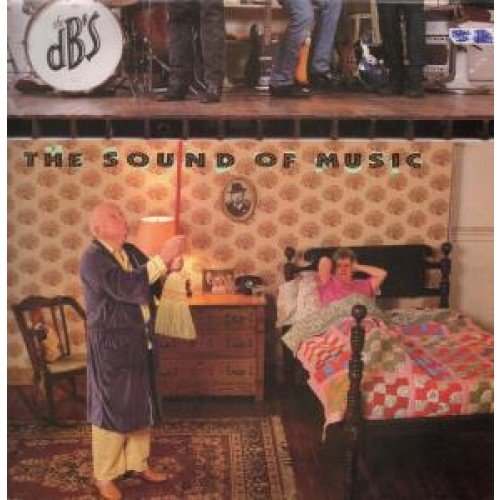
In 1987, at a time when I was starting out as a lawyer, and making real money for the first time, I was comfortable taking a flyer on a CD, and I remember getting the dB’s album The Sound of Music, probably after hearing something from it on the radio, probably WFUV. And it was good. It was filled with great, catchy songs, but my favorite then, and now, was “Change With The Changing Times,” which also featured Benmont Tench, from Tom Petty’s Heartbreakers, on organ (but not founding member Stamey). It’s a song about a man worrying that if he doesn’t keep up with his love’s changing interests, he’ll lose her. And it is catchy as hell.
Here's the part of the blog post where I should pivot from writing about the song, to commenting about how, considering the leaked Alito opinion on abortion, America is about to change, and wondering how we will change with the changing times. But, honestly, I’m so sickened by the fact that we stand on the brink of seeing a Supreme Court packed by politicians who represent a minority of Americans strip a broadly popular constitutional right from women, with an opinion that might have well simply been a picture of Alito raising his middle fingers at most of the country, and which leaves open the actual risk of rolling back other constitutionally-guaranteed rights, ranging from marriage equality, contraception, sexual privacy, and even public school funding, that I really don’t want to go there. Any more than I just did.
In a move that feels akin to eating out of Jordan's lunchbox, I'll be quick before he notices I have encroached upon his sole operator territory of the golden age of prog. But ain't this an absolute banger? You see, I too was there, the SMM home for distressed elderly muses a port of solace for me as well, courtesy my life misspent in record shops.
The Yes album was the pinnacle of this venerable band, one of those uber snobby remarks for which I am famous, especially when you consider it was only number 3 in their 22 and still counting number of studio recordings. (And more so if you consider I have never felt it necessary to listen to either of the two albums that preceded it.) The Yes album came to me fully formed, with neither need to get the back story and, even, not that much to take the story further forward. OK, in true I-am-not-that-much-of-a-fan style, I probably only have a handful of their other records: Fragile, Close to the Edge, Yessongs (live) and the Ultimate Yes, the 35th anniversary compendium, the latter being mainly to ensure CD versions (aka unscratched) of the songs I most enjoy. I think it is the relative simplicity of the album I so love, that word, of course, within the context of Yes, relative. So the guitar is noodling majestically all over, especially when Steve Howe picks up acoustic stylings, the bass in challenging, the drums all of a clatter, but the keyboards, c/o Tony Kaye, are pure meat and potatoes. None of yer synthesisers and mellotrons, or very little, so soon to become the band's stock in trade. Largely organ, and a rhythmic punch rather than the look at me bombast that later players brought to the role. Despite being a fan of the Keith Emerson school of keyboard play, I never took to to Kaye's replacement, Rick Wakeman's octopoid filigrees.
Live in 2000
Perpetual Change is the song that highlights both this iteration of Yes and, thus, for me, the band as a whole. But it is also a good marker for the apparent MO of the band, given the, at best, impermanence of the ranks. With at least 19 members, with, give or take, an additional 4 for live performance, that isn't bad going for a 5 piece band. OK, the countered excuse is their longevity: 53 years on the road now, together with the unhelpful ravage of the grim reaper, taking founder member and pivot, Chris Squire, in 2015, who would almost otherwise still be in the fold. (Altho', to be fair, he did have 4 years out, when the band had a "hiatus", 2004 - 8). The only other "original", which he wasn't, would be Steve Howe, the guitarist, and he looks to have had some rests in the '80s and '90s. Which means there has been no single presence from start to finish. The fact that the members clearly weren't chums didn't help, not least after decades of touring together, with the presence, often at the same time, of bands that had as much claim to the name as the official version, and certainly played the same songs. So, I give you Anderson Bruford Wakeman Howe, who ploughed a parallel furrow, between 1988 and 1990, and arguably with more of the classic line-up than the baton toting newcomers. Or there was the time when there was not only Yes, but Yes featuring Jon Anderson, Trevor Rabin and Rick Wakeman. Complicated and complicating. Wiki here have a good go at trying to unravel it. It is also worth having a look again at Tony Kaye, ousted, after the Yes album. Would that be the end of his career? Well, far from it, but if he was never quite as successful with his own bands, even if Flash also contained another ex-Yesser, in Pete Banks, who preceded Howe in Yes, on guitar, Yes were still there to welcome him back in the fold, 1982 - 1985, his less cluttered style perhaps ideal for their 2nd chart bothering round of hits, as singles became a surprising late string to their bow. (Even if an earlier recumbent of his seat had the fifth of writing credit he might have had. (That fifth was, for me, the most extraordinary ever Yes man, one Trevor Horn, the erstwhile Buggle and later producer of Fairlight heavy magnum opuses for the likes of Frankie Goes To Hollywood and Seal. True, his associate Buggle, Geoff Downes had also joined up, but has gradually become more subsumed into standard erudite muso mode, by re-joining the band again at later date, where he currently remains.)
Live 2018 (and not the official Yes, being the "featuring Anderson, Rabin, Wakeman.)
I have to say I would not probably cross the road now to see Yes perform, even if it were in my own local Darwin Park, in Lichfield, which I think might, anyway, be a stretch and unlikely. I can sort of get the fact that bass and drums are dispensable within their sound: all the players have been good, even if some better. Despite my above comments, I would accept other than Tony Kaye, and, indeed, the one time I did see the band live, it was Rick Wakeman, who makes for a good show live, even if his flourishes and fandangoes became essentially annoying. I can't really speak for the other myriad keyboard players, but Patrick Moraz had form, replacing Keith Emerson in the Nice (or sort of), ahead of becoming a Moody Blue. (Which, for me, I am afraid, is a minus point.) Singing? Well, why, I wonder, would you even entertain it not being Jon Anderson. It is true I haven't even bothered to find out if Benoit David or Jon Davison cut the mustard, apart from any clip appearing here. I mean, they found David in a tribute band, smacking of how Judas Priest go about replacing singers....
Also 2018, the "official" Yes.
Who, like me, thought that last the weakest by a mile? Anyhoo, me? I'm off to play my 1971 original vinyl of the Yes Album......
Even as far back as 1970, David Bowie was not considered particularly "normal". He dyed his hair some crazy color(s). He cut it strange - like no one else. Yes .. we had the Beatles's mop cuts and some hippie "let it grow" hair-styles - but Bowie was weird. He wore strange clothes.
That said, to me, David Bowie embodied the right to be and the ability to be different. I place <Space Oddity> at the top of my personal list of Bowie's best songs (and I used it some tie back in a now removed MediaFire blog [but restored here]).
That said, our current theme looks at Change, wherein Bowie excels.
Way back when things like changing the color of your hair, changing your born gender, changing even your appearance were looked down upon (it's still true) -David Bowie was out there doing it all.
Ch ... ch... ch ... changes (one more or one less "ch" in the original) seems to me to be the prime choice for our current theme. It merges <In Memoriam> and the current theme in one.
The lyrics, for example: "turn and face the changes" seems to me to be the most critical part - way out in front of the times, Bowie seemed to know where <changes> were headed. Even when we didn't. I would place him on a per with Mr Dylan for his lyrical ability. Look what else he says: "These children that you spit on/ As they try to change their worlds/ Are immune to your consultations". Please keep in mind that this is the 70s, and you know where the world/youth was at at that time: lots of changes going down.
Known more for his "stagecraft" and songwriting, Bowie also played a few instruments. The credits for <Changes> credit him for vocals and sax. You see him playing the guitar in the clip above. His band included Mick Ronson and Rick Wakeman, both of whom worked with a number of other names you've probably heard of.
Well it is, isn't it? And it would have, anyway, because everything changes, that's a fact, to paraphrase Bruce Springsteen. Which is about as philosophical as I am going to get. So I am not going to trump on about politics, probably a relief, because everyone everywhere else will be. But I am going to celebrate this wondrous song, particularly as it later became quite an anthem for civil rights, something we could maybe start storing up in reserve. (Sorry, I said I wouldn't.....)
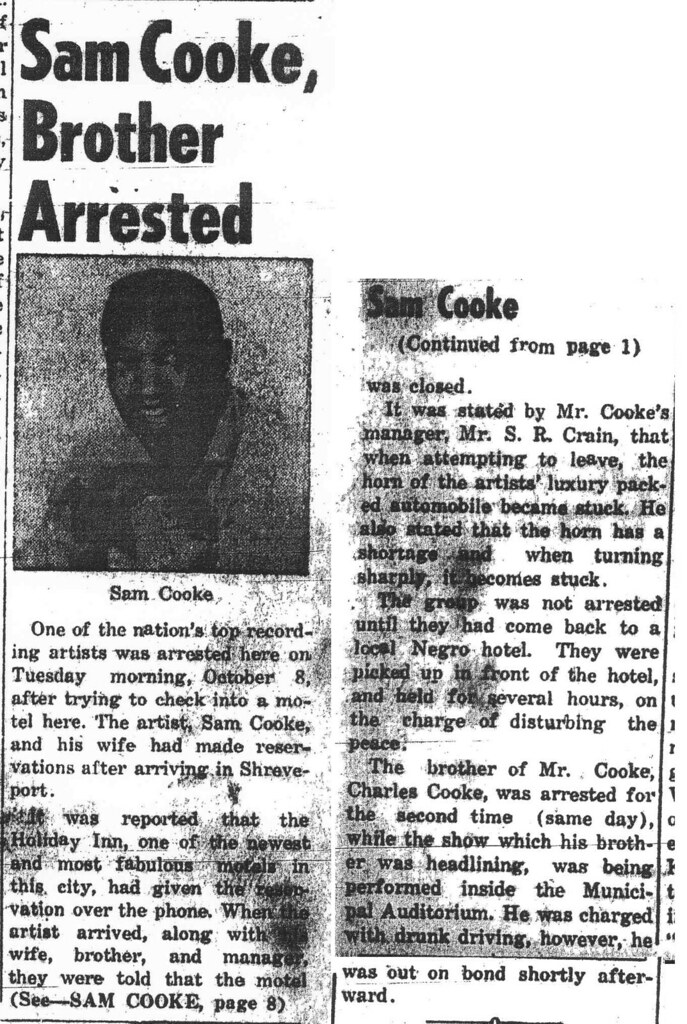
The b-side to a latter-day single in his career, Cooke was moved to write and record it, late 1963 into 1964, after an incident where he had been turned away from a whites only motel in Shreveport, Louisiana. A Holiday Inn. Despite being, arguably, a previously light-weight lyricist, perfect for the pop-soul that endeared him to a largely white audience, he had also been stung by Bob Dylan's emergence, social conscience a'blazing, so he seized the moment. ("Blowin' in the Wind" was a staple in Cooke's live set.) His producers, inevitably warned against the risks of alienating his fans, hence it's appearance on the flip of "Shake." No, me neither. Both "Shake" and the album both the songs appeared on, "Ain't That Good News", actually his last, sold modestly by Cooke's standards. But that has been dwarfed by the legacy and life of the song, voted number 12 in Rolling Stone's 500 Greatest Songs of All Time, as well as being selected for posterity within the Library of Congress, as being "culturally, historically or aesthetically important." All three, say I. But I am ahead of myself. Cooke actually only once played the song live, on TV, the Johnny Carson Tonight show. (I couldn't find any recording thereof to link, sadly.) It was then a full 10 months before the single was ready for release, which eventually took place, over a year after recording, in late December 1964. That release date was already planned, when Cooke was shot dead at another motel, this time in Los Angeles. Colour code uncertain.
There are myriad covers. Although maybe more the metier of the estimable Cover Me Songs, here are my favourite five.
For me, the song that makes The Band's 1973 album, "Moondog Matinee," an essential, the combination of Richard Manuel's keening vocal and the arrangement transformed from the orchestral splendour of the original to simple affecting sublimity.
Another radical revision of the arrangement, Herbie Hancock playing his jazz piano around, behind, on top of a conventional soul vocal version, englishman, James Morrison, the two morphing together just right. But only just.
An astonishing and the possibly OTT extravaganza that was Baby Huey. Just euphoric. Makes me, a middle aged white man, channel James Brown. Convincingly. (Maybe.)
Uncertain still whether this works, cello and the never-less-soul man Ben Sollee. On balance, it does.
Finally, an instrumental mix of all the styles shown above. And more. Bill Frisell, an alchemist of electric guitar, able to run with any genre and leave it resolutely unclassifiable beyond exquisite.
What a song, what a tune. Let it give confidence for the changes that will come. After all, it is all in the ear of the beholder.
Anyhow, don't get upset about the what if of politics, go here, cheer yourself up with some Sam.
Things are going to change on January 20. In the abstract, as an American citizen, I’m pleased that our country has a long tradition of peaceful transfers of power between incoming and outgoing presidential administration. But in the real world, I really wish that there was some way to prevent the president elect from taking office. As I wrote elsewhere a few days after Election Day:
It made me wonder how this great country could elect someone whose apparent view of appropriate behavior is the exact opposite of how I was raised and how I raised my children. I know that he is a liar, a bully, a sexual predator and a man who had no compunctions mocking a person with a disability, the parents of an American serviceman who died in action, and women who fail to meet his personal standards of beauty, but whether or not the candidate himself is actually a racist, homophobic, antisemitic, misogynistic, white supremacist, that’s the rhetoric that he used to fire up his supporters.
So, yeah, I’m not a fan.
I mean, whether or not the latest Russia blackmail material story is true or not, what amazes me is thatit actually seems plausible that someone who bragged about grabbing women's genitals without consent or joked (?) about dating his own daughter would hire Russian hookers to provide a golden shower. Plus, we know how much he loves gold.
It is hard to tell what the lyrics are to The Fleshtones’ “The World Has Changed,” because singer Peter Zaremba has a bit of a mushmouth, and they don’t seem to be available anywhere on the Internet, so I can’t really tell whether the whole song works for my premise, but the chorus, “Don’t you understand the world has changed?” is good enough. The Fleshtones, by the way, formed in Queens, NY, my native borough, in the mid-1970s and their brand of fun, sloppy, supercharged garage rock meshed well with the punk and new wave scene in New York during that period. I remember playing them on the radio, and this song comes from their first full album, Roman Gods, on I.R.S. Records. The Fleshtones, despite a fairly strong cult following, never really hit it big, like their label mates The Go-Go’s or R.E.M., but have continued to record and perform to the present (unlike The Go-Go’s or R.E.M.).
Back to politics. In 2008, Barack Obama ran on a platform that emphasized hope and, yes, change. Hope for a better future, and change from the failed presidency of Dubya. And while President Obama’s eight years weren’t perfect, they were pretty damned good. He brought a thoughtfulness and decency to the office, gave African Americans and other minority group members hope that they could aspire to the Presidency (and by implication, to anything), and extended health care to millions. He helped bring the country out of the massive recession and financial crisis that confronted him when he took office, gave the order to kill Bin Laden, and was a shining example of how to be a husband and father. Among many other things.
Two nights ago, he gave a stirring, inspirational and personal farewell speech that, fittingly, returned to the themes of hope and change that were crucial to his election. Because he, and his speechwriters, are better writers than me, let me quote a bit from that speech, on the issue of change:
This is where I learned that change only happens when ordinary people get involved and they get engaged, and they come together to demand it.
After eight years as your President, I still believe that. And it's not just my belief. It's the beating heart of our American idea — our bold experiment in self-government. It's the conviction that we are all created equal, endowed by our Creator with certain unalienable rights, among them life, liberty, and the pursuit of happiness. It's the insistence that these rights, while self-evident, have never been self-executing; that We, the People, through the instrument of our democracy, can form a more perfect union.
What a radical idea. A great gift that our Founders gave to us: The freedom to chase our individual dreams through our sweat and toil and imagination, and the imperative to strive together, as well, to achieve a common good, a greater good.
For 240 years, our nation's call to citizenship has given work and purpose to each new generation. It's what led patriots to choose republic over tyranny, pioneers to trek west, slaves to brave that makeshift railroad to freedom. It's what pulled immigrants and refugees across oceans and the Rio Grande. (Applause.) It's what pushed women to reach for the ballot. It's what powered workers to organize. It's why GIs gave their lives at Omaha Beach and Iwo Jima, Iraq and Afghanistan. And why men and women from Selma to Stonewall were prepared to give theirs, as well. (Applause.)
So that's what we mean when we say America is exceptional — not that our nation has been flawless from the start, but that we have shown the capacity to change and make life better for those who follow. Yes, our progress has been uneven. The work of democracy has always been hard. It's always been contentious. Sometimes it's been bloody. For every two steps forward, it often feels we take one step back. But the long sweep of America has been defined by forward motion, a constant widening of our founding creed to embrace all and not just some.
The President used the word “change” 19 times in his address, which I don't think is a coincidence. If you want to read a really good speech, check it out here (you can watch it, too).
We don’t know exactly how things are going to change starting on the 20th, but there are bad indications, in what the new guy is saying (or what may be in his heart), what he is doing, and what his nominated appointees have said and are saying. Let’s hope that this is one of President Obama’s “one step[s] back” after his two strides forward. Because otherwise, we’ve got a problem.
Star Maker Machine does not accept music submissions from artists or promoters. However, most of the contributors here do accept submissions for our own blogs, listed below. Please visit our blogs, take the time to listen to what we post, and then feel free to contact us if you feel that your music would be a good fit.