












Showing posts with label Jimmy Page. Show all posts

Friday, December 16, 2022

Celebrate: Celebration Day

Led Zeppelin: Celebration Day
[purchase

One of the joys of having written for Star Maker Machine since 2011 is that one week I can write about Lene Lovich, a quirky singer with niche recognition, and the next week I can discuss Led Zeppelin, one of the most successful, well-known and mighty rock bands of all time. (In fact, my first ever piece, a holiday post about The Roches’ version of “Deck The Halls,” was published as a guest post by former moderator Darius almost exactly 11 years ago, using my former pseudonym). 

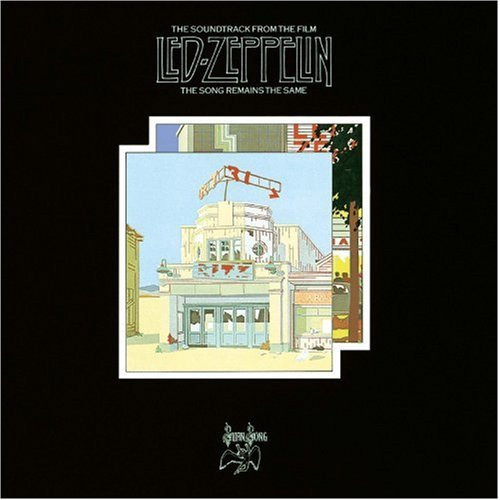
In 2014, I wrote a piece for a Thanksgiving-related “Pilgrims and Immigrants” theme about Led Zep’s “Immigrant Song,” and mentioned how seeing the oft-maligned (including by members of the band) movie, The Song Remains The Same, turned me from a Zeppelin skeptic to a fan, based mostly on the power of the live performances in the movie (which, I know, weren’t their best work. Still.....) And one of the songs that caused this change was the live version of “Celebration Day,” which was from the band’s 1973 shows at Madison Square Garden. It was on the soundtrack album, but not in the movie, but I saw the movie once and played the soundtrack many, many times. Certainly now, it’s all kind of mushed together in my mind. That’s why I’ve linked to the soundtrack album, and not Led Zeppelin III, where the song originally appeared. 

Another thing to celebrate about writing for SMM is how much I’ve learned about music because I (usually) do research on the music and bands that I write about. Not research like I did for my college thesis or for a legal brief, but I do read stuff. And one of the things that I learned about “Celebration Day,” is that Robert Plant’s lyrics were inspired by his first impressions of New York City. Which immediately makes the song better, in my mind. Just a brief aside—I worked in New York City for most of my career, and my last office was near Rockefeller Center, so that at this time of year, I usually walked by the big tree, dodging annoying tourists. And after doing that for years, you can get jaded. But for the last almost 10 years, I’ve been working in Westchester County, only occasionally going into the city for work, and I kind of miss it. The other night, I went to a holiday party for my old firm, in Rockefeller Center, and walked by the big tree again, dodging happy tourists, and it was fun. It is a beautiful tree, and everyone seemed so excited to see it and be near it and take pictures of it. And I did, too. 


OK, back to “Celebration Day.” Not knowing that the song was about New York, the part that jumped out at me is when Plant sings, 

My, my, my, I'm so happy 
I'm gonna join the band 
We gonna dance and sing in celebration 
We are in the promised land 

I took that to mean that the song was about Plant’s joy in being in the band (but not the Band of Joy), and maybe that’s part of it. 

Then there’s the music. The great producer Rick Rubin said that the song “feels like a freight train, even though it’s not one of their heavier songs.” Not surprisingly, Rubin is right. Jimmy Page’s guitar is incredible, John Paul Jones’ bass is amazing, and John Bonham was his usual brilliant on the drums. 

So, most rock lovers know that Led Zeppelin basically disbanded after the Bonham’s death in 1980. Although there were occasional reunions of the survivors after that, the last one was in 2007, at a concert celebrating the late Ahmet Ertegun, who was the head of Atlantic Records, Led Zep’s label (and my ultimate boss for the summer that I worked at Atlantic). That performance, which featured Jason Bonham on drums, was filmed and recorded, and both the movie and soundtrack album were released (but not until 2012) with the title Celebration Day, although our featured song doesn’t actually appear.

Thursday, October 15, 2020

Guitar Heroes: Scrap Metal

Gretchen Menn: Scrap Metal
[purchase

The guitar, of course, is the signature instrument of rock music, and it should also come as no surprise that over the years, I’ve written about, or at least mentioned, most of my favorite guitarists on this blog and elsewhere. Never Eddie Van Halen, whose untimely loss inspired this theme, but he’s a guitarist whose talent I appreciated, but I never was a big fan of the music he created (and it was nice to see that most serious obituaries of EVH mentioned one of my true favorites, Allan Holdsworth, as a primary influence on him. Which sounds weird--as if I was happy that EVH died. I’m not.) 

So, rather than tread down another well-worn path, I decided to write about a great guitarist, about whom I know very little—Gretchen Menn. I first learned about Menn when my wife showed me something in a Smith College publication about her. Menn, a proud member of the class of ’97 (my wife is ’82; my daughter is ’15), was a music major at Smith, and it led me to check out her music. And it turns out that, in pretty much every way, Menn is a real badass.

According to her website bio, Menn, whose father was the editor in chief of Guitar Player magazine, studied classical guitar before moving on to rock and jazz. At Smith, she “convinced a professor to allow her to launch a special studies project on the music of Frank Zappa. Her analyses of “The Sheik Yerbouti Tango” and “The Girl in the Magnesium Dress” showed an interest in genre-bending composition that would manifest later in her original instrumentals.” 

After college, she went to flight school, flying regional jets before turning to a music career, playing in a few different projects before releasing her debut album, Hale Souls, from which our featured song, “Scrap Metal” comes. It’s a classic guitar shredding showcase, and as a shredder, Menn takes a backseat to no one. But she is much more than just a technical wizard. Again, quoting from her website, “[s]he has studied, in equal parts, the music of Mozart, Beethoven, Steve Morse, Frank Zappa, and Jimmy Page.” 

Speaking of Jimmy Page, Menn is the guitarist, playing Page’s parts, in Zepparella, an all-female Led Zeppelin tribute band. You can see her here channeling Page, bowed guitar and all:

In 2016, Menn released her second solo album, Abandon All Hope, a musical adaptation of Dante’s Inferno. Not surprisingly, it is a little more complex and varied in tone than her debut, and includes strings and other instruments (and a chorus), all orchestrated by Menn. Here’s the first track, “Shadows.”

Wednesday, July 6, 2016

The Number 4: Four Sticks


Led Zeppelin: Four Sticks
[purchase]

I never knew why “Four Sticks” had that title, and until I decided to write this, I never cared enough to try to find out. I’ve mentioned in the past that I’m not a stickler for good lyrics, which is not to say that I don’t appreciate them, but that I’m generally more concerned with the feel of a whole song. So what “Four Sticks” meant, or what the lyrics to the song are (which don’t mention any number of sticks at all) wasn’t all that important. But when I decided to write about this song, it seemed like a good idea to find out, if possible, why the title was chosen.

And it turns out to be pretty simple—drummer John Bohnam used four sticks when he played the song, believing that he needed the extra wood to get the volume he wanted. No mystical or mythical back story, just the pure need for power.

“Four Sticks” appears on one of the legendary rock albums of all time, the theme-appropriate fourth Led Zeppelin album, which is technically untitled, but usually referred to as Led Zeppelin IV (or the fourth album, or Runes, or Four Symbols). Each member of the band adopted a symbol (Sandy Denny, who sang on one song, got her own symbol), in an attempt to deflect attention from the band and the members personally and put the focus on the music, as a reaction to criticism that their popularity was all based on hype. As it turned out, pretty much every song on the album entered and has remained part of the classic-rock canon, most notably “Stairway to Heaven,” in my teenage years considered to be the greatest rock song of all time (before the predictable backlash, including from Robert Plant). The album sold many millions of copies, and is regularly cited as one of the best rock albums ever.

“Four Sticks,” though, is generally considered to be the worst song on the album. The band seemed to agree with this assessment—they apparently played it only once live, although it has been occasionally trotted out by Page and Plant, and re-recorded with Indian and Middle Eastern arrangements. It is also the only song from IV not on the band’s 1990 box set. It is a complicated song, in odd time signatures, with uninteresting lyrics. The original’s power, though, is undeniable, thanks in no small part to the four sticks used by Bonham.

Remarkably, more than a quarter century after their official breakup following Bonham’s death, Led Zeppelin has been in the news, with the jury verdict absolving them of plagiarizing from the song “Taurus,” by Spirit in creating “Stairway to Heaven.” That Led Zep was accused of plagiarism is not surprising—they have been accused of it numerous times, and have altered songwriting credits to reflect this. But this time, I just don’t hear it.

Monday, August 12, 2013

UNUSUAL COLLABORATIONS: ROBERT PLANT AND ALISON KRAUSS


Robert Plant and Alison Krauss: "Please Read the Letter"
[Purchase]

For my money, when it comes to unusual collaborations, it doesn't get a whole lot more unusual -- or, at the very least, "unexpected" -- than Robert Plant and Alison Krauss. Yes, true enough that Plant has done some fairly eclectic stuff throughout the course of his post-Zeppelin career, but few could have foreseen his joining forces with the queen of modern bluegrass, Alison Krauss.

Ultimately, it's T-Bone Burnett who oversaw the making of their 2007 album, Raising Sand, but Plant and Krauss first joined up for a duet on a Leadbelly song in 2004 when Leadbelly was inducted into the Rock and Roll Hall of Fame. When that went well, the two of them began discussing an album, and it was Krauss who brought in Burnett, having worked with him on his soundtrack for O Brother, Where Art Thou?

With the help of Burnett's expert production, Raising Sand works beautifully. Plant and Krauss come from different worlds, but clearly have much in common when it comes to music sensibilities. Their voices, Plant's now mellowed with age and Krauss's already angelic voice now truly a thing of wonder, complement each other perfectly throughout the album. And among all the excellent songs on the album, "Please Read the Letter" is the one on which they (arguably) work together best of all. Interestingly, as the album is full of covers, it's also the only song that either of them had a hand in writing -- composed by Plant and Jimmy Page, it originally appeared on that duo's 1998 album, Walking into Clarksdale. But it might as well have been written with Krauss in mind, as this version easily surpasses the original.

There was talk of a second album from these two, but apparently that is on hold after a false start in the studio a couple of years back. Whether that ever sees its way through to completion is an unknown, but until then there is always Raising Sand.

Wednesday, May 2, 2012

Unusual Instruments: Nobody’s Fault But Mine

Jimmy Page and Robert Plant with Hossam Ramzy‘s Egyptian Ensemble: Nobody’s Fault But Mine

[purchase]

Abigail Washburn: Nobody’s Fault But Mine

[purchase]

Here are two very different versions of the same song, each of which qualifies in a different way for our Unusual Instruments theme. Nobody’s Fault But Mine is a gospel blues song that can be traced back to at least 1924, when Blind Willie Johnson recorded it. The song has been done in may ways by many artists over the years. Johnson recorded it with acoustic guitar and growly blues vocals, the Staple Singers did a pop-gospel version, and there have R&B and folk versions as well, just to name a few.

One of the best known versions of Nobody’s Fault But Mine was done by Led Zeppelin in 1976. Robert Plant removed some of the more overtly religious lyrics, and replaced them with verses based on blues lyrical motifs. The whole thing was given one of Led Zeppelin’s trademark thunderous rock treatments. Personally, I never liked Plant’s screaming vocals with the group, or Jimmy Page’s screaming guitar either. But I have come to admire the artistry of how Led Zeppelin put their songs together, while still not caring for the results. Zep always had one secret weapon in their music, that helped make them sound like no one else. Early in their existence, they found a link between the modality of the blues and the music of the Arab World, and many of their songs were built on that link. So it was that, years after the dissolution of Led Zeppelin, Robert Plant and Jimmy Page got back together to record the album No Quarter. Here, Plant and Page made explicit the connection that had been such an important influence. No Quarter was recorded with a group of Egyptian musicians led by Hossam Ramzy. Some of the instruments they play on the album include doholla, duf, bendir, and reque. The picture above is a doholla. Hossam Ramzy is well versed in the Bedouin music of Egypt, and he is known for collaborations with Egyptian artists like Rachid Taha, but also with Western artists, including not only Plant and Page but also Peter Gabriel.

The banjo is the unusual instrument in my second version of Nobody’s Fault. Of course, a banjo is not that unusual, but it is in this context. Going back to the earliest music that might be considered blues, you find that the old-time black string bands often included a banjo. So there may well have been a version of Nobody’s Fault But Mine that included one, but I guarantee that it didn’t sound like Abigail Washburn’s version. Washburn began her musical career while she was living in China, and she even wrote bluegrass songs with words in Chinese, some of which she has recorded. So it makes sense that Washburn would cross musical as well as political boundaries. Her singing of Nobody’s Fault is somewhere between the song’s origins in blues and as a spiritual, but the banjo is not a guitar. So Washburn creates a percussive backdrop that works as a heartbeat, while also providing harmony for her vocal. The result is not exactly blues or gospel or bluegrass, but something entirely new.

Friday, December 2, 2011

Leftovers (Reproductions): Kashmir


Jimmy Page and Robert Plant: Kashmir

[purchase]

For our Reproductions theme, the idea was to post remakes of songs that rendered the original in a bigger arrangement. How can you do that with Kashmir? It’s a fair question, because the Led Zeppelin original already has a huge sound. Not only that, but the original Kashmir was an epic, clocking at 8:28, and going through some remarkable changes.

Led Zeppelin used to talk about how their sound was influenced by the music of the Arab world, and that was never clearer than in Kashmir. Still, 20 years later, Robert Plant and Jimmy Page reunited to create an album that revisited 13 of their songs from Led Zeppelin days, and made the Arab musical connection explicit. Here, Plant and Page are fronting a nine piece rock band, with instruments including mandolin and hurdy-gurdy. Add to that the string section from the London Metropolitan Orchestra. But the kicker is an ensemble of Egyptian musicians led by the great Hossam Ramzy. The album, No Quarter, is a record of a concert, and Kashmir was the grand finale. Now the song clocks at 12:23, and the extra time includes Egyptian percussion breaks. Amazingly, the sound is even bigger than the original version, and the song is even more of an epic than before. And yet, it doesn’t feel overdone at all. By this time, Robert Plant could no longer hit the highest notes that he was once famous for, but his voice still had all of the power he needed to pull this off.