












Showing posts with label Nina Simone. Show all posts

Friday, October 6, 2017

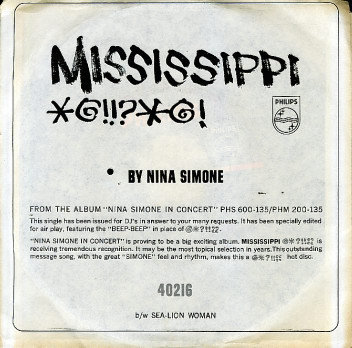
True Stories: Mississippi Goddam


Nina Simone: Mississippi Goddam
[purchase]

When I decided to write about this song, I had no idea that a couple of days later, Nina Simone would be nominated for the Rock and Roll Hall of Fame. Simone is one of those prodigiously talented artists who is widely influential, but has, I think, sort of fallen out of the conversation because of the course of her career, and her long illness and death back in 2003. I’ll admit that I was one of those who had heard her name, was familiar with a few songs, but really knew very little about her until I watched the 2015 documentary about her, What Happened, Miss Simone?

What happened was a sad combination of being an outspoken, black civil rights activist a few years before it wasn’t a career killer, mental illness, spousal abuse and poor advice, which resulted in Simone leaving the public eye for years, just when her music and message would probably have been successful. And it is likely that “Mississippi Goddam” was the turning point in her career, for better and for worse. I recommend reading her bio somewhere, or seeing the movie (or one of the other movies about her that are out there).

The song was written by Simone, reportedly in an hour, as a reaction to both the killing of Medgar Evers in Jackson, Mississippi and the bombing of the 16th Street Baptist Church, in Birmingham, Alabama, about three months apart in 1963.

Evers, a World War II veteran, became a leading civil rights activist, ultimately becoming the NAACP field secretary for Mississippi, where he led efforts to desegregate schools, beaches, parks, buses and the state fair, while also leading voter registration drives. He became a particular target of the White Citizen’s Council, and Evers survived two assassination attempts in May and June 1963 before being gunned down in his driveway. He was taken to a white hospital, where he became the first African American patient admitted to an all-white hospital in Mississippi, but he died within an hour of admission.

Byron De La Beckwith, a member of the White Citizen’s Council, and later on, the KKK, was arrested and charged with the murder, but all-white juries would not convict the piece of crap. It was not until 1994 that he was convicted and imprisoned, and he died behind bars in 2001, at the age of 80.

Evers has become a member of the pantheon of civil rights martyrs, and in addition to Simone, songwriters such as Bob Dylan, and Phil Ochs have written songs about him (one of which, I featured in the second piece I ever wrote for this blog). He has a college named after him, statues of him have been erected, and stories, books and films have chronicled his life and death.

A few months after Evers’ shooting, some KKK cowards dynamited a black church in Birmingham, killing four girls, Addie Mae Collins (age 14), Carol Denise McNair (age 11) (a friend of Condolezza Rice), Carole Robertson (age 14), and Cynthia Wesley (age 14) and injuring 20 more. The death of these four young girls has been credited with opening the eyes of many to the need for change. That being said, although the FBI had identified suspects, J. Edgar Hoover blocked any prosecutions at that time. Three of the four murderers were convicted much later, one in 1977, one in 2001 and one in 2002. The fourth escaped prosecution by dying in 1994. Not surprisingly, this incident has been memorialized in song, writing, sculpture and film.

Simone’s song was first released in a live version, recorded at Carnegie Hall in 1964. While the music is jaunty, its lyrics are not, and the performance includes a few pointed asides from Simone. Although the song became an anthem for the civil rights movement, Simone believed that it damaged her career, and that the music industry turned against her. It isn’t one of those songs that singers trot out anymore when they want to hearken back to the civil rights era, maybe because it isn’t a great sing along, and that’s too bad.

I heard “Missisippi Goddam” on the radio the other day in the car, and I was struck by how Simone married what sounds like happy music with such angry lyrics. It wasn’t the impetus for this theme, but when I realized that it fit, I had to write about it.

Friday, July 28, 2017

Two Words: Four Women

Nina Simone: Four Women

[purchase]

Lisa Simone, Dianne Reeves, Angelique Kidjo, Lizz Wright: Four Women

[Not available for purchase]

Dee Dee Bridgewater: Four Women

[purchase]

Was Nina Simone the Toni Morrison of jazz? The case can be made with songs like this one. Both women used their art to present unflinching pictures of the black experience, black women especially. Four Women is exactly what the title suggests, a song that presents brief portraits of four women and the experiences that shaped them. Each woman gets one verse to tell her story. Simone’s genius here lay in the fact that that one brief verse was enough to tell us what she wanted us to know. This song is not easy to listen to, its lyrics harsh. Simone wanted us to understand our privilege in not having to live these lives. I would imagine that black women hearing this could listen to these words and rejoice in how far they have come, or reflect on how far they still have to go. I have not lived their lives, so I can not truly say. The rest of us can try to understand that Simone is not exaggerating here. We can allow her words to appeal to our better natures, and try to find out what we can do to help. We can begin by not practicing the types of exploitation described here.

There can be no doubt that this song, from 1966, continues to resonate today. It is a staple of many tributes to Nina Simone, such as the one the quartet version I have featured here comes from. There would possibly be more covers of the song now if the major labels were willing to release such material. Dee Dee Bridgewater’s beautiful take on the song comes from an album released on an independent label. That album chronicles Bridgewater’s quest to connect to her African origins by making music with Malian musicians.

Tuesday, April 21, 2015

LIGHT: There's a light, a certain kind of light.......


Yes, you got it, "that always shines on me", fab 60s BeeGee perennial, that struck me as a better response to Andy's excellent Bruce piece below, which had automatically said Richard and Linda to me, before remembering that leads to darkness, and it is light we are celebrating. (Richard and Linda? Thompson? Must I talk you through everything? From "Shut out the light" it is one short step to"Shoot Out the Lights", oui?)

So we are talking about this, from, unbelievably, 1967, the 2nd single from their debut LP. Written by Barry and Robin Gibb, it peaked at 17 in the US and 41 in the UK. And it is undoubtedly a cracking song, but the arrangement? Well, let's say it was 48 years ago...........

So here's a whizz-band hurtle through some other versions that may, or not, have passed you by.


 First off, the Flying Burrito Brothers. Not on either of the first couple of studio LPs produced by the initial Gram Parsons fronted version of this possiblystillgoing (somewhere) band, this appeared on a compilation to commemorate their first break-up and the first few line-ups. I bought this as an incredulous teenager in the early 70s, shocked by the sheer country-ness of it. Lured in by the Byrds, they had seemed the logical next step, but it took me a while to rationalise that against my standard rock fare of the day. It was this song, however, that sealed it, the aching plaintiveness of the vocal stripping the sinew from my unsullied heart, in preparation for the adult world of let down and regret. As well as underlining what a piece of songcraft was the original.


Next, it's Nina Simone, and I confess I was a whole lot older before I could handle her spiky charm. I guess this arrangement hasn't dated that well, but that isn't the point, as she imbues the song with her smoky jaunt, suggesting a devil may care acceptance that doesn't, even for a moment, convince. (I would love to hear this cover covered by Me'Shell Ndegeocello, but it sadly wasn't on her Nina tribute of a few years back, not that I will let such a situation prevent me from promoting it!)


Finally a reggae-lite version by one-time Bronski Beat-er and Communard, Jimmy Somerville. In truth it is a slight interpretation, shown really to display his unusual and exquisite vocal range. And I like the video. And, if I'm not mistaken, it is Sarah-Jane Morris singing alongside him, whose lower register perfectly complements, if somewhat counter-intuitively.

So no room, I am afraid, for the version by Michael Bolton or Micky Bubbles. (In my book there is never any room for Micky Bubbles.........) Hope you enjoyed. And, Me'shell, if you are reading(!), how about a volume 2?

Find 'em all:
Bee Gees
Nina
Burritos
and Jimmy

(Oh, OK and Me'shell)

Thursday, June 9, 2011

1967: In the Dark


Nina Simone: In the Dark

[purchase]

So far, our survey of 1967 has focused on male rock and pop singers. I’m using the terms “rock” and “pop” as broadly as possible, and we could stay in that vein and still present an amazing week, because there is plenty of material. Partly, that’s because the music business was very different in those days. Where a major artist now might make an album every three years, in 1967 The Beatles made two classic albums, and that put them behind the pace. Nina Simone made three albums that year, and that was the norm.

In presenting Nina Simone, one might think that I am turning my attention to the year in jazz. That was indeed what I originally had in mind, and Simone is rightly considered one of the greats of jazz. But Simone’s second album of 1967 caught my eye. It’s called Nina Simone Sings the Blues. One of the amazing things about Simone was her ability to sing masterfully in so many different styles, and here she showed herself to be a fine blues singer. To me, In the Dark is much more a blues song than jazz, and Simone approaches it that way. The darkness in this song focuses senses other than sight, particularly hearing and touch. Simone took that idea, and created one of the most sensual pieces of music I have ever heard.

Friday, May 20, 2011

Show Tunes: Pirate Jenny


Nina Simone: Pirate Jenny

[purchase]

Most of the songs this week have come from Broadway, and, in a sense, Pirate Jenny is no exception. The song comes from The Three Penny Opera, which debuted in the original German in Berlin in 1928. However, the lyrics heard here are the English translation that was done for the first Broadway production of the show. In the show, Polly Peachum is a maid in an inn by the harbor in London, and she takes abuse regularly from the patrons. Pirate Jenny is Polly’s fantasy of revenge for this abuse. Some productions of The Three Penny Opera have given the song to a different character, the prostitute Jenny, but this is not what Bertolt Brecht and Kurt Weill, who wrote the original book and music, intended. Nina Simone’s performance clearly belongs to Polly. Simone gives the song a spare arrangement, and she speaks rather than sings many of the lyrics. This gives her performance a raw power which suits the song perfectly.

Incidentally, there is a recording of this song by Steeleye Span, with the title The Black Freighter. Ironically, there is no black freighter in the German. The corresponding lyric in the original describes a ship “with eight sails”. However, since that doesn’t scan properly in English, it was replaced by “the black freighter.”.

Wednesday, July 16, 2008

Heaven Week: Nearer to Heaven


Nina Simone: Nearer to Heaven

[purchase]

I have 73 songs by Nina Simone in my iTunes library. Some I know better than others; sometimes, when I press play on Nina, the songs—all great—start to blend together if I'm not paying attention. In a way, that's okay. Because every time one of her songs comes up on shuffle, isolated from the rest of its album, it's like I'm hearing genius all over again. Like a little aural truffle. That was the case for this song. I didn't jump up and say "Nearer to Heaven!" when I found out this week's theme. Searching my library, this song fit the theme. So I honed in on this one for the first time just a few days ago and, unsurprisingly, it's genius.

Sunday, June 29, 2008

Fifty States: Mississippi


Ted Hawkins: Missin' Mississippi

[purchase]

I will not spend time repeating myself, because I have just written a long piece about Ted Hawkins over at my own music blog. If you are not familiar with Hawkins, you really should be, and seriously won't regret looking further into his music - there are a couple more tunes to get you started in my Ted Hawkins post. Hawkins was raised in Biloxi, Mississippi (in fact, he also has a great song called 'Biloxi') but, after wandering the United States as a young man, eventually became a Venice Beach, California mainstay, busking on the boardwalk there 8-10 hours per day. The raw emotion in his beautifully natural and unpolished voice blows me away every time. Feels like coming home!

Bonus tracks:

Nina Simone: Mississippi Goddam [purchase]

Jimmie Rodgers: Miss the Mississippi [purchase]

Sammy Walker: And the Mississippi Delta Cried
[no purchase link available]

Thursday, June 12, 2008

Advice: House of the Rising Sun


The Animals: House of the Rising Sun [purchase]

Probably the best known version of this classic song...although the earliest known recording dates from 1933.
N.B. Essentially not available, seeing as the CD it is from is selling here, used, for £294.36 (close to $600)!

Nina Simone: House of the Rising Sun [purchase]


Variously a song about a life gone to ruin through gambling or prostitution, this is one that has been covered by all and sundry.

"There is a house in New Orleans
They call the Rising Sun
And it's been the ruin of many a poor boy
And God I know I'm one...

Oh mother tell your children
Not to do what I have done
Spend your lives in sin and misery
In the House of the Rising Sun."

Read more about House of the Rising Sun over at Wikipedia...there's a surprising amount to learn!

Thursday, May 22, 2008

Little Black Book: Suzanne


Leonard Cohen: Suzanne

[purchase]

We speak so easily of lyrics, but music and interpretation are a big part of meaning.

For example, take Suzanne, a sad tale of a second-person hero who falls in with a half-crazy temptress with a perfect body, and - as far as I can tell; Leonard Cohen's lyrical style is often oblique - catches her madness like a virus in the process. In the original version of this 1967 song, Cohen's molasses-slow delivery and lugubrious vowels flavor the lyrics with an aching tone of regret for such recklessness, and its inevitable conclusion. As the first track on Leonard Cohen's first major release, the song would come to set the tone for the incredible career that followed.

But as the history of Hallelujah amply demonstrates, the possibilities for tonal interpretation that Cohen's openly vague poetics provide are vast. Some subsequent covers of Suzanne -- and there are many -- seem to have interpreted the dream-like second verse, with its directly biblical narrative of a pitiable and lonely Jesus, as a prompt towards a more mystical approach, as if we should celebrate the way our almost-narrator openly embraces madness as a kind of visionary model for behavior. Others seem to emphasize the woman, as if the cost did not truly matter, as if to say that love is a madness well worth embracing. Here's a couple of samples, just to prove how much tonal shift can matter to meaning:

Nina Simone: Suzanne [purchase]

Peter Gabriel: Suzanne [purchase]

Neil Diamond: Suzanne [purchase]