OK, so a bit of international licence here, an entente cordiale to fit the subject, which, like a kinky boot, it does, très snug. I love a bit of foreign, do I, so it was with some disappointment and frustration I have felt it wise to cancel a forthcoming jaunt to Paris. Little to bear, in comparison to our friends in Ukraine, but Putin can go sit on one. OK, as he could before, but this biscuit has been well and truly taken, the birds of his political interferences in US and UK governments now arguably coming home to roost, as "we" struggle to work out what is and isn't justified in return. Bad and sad days.
Endeavouring to remain upbeat, let's pursue the arena of pop in translation. Yé-yé, as our french cousins say. One rule, mind, that being an avoidance of where an anglophone artist simply translates their song into french, and copycats it, so none of this, no Bowie or Blondie. (Strangely, this is a trick the Beatles never pulled off, even if tried a bit of Deutsch.)
Africain à Paris/Tiken Jah Fakoly
The above is an extraordinary piece of translation, changing both the words and the locations, succeeding in an impressive alchemy. And, musically, is it any less wrong to suggest the Parisian music scene is to Africans that New York might be to an Englishman? The number of artists from that continent in the French capital, making there their music, is immense, belying a concept that Paris could well be the home of African culture.
Hey Joe/Johnny Hallyday
I'm uncertain if the translated lyric has actually, name apart, anything to do with the original, but, it being my favourite song, possessing dozens of versions of it, yes, of course, this I already have and was so already well familiar with. Fond of, less. Having said that, it was a song he never stopped playing, with this considerably later version even quite edgy, in a poundshop Keith Richards way.
L'Amour C'Est Comme Une Cigarette/Sylvie Vartan
Well, if we are going weird, we have to go here. Ms. Easton's paean to the early morning commute seems clearly a whole different concept through a French lens, this song stealing only the tune, as it, well, as you do, compares love to a cigarette. A Gauloise, I assume. I will avoid smutty allusions around sucking on it and watching it turning slowly to ash.
D'En Haut de la Tour de Guet/Francis Cabrel
Another of my favourite songs in coverland, the translation itself a labour of love. Indeed, so wordy is most of his work that you forgive all the continentals who sang on, regardless, in English, rather than wrestle long and hard, as clearly had the performer here. It comes from an entire album's worth of similar fare, and I tip my chapeau his way.
Hôtel de Californie/The Cat Empire
Is this cheating? I suspect it is, but it is such a delightfully gallic take on the song to ignore the fact it was cobbled together in Australia by Melbourne ska-punkers The Cat Empire. And what better place to end this reverie.
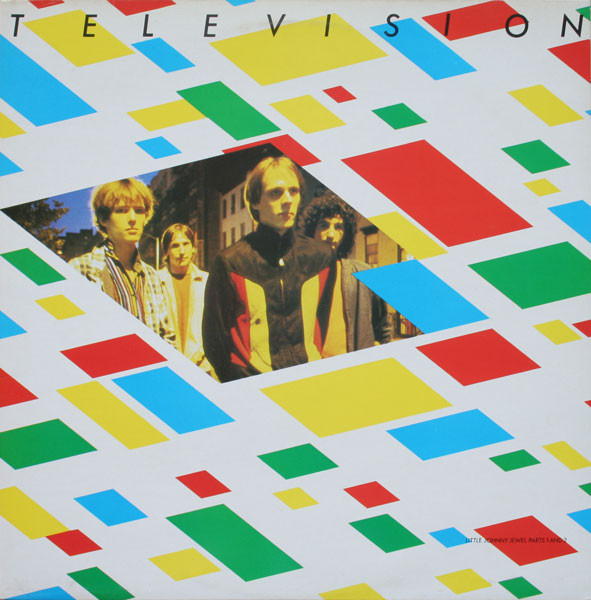
I scanned my list of potential subjects for this theme (read my last post if you don’t know what I’m talking about) and decided again to write about a band that I hadn’t discussed before—Television. I’ve written about small-t television many, many times, here and elsewhere (not going to link, since there are too many), because watching TV is probably how I spend more of my leisure time than anything else, but I’ve never written about the band. While Todd Rundgren’s failure to ever be discussed in this space was very surprising, it is almost as surprising that Television has only been discussed twice—back in 2008 and 2009—and both times about the same song, “Marquee Moon.” Which happens to be an excellent song, but we’re going back to Television’s first release, “Little Johnny Jewel,” a single on their manager’s label, released in 1975.
Although Television came up out of the same C.B.G.B. scene as the Ramones, Blondie, Patti Smith, Talking Heads, Richard Hell and the Voidoids and the Heartbreakers, among others, who I often played on the radio back in the 1979-1982 period when I was doing college radio, I had trouble connecting with the band then. As someone who grew up on classic rock and prog, I (eventually) came to understand the hard, fast ethos of punk that those other bands followed (although for some, that changed over time) as a rejection of the older forms of rock. While I still loved what I grew up on, I also learned to love punk (and new wave). But Television’s meandering jams and guitar solos and stream of consciousness lyrics, sung by Tom Verlaine in a yelping voice that, to my ears at least, made David Byrne sound great in comparison, somehow didn’t fit in to the slots that I had in my head at the time. I couldn’t understand how they were in the same category as the Ramones, whose simple two-minute songs done at breakneck speed were nothing like the long songs that Television produced.
Because of their timing, and their identification with the downtown NYC music scene, and because of the rough sound of their music, Television is usually lumped in with the punks, but interestingly, I’ve seen them referred to as both proto-punk and post-punk, which seems impossible without some sort of time machine. And yet, it makes sense, when you look closely. Television presaged punk both temporally and in their attitude, but their sound was not “punk” in the way that word is commonly used, so like “post-punk” bands, they embraced the brashness of punk, but not all of the sound.
In my old(er) age, I’ve come to appreciate Television more and more. Maybe it is my more mature approach to music that is less interested in putting artists and their music in genre slots, so that I enjoy the connections that artists that seem very different actually have. I know, for example, that the first time that I heard “Impossible Germany,” by Wilco, one of my favorites, I was struck by how the intertwined guitar parts played by Nels Cline and Jeff Tweedy reminded me of Television’s Verlaine and Richard Lloyd.
As mentioned above. “Little Johnny Jewel” was the first song released by Television, its 7 plus minutes split into two parts on a 45, and it’s an odd one. Opening with a bass line (from Fred Smith, who had replaced Richard Hell), before Billy Ficca’s drums and the guitars enter, the instrumental eventually resolves into a groove before the vocals begin. The song may be about Iggy Pop, whose real name was James Newell Osterberg, Jr., but his middle name is sometimes listed as “Jewel.” There’s a long instrumental guitar section featuring Verlaine soloing in the middle that sounds closer to psychedelia or even jazz than punk before the groove returns, along with the lyrics:
Oh, Little Johnny Jewel He's so cool
But if you see him looking lost
You ain't gotta come on so boss
Verlaine recalled in an interview: “Lou Reed asked me, ‘Why’d you put out this song? This is not a hit.’ I said, ‘What band playing a bar in New York, issuing their own single, is gonna have a hit?’” However, the single sold surprisingly well, and arguably kickstarted the New York punk movement.
Let's not forget the full glory of the title, not least as it is the how and why they happened to be together that underlines this piece. Hearing a snatch on the radio, I rather guess most civilians assume this to be the Human League, so similar it is to the template already riding high the charts. Indeed, wise to that, the record company contrived to include the song on 1988's Greatest Hits collection of that band. But it wasn't, it arising purely from the serendipity of movie producer Steve Barron rejecting Giorgio Moroder's original choice of singer for a tune he had been hired to write.
Electric Dreams was a film made by Barron, earlier better known as the director of innumerable music videos, such as Take On Me/Aha and Money For Nothing/Dire Straits. In truth, that is as much as you need to know about the film, it being somewhat lightweight tosh, with a soundtrack album, Electric Dreams, featuring many of the great and the good of the day. As I look back at this, Jeff Lynne jostling with Culture Club, plus a couple of Moroder instrumentals, it is remarkable how little else has stuck. It is, really, only the Oakey/Moroder collaboration I can recall. Or anyone else recalls. Room for confusion arises in that the duo produced an album called Electric Dreams. The song and several more they cooked hastily together. Again, only the title track has had any real posterity.
Be My Lover Now/Oakey & Moroder
Moroder seems an interesting guy, and certainly lucky to be in the right place at the right time. Whilst his website might describe him as the founder of disco, a claim he seems on shaky ground with, it correctly asserts he was a trailblazer of electronic music, seeing the more popular opportunities in synthesisers , still then more the domain of serious prog-rockers. I had not before appreciated that the song, Son of My Father, taken to the UK chart by band Chicory Tip, was one of his writes. Pretty slim fare, it's true, but it was certainly the first synthesiser led track I can recall on Top of the Pops. As a producer and studio mogul, Moroder pumped out a slew of singles, embracing the twin idioms of disco and electronica. If by attrition alone, some of these had to be hits, with Donna Summer's I Feel Love being his biggest and best known breakthrough. If many of his themes and backing tracks sounded the same, that seemed no bad thing, and he took the launch into film scores. Here, Midnight Express was clearly his high water mark, but the list of his other involvements is immense, from work with David Bowie and Blondie. And Electric Dreams, of course.
The Chase (Midnight Express)/Giorgio Moroder
A couple of decades silence and he was again suddenly the rage, taken up by Daft Punk and celebrated once more, delighting in being able to remind the world of his modest contributions to music.....
Giorgio by Moroder/Daft Punk
Phil, or Phillip, as he now prefers, Oakey, has also made the most of his opportunities. As lead singer for Sheffield electronic noise terrorists, The Human League, beleaguered and embattled by lack of success, he was left high and dry when the musicians in that band left for Heaven 17, alone, with only the name of the band. By some enormous quirk of fate he hired a couple more players, added in two schoolgirls he had seen dancing at a club and they were huge. And rightly so. Dare, courtesy some fabulous songs, strident yet simple synth melodies, Oakey's shaky stentorian voice and the glorious naffness of the girls, leapt into the charts as an album, the singles vying with each other to get higher and higher than the one before. Culminating, inevitably, with the joy of Don't You Want Me, number one forever over the Christmas and New Year of 1981 into 82, buoyed by a never more memorable video. If their pinnacle, it certainly wasn't all they had, that line up managing a decent follow-up ahead of creeping personal differences. Another rebirth, as Jam and Lewis picked up the band and gave them a shake, and provided much of the material, with Human shaking the rafters worldwide. Since then they plod on, Oakey, the girls and whomsoever, surviving on the oldies market and the flurries of hope that each new release provides. I think I would certainly still cross the street to see them live.
Never Let Me Go/The Human League
So, the actual song? Well, as described, Barron suggested Oakey and, seemingly, ten minutes in the studio and it was the first take that was used, achieving a 1984 number 3 hit in the UK, but only featuring in the Billboard Dance Chart, if still a not unhealthy 20. In their (electric) dreams, not.
He was nerdy. He was hot. And he was dead. But in 1978 Buddy Holly was one of the most popular rock and roll artists of the day. Gary Busey earned an Oscar nomination for portraying Buddy Holly in The Buddy Holly Story. Elvis Costello, borrowing Buddy's look, was touring the US of A to promote This Year's Model. And Chrysalis Records picked Blondie's glossy cover of his "I'm Gonna Love You Too" as the first single on what would be the band's breakthrough Platinum album Parallel Lines. (Well, at least the single went Top 10 in Italy).
Buddy's version, credited to Joe B. Mauldin, Niki Sullivan and Norman Petty, was the lead off track on his 1957 sophmore album Buddy Holly.
I also like the Terry Jacks cover, which appeared on his hit 1974 Season in the Sun album and went Top 10 in Canada.
Has it really been two and a half years since we last posted a tune from Yo La Tengo? Then since I seem to be on a track to post originals and covers this week, let's return to the fold with a bang, letting their take on this Blondie classic stand up against the original as a perfect exposition of the difference between the disco-punk new wave at the end of the seventies and the post-punk grunge rock of the early nineties. Because when it gets right down to it, doesn't the original sound just a little more anthemic than you remembered, perhaps only a single step away from both Abba and the Go Gos?
Blondie headlined the first rock and roll concert I went to. It was an all-day bill that also held Duran Duran and Elvis Costello. Not a bad deal for $15 American, no?
I'd like to say that I fell asleep with Debbie dreams, later on that night, but I didn't. I was so tuckered out that I don't remember what my sleepy-time included. Over the next few months, though...
All my lawn-mowing money (hey! I was 13 - I got cash where I could) was sent to the Columbia Record And Tape Club... one of the lps I wore out, over the next couple years, was Eat To The Beat.
I love the placement of this song, on that album - 3rd to last. Lull us listeners into dreamy-land before finishing us off with what - to me, anyway - is a sweet 1-2 lullaby kiss-off to punk rock.
Most folks know where this week's theme title came from. But less seem familiar with Blondie's "other" phone-themed song, an earlier, popular cover of an obscure song by Jack Lee's short-lived US West Coast power pop trio The Nerves, which sped up the song a la punk and gave Blondie their third top 10 song on the UK charts (Trivia note: their first chart-topper, the previous year's Denis, was also a cover). By the time all-American all-girl thrashpunk band L7's even faster cover found it's way to the Jerky Boys Movie soundtrack in 1995, the song was already starting to fade from the national consciousness - tellingly, L7 and The Nerves were both from Los Angeles - and until Cat Power revived the song for a Cingular commercial in 2006, it hadn't really stuck in mine, either.
But despite my affinity for all things sweet, I think sticking with the punk evolution is a better way to appreciate this one, in the end. The opening ring is cute, and the drum-beat rich and just frantic enough in all three versions here today. Blondie's harmonies are sweet, and typical of the sound that brought the American New Wave to the forefront of popular music in my own formative years, and lead singer Debbie Harry has a great tone here. But I mostly like this tune for the room it opens up for the guitars - something you can hear in every incarnation.
I love the bassline in Blondie's "Rapture". Since it is, at least in part, a rap song, I would be surprised had it NOT had a great beat. It was, in fact, one of the first hit songs to contain rap music back in 1981. Maybe having a popular band with a gorgeous lead singer helped rap be more palatable to the mainstream at the time. Whatever the case may be, I think this song is great. When I first heard it I hated it, I thought it was strange, but then again I was young. Now I find it completely unique, fun, and somewhat ahead of its time. Any song that can blend the funky beat, the rap music, the sultry and delicate female vocals and be by a new wave bands gets props in my book.
Evidently, "Detroit 442" is Blondie's tribute to Iggy Pop/ The Stooges. That's what lead singer, Debbie Harry, was quoted as saying in a Mojo Magazine special on New Wave, anyhow... I was just reading the mag this afternoon, but don't remember the exact quote, so... um. Yeah.
Enjoy. -------------
Blondie's second album, Plastic Letters reached #72 on the U.S. charts, #10 in the U.K., and all the way up to #9 in Germany.
Star Maker Machine does not accept music submissions from artists or promoters. However, most of the contributors here do accept submissions for our own blogs, listed below. Please visit our blogs, take the time to listen to what we post, and then feel free to contact us if you feel that your music would be a good fit.