








Showing posts with label patti smith. Show all posts

Monday, January 31, 2022

Boss: Little Johnny Jewel

Television: Little Johnny Jewel
[purchase] 

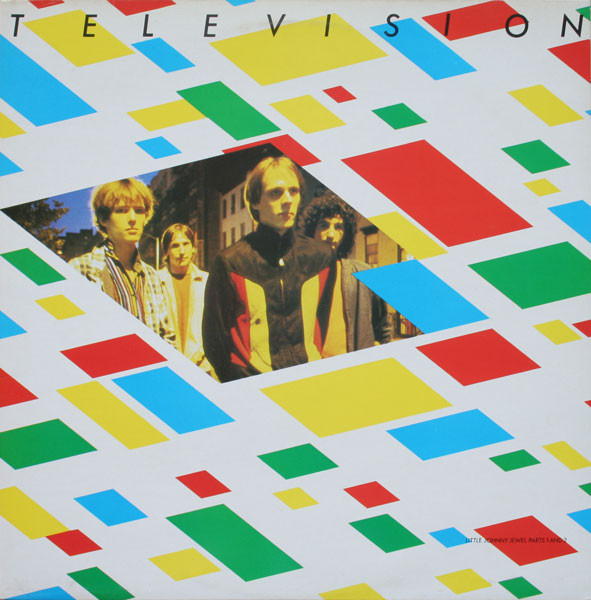
I scanned my list of potential subjects for this theme (read my last post if you don’t know what I’m talking about) and decided again to write about a band that I hadn’t discussed before—Television. I’ve written about small-t television many, many times, here and elsewhere (not going to link, since there are too many), because watching TV is probably how I spend more of my leisure time than anything else, but I’ve never written about the band. While Todd Rundgren’s failure to ever be discussed in this space was very surprising, it is almost as surprising that Television has only been discussed twice—back in 2008 and 2009—and both times about the same song, “Marquee Moon.” Which happens to be an excellent song, but we’re going back to Television’s first release, “Little Johnny Jewel,” a single on their manager’s label, released in 1975. 

Although Television came up out of the same C.B.G.B. scene as the Ramones, Blondie, Patti Smith, Talking Heads, Richard Hell and the Voidoids and the Heartbreakers, among others, who I often played on the radio back in the 1979-1982 period when I was doing college radio, I had trouble connecting with the band then. As someone who grew up on classic rock and prog, I (eventually) came to understand the hard, fast ethos of punk that those other bands followed (although for some, that changed over time) as a rejection of the older forms of rock.  While I still loved what I grew up on, I also learned to love punk (and new wave). But Television’s meandering jams and guitar solos and stream of consciousness lyrics, sung by Tom Verlaine in a yelping voice that, to my ears at least, made David Byrne sound great in comparison, somehow didn’t fit in to the slots that I had in my head at the time. I couldn’t understand how they were in the same category as the Ramones, whose simple two-minute songs done at breakneck speed were nothing like the long songs that Television produced. 

Because of their timing, and their identification with the downtown NYC music scene, and because of the rough sound of their music, Television is usually lumped in with the punks, but interestingly, I’ve seen them referred to as both proto-punk and post-punk, which seems impossible without some sort of time machine. And yet, it makes sense, when you look closely. Television presaged punk both temporally and in their attitude, but their sound was not “punk” in the way that word is commonly used, so like “post-punk” bands, they embraced the brashness of punk, but not all of the sound. 

In my old(er) age, I’ve come to appreciate Television more and more. Maybe it is my more mature approach to music that is less interested in putting artists and their music in genre slots, so that I enjoy the connections that artists that seem very different actually have. I know, for example, that the first time that I heard “Impossible Germany,” by Wilco, one of my favorites, I was struck by how the intertwined guitar parts played by Nels Cline and Jeff Tweedy reminded me of Television’s Verlaine and Richard Lloyd. 

As mentioned above. “Little Johnny Jewel” was the first song released by Television, its 7 plus minutes split into two parts on a 45, and it’s an odd one. Opening with a bass line (from Fred Smith, who had replaced Richard Hell), before Billy Ficca’s drums and the guitars enter, the instrumental eventually resolves into a groove before the vocals begin. The song may be about Iggy Pop, whose real name was James Newell Osterberg, Jr., but his middle name is sometimes listed as “Jewel.” There’s a long instrumental guitar section featuring Verlaine soloing in the middle that sounds closer to psychedelia or even jazz than punk before the groove returns, along with the lyrics: 

Oh, Little Johnny Jewel
He's so cool
But if you see him looking lost
You ain't gotta come on so boss


Verlaine recalled in an interview: “Lou Reed asked me, ‘Why’d you put out this song? This is not a hit.’ I said, ‘What band playing a bar in New York, issuing their own single, is gonna have a hit?’” However, the single sold surprisingly well, and arguably kickstarted the New York punk movement.

Monday, August 30, 2021

Bigger Strings: The Black Angel’s Death Song


Velvet Underground: The Black Angel’s Death Song
[purchase] 

John Cale is another musician whose work I’m aware of and have enjoyed, but never (until now) spent much time learning about his life and career. I knew he plays the viola, among other instruments, that he was one of the founders of the Velvet Underground, put out some solo albums, at least one of which I played back in my WPRB days, and did an album with Brian Eno a couple of decades ago (gasp!). This turns out to be, somewhat embarrassingly, a pretty pathetic summary. So, in brief (and admittedly, mostly gleaned from Wikipedia), Cale was born in Wales in 1942, adopted the viola as his primary instrument and studied music at Goldsmiths College, University of London. Cale once described the viola as the “saddest instrument of all and, no matter how adept you get at it or no matter how fast you play it, you can’t get away from the character of it.” 

Cale quickly became enamored by the more avant-garde and experimental classical music becoming popular in the 1960s, including organizing a Fluxus concert in 1964 and conducting the first U.K. performance of a John Cage piece. He obtained a scholarship to work with Aaron Copland at Tanglewood, but they “fell out,” and Cale then moved to New York where he participated in an 18 hour performance of an Erik Satie composition and joined La Monte Young’s Theater of Eternal Music. 

OK—enough with the classical music (I mean, really, two posts in a row writing about classical music which I know basically nothing about…. I’m really not trying to pull a Metal Machine Music and alienate you all). 

Cale also liked rock music, and joined up with Lou Reed to found what became the Velvet Underground in 1964. Cale’s taste for the experimental, particularly drones, when combined with Reed’s penchant for rock and poetry (and manager Andy Warhol’s Andy Warhol-ness) resulted in early albums that were kind of all over the place. 

One of the more experimental songs from the debut album, Velvet Underground & Nico is the cheerily named, “The Black Angel’s Death Song,” which, for the most part, features Cale’s droning and dissonant electric viola with Reed and Sterling Morrison each playing away on guitar, while Reed chant/sings wordy lyrics in a style that had to be influenced by Dylan. There’s also what sounds like feedback, but was actually Cale hissing into the mike. I know that description doesn’t make it sound all that appetizing, and the song got the band fired from their residency at Manhattan’s Café Bizarre. But while it isn’t something that I’d listen to regularly, there’s something intriguing about it that made me glad that I checked it out again for this piece. 

So, what’s the song about? It is hard to say. Reed himself has said that “The idea here was to string words together for the sheer fun of their sound, not any particular meaning.” But the imagery is so strong, I find that hard to believe. I’ve seen claims on the Internet that the song is about life’s choices, heroin, suicide, the Holocaust, and Communism. Check it out, and let me know what you think. 

Eventually, Reed and Cale fell out over the direction of the Velvets, and Cale was replaced by Doug Yule (I guess you had to have four letters in your name). Cale went on to a career as a producer (for, among others, the Stooges, Jennifer Warnes, Patti Smith, The Modern Lovers, Squeeze, and Alejandro Escovedo), collaborator (including with Reed on Songs for Drella in 1990), and solo and soundtrack artist.

Thursday, August 13, 2020

Great: The Great

[stream on Hulu] 

I watch a lot of TV in general, but the end of almost all outside the home entertainment and, until recently, televised sports, has meant that I have watched even more. One of my favorite shows from the last few months was The Great, on Hulu, which describes itself as “a satirical, comedic drama - based on the occasional historical fact - about the rise of Catherine the Great from outsider to the longest reigning female ruler in Russia's history.” It is completely over the top, barely historically accurate, bawdy, violent, silly, and exciting. Basically, it was a lot of fun, with some great performances (and some of the most amusing color blind casting that I’ve seen). And yes, they address the whole “sex with a horse” thing. (“Fake news,” apparently.) It has been nominated only for best directing and best writing in a comedy series Emmys, which is not nearly enough. 

There are ten episodes in the series, and at the end of each episode, the credits roll over a modern song, and the choices by music supervisor, Maggie Phillips, who had a similar role with The Handmaid’s Tale, are generally inspired. Warning, spoilers follow! 

Episode one, where we first learn of Catherine’s goal to wrest control of the country from her feckless husband, ended with Patti Smith’s strangely faithful cover of Tears for Fears’ “Everybody Wants To Rule The World.” In episode 2, she begins to gather allies, and the credits play over Primal Scream’s “Movin’ On Up.” Cat Power, who titled an album The Greatest, contributed “Free,” for episode 3, although that song is from a different album. In episode 4, Catherine and her officially appointed lover enjoy each other’s’ company, so what better song could play during the credits than Buzzcocks’ great pop/punk song “Orgasm Addict?” And in episode 5, Czar Peter has been poisoned, but Catherine realizes that she’s not ready to take over, so Courtney Barnett’s rocking "Nobody Really Cares If You Don't Go To The Party,” with the lyric "you say you'll sleep when you're dead, I'm scared I'll die in my sleep" highlights Catherine’s ambivalence. 

The second half of the season begins with episode 6, where Catherine attempts to interest Peter in science, to less than positive results. Under the credits, we hear Thomas Dolby’s signature song, “She Blinded Me With Science.” As Catherine seems defeated in episode 7, Phillips chose Sharon van Etten’s lugubrious cover of “(What's So Funny 'Bout) Peace, Love, And Understanding,” featuring Josh Homme (and if you want more, and I think better, covers, check out this post). But as the treasonous planning picks up in episode 8, the credits play over female hard rock pioneer Suzi Quatro’s “The Wild One.” And as Catherine’s plot seems likely to succeed, the credit music is Cass Elliot’s appropriately hopeful “New World Coming.” 

The final episode ends with a cliffhanger, after a pregnant Catherine sacrifices her lover to save her coup. But is he dead, and does she succeed? (We do know the real answer to the second question.) And in a twist, the season ends with a haunting new cover of Leonard Cohen’s “Bird on a Wire,” by Simone Istwa. It is the only one of the credit songs that appears on the show’s soundtrack album, which otherwise features selections of the show’s original music composed by Nathan Barr. Including a song called “Tainting the Borscht.” 

I could have linked to the videos of all of the songs, but instead, just go here, and you can read more about the music, and play all of the songs. And you can look forward to season 2. 

Huzzah!

Monday, May 5, 2014

Radio: Midnight Radio


Dar Williams: "Midnight Radio"
[purchase]

As a middle-school youngster, I used to listen to Harry Chapin’s Greatest Stories Live like an addict—sometimes multiple times per day. The second track, “W.O.L.D.,” was never my favorite on the album, but that didn’t stop me from memorizing every word of it by heart. Regardless, fellow poster Retropath has already contributed more commentary about the song that I would have, so I’ll move on to another radio tribute.

“Midnight Radio” is a song from the rock musical Hedwig and the Angry Inch, written by Stephen Trask. The version above was first covered by pop-folk artist Dar Williams a decade after Hedwig’s premiere as the penultimate track on her 2008 album Promised Land. It’s a moving song of reminiscence for those who have sentimental emotional memories of feeling connected with the world in a new way because of the radio (which, it would seem, applies to most people who read and write about music).


The lyrics illustrate the narrator becoming a star vicariously through the strong female voices on the radio: “Here’s to Patti / and Tina / and Yoko / Aretha / and Nona / and Nico / and me.”

Saturday, October 1, 2011

Neil Young covers: Helpless


Patti Smith: Helpless

[purchase]
doa: Helpless

[purchase]
Cowboy Junkies: Helpless

[purchase]

I'm squeaking under the time-wire this time…I started out this posting week in the ER (I'm okay now) and my mom is also gracing another hospital with her presence (she's doing as well as an 86-year-old can). So I think the title of my post says it all when it comes to serious health issues: they can leave us feeling helpless.

Recently, Patti Smith has been broadening her punk roots: This song's downright ballad-y. It's from her 2007 album Twelve, a great selection of a dozen cover tunes.

The second version is from a 2004 EP Deadstock, which also includes pretty faithful cover versions of CSN-and-sometimes-Y tunes Ohio, Woodstock, and Find the Cost of Freedom. Will you hate me when I mention that doa are Japanese?

Finally, I've included my favorite version featuring a live Margo Timmons' soulful croon.

Aaaaand...looks like I made this week's deadline!

Monday, July 19, 2010

Parentheses: Land: Horses/ Land Of A Thousand Dances/ La Mer (De)


Patti Smith: Land: Horses/ Land Of A Thousand Dances/ La Mer (De)

Purchase:

Patti Smith was a writer before she was a musician, having published two books of poetry and having written for a couple of music critic magazines before ever standing on the stage at CBGB. She has said that she was inspired equally by Rimbaud and Ginsberg as she was by The Rolling Stones and Dylan. I think these odd cross currents of influence are no where more clear than on Land: Horses, the sprawling, nervous, beat-punk climax of her debut album, Horses. The story that the song tells is disturbing, to say the very least, and the music further sets the listener on edge. The unnatural juxtaposition of Smith's story of a teenage physical assault with the lyrics to Chris Kenner's Land of 1,000 Dances only adds to the disconcerting feeling.

After numerous internet searches I still can't say with any authority what the parenthetical "(De)" at the end of the title refers to. It might be a reference to Debussy, who wrote an orchestral composition called La Mer, but that's just one person's idea.

But a great song is a great song and a parenthesis is a parenthesis.