Showing posts with label cat stevens. Show all posts

Friday, August 9, 2019

Cutlery that cuts: The First Cut is the deepest


purchase [ P.P. Arnold's The First Cut]


Well ... actually, no intent on the part of the moderator to incite or encourage violence. On the other hand, in my note to SMM bloggers, I pointed out that most of the initial round of posts were focused on spoons - as opposed to the alternative forks and knives. (Neglected to mention sporks!) So ... either forks (possibly as ... in the road ... ) or, of course, cutlery of the cutting kind.

There are a couple of note-worthy versions of <The First Cut is the Deepest>, but the first that caught my attention was from Cat Stevens. Actually, it was Tea for the Tillerman that turned me on to Cat Stevens (later Yusuf Islam) and it was only after the hits from Tea for the Tillerman that I went backwards and forwards to catch some of his other work - including, belatedly, The First Cut.
Although his version pre-dates most of the equally well-known renditions by Rod Stewart and Sheryl Crowe, it isn't particularly well-known that the first released version is from P.P. Arnold (released just before Stevens' own version).


Looking at the Cat Stevens official version, I find myself considering the roads he has been down. I trust he still likes dogs.

The song carries a poignant story line: you never forget your first love-loss. Probably true, and even shrinks of today with all their research and methods can't say for sure if it's true or not, right?
Not much here in the way of blood and gore of the type perpetrated by knives and similar blades. Sorry. 

In the end, the most famous version of the song appears to be the Rod Stewart version, included on his 1976 "Definitive Rod Stewart" and later releases.


Sunday, December 2, 2018

LEFTOVERS: LEAVES: TEA


Let's get this straight, tea is so not my cup of tea. I can't stand the stuff, being an avowedly (instant) coffee man. Yet it is an enduring image in the world of popular song, often used to evoke a peculiar englishness that has, bar the drinking of it, gone. But it gives me the opportunity for a list post, which, in the leftovers pile, will at least avoid any flak for using up "all the ideas" Thus, in time honoured, please warm your pots.......


Cup of Tea/Shack. Lovely peaceful vibes, with a hint of ye olde psychedelia which belies its youth, the song being barely a decade old. Given that it stems from the never more aptly named Head brothers, arguments might exist as to whether this song is about assam or darjeeling. Or indeed anything more exotic, but it has a timeless, restful quality I can drown in.


Penny Royal Tea/Kristin Hersh. I know, I know, it's a Kurt song, but I prefer this version to the original, excepting the Unplugged performance. I wondered quite what Penny Royal tea was, thinking it may even be a brand of teabags available in Walmart or some such, then that the song may have been a play of words, bemoaning the pitiful returns on his song publication rights: royal tea/royalty, right? As ever, wiki is my friend, and it is apparently an often unsuccessful chinese abortifacient...


Tea and Sympathy/Janis Ian. Beautiful string arrangement with typically understated Ian vocals, a wry reflection on loss. And at last a song about tea tea. I would politely endure a cup of tea under the circumstances described, and traditionally have about one cup a year, usually with aged relatives. And similar references, no doubt.


Tea For One/Led Zeppelin. Not an entirely dissimilar concept as above, portrayed and presented a little differently, it's true. Percy missing his missus, tea for one being the metaphor for alone. Whilst I can't imagine vintage Zeppelin drinking anything but (vintage) champagne, OK, maybe brown ale for Bonzo, strangely the idea of the current Plant drinking a mug of tea, probably in a Wolverhampton Wanderers mug, seems entirely apposite.


Tea Leaf Prophecy/Herbie Hancock featuring Joni Mitchell. Her song, mind, but this version has always appealed more, the original still displaying residual vestiges of a folk tendency within this, as we later learnt, decidedly jazz singer. It is also good to have a salient reminder of the erstwhile bonus in every olden days cuppa, that of having your fortune made available courtesy the leaves left in the base of the cup. Try doing that with a teabag, Mr Lipton!


Tea Stain/Tindersticks. Cripes, I love(d) this band. As an instrumental this isn't perhaps the most representative of their output, but does give the european arthouse soundtrack quality they inhabit so well. It's a pity as I can picture their lugubrious singer, Stuart Staples, finding it only too easy to imagine him with old tea stains down the front of a crumpled white shirt. (You wanna hear him sing? Sadly I can find no further tea references, Will coffee do?)


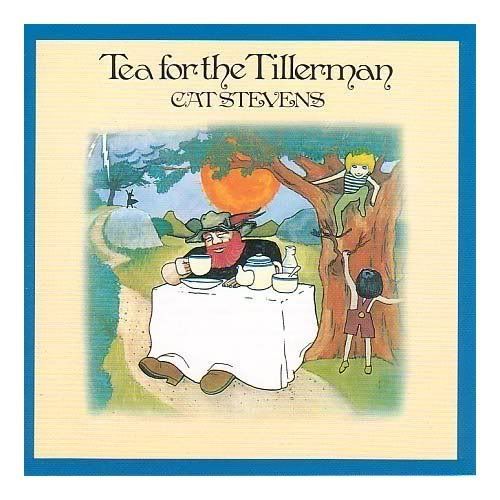
Tea For The Tillerman/Cat Stevens. Bit of vintage Cat when he was still Cat, rather than Yusuf realising he didn't sell so well without a bracketed reminder. This album and the follow up, Teaser and the Firecat, soundtracked my miserable teens, the angst and ennui of his vocals hitting a chord with lonely adolescents everywhere. There seem to be a lot of websites arguing the meaning of the phrase, but I think the picture says it well enough, whether the jovial beardy is the man who tills the soil or pulls the tiller. Personally I think the 1 minute version on the album is probably better.


Tea Leaves/The Snails. I'll be honest. This isn't the song I wanted to include, hoping that a song of equally little-known band UK The Scaremongers might be available on YouTube. It wasn't, but I encourage you look for the song, part of the Sound of Mature Huddersfield as they style themselves.
This song? It OK.

So, that's yer lot. Eight, as anything more might be seen as hogging it, seeking vaingloriously too wide a demographic where at least one song might appeal. (Memo to self, what do they drink in Tarrytown?) No room even for this......

Explore!


Monday, October 17, 2016

My First Album: Tea For The Tillerman


Cat Stevens: Father And Son
[purchase]

Unlike my predecessors in this theme, I’m pretty confident that Cat Stevens’ Tea For The Tillerman was actually the first album I owned.

I’ve written before about how my interest in rock music started in the summer of 1969, listening to the AM radio on the way to day camp. And the following summer, I remember that the cool, sophisticated counselors (who were probably all of 16 or 17), were listening to Cat Stevens. I became a fan, and I asked someone (parents? grandparents?) for a copy of Tea For The Tillerman, which I received, and listened to repeatedly.

I remained a Cat Stevens fan for years—the first concert I went to without my parents was to see him at Madison Square Garden with my friend Laura in, it appears, 1976. I remember that we sat way up in what were then the “blue seats,” but it was still great (although not everyone agreed).

My wife is also a big fan, but by the time that we got together he had already converted to Islam, changed his name and stopped performing until his return in the mid-2000s. And a few years ago, I wrote a piece about him over at Cover Me.

Tea For The Tillerman is, undeniably, a great album. It was both a critical and commercial success, and pretty much every song is a winner. It was the record that made Stevens a household name around the world.

In some ways the most unusual song on the album is “Father And Son,” originally written for an abandoned musical theater project about the Russian Revolution (which sounds like it could have been Max Bialystock's second idea). It features a dialogue between a father, sung by Stevens in a lower register, and a son, sung in a higher register, in which the son expresses his desire for independence and the father argues in favor of a more traditional future. Despite its initial historical inspiration, the song captured the generational divide of its era in a way that showed both the conflict it caused in families without neglecting the love. By the way, in the Cover Me piece there is a great version of the song by Johnny Cash with Fiona Apple.

Stevens, shortly after the song was released, was quoted as saying that "I’ve never really understood my father, but he always let me do whatever I wanted—he let me go. 'Father And Son' is for those people who can’t break loose."

This was probably not the favorite song on the album of the 9-year old me, but the 55-year old me, who has two adult children, and recently lost a father he was very close to, has found it quite touching and perceptive. It’s probably a sign that it is a good song, when it resonates with you as a child and as an adult, right?

Tuesday, October 7, 2014

MUSICAL CHAMELEONS: CAT STEVENS/YUSUF ISLAM


Well this cat has certainly run a ragged path around his image(s) over the decades, so as good a candidate as any for this thread, even if he is surreptitiously slipping back out of the more severe incarnation of his current given name.

Born Steven Georgiou, of joint Greek Cypriot and Swedish stock, in 1948, one recurring theme throughout his careers has been an apparent sense of dissatisfaction and restlessness, never proving himself comfortable within the confines and constrictions of the music industry, and uncomfortable with the adulation of his fans, with repeated searches for solutions to the mysteries of life. How much of this could be explained by the polar opposites of his Greek orthodox and Baptist parents, who, effectively, split the difference in their ideologies, and sent him to a Catholic school, remains open to conjecture, but it seems he was an aloof and lonely lad, happier in his own company, tinkering with those musical instruments made available to him. Like many later musicians of his generation, Art School became the obvious next step, which clearly was not entirely without merit, as he was responsible for the design of many of his album covers. Originally seeking a musical career under the name Steve Adams, his first success came as a songwriter. If he had stalled there alone, he would probably still be remembered fondly, if only for this song, covered memorably by PP Arnold, Rod Stewart, Sheryl Crow and many more. He sold it to PP for £30, currently about $50.

Performing solo in pubs and clubs, a name change was more seriously applied to, with some insight as to what may help, believing the US marketplace was full of animal lovers. Thus Cat Stevens was born, and he swiftly picked up a recording contract of his own. Furthering the animal metaphor a step ahead, his first UK top 30 hit was with, ironically, "I Love My Dog", and here his first image is outed, the swinging 60s fingerclicking hipster, velvet suit, dark glasses and a hideous over-produced backing. A couple more hits followed, "Matthew and Son", again subsequently much covered, including a reprise in the 2nd stage of his journey, and the now somewhat arch sounding, "I'm Gonna Get Me a Gun", a song I don't suppose still likely to feature in his act.

The contracting of tuberculosis in 1969 ground this early start into the ground, the long hospitalisation instilling in him a hunger for some spiritual fulfillment, as he gave up meat and took up meditation and yoga, growing long both hair and beard. It was a very different Stevens that re-launched in 1970, as a lovelorn folkie troubadour, with Mona Bone Jakon, getting his first US gold record with "Lady D'Arbanville", his appearance now perfect for the 70s singer-songwriter boom. Successive LPs became bigger and bigger, through Tea for the Tillerman, Teaser and the Firecat and Catch Bull at Four, these 3 being my personal favourites in his canon. And, because I can, this was my favourite song, and still is, perhaps revealing quite what a shy and introspective boy I was........

Disillusion was seeping in, and he relocated to Brazil in 1973, in part as a tax exile, developing a more "varied" style, of additional electric instrumentation, with synthesisers and a funkier feel to the fore. It didn't work for me, and he and I parted ways. During this time he began to explore other religions, converting to Islam in 1976 after a(nother) near-death experience. Changing his name again to Yusuf Islam, in 1978 he turned his back on the music industry, in part believing the vanities thereof were contrary to teachings of the Koran, devoting himself to philanthropy and education, opening several Moslem schools in London, and working with a number of equivalent charities. Unwittingly, given his prominence amongst Islamists, hindered by some unhelpful and possibly misquoted commentary on 9/11, he was, in 2004, denied entry to the US and sent back to the UK, arousing a transatlantic political furore between the respective governments. He was later able to return to the States in 2006.

In the latter part of the 90s there was a gradual return to music, albeit originally purely secular and without the adornment of instrumentation, and initially in Arabic. Now I am sure I would be wrong in suggesting that commercialisation had anything to do with it, seeing as his income, in 2007, was estimated at still being $1.5 p.a. from  U.S.royalties alone, but perhaps his fanbase were delighted when he suggested that his wholesale retreat from western music had been hastier than he had wished, and returned to admitting to and acknowledging, and playing songs from, his Cat Stevens years. His new material has not been a vast catalogue, nor, it's true, perhaps received to the level of his glory days, but he remains a world player, playing often for charitable causes close to his heart and faith. As a way of concluding this chameleon's chronicle, here is his version of someone else's song, the lyric presumably ringing true with his post-conversion experiences with the media and more. I am no expert and unqualified to discuss the intricacies and inconsistencies of (any) faith, but I would too chime in with the sentiment. Hell, I think he is just a great singer, who has written a shedload of a lot of good songs. It's good to have him back.

Here is quite a good documentary from a couple of years back.

So what am I going to point you to? Actually you can't goo wrong with any of his Greatest Hits collections, but for overall consistency it is, for me, Tea for the Tillerman and/or Teaser and the Firecat.

Enjoy!!

Monday, February 23, 2009

Shorties: Tea for the Tillerman


Cat Stevens: Tea for the Tillerman

[purchase

Okay... I can just hear all of you now - "this week's theme has the Folkie Woman stumped", you are thinking...

I am here to say that not all folk tunes are droning, whining, navel-gazing, train- or mining-disaster-related... and not everything in the genre clocks in at 4+ minutes long - we do have some short, sweet and simple songs to offer up..

Exhibit A - aaahhh...

Tea for the Tillerman came out in 1970 when I was a sophomore in high school - to say it was captivating is an understatement. Such a pain to have to turn that pesky album over to hear Side 2 - hooray for CDs...

When I met my soon-to-be husband in college, the first thing I thought was that he looked like Cat Stevens - Tillerman was a huge part of our life together then as well...

In fact, the whole family was listening to it on our way to vacation on St. George Island this summer... and I was excitedly describing to our kids its far-reaching impact... such that I missed the turn and we went an hour out of our way - Cat Stevens still has the power...

I don't know what this shortie *means*... other than the piano and the chorus and the switch in tempo make me feel good - happy day!

Bonus song from the same album, also less than 2 minutes...

Cat Stevens: But I Might Die Tonight

Wednesday, January 14, 2009

Soundtrack Songs: If You Want To Sing Out, Sing Out


Cat Stevens: If You Want To Sing Out, Sing Out

[purchase]

Most movie buffs know that the dark, existential cult comedy favorite Harold and Maude, which revolves around a relationship between a suicidal young man and a giddy woman old enough to be his grandmother, was critically ignored when it was first released in 1971, though it would go on to make several of the American Film Institute's top 100 lists in and around the turn of the century. But less people know that, despite the relative popularity of Cat Stevens' other output, the two songs which he composed specifically for the movie did not appear in any audio format until their release on a 1984 compilation.

In fact, though a nominal soundtrack containing a different set of tunes was released in the late nineties, the real Harold and Maude soundtrack, which featured a particular set of relatively delicate Cat Stevens tunes carefully cultivated by Stevens to match the movie in pace and premise, was not released until 2007, and then only in a limited edition of 2500 (though links such as the one above still net you import compilations which serve as functionally complete soundtrack disks, as cobbled from other sources).

But whether you have to do it piecemeal of are willing to pay the big bucks for the collectors editions, these songs are worth having, and hearing, both in and of themselves and as the set that Stevens and film director Hal Ashby intended. In the film, and in sequence, the songs lend a sense of youthful vigor and absurdity to the interplay between the emotionally stunted and severely suicidal Harold and his spry septuagenarian fascination. And just as the extant pieces Stevens borrowed for the soundtrack led full lives of their own before the movie, the two songs he wrote for the film -- If You Want To Sing Out, Sing Out and Don't Be Shy -- stand on their own as well, retaining the poignancy of their setting, though they seem a touch lighter without the sense of irony and context which sprung so effectively from the dissonance between the bounciness of Stevens' echoing voice and acoustic strum style and the death fascination of its subjects.

Tuesday, December 23, 2008

Peace On Earth: Maybe There's a World


Yusuf Islam: Maybe There's A World

[Purchase]

It was unheard of when beloved singer-songwriter Cat Stevens converted to Islam at the height of his fame back in the 1970's. Now, we find it less shocking to see celebrities dabble in other religions, but then it was very odd, and his disappearance from songwriting was even more of a shock. But his conversion gave a famous face to the religion, and now more than ever, it is good to have someone we recognize and respect making music of peace from a culture that is so misunderstood in our part of the world.

In 2006, under his Muslim name Yusuf Islam, Cat Stevens produced his first original album in over twenty years. I wasn't sure what to expect when I first heard a song from the album, but I was pleased to find that it had all the charm of the Cat Stevens records I love so much. He couldn't have chosen a more pertinent and important time to make a comeback and share his message of peace.

Tuesday, June 10, 2008

Advice: Cat Stevens Edition


Cat Stevens: If You Want to Sing Out, Sing Out

[purchase]

In some sense, nearly every song by Cat Stevens feels like advice or a pep talk. His songs are overwhelmingly about searching for your place in the world and are (usually) filled with hope. Here are two of his most literal advice songs. First, the wonderful pep talk that is "If You Want to Sing Out, Sing Out"--one of his most positive, optimistic songs, which is saying a lot--from the classic film Harold and Maude. I'll take the clever suicidal Harold over the clever pregnant Juno any day.

Stevens' songs are all over this film's soundtrack, to the point that they're pretty much a character in and of themselves. It is one of the greatest films, so check it out if you've never seen it. The first time I saw it was actually in high school--literally, in high school. For some reason my junior-year English teacher thought this was an appropriate film to show his students. As far as I was concerned, it was--this had a greater effect on me than Catcher in the Rye ever would. But you can imagine how many kids in the class freaked when Harold and Maude wind up in bed together.

Cat Stevens: Wild World

Next up, the more well-known classic "Wild World." This is really kind of a strange song when you think about it. The narrator has just been dumped; apparently his girlfriend is making her way to the big city. Despite having his heart broken in two, he proceeds to give her advice on what the big bad world is really all about--you could almost read this song as a bitterly sarcastic kiss-off: "You're dumping me? You think you'll find someone better? Okay, sure, go ahead, I hope you make a lot of nice friends out there." Adding to the weirdness of the song is that the verses make plain that this conversation is between two lovers, but the chorus is decidedly old man/young girl. Why the hell does he know so much about the world, yet she's only just setting out to discover for herself?

But this is Cat! I know too well from the rest of his songs that he's not trying to be creepy nor sarcastic. It's just not the kind of nuance that finds its way into his songs. I think he's truly giving his heretofore sheltered ex some heartfelt advice.

Tuesday, April 8, 2008

Days of the Week: Tuesday's Dead


Cat Stevens: Tuesday’s Dead

[purchase]

I was reading another blog the other day in which the writer called Cat Stevens a “guilty pleasure.” Not possible! Cat Stevens is the ultimate antidote to sadness and cynicism (Harry Nilsson, too). Every song he sings seems to greet the world with open arms. “Tuesday’s Dead” isn’t my favorite of his songs, but it’s still great.