Saturday, July 28, 2018

Remedies: Love Potion Number 9

The Clovers: Love Potion Number 9

[purchase]

The Clovers started out before the rock and roll era, and became regulars on the rhythm and blues charts before anyone knew who Elvis Presley was. But they never had a number one song on the r & b charts, and never crossed over. Despite this, they were the original artists on a song that has endured long after most of the songs that charted in 1959 have been forgotten. Of course that song was Love Potion Number 9. Oddly, the song was their last major hit. The group had had lineup changes almost from the beginning, with a single member leaving at a time and being replaced. But right after Love Potion Number 9 charted, the group split in two, with both halves claiming the Clovers name. That would be the end of their popularity.

I can not help wondering what might have happened if they had stayed together. Love Potion Number 9 was the result of a big break for The Clovers. It was their first chance to work with the producing and songwriting team of Jerry Lieber and Mike Stoller. Lieber and Stoller are legends today, and rightly so. In the 1950s, it seemed that everything that bore their names turned to gold. Love Potion Number 9 would not become a major hit until it was covered by The Searchers in 1963, but I have always preferred the Clovers original version. Here, there is a nice New Orleans vibe to the rhythm that would be completely removed in the Searchers’ version.

The Coasters: Love Potion Number 9

[purchase]

The Clovers became the original artists on Love Potion Number 9 almost by accident. Right before Lieber and Stoller were hired for the session, they had been working with the Coasters, in a session that yielded the hits Charlie Brown, Along Came Jones, and Poison Ivy. If things had gone just a little differently, The Coasters might have been the original artists on Love Potion Number 9. They finally did record the song, as heard here, in 1971. This was a completely different take on the song then what they might have done in 1959. Times and musical tastes had changed, and The Coasters were clearly trying to update their sound with this jazzy funk take. The “Serve it up and drink it down” chorus vocal is new, and the Latin feel to the opening is something Santana might have done at the time. Curiously, there is a Santana video on YouTube that is mislabeled as Love Potion Number 9; it is actually a performance of Evil Ways, but the melodies are surprisingly similar.

The Lamours: Love Potion Number 9

[purchase]

I couldn’t resist including this wonderfully sassy version by the Lamours. They are clearly covering the Coasters’ version, retaining the “Serve it up and drink it down” chant and making the Latin vibe even more explicit. Male singers have always changed the year in the lyrics to keep them from being too old. So the original is “I’d been this way since 1956”, but the Coasters sang “1966”. The Lamours, however, are both shamelessly retro and female, so now we hear “I told her that I was a flop with guys/ I’d been this way since 1955”. So they are taking a 1971 version of the song, performing it now, and treating the lyric as though it was 1959 again. It’s a head scratcher for sure, but it sounds great.

Thursday, July 26, 2018

REMEDIES: POCKET FULLA MEDICINE/MADDER ROSE


One might well question quite what medicine the band had in their pockets as you listen to this slow and dreamy waltz. Less the second coming of the Velvet Underground, as the british press cited them, this sounds more like the Shadows spaced out on quaaludes, with a brief hint of klezmer in the side streets. In a good way. I was a fan back in the day, their day, mid 90s, the band bigger in Europe than at home, the breakthrough being their UK Reading festival performance in 1993. (Now ain't that a line-up?!) Hell, you can even hear that performance here.

So who or what were Madder Rose? The brainchild of Billy Cote, songwriter and guitarist, and Mary Lorson, singer and frontperson, they came together in 1991 New York, an archetypal Greenwich Village loft band. Languor was very much a watchword for those days, and, although not perceived as bedfellows then, I can latterly see parallels with Mazzy Star and the Cowboy Junkies, as well as the Dandy Warhols and Low. This track, an instrumental closer, appears on their major label debut, 'Bring It Down', in 1993. Thanks to the support of John Peel, the UK underground through to alternative DJ I reference frequently, they secured that festival slot, selling 10k copies of that record in the UK as that took place.

Those of you, if any, who have access to this debut, may query, the featured song apart, my comparisons, but, as each successive album dropped, so the more energetic indie-isms became ever more reined in, the songs becoming more thoughtfully arranged, latterly adding even some restrained electronica to the mix. 1999's "Hello June Fool" was as far as this iteration got, sadly, the band then breaking up. It was, however, good to see their brand get a hearing on "The Sopranos" in 2007, from the same valedictory album. Remember it?


But the story didn't end there, both Cote and Lorson following through on solo works. I need here to discuss how and why I became drawn in. Cooking Vinyl, their eventual  record label, were a company that gave a good guarantee of quality. In the early 80s through 90s I was a huge fan of their roster, Oyster Band, Michelle Shocked, Jackie Leven, all sorts of left field fare. And they had a club deal: join, some sort of yearly fee, and they discounted hugely their product, provided enough was bought. That was how I caught Madder Rose and, better still, how I caught Mary Lorson's next project, Saint Low. You could argue this whole piece a shallow artifice around the presentation of a single song. To which I would respond: And?

Lorson's first solo album in this name, with some added Cote guitar duties, is the terrific, 2000's eponymous 'St. Low." And this is the closing track. Sure, she has done more since but, in my book, I rest my case. This always makes me feel a whole lot better. Try it. Sometimes I just want to play a song. That's all. Trust me. I am a doctor. If you can't love this, you don't have a heart.


Madder Rose
Saint Low

Wednesday, July 25, 2018

Remedies: Cure For AIDS


Dan Bern: Cure For AIDS [purchase]

A couple of weeks ago, my wife and I went to see Karen Finley’s show, Grabbing Pussy (based on her new book, coincidentally published by a company partially owned by a friend). If you have never seen Karen, one of the most famous performance artists ever, you really should. Her shows, which focus on political and social issues, are always thought provoking. She makes connections and observations that are truly astounding. Watching her shows is like trying to drink from a fire hose--her words and ideas come at you in torrents, you can't take it all in, but what you are able to digest is pretty incredible.

We first met Karen years ago when I coached her daughter Violet, a friend of my daughter’s, in soccer, and became friendly with her and her ex-husband Michael. We’ve seen Karen’s shows where she channeled Liza Minnelli, Jackie O and others, but she is always her provocative self. This show, though, as you can tell from its title, was focused on the current groper-in-chief, and others, such as Harvey Weinstein, who used their power to exploit women. Karen also touched on many other things, including something that has profoundly affected her (as we have seen from her other shows and writings), the many friends that she lost over the years to AIDS.

When my wife and I arrived at the theater (early, of course), we were happy to see that Michael was there, and that Violet (who was a pretty good soccer player, and has created her own controversial art) had flown in from LA). Not surprisingly, many people in the crowd knew Karen, Michael, and Violet, and we were introduced to some of them. Joining us at the table was a gentleman who was introduced to us as Michael, another old friend, and it quickly became clear that he had an electric personality. At one point, Karen came out of the dressing room to say hi, and new Michael mentioned that he had seen an exhibition of works by David Wojnarowicz, an artist and AIDS activist who died of the disease in 1992, who had been a friend of theirs.

Our new friend, it turned out, is named Michael Alago, and he has had a fascinating life, some of which we learned chatting with him before the show, and more of it we learned from watching a documentary about him on Netfilx, with the great title, Who The Fuck Is That Guy? Alago, a gay Puerto Rican from Brooklyn was, and is, a music obsessive, whose vast knowledge of, and boundless enthusiasm for, music got him jobs at The Ritz, eventually booking the shows at that legendary venue, and as an A&R representative for Elektra Records, where he signed Metallica and executive produced Nina Simone's last album, and later at Geffen Records.

Michael (and Karen and Michael) and I are roughly the same age, and yet we lived very different lives. While I was obsessing over music in my suburban bedroom, and at WPRB, Alago was going to Max’s Kansas City, CBGB and other clubs, staying out all night, and hanging out with Bono, Johnny Lydon, Springsteen, the Dead Boys, Metallica, and many, many, many others (which you can see in the film). The three of them were part of a world of music, art, photography, and writing that was sadly filled with many people lost to AIDS, addiction, or both. And it struck me that while these losses devastated people like them, to me it was really more of an abstract concept because none of my friends died from these scourges. So, while I can certainly understand it when Karen discusses the effect of this lost generation of her friends, it can't really affect me the same way. But one of the things that great art can do is to allow you to experience feelings outside your personal existence.

Towards the end of Who The Fuck Is That Guy?, the discussion turns to the fact that Alago was HIV positive, and appeared, a number of times, to be on the edge of death, something that he was open about during our discussions at the theater. Now, because current-day Michael is all over the film, we know that he didn’t die then, and the film doesn’t really explain what happened, except to refer to new drug cocktails and regimens, so it is fair to assume that this is what “cured” him. And today, he appears to be in excellent health, he is clean and sober (although he did eat a bunch of french fries during Karen’s show), and he has left the music business to become a photographer.

Another thing that we all discussed before the show (I did mention that we got there early, right?) was the fact that there doesn’t seem to be the same kind of protest music against the president and his awful policies as there had been against the Vietnam War when we were kids. We had heard the CSN&Y song “Ohio” in the car coming into the city, and that song, about the killing of students at Kent State during an antiwar protest, was all over the radio then, and continues to be part of the classic rock canon. And it isn’t the only song like that. While there are anti-Trump songs, they don’t get played as broadly, which in part is a result of the way that the radio and music business has changed, but it also does seem that there just isn’t as much political music being made these days. Alago mentioned that Ministry recently released AmeriKKKant, which is overtly political, but it is unlikely to break into the mainstream. I brought up Dan Bern, about whom I have often written, who writes political songs (and poetry, and paints political pictures), but again, he doesn’t get all that much airplay. The Drive-By Truckers released a pointedly political album at the end of 2016, which got a reasonable amount of positive press, but was not heard much on mainstream media.

Back in 1998, Bern released an album, Fifty Eggs, produced by Ani DiFranco, which had, as one would expect from Bern, a bunch of topical songs (and one beautiful tribute to his sister). One of them was “Cure For AIDS.” At the time, the AIDS epidemic was still rampant—the number of HIV infections, globally, peaked in about 1997, the number of AIDS deaths globally was still rising, as were the number of people living with HIV. But in the US, AIDS deaths, as a result of new drug regimens, had recently begun to plummet. Bern’s song, though, posits a magic bullet-type cure for the disease, which resulted in a six-month long period of sexual excess, ready access to morning after pills, and the end of homophobia. And, most importantly, “Nobody was afraid.” Of course, none of that has happened, but it is certainly better now, when an HIV diagnosis is no longer a sure death sentence, and AIDS is no longer an easy excuse for hatred.

In March, Bern mangled some of the fingers on his left hand, and had surgery, which led to the removal of part of his middle finger, a partial remedy at best. He is out on tour—I know that at one point he had friends play guitar for him, but I’m not sure if he is able to play guitar now (there is at least one pretty famous guitarist who did pretty well without a middle finger on his right hand, though).

Tuesday, July 24, 2018

Remedies: Medicated Goo


purchase [Medicated Goo]

As Darius noted, music itself is a remedy for what ails you. And Steve Winwood has long been one of my favorites to make me feel better. Not that Traffic's Last Exit album was that good, but it includes Medicated Goo, and that is a fine example of Traffic at its best.

I kind of like the imagery of the touring medicine show that the song evokes, and there have been a number of bands that styled or named themselves accordingly: Dr. Hook & The Medicine Show and Old Crow Medicine Show, as well as songs with lyrics that do the same: "Say, Say, Say" and "Your Song".


The song was co-written by Jimmy Miller, who also made music history with Blind Faith and the Rolling Stones.

It's not a very difficult song to play, so it's no surprise that there are a number of cover versions listed at YouTube:

There's a Dave Mason version but since he was part of Traffic, that may not count as a cover?

Scott Sharrard and the Brickyard Band

The Black Crowes

Dreams


Band of Heathens

Jackie Greene

Sunday, July 22, 2018

Remedies: Rock and Roll Doctor

Little Feat: Rock and Roll Doctor

[purchase]

Different people have different definitions of what constitutes feel good music. Chances are, our new theme will bring out plenty of examples, because music that recommends a remedy should feel good. Certainly, that should be the case when the song itself advises music as the cure for what ails you. So, for me, it only makes sense to lead off with Little Feat in their classic line up. This was a band that took the blues rock that had developed in the 1960s, added at least a hint of New Orleans, especially in the rhythm section, and topped it all off with the tasty slide playing and skewed lyrical sensibility of Lowell George. That is a combination that certainly makes me feel real nice whenever I hear it.

Friday, July 20, 2018

July: Mama Bake a Pie (Daddy Kill a Chicken)

[purchase]


Tom T. Hall has been called the Nashville Storyteller.  To me, he’s the last great storyteller Nashville will probably ever see.  There is a significant difference between a songwriter and a storyteller.  A storyteller, in three to five minutes usually, can make you care deeply about the characters in the song; whereas a songwriter can bring the world in different ways, with the art of wordsmithing.  Tom T. Hall has many song hits to his name, whether recorded by him others, and an each single one, I have cared deeply about those characters.

The first time I heard "Mama Bake a Pie (Daddy Kill a Chicken)" was on an album of oddities and b-sides by The Drive-by Truckers. I even assumed they wrote it. That’s the problem with digital music, there is no glorious artwork to pull out, with wonderful liner notes for one to peruse at their pleasure.  When I first heard it, I knew Patterson Hood was busily beating his anti-war drum because Iraq was going hot and heavy.  Honestly, I didn’t think much of it then, but it steadily grew on me.  When I discovered Hall wrote it, I was instantly over the moon, especially as I listened to the words more and more.

Tom T. Hall wrote it in protest of the Vietnam War. That was his intent and it is clear, as plain as day.  Vietnam has always loomed large in my life.  I don’t know why.  The war ended the year I entered it and none of my immediate family ever served in Vietnam. I think there might be a connection there.  My father served in the Guard and stayed in college, hence he had a deferment.  Maybe there is some lingering residual guilt there, to be honest, however, in that place in time, I might have done the same. Vietnam was weird for our country. First modern loss.  First time seeing body bags on the runway from a war. First time seeing the glaring duplicity of the draft.  First time seeing young men and women being spit on, all for serving their country, so the very people protesting them had the right to protest.  First time a sitting president made sure his family made millions upon millions, by supplying weapons to the very soldiers who were dying by the scores, just to keep that war humming.  The first time an incoming president sabotaged a peace treaty, just so he could get elected.  Out of all this madness and chaos, however, came some the best music this country has ever produced.

I would place the song in either the early days or about halfway through the Vietnam War.  The reason why I’ve assumed the time, is because there is no all out bitterness at those who have served, like in the latter years.  It’s about a good old boy who lost his legs in the war and is traveling home on a plane.  A man asks him if it was worth it and stewardess inquires if he was scared. The soldier responds in the manner that is expected of all who serve, whether if they believe it or not.  The story continues about all his fears and worries awaiting him ahead.  The parents, the former girl, the family and a July fourth parade.  

Tom T. Hall may have been going strictly for antiwar, but I took other things away from the song.  The shock of returning someplace without mortars, automatic fire, mines and grenades.  In WWII they called it shell shock.  In Vietnam it was the thousand yard stare.  Now we simply call it PTSD.  Adjusting to that must be horrendous and have it fall on anybody, especially young, healthy Americans, well that is the biggest heartbreak of all.  Another thing was the young soldier anticipating all the problems at home.  Parents heartbroken, girl no longer his, and just what was he going to do with the rest of his life.  Countless young soldiers deal with this upon coming home.  You would think the land of milk and honey would have a program/programs to help these men and women adjust, instead spending money to send more off to war, wouldn’t you?  I keep returning to that bottle in his lap.  It haunts because I have struggled with my own demons.  Whether it be drink, drugs, or anything else, nothing will stop those demons and nightmares from coming out to play, except maybe love.  

Tuesday, July 17, 2018

July: Riot in Cell Block #9


purchase [The Robins: Riot ... ]

The Robins and Elvis Presley were hot a little before my time. Now, that doesn't mean I couldn't have developed an affinity for their music. I mean, hey, you can believe that Elvis is still alive. So ... certainly, their songs have a life of their own that periodically shows sparks. The Robins? - they were a 50s band that  Jerry Leiber and Mike Stoller poached to put together the Coasters, with whom they had a string of early rock hits.

Leiber/Stoller were pretty successful in the 50s and 60s both as song writers and producers. In addition to writing "Riot" and various other Coasters hits, they penned "Hound Dog" of Presley fame, "Yakety Yak", "Stand By Me", "On Broadway" and a total of about 70 hits that earned them a place in the Rock and Roll Hall of Fame in the 80s.

One of the Leiber/Stoller hits that keeps coming back in various versions is about a jail riot that starts in cell block 4 and continues for almost 2 days until the authorities use gas to subdue the inmates.
It's the 48 hours from July 2,1953 to July 4, 1953.

Take a minute to consider the appeal of a song like "Riot", paying attention to the reputation that rock music had at the time: a bad influence on our youth.

The riot started down in cell block number 4
Spread like wild fire across the prison floor
Scar-face Jones said, "It's too late to quit"
Pass the dynamite 'cause the fuse is lit

Y'all gotta stop that stuff goin' on over there
If ya don't stop that riot, y'all gonna get the chairSI said, "Hey now boys, get ready to run
Here come the warden with an automatic gun"
Is this anything you want your kids listening to?

The version I first heard is the Johnny Winter one.


However, of course, the Blues Brothers. (But they've got the dates wrong!)


And Commander Cody and his Lost Planet Airmen (with Jerry Garcia, who also covered it with his band... um... the Grateful Dead...)


And then the Beach Boys reworked it as Student Demonstration Time


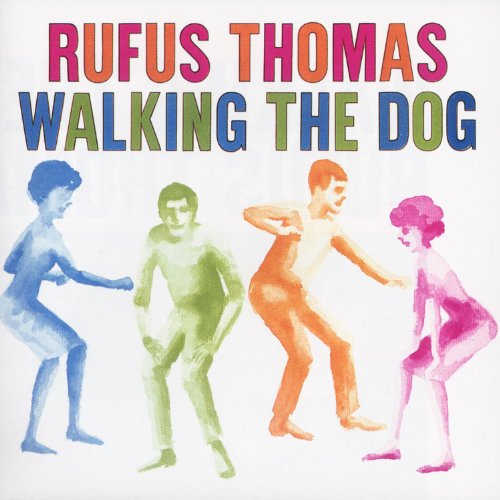
July: Walking The Dog


Rufus Thomas: Walking The Dog
[purchase]

At this point, Rufus Thomas is probably best remembered for this fun, nursery rhyme influenced song, but it was only one of his hits, mostly novelty dance songs, often about dogs or other animals, in a long musical career that started as a child tap dancer on the streets of Memphis in the 1920s, and included stints in minstrel shows in the 1930s, as a vaudeville performer in the 1940s, as a songwriter, performer and DJ in the 1950s, as a popular recording artist in the 1960s, and he continued to perform and record thereafter, often billed as “The World’s Oldest Teenager” and “The Funkiest Man Alive,” until not long before he died in 2001 at the age of 84.

Thomas recorded for Sun and for Stax, the minister at his wedding was Aretha Franklin’s father C.L. Franklin, he worked for 20 years in a textile factory, he acted in Jim Jarmusch and Robert Altman movies, and he performed with Prince, at the 1996 Olympics, and with the Blues Brothers Band. And his daughter Carla Thomas is considered the Queen of Memphis Soul (and who I missed when I wrote this.)

Pretty much everyone has covered “Walking The Dog,” from the Stones, to the Everly Brothers, to the Flamin’ Groovies, as well as Aerosmith, Roger Daltrey, Bruce Springsteen (in an epic 14 minute plus version), Ratt, The Grateful Dead, and John Cale. And many, many more.  Even in Finnish! But Thomas’ version, with its New Orleans influenced style, and the joy that he brings to the silly lyrics, is still remembered because it is just that good.

And yes, it mentions July.

As I was writing this piece, I thought back to walking our family dog, Strummer, who died back in 2014. In July. You can read more about him, and our relationship, here.

Sunday, July 15, 2018

JULY/THE CUCKOO


Sure, you know this, of course you do. You may have sung it as a child; it certainly sounds as if you should have sung it as a child. I didn't but, when I first heard it, I sort of wish I did, or had. I first came across it on the remarkable Kristin Hersh solo album, 'Hips and Makers', in 1994, somewhat of a sidestep from her earlier and later career as, arguably, THE Throwing Muse. (No argument really, but reference is always made, compulsorily, to her half-sibling in the band, Tanya Donnelly.) Tucked in towards the end of a slew of songs of sparse self-immolation comes this cover of an old english folk song, Roud 413 no less. (Me, neither.) It stands out by virtue of its simplicity, perhaps the trigger to her later album, consisting entirely of traditional appalachian ditties, 'Murder, Misery and then Goodnight', also strongly commended. Many of this songs on that set too have a link back to the ballad traditions of Britain.


So what have cuckoos to do with July? Well, everything apparently, or sort of, at least over here. Let me direct you to the lyrics, except, being from the canon of trad.arr., often the lyric varies from version to version, as there is some uncertainty as to whether they "never holler cuckoo till the 4th of July" or whether they "sucketh white flowers to keep her voice clear", the lines apparently interchangeable. This may help. But, as I was saying, it was deemed so essential that a cuckoo's song be heard to beckon in the start of summer that the venerable Times of London traditionally published,  and may well still do, yearly letters around when readers had heard their first of the year. Indeed, a book has put these together. And for those who are thinking the 4th of July late for summer, and I write on the 15th after a full 8 weeks without rain, the suggestion is that the July versions of the song emanate from singers trying to appeal to an american ear.

The list of performers who have included this song in their repertoire is huge, not unexpectedly including the greats of folk song on both sides of the pond, from Jean Ritchie to Shirley Collins, Doc Watson to Martin Simpson, let alone Bob Dylan and Joan Baez. More surprising are versions by rock/blues screamer  Janis Joplin (in Big Brother and the Holding Company) and rapper Buck 65. Here, however are a few more elegant versions, three of my, other than Kristin, favourites.

Archetypal englishman in L.A., Richard Thompson, together with Eliza, daughter of Martin, Carthy and Canadian legend Garth Hudson:


 A radically different version from blues muso-ethnologist Taj Mahal:


And Laura Veirs, with a fairly traditional take:


Hell, I haven't even included Townes, Rory and many, many more. (And some of these, mentioned and/or featured may offer the flower sucking over July. So sue me!) But, before I send you to the record store, all this romanticism should not take away the ugly truth about this bird.

Do you know, if you like the Kristin, buy the whole damn album!

Friday, July 13, 2018

JULY: Fourth Of July


Purchase Shooter Jennings, "Fourth Of July" 

Shooter Jennings, heir apparent to the legit country music crown, is doing his goddamnest to keep the weird in country weird. I'm talking real weird, the opportune word here being weird. Jennings is, of course, the son of country royalty Walon Jennings, and he's done his best to give a one finger salute to the Nashville establishment and make music his own way. And while it might not always be country, it's also rarely anything else you might recognize.  He's done things his own way, and he's shredded out some of the best, and the strangest, country tracks you'll ever actually enjoy.

Shooter's has one boot deep in tradition, as you'll hear on the tag line in this track, featuring a very drunk, but also very royal, George Jones, slurring out "He Stopped Loving Her Today." What else you'll hear, way out in the the other realm, is a bit outta space and outta time. Shooter doesn't really do music you'd feel comfortable labeling. This is evident in almost anything you might randomly pick from his Spotify profile. So yeah, hopefully, at this point, you're digging in. But, go deeper into his albums and you'll see how Jenning's "eff you genius" cuts across genres without approval, permission or apology. Jennings makes music his own way, which is a terrible cliche, but I can't think of a better way to describe how the crown prince has found his own feet in the whirlwind and followed up on what his father, the king, laid out out for him to follow. Case in point: he cut an album with Stephen King, 2010's Black Ribbons, which is one of the most interesting, spaced out, deeply current-events-rooted and sonically wild concept albums I've ever heard. Though, the unique factor is true for pretty much anything Shooter Jennings has recorded. If you haven't done it yet, listen up.
I promise you'll love what you hear.

And even though we're not talking about the track, as this is about "Fourth of July", his kicker "Fuck You, I'm Famous", from the same album is a beautiful antidote to our current near-dystopia scatter shatter, end of the world blues...Happy 4th of July, kids...hope those explosions outside are just kids shooting off fireworks..and not the revolution we really need.


July: Shine On Harvest Moon

Milton Brown: Shine On Harvest Moon

[purchase]

Leon Redbone: Shine On Harvest Moon

[purchase]

Asylum Street Spankers: Shine On Harvest Moon

[purchase]

Coleman Hawkins and Ben Webster: Shine On Harvest Moon

[purchase]

The term “classic” is certainly overused, but I think it’s fair to say that Shine On Harvest Moon has earned it. The song was written and originally recorded in 1908, and countless artists have performed it since. At this point, you could also call it a folk song, and I can live quite comfortably with that as well. The versions I have chosen show only a small part of the range of possibilities for performing the song.

Milton Brown is one of the subjects of a fierce argument in the field of western swing music. Bob Wills is widely known as the father of western swing. In fact, however, Wills, though not heard here, cut his musical teeth in Milton Brown’s band. So adherents feel that the title of creator of western swing should belong to Milton Brown. On the basis of this 1935 performance, I would say that one can hear western swing beginning to take shape, but we are not quite there yet. To be fair, however, I would have to listen to a lot more of both Brown’s and Wills’ music before giving a real opinion. It’s an assignment I would not mind at all, given the time.

I am sure I must have heard other versions of Shine On Harvest Moon, but this one by Leon Redbone was the first to make an impression on me. This is actually one of the best known songs Redbone recorded. He specializes in finding forgotten gems from the American songbook, and giving them the folk orchestra treatment heard here.

I included the Asylum Street Spankers here because, first of all, they do a great job with the song. But this version also restores the original female lead vocal, and the delivery here is close to how the song was originally sung. Also, the Spankers restore the original order of the months. Most performers nowadays sing, “January, February, June and July” But the original lyric is heard here: “April, January, June or July”, with April stretched somehow to three syllables. The Spankers opt for a musical feel that somewhat recalls Redbone’s version, but adds the klezmer feel of the clarinet line and the doubletime verse at the end.

I was done with this post, or thought I was, when I came across my last selection, by Coleman Hawkins and Ben Webster. Here is an instrumental version during a theme dedicated to lyrics. This version is just so sweet I had to include it. This is small combo jazz from 1959, at a time when bebop and cool jazz were all the rage, and free jazz was about to make its appearance. But this performance harkens back to an earlier time. I would put this on a short list of tunes to play for someone who is just hearing jazz for the first time.

Thursday, July 12, 2018

July: Armstrong


Nanci Griffith: Armstrong
[purchase]

It isn’t a particularly profound or original observation to point out that 1969 was a pivotal year. There were Woodstock and Altamont and tons of amazing albums, Nixon’s inauguration, the Stonewall Riots, the Mets won the World Series, the U.S. secretly bombed Cambodia while the antiwar movement gained strength, the Beatles had their picture taken on Abbey Road and performed for the last time, the Manson family went on a murder spree, Sesame Street debuted, and Ted Kennedy pleaded guilty to leaving the scene of an accident. Just for starters.

But if you had to pick the number one event of 1969, you’d probably pick the small step for man, and giant leap for mankind—Neil Armstrong’s first step on the moon, which took place in July, 1969. I was 8 when it happened, and I remember being allowed to stay up late to watch history being made. (Most of the other times I was allowed a late bedtime that year related to the Mets). As a kid in those days, there was little more exciting than watching rockets launch—we’d stare at the TV, waiting for the countdown, and what seemed like the slow climb of the rocket into space.  Which may be why MTV's early branding included videos of rockets and moonwalks. The moon landing was something truly amazing, especially when you consider that the watch I’m wearing now probably has more computing power in it than the entire Apollo 11 mission used.

While watching the landing, John Stewart, formerly of the Kingston Trio, wrote a song, “Armstrong,” which is about how despite all of the problems in the world, and our differences, everyone watched, or heard, about Armstrong’s amazing feat. I can honestly say that I never heard the song, but here it is:


(That’s the single version, which is different from the version released a few years later on Stewart’s album, Cannons In The Rain. I never heard that version either.)

The song has been covered a few times over the years, but the one I did hear was by Nanci Griffith, on her album Clock Without Hands. In fact, the album features three Stewart covers, including “Armstrong,” and Stewart plays acoustic guitar on the track. (Pete and Maura Kennedy, who I saw at Clearwater, contribute mandoguitar and vocals). It is a pleasant folk song, and Nancy Griffith’s distinctive vocal style works well. And the lyrics mention July.

The Dexateens, an underappreciated band from Alabama, released a song called “Neil Armstrong” a few years ago on their excellent album Hardwire Healing, which was produced by the Drive-By Truckers’ Patterson Hood and David Barbe, who was in Sugar and has produced Truckers albums. Matt Patton, the Dexateens' bass player now fills that slot in the Truckers. Unlike the Stewart song, though, the Dexateens seem to be focusing more on how the moon shot, and his celebrity, affected Armstrong. And the lyrics also mention July.

Apparently, there are some people who believe that it was actually Louis Armstrong who was the first man to walk on the moon. He wasn’t, of course (although he sang “Moon River”), but he died in July—on the 6th, in 1971, at his home in Corona, Queens, about a mile from Shea Stadium, where the Mets lost 5-1 to the Expos.

Wednesday, July 11, 2018

JULY: JULY, JULY/The DECEMBERISTS


Can it really only be 16 years since the Decemberists first peered around the corner into existence? Strangely, and I speak as a fan, it seems so much longer. Not, it is true, to the taste of all, the vocals of bandleader Colin Meloy being possibly the main hurdle to mass approval, together with their unworldly appearance,  the senior common room at a Cahoots/The Band theme night, and their downright odd arrangements, a quirky mix of the archaic with the unexpected, conspire to a niche version of world famous. Which is just fine in my book. And 'July, July' is perhaps the standout track on debut LP 'Castaways and Cutouts'.

Colin Meloy reminds me of Richard Thompson in a strange way, a catalyst of tradition and electricity. But maybe not so strangely. (Yes, I am going to talk about Meloy mainly, rather than the band, regardless of how tremendous are his cohorts, instrumentally, and they are, without him as prime singer and songwriter, they are meaningless. His band and he calls the tunes.) Constantly ploughing his own singular furrow, undoubtedly indebted to the british folk revival of the 60s and 70s, yet ears attuned to influences elsewhere. He has produced a series of solo albums, EPs really, devoted to such disparate bedfellows as Shirley Collins, Sam Cooke, Morrissey and the Kinks. But are they so very different? In Meloy's hands, often just his guitar and marmite voice, sometimes with spectral backing vocals, the similarities become immense.


See what I mean? OK, so 'Summertime' is hardly unique to Cooke, but what a version this is, drawing into focus what a great song it is, a steamy Tennessee Williams 3 acts in a few simple verses. And so too the songs of Stephen M. and of Ray Davies, let alone the trad. arr. seamed by Collins. I have to question, mind, quite what Meloy now has to say about the increasingly bizarre rants of the erstwhile Smiths frontman, whose image he has allegedly inked on his skin.

The Decemberists, of course, plough similar, albeit augmented by the trappings of electric rock music, chucking in accordion and stand up bass where necessary, and now, in 2018, the introduction of synthesisers and similar new-fangled. And now, instead of ancient mariners, they sing about village idiots.

Having caught them live in Birmingham (UK!) on their 'King is Dead' tour, I found myself initially uplifted, ahead of finding their cerebrality perhaps fits better with the recorded than the live. And there is then a strange dichotomy between the earnest lyrical scene-setting and Meloy gradually morphing into a demented ringmaster, corralling the crowd into choral participation. (I should add I am the frowning geezer in the crowd who never sings along, when asked to, or claps or waves a lighter. I can't abide all that stuff.) However, when they recently revisited the canon of 60s/70s folk in the guise of 'Offa Rex', their collaboration with folkish gamine, Olivia Chaney, this I wanted to see, so wanted to see. Still do. Interestingly they are keeping mighty quiet as to who the support on their forthcoming UK tour might be, my hope and money on Chaney..........


A final thought, for those who have ploughed through the vids above, and can't quite get it. This helpful instruction manual might help.

Still with me? Probably the best place to buy.

Tuesday, July 10, 2018

July: Mercy on Broadway/Laura Nyro


purchase [ New York Tendaberry]


As Darius notes, there are plenty of great July 4th songs to choose from, but that was never my personal intention in selecting the <July> theme. lyrics.com shows ~ 2000 songs with July in the lyrics (some repetition), so there's a lot to consider. Somewhere in that long list, among others that I would/could write about, I picked out "Mercy on Broadway". A song I wasn't familiar with, but a name that I was.

When I think Laura Nyro, I think "Wedding Bell Blues". On the second round around, I think "Eli's Coming" [Three Dog Night]


and "Stoned Soul Picnic" [The Fifth Dimension]


and "And When I Die" [Blood, Sweat & Tears].


For these, it's someone else's version of her powerful song-writing that comes to mind first. But rather than diminish Nyro's legacy, the fact that these greats chose to cover her work and hit the top of the charts with them only embellish her rightful place.

On the one hand, I want to lament our loss - Nyro died age 49 of ovarian cancer - the same age as her mother of the same. That IS sad. On the other hand, she left behind a style and a musical repertoire that is still strong decades later, a larger legacy than most can aspire to.

Come to "Mercy on Broadway". Yeah, it includes the per-requisite <July> in the lyrics - more than once in fact (unlike some of the other 2000 in the July lyrics list, where the word shows up once), and she uses month names in various other songs as well - in tune with the seasons?

Nyro was a New Yorker, so her reference to Broadway is apropos. Her references to the fare of the side-streets is equally real - she played the streets and subways of the city in the 1960s.
But it's the combination of her vocal shifts and, as Elton John put it, her "rhythmic and melodic changes" that place her apart. It's her cross over between R&B, jazz, blues and pop that made her songs so accessible to all the other bands. Like several other songs she wrote, it builds/morphs from jazzy blues to full out rocking by the end of the song.

For the record, the Christine Spero Group put out an entire album of Nero songs, but it doesn't include "Mercy".

Sunday, July 8, 2018

July: Money For Floods

Joan Baez: Money For Floods

[purchase]

Richard Shindell: Money For Floods

[purchase]

We’re About 9: Money For Floods

[purchase]

“My name is Eliza I live by the river My daughter Louise will be three in July…” A little digging uncovers a large number of songs to choose from for our new theme. However, I love a challenge, so I wanted one that did not reference the fourth of July. Don’t get me wrong, there are some great fourth of July songs that I hope we get to over the next two weeks. But there is also Money For Floods.

It wasn’t a hit, but Joan Baez has recorded the most popular version of the song to date. I often find that people who don’t like Joan Baez object to the sound of her early recordings. These were pure folk, and Baez’ voice at the time was admittedly an acquired taste. She had a high soprano voice that could sound shrill to some, and with only her guitar playing as accompaniment, you could not miss that voice. But two things happened as time went on. First, Baez began to experiment with fuller arrangements of her music. Some of these experiments, to my tastes, served her poorly, but she was certainly one of the most innovative folk artists of her day, and the best of this music still sounds fresh today. Second, Joan Baez was very young when she started, and her voice had changed noticeably by the time her career was ten years in. By the time she recorded Money For Floods, Baez was singing in an alto to low soprano range. This mature voice is capable of emotional depths that Baez could not achieve in the same way in her youth. The early shrillness, which I never minded, is a distant memory on this recording. Money For Floods is a song that gains a great deal by being sung by a woman, and Joan Baez delivers.

Baez has a few songwriting credits sprinkled throughout her career, but she is best known as an interpreter of traditional songs and the work of other writers. Such is the case here. Money For Floods was written by Richard Shindell. Shindell can write and sing a song from a woman’s point of view and make us believe in the song, because he is just that good. His arrangement of the song dictates that the sound begins intimately, and then swells at the first chorus, and the other versions I present here each follow this pattern in their own way. It is a musical metaphor that is fully explained in the lyrics by the end of the song, and it is a brilliant device.

Finally, I have included a version of the song in an a capella arrangement. We’re About 9 finds a way to make this work in a minimal arrangement that derives its power from its sparseness.

I found one more version of Money For Floods that I chose not to include, by Rob Rowe. Rowe has a voice that I find to be overly dramatic for the song, and his band doesn’t find the emotion of the song, to my ear. Also, Rowe changes the lyric so that the point of view is male, and that just doesn’t work for me on this song.

Thursday, July 5, 2018

Burn/Fire: Fire On High


Electric Light Orchestra: Fire On High
[purchase]

Regular readers of my work here and elsewhere know that I’m a fan of prog rock, and I think that it is pretty clear that the Beatles were a profound influence on prog bands, many of whom have acknowledged this directly, or have covered Beatles songs. Electric Light Orchestra,which was founded when Roy Wood, of The Move, wanted to explicitly pick up where the Beatles left off, and use orchestral arrangements and instruments to fuse classical music with pop shows how it is possible to mix the two.

Initially, Wood recruited Jeff Lynne to join The Move, which also included drummer Bev Bevan, and they gradually morphed the older band into a new unit, Electric Light Orchestra. Wood left the band during the recording of their second album, leaving Lynne as the leader. And, there is no question that Lynne loved the Beatles (and the Beatles loved him—as you can see in the article that I linked to above, not only did they like his songs, Ringo and George guested on their albums, Lynne produced solo albums for Ringo, Paul, and George, replaced George Martin as producer for the Beatles’ last singles, and, of course Lynne was a Traveling’ Wilbury).

I was a fan of ELO during their mid-late 1970s heyday. I enjoyed the mix of pomp and pop. “Fire on High” is one of their stranger songs, suitable only as a B-side—an instrumental (mostly), with backwards vocals ("The music is reversible, but time... is not. Turn back! Turn back! Turn back! Turn back!"), choral segments and all sorts of odd stuff going on, making it still a fascinating listen.

Interestingly, despite its weirdness, a portion of the song was used by CBS for its sports coverage in the 70s. I have a strong memory that it was used for the network’s NBA coverage, but the Internet disagrees, telling me that it was actually, used for a sports anthology show, sort of like the better-known Wide World of Sports called the CBS Sports Spectacular. As we know, memory is a strange thing.

Back in the late 1980s, my friend Bill and I shared an apartment in New York, in the days when having an answering machine was still something that everyone had, and creating a theoretically clever outgoing message was popular. I remember that we used a few seconds of “Fire on High” and pretended that we were announcing a game while imparting the standard “we aren’t home, leave a message at the beep” message.

As I am writing this, I’m having second thoughts about whether it is a good idea to share this story or not. But we're all friends, here, right, and you won't think less of me. Right?

Wednesday, July 4, 2018

Burn/Fire-Have Love Will Travel


We'd like to welcome a new writer--Gregory W. Smith--to our ranks.  Here's his first post!!

For the theme of Fire/Burn, I’m choosing Tom Petty’s The Last DJ generally, and “Have Love Will Travel” specifically. I know neither of these have flames or burning in the title, but bear with me.

Let me set the stage, the year is 2002 and music is not what it used to be.  Satellite paid radio is on the rise and am/fm radio is being replaced by AOR, instead of the latest and greatest from the artists we have all known and loved for years.  American Idol is just finding its sea legs, where judges tell you who is the latest and greatest, instead of homegrown or even nationally known DJ’s.  The music business is in shambles at worst, or a cheesy popularity contest at best.  Along comes Tom and the boys to release a scathing attack on the music industry in album form.  The same Tom Petty that went to war over album prices in the eighties and never, ever took a corporate sponsor to go on tour.  Tom Petty and the Heartbreakers, the last great American rock band IMHO.

The album starts off with the title track, a love note to Los Angeles DJ Jim Ladd.  I don’t know much about this guy, but Tom thought the world of him apparently.  “Money Becomes King” follows at  number two, with “Joe” coming in at track four.  These three tracks all take aim at the music industry, but in three different ways.  “Money” is a shot of that feeling we’ve all had, when our hometown music god or goddess hits the big time.  You can still see in your mind’s eye, the large constellation they were in your small universe.  “Joe” takes aim at those notorious producers that seduce and use all the dreamers with stars in their eyes, just trying to score a record deal.  Once again, not about fire, but I think the world of those tracks.

The track that I first thought of at the mention of Burn/Fire is “Have Love, Will Travel” (track 11 on the album.)  Let me preface, that since his passing, this is the song of his I have most turned to most. It speaks to me now in ways it never did before.  His lines stand out it this song and stirs up imagery of what I have always viewed music to be.  Two lines or stanzas stand out most to me.

How about a cheer for all those bad girls
And all those boys that play that rock n roll  
They love it like you love Jesus
It does the same thing to their souls
 
That is the first one.  Music is by its nature spiritual.  It moves people to dance, to sing, to feel that you are no longer alone in the world, much like the Pentecostal denomination does for its parishioners.  A concert, whether it rock, rap, country, or polka dotted dinosaurs that play tambourines, is nothing but revival church writ large.  It stirs everyone deep down in their souls, at least it always has for my friends and I.

The next stanza is:

Maggie’s still trying to rope a tornado
Joe’s in the backyard trying to keep things simple
And the lonely dj’s digging a ditch,
Trying to keep the flames from the temple

And now you know why I chose this track.  The imagery in that one stanza gets me every single time.  I don’t what tornado Maggie’s chasing, but her hope is still there that she will rope it.  The simplicity of Joe, a man that appreciates the simple things in life, makes him loveable in his own. And then there’s that DJ.  He’s already tried creating a  line to keep the flames away and he’s down to his last line of defense, digging that forsaken ditch.  The flames are approaching, rising, burning the very air he breathes into his lungs, and still he won’t relent, won’t give up, won’t wave that white flag or won’t back down, if you will.  The temple is sacrosanct, the temple is all, the temple must survive at all costs.  And what is in the temple pray tell?  Why music of course.  The one thing that will never let us down.  The one thing that is there through the smiles and the tears.  The one fragile thing that protects our souls from the evil, vindictive, insane world.

Tuesday, July 3, 2018

Burn/Fire: Crash and Burn


Crash and Burn is a pretty popular phrase (Wikipedia says it's a "euphemism" for fail utterly, often with spectacle.) It's the title of several movies, some video games, and numerous songs - many of them unrelated except in title.

I had originally picked out the song by Yngwie Malmsteen, partly because I hadn't listened to him in a long time and recalled that I thought he was pretty good. But a little deeper digging revealed all the other songs with the same name. (I confess I am left a little confused about the role of copyright when so many can use the same without infringement.)

Starting with Yngwie [purchase]: the name immediately places us somewhere north or Europe (at least originally), and, yes if for some reason you never picked up on him, he's a hard rock guitarist with a classical background who hails from Sweden. And he's got lots of accolades dating back to the 80s. Apparently, if you can hit 1000 notes in succession in Guitar Hero II, you achieve the Yngwie Malsteen award.


Moving on: I linked to Sheryl Crow a few posts back and now again. Her "version" of Crash and Burn [purchase] has essentially no relation to the Malsteen song. To me - it's much nmore accessible (I don't really care for pyro-technic guitar behind Malsteen's style although I appreciate the skill involved). Sheryl Crow's more <Clapton> style is what I generally look for.


And then there's Thomas Rhett, country singer who has piled up a few hits, including Crash and Burn from 2015. You keep waiting for the girl in the video clip to change her mind, but then ... it is called Crash and Burn [purchase], so ... not.


And finally Savage Garden, another band whose name I know but am confessedly pretty ignorant of except for what I found online: to my loss. Like the above, they've got a Crash and Burn [purchase] song off their second and last album before they disbanded.


Thursday, June 28, 2018

Burn/Fire: B.B. King - Lay Another Log on the Fire


purchase [Another Log on the Fire]

Fame is fickle. B.B. King had it, C.L. Blast missed it. He had a knack for music - but no luck to go with it. B.B.King's <Another Log on the Fire> was penned by this man - Clarence Junior Lewis (aka C.L. Blast). And in fact, Blast at least once played with B.B. King, Otis Redding and others.
But he never made it to the "big time" on his own.


Because B.B. King played with him at one time, he may have picked up this song back then. Amazingly, IMHO, Blast's version of "Fire" is at least as good as BB's, so you have to wonder at the fickleness of fate.

Various sources note that Blast's [bad] luck included mis-management.
The story of the Juana label partially lays it out. Juana, a record label out of Atlanta, was poorly managed by Frederick Knight (of Ring My Bell Fame) and Blast was part of the line-up/artists signed up to the label.


From '55 to 80 or so, Blast worked without coming up with a major hit.
He did his military service in the late 50s touring and singing to fellow soldiers. In 1980, Atlantic/Cotillion (thanks, Arif Mardin) put out his first LP.

Blast, however, might take a Guinness record for number of labels a musician has worked with:
Fury, Atlantic, Columbia, Knight's Juana label, and United.

C.L.Blast also penned a few other songs, some of which you may have run across:
Love Don't Feel Like Love
What Can  I Do
If I Had Love You More
I Just Don't Know
And to his further credit, he collaborated on "Ring My Bell" with Frederick Knight.

The 1984 version of the song was recorded at Muscle Shoales studios.


Wednesday, June 27, 2018

Burn/Fire: Fire Door


Ani DiFranco: Fire Door [purchase]

I’m using this Ani DiFranco song, which mentions fire, as an excuse to write about the recent Clearwater Festival, where DiFranco performed. More to the point, though, the weekend was hot and sunny, and despite some precautions, I did get a little burned.

I’ve written about Clearwater before, and it is one of the regular musical highlights of the year for me. Every year is the same, but different, and not just because there are different acts. Like most years, it was a long weekend filled with great music, some of which are new discoveries. Like most years, we get there early, claim our spot at the main Rainbow Stage, and walk around the place, shopping, visiting the Activist Area, and taking in the beauty of the Hudson River. As usual, we ran into friends. And like most years, there is some weather issue—as noted, this year it was hot and sunny both days, which is better than rain, or high humidity, but can be uncomfortable.

This year, though, it seemed as if the festival bookers didn’t have as many big name acts as in the past, especially on Saturday (and some “regulars” such as Toshi Reagon and Josh Ritter were absent). I don't know whether that was a money issue, an editorial decision, or based on availability, or some combination, but it meant that we spent the weekend sampling lots of music from bands that we were unfamiliar with, often moving from stage to stage to catch partial sets. My wife and I (and our daughter who attended with us—another difference) spent more time apart because different things interested us. Because there were fewer “must see” acts on the main stages, I visited the Dance Stage multiple times, which I had never done, to hear Cajun and Zydeco music, and we spent time at the intimate Workshop Stage for the first time, which led to my favorite performance of the weekend.

So, here we go. On the bus ride from the parking lot to the Festival site, we overheard a group of young women bemoaning their hangovers, and their concern that it would affect their performance. Of course, we had to ask them about this, and they turned out to be singers from a band billed as “Upstate Rubdown,” but which at the Festival called themselves “Upstate.” In my exhaustive pre-Festival research, I had checked out their music, and they were on the list of bands that I wanted to try to see. But we began, traditionally, at the main Rainbow Stages with what I call the “old folkies show,” now called “Songs for Pete and Toshi,” to honor the founders of the event. It included, David Amram (87), Josh White, Jr. (77), Tom Chapin (73), The Kennedys, Mike & Ruthy, Tom Paxton (80) and the Don Juans (58 and 66), and Joanne Shenandoah (60).

After a bit of that, we decided to move to the smaller Hudson Stage to check out Upstate. And they were great, despite any lingering hangovers. My daughter described them as like Lake Street Dive crossed with the Staves. She also believes that she may have met some of the women we spoke to on the bus when she visited their alma mater, SUNY New Paltz, for an a capella event.

Next up on that stage was Making Movies, two sets of brothers, one of Panamanian heritage and the other of Mexican heritage, who rocked bilingually, and included many songs focusing on the newsworthy plight of immigrants. Their music reflected many influences, including various genres of rock, Latin and African music.

 
We then returned to the Rainbow Stage for husband and wife-fronted The War and Treaty, which melded blues, rock, R&B and gospel.


They were also excellent, but it was really hot, and I wanted to check out singer/songwriter Margaret Glaspy back at the Hudson Stage (where I could stand in the shade). She was good, too, and I particularly enjoyed her Lucinda Williams cover.


After that, I met up with my wife, and we browsed some of the environmentally focused vendors, before I plunged into the Dance Stage for Beausoleil avec Michael Doucet, and enjoyed their Cajun dance music (but not as much as my friend Frank, who was dancing hard, and sweating through at least his first shirt of the day).

 
I headed back to the Hudson Stage for Beth Orton, and while I was a fan of her early songs, I was not familiar with much of what she was performing, and I had some trouble connecting with some of the unfamiliar songs, which were pretty dark and downbeat.


So, it was back to the Dance Stage for C.J. Chenier and the Red Hot Louisiana Band, a hard rocking Zydeco unit, which filled the floor with joyous dancers (including Frank, sweating through another shirt).

 
It was finally time for the “headliners” at the Rainbow Stage, and we got to hear pop humorists They Might Be Giants. My daughter again pithily remarked at how much work they put into very silly songs.

 
After that, we took a brief trip over to the Sloop Stage, where festival regulars, The Kennedys, displayed their usual excellent singing, playing, songwriting, and storytelling.


But we returned to the Rainbow Stage to hear first night closer, Ani DiFranco, another regular Clearwater performer, who played an strong set that combined her distinctive guitar style with her broadly political, thought provoking songwriting. I don’t believe that she played “Fire Door,” but I wasn’t really listening for it—nevertheless, it is a fine song, about dealing with the aftermath of a relationship betrayal. She did start the set with “Little Plastic Castle,” which I love. So that was nice.


Not bad for Day 1, right?

Sunday promised to be even hotter, but undaunted, our trio of music lovers arrived early, set up at the Rainbow Stage, wandered around a bit and returned for a new feature. Choir! Choir! Choir!, a couple of Canadians who specialize in creating participatory choirs, invited all interested to the front of the stage to learn the background parts to the folk classic, “Turn! Turn! Turn!” My wife and daughter participated, because they have beautiful voices and love to sing. I sat back and listened, because as anyone who knows me knows, I cannot sing. At all. They had fun, although it was a bit disappointing in the end because the lead singers, some of the “old folkies,” didn’t seem to understand what was going on, and were even less rehearsed than the choir.


After that, my wife and daughter headed over to the Workshop Stage for a “harmony workshop” with the band Mipso, while I went to check out River Whyless at the Hudson Stage.


I enjoyed their folk rock sound, but decided to leave part way through their set to join my wife and daughter for two reasons—to hear Mipso, and to try to make sure I got a seat for the next performer at that small tent, Rhiannon Giddens. The tent was packed, with an overflow crowd standing and sitting around the edges. Mipso, a rootsy, folk rock band, played songs and answered questions from the crowd. What I heard made me want to check them out when they did a full set later in the day.


When they were done, a few people left, but the crowd size increased as the time for Giddens to take the stage approached. Luckily, I was able to get a seat.

Rhiannon Giddens is remarkable. Her latest album made my list of favorite music of 2017. She’s a MacArthur award winner, and her bio on their website begins:

Rhiannon Giddens is a singer, instrumentalist, and songwriter enriching our understanding of American music by reclaiming African American contributions to folk and country genres and revealing affinities between a range of musical traditions, from gospel and Celtic to jazz and R&B. 

During the next hour, she sang, played the guitar, banjo, and fiddle, and discussed each song with us, and they included everything that is mentioned above, including a song in Gaelic and one in Spanish.


Being able to see a genius with such prodigious talent in an intimate venue was one of the best things that I have ever experienced at Clearwater.

After a quick lunch, I checked out Terrance Simien and the Zydeco Experience at the Dance Stage (Frank, however, wasn’t there on Sunday—maybe he was doing laundry), and they provided some rocking Louisiana sounds.

Then, I checked out country rock legends Dave Alvin and Jimmy Dale Gilmore, who played some songs that I recognized, both originals and covers, while never missing a chance to say each other's full names.


I wandered back to the Hudson Stage to listen to Mipso, and their music was equally enjoyable in a larger setting.
 

It was now time for the headliners, so it was back to our base at the Rainbow Stage to hear an hour of Rhiannon Giddens, with a full band, including fellow former Carolina Chocolate Drop Hubby Jenkins on guitar (and lead vocals on a few songs). What the set lost in intimacy, it made up in power. As you can probably guess, her performances were the highlight of the weekend for me.

Next up was Jeff Tweedy, who I am also a huge fan of. Tweedy delivered a set of mostly Wilco songs, with a few covers, Loose Fur songs, and new songs mixed in. As much as I like him, I think that his solo act would be better in a small club than a large festival stage. His stage banter, though, mostly about his perceived personal and professional failures, was extremely amusing, as expected.

Finally, the weekend ended with an amazing, rocking set from The Mavericks, who are not only a great band to see live, they also seem to be enjoying themselves on stage as much as we did in the audience. I think that my daughter, who was not familiar with the band, is a fan now.


I grudgingly left during the Mavericks’ last song, to try to beat the crowd, sadly listening to the sound of them tearing the joint up fade away while we approached the buses, although I suspect the extra few minutes wouldn’t have made a huge difference in our exit time.

We returned home, exhausted, hot, burned and tanned, and in awe of all of the great music we heard over the weekend. It wasn’t the best lineup I’ve ever heard, but to some that is to some degree beside the point.