purchase [red rain]
Wednesday, March 1, 2017
Pour: Red Rain
purchase [red rain]
Posted by KKafa at 10:53 AM View Comments
Labels: Peter Gabriel, pour. red rain
Tuesday, February 28, 2017
Pour: Sugar, Sugar
The Archies: Sugar, Sugar
[purchase]
A couple of years ago, I wrote about how my love of music began in the summer of 1969. That summer saw the release of “Sugar, Sugar,” a classic “bubblegum” rock song credited to The Archies, a fictional band of cartoon characters from the comics, and specifically, from The Archie Show, a cartoon series that began airing in 1968 on CBS. As a 7 year old, I was directly in the target demographic, and remember watching the show, and its various later incarnations and spin offs. The Archies, of course, were an attempt to piggyback on the success of The Monkees, a fictional group of actual humans which remarkably turned into a real band, themselves created to piggyback on the success of The Beatles, an actual band of legendary humans.
“Sugar, Sugar” was written by Jeff Barry and Andy Kim, and features the lyrics ‘Oh, sugar, pour a little sugar on it honey/Pour a little sugar on it baby,” making it theme-appropriate. Because Archie, Betty, Veronica and the gang were fictional, the song featured a crew of studio musicians managed by Don Kirshner (who had originally supervised The Monkees’ music), including Chuck Rainey, who played with Quincy Jones and Steely Dan, on bass, and drummer Gary Chester, who appeared on tons of hit records. Lead vocals were performed by Ron Dante, accompanied by Toni Wine, who multitracked their voices to create the full Archies sound.
Ultimately, “Sugar, Sugar” was the number one song of 1969, and its influence cannot be underestimated. You find its DNA in the power pop that arose in the 70s and 80s, and even in punk bands like The Ramones. Not to mention Def Leppard. Since I love that music (other than Def Leppard), I have to believe that constant repetition of “Sugar, Sugar” during the summer of 1969 somehow imprinted in my brain a susceptibility to poppy, hooky music. Remarkably, the song became a hit again the next year in a cover by Wilson Pickett, a very different artist. It has been covered often, by artists as diverse as Alex Chilton, Bob Marley, The Germs, and Homer Simpson. There are also German, two Czech, and Spanish covers. Recently, it was featured on Riverdale, a noir live action version of the Archie comics, played not by some modern version of The Archies, but by Josie and the Pussycats. (All of a sudden, this is turning into a Cover Me "Five Good Covers" piece....)
Flash forward from the summer of 1969 to the summer of 1978. That was the summer that I graduated from high school, and as a graduation present, my parents sent me to Europe on a multi-week teen tour. It was an incredible experience. We flew to London, took a ferry to Holland, and then bussed south to Italy—I’ll never forget waking up in the middle of the Alps for the first time—then north to Paris before I somehow was trusted to lead a small group of my fellow teens back to New York while the rest of the group continued on without us. We had a good group of kids, mostly from the New York area, and I very quickly became closest with two other guys, Larry and Keith. We spent an enormous amount of time together that summer, riding buses, touring and just hanging out.
It turned out that Larry’s father was Don Kirshner’s partner, and he joked that The Monkees and Archies were going to put him through college. At the time, though, their big act was Kansas, and after we returned from the trip, we all saw the band play Madison Square Garden together. As things happened, we grew apart as our lives turned to college, careers and families.
Flash forward to 2011, about a year after I joined Facebook. I had reconnected with Keith and Larry, and another woman, Nancy, who had been on the trip. We met for dinner in New York, and had a great time, but although we promised to do it again, we haven’t. I’ve been in touch, on and off with Larry, on Facebook and off, have had a little contact with Keith on Facebook, and it appears that Nancy has unfriended me. That’s sort of the way life is, I guess. It is difficult to keep in contact with people when your social circles really don’t overlap, your relationship is based on a short, intense period decades in the past, with a long eventful gap and considering the amount of effort that it takes to rekindle a friendship.
The other day, I was lucky to attend a speech at Princeton Alumni Day by Eric Schmidt, the CEO of Alphabet (the holding company for Google). He talked about how his belief was that technological innovation would solve the world’s problems. In response to a question about the effect of social media on human interaction, he observed, essentially, that we may have more relationships, but that those relationships are not as deep. And that does seem to be the case in the Facebook era.
Personally, I’m not complaining. I’ve always been somewhat introverted with a small number of close friends at any given time. Through Facebook, I’ve been able to create a larger circle of friends, some who I haven’t spoken to in years and some of whom I’ve never even spoken to in person, and enjoy interacting with them comfortably in the ether.
Posted by Jordan Becker at 9:00 AM View Comments
Labels: Alex Chilton, Bob Marley, Def Leppard, Don Kirshner, Homer Simpson, Josie and the Pussycats, Kansas, pour, The Archies, The Beatles, The Germs, The Monkees, Wilson Pickett
Saturday, February 25, 2017
POUR: Moi, Ca Plane - Plastic Bertrand
Just because my country has voted to BRexit Europe doesn't make me any the less the polyglot Francophile. (Pretentious? Moi?) So, given a paucity of songs pouring out this, that and and the other, or like this, that or the other, what am I to do? My first choice has had several appearances here, so it has to be the glory that is Plastic Bertrand.
Roger Allen Francois Jared, a member of that scatologically slim brotherhood, Famous Belgians, isn't really all that famous, even arguably in Brussels. But he did have an international hit single in 1977, a number 8 in the UK, and, highly convincingly for a foreign language song, number 57 in the U.S. Billboard chart. And while it only peaked at 11 in his homeland, of course the french and the swiss granted it toppermost off the poppermost, with number 1s.
It wasn't even his song, it having been originally written and performed by his record producer, Lou Deprijck, always denied by Jared until a 2010 court case eventually confirmed the truth. In fact, he hadn't sung any of the songs on his first 4 albums. Ooops. I think this truth spoils the story, if I am honest, but thankfully there has yet to be a case questioning the validity of one Elton Motello, who sang a loosely "translated" english version.
Thankfully leaving that behind, I thought it entirely essential to reveal another genuinely francophone version, courtesy the excellent Nouvelle Vague. From their 3rd album, this is what the band had to say about it. (O, so it wasn't sung by a french person either......)
Finally, and unnecessarily, above is a version I had never been aware of, NYC's finest, Sonic Youth, covering it. I wondered why too.
Find the original here
(And I bet you are still reeling that Audrey Hepburn was belgian?)
Posted by Seuras Og at 10:21 AM View Comments
Labels: Ca Plane Pour Moi, Nouvelle Vague, Plastic Bertrand, pour, sonic youth
Friday, February 24, 2017
Pour: Coffee and Tea Edition
The Ink Spots: The Java Jive
[purchase]
Manhattan Transfer: The Java Jive
[purchase]
I will always associate this song with being excused from gym class. It happened in my senior year of high school. I had sung in the men’s chorus, (which was a way of getting out of homeroom), for three years, and the conductor urged me in my junior year to take choir as well. I also took choir as a senior, but I never even considered taking Schola Cantorum. This was the elite small singing group and class, and I never thought I would be good enough. I was, however, a rarity in high school especially, a true basso profundo, a low bass. I could sing notes below the staff with authority. So it happened in the middle of my senior year that one of the basses in Schola Cantorum broke his leg in a skiing accident, and could not perform with the group for the rest of the year. My choir teacher, who also taught Schola, basically strong-armed me into the group. He even got me excused from gym for the remainder of the year, which meant I got credit for nine classes in an eight period day. Java Jive was the first song I learned with the new group.
Java Jive was originally done by the Ink Spots, as presented here. I did not know that until years later. When I found the Manhattan Transfer version, I thought my search was over. In fact, I don’t think Manhattan Transfer has ever done an original song, but they do have a marvelous way with covers. Their Java Jive starts out being pretty faithful to the Ink Spots, but, at the bridge where they start listing the beans, they begin to make the song their own, and they take it out in style. The original lyric here says, “unless it is a cheery cheery bean”, which I have to assume was period slang. Manhattan Transfer’s pronunciation here is muddy, and some later versions sing it as the nonsensical, “chili chili bean.” I have never tried using coffee beans in chili, and I don’t expect to.
Horace Heidt and His Musical Knights: I’m a Little Teapot
Finally, our theme would not be complete without a version of I’m a Little Teapot. I have played the hero here, wading through some truly appalling examples of how bad children’s music can be to find this one. It’s a bit obscure now, and I could not find a purchase link. But this one was a big band hit in 1940. There was a dance that went with it, the Teapot Tip. The song was written a year earlier, and a dance that was more appropriate for very young children, and also easier, was also created at that time. I don’t have all of the details, but I believe the kids’ version was basically the moves that kids do to the song to this day. If you have ever sat through the preschooler portion of a dance school recital, you know the moves I mean. Meanwhile, in my big band version, I believe the singer is Ronnie Kelton. This is the only version of the song I could find that includes the lyrics about Napoleon.
Posted by Darius at 2:19 PM View Comments
Labels: Horace Heidt and His Musical Knights, Manhattan Transfer, pour, Ronnie Kelton, The Ink Spots
Thursday, February 23, 2017
Pour: Jose, Weather Girls & Supertramp
purchase [ Jose Feliciano ]
purchase [ Weather Girls ]
purchase [ Supertramp ]
There is no small list of songs that include "pour" either in the title or the lyrics: poring rain, pouring out my heart, pouring liquid or other.
Of course, as a child, you likely learned: It's raining, it's pouring ... the old man is snoring.
Jose Feliciano's Rain make the most of it.
But - keeping in mind that pouring has multiple connotations ... here's a couple more:
Weather Girls:
Posted by KKafa at 9:15 AM View Comments
Labels: Jose Feliciano, pour, Rain, Supertramp, weather girls
Sunday, February 19, 2017
Small Town: Swann Street
Purchase: www.dischord.com
Here’s a band that never really was: Three was an offshoot of
two DC bands, Minor Threat (drummer Jeff Nelson) and members of Grey Matter,
with early involvement from Dischord Records creator and DC musical founding
father, Ian MacKaye. Mackaye and Nelson had just recorded a legendary (in my
town) two song project called Egg Hunt,
and were looking to form something new. Sadly, Three never got off the ground,
save for one album, a brilliant rock n roll album, far afield from the
discordant, angry nue-punk we expect from Dischord, called Dark Days Coming.
On that album, which I heard first on vinyl, which places it
in its own special category of my musical memories, is a song called Swann Street. Swann Street is anthemic in the very best ways, slow burning
through a solo acoustic guitar opening before winding up full-on with tidal
wave drums, Townshed-esque power chords, and a chorus meant to sung
stadium-sized loud.
Despite the refrain to “keep your ear to the ground”, which
is radio-worthy and demands a sing-along, there’s an odd, somewhat out of place
line, …”these berries smell like shit/I don’t know why,” which places this song
firmly in DC territory. The song is named after the street in Dupont Circle,
Swann Street, where singer Steve Niles lived. The berries are a reference to
the Gingko trees that line the streets of DC, especially in my old neighborhood
of Dupont. Famous for dropping a particularly stinky berry, everyone in DC
knows the springtime nightmare of stepping on a gingko berry and then carrying
that sticky, jellied mess into their home, grinding it in the carpet—getting it
out shoe tread is worse than dealing with dog poo. The smell of ginkgo
permeates the city in spring and never fails to make one wonder: who the hell
planted these trees? They had to know…
According to Dischord.com, where I had to turn to get a lot
of this info, Three imploded before Dark
Days Coming was released, but Grey Matter went on to release a number of
seminal Dischord albums, and in 2008, at the Black Cat’s 15 Anniversary show,
they performed a superb rendition. Hearing the audience singing along reminded
me of both what a great song this is, but also how insular, in the best way,
the DC music scene was (is). This is a
secret classic, and when I meet someone who knows this song, knows how great it
is, there is an instant bond, in the way the great songs can bind us together.
I’m not doing the song justice: I picked it because even
now, at 45, the song turns me up inside like it did when I first heard it, back
in 1990. Sometimes, when I try to put into words what songs mean, I feel like
I’m somehow taking away from the neural-spark that a great song ignites inside that
ineffable joy, a sharpening of the soul, a infinite initial reaction that,
despite the years, will always repeat.
Swann Street is a boundless,
wound-up blast; a rock anthem worthy of bands far bigger in size than Three and
it never fails to remind me of home. And, DC, despite being a seat of power and
almost always the center of the world’s attention, is really just a small town.
But, then, home should always feel that way.
Posted by Andy La Raygun at 7:13 AM View Comments
Labels: DC, Dischord Records, Grey Matter, Minor Threat, Small Town, Swann Street, The Black Cat, Three, Washington
Friday, February 17, 2017
SMALL TOWN: TRUCK STOP LOVE
purchase Truck Stop Love
Posted by Unknown at 9:02 AM View Comments
Labels: Alligator Gun, Compound Red, grunge, Kansas, Manhattan, Scotti Bros, Truck Stop Love
Thursday, February 16, 2017
Small Town: Devil Town
[purchase the soundtrack]
Lots of TV shows have been set in small towns, but my favorite, by far, was Friday Night Lights. In fact, I’d argue that season 1 of the show was as good as any first season of any show I’ve seen. While there were some creative ups and downs over the show’s five season run (really, Landry killed a guy?), it still ranks as one of my all-time favorites. If you haven’t seen it, it is available on Netflix, and elsewhere, and you really should.
I’m not from Texas, and I’ve never lived in a place where football held such importance as the fictional town of Dillon, where the show is set, but what made the show so great was the way that it created a world that was nevertheless recognizable to more than small town dwelling Texans. Not only recognizable, but relatable.
The show also used music well. I’ve written before about the role that Explosions in the Sky had, although not as prominent a role as it did in the film on which the TV show is loosely based, but it also used popular music in a way that enhanced and commented on the narrative. Many articles have been written about the show’s music, so it isn’t just me.
One of the most memorable musical moments comes at the end of the first season, a season that started with a tragedy and built toward the Dillon Panthers’ rocky road to “State,” the championship game in (now demolished) Texas Stadium. SPOILER ALERT: The Panthers win, with an improbable second half comeback. Look—it is a TV show, and in its first season, with no guarantee of renewal, so forgive the creators (notably, Jason Katims, who went on to create Parenthood, and used a number of FNL actors as guests) if they wanted season 1 to have a happy ending.
After the triumph on the field, and the requisite hugging and mugging, the scene shifts to the team’s victory parade down the main drag in Dillon, with what seems to be the whole town out to cheer. But rather than set the parade to something easy and triumphant, they used the song “Devil Town,” which is anything but.
Originally written and recorded by Daniel Johnson, a talented songwriter who has battled mental illness, but whose voice, admittedly, is an acquired taste,“Devil Town” has been covered by others, probably most famously by Bright Eyes. In fact, when the Friday Night Lights episode was shot, the editor used that version, but when they sought permission to use it in the final broadcast, Bright Eyes declined. Bad move, Conor. Instead, the publishing company suggested a number of other artists, and the creative team decided to commission Austin, Texas singer/songwriter Tony Lucca to cover the song which was used in the scene. It was also used earlier in the season, and again toward the end of the series. And in a very creepy promo for the show.
The song focuses on the dark side of a small town, and its references to the town’s residents as vampires resonated as a commentary on the odd hero worship that the residents of Dillon, and by extension, other similar places, had for a bunch of athletically gifted teenagers. Prior to writing this, I watched the episode in question again, to see how the song worked in context—and it really was perfect.
The entire season didn’t shy away from showing the darker side of Dillon, while also providing a fair number of uplifting ones.
The show essentially starts with the team’s golden boy quarterback, destined for glory, getting paralyzed on the field, and ending up in a wheelchair. That opens the door for the feel good story of the shy, artistic and sensitive backup quarterback to learn leadership skills, have a relationship with the coach’s beautiful daughter and win the state championship. There are characters who are dealing with missing parents, or bad parents, or no parents, as well as strong families. There is love, lust and betrayal, both by adults and teens. People struggle to survive, and others succeed. The show illustrates both racial divisions and racial harmony. There are dreams achieved, and dreams dashed. There is the pure joy of watching a team come together and triumph, and there are craven boosters who use the team for their own benefit. And during the parade sequence, all of this was summarized in the faces and expressions of the characters, as the song played.
Fittingly, the episode, and the season, ended on an ambivalent cliffhanger. We see the victorious coach, who announced his intent to leave the team for a Division I college job, but had expressed second thoughts to his wife, listen to his paralyzed former star turned assistant coach lecture the team on what they need to do in the off season to repeat as champs, in language that could have come from his own inspirational speeches. He enters the locker room and receives a slow-clapping ovation from his team.
Will he go, or will he stay? Season 2 is also on Netflix.
Posted by Jordan Becker at 8:30 AM View Comments
Labels: Bright Eyes, Conor Oberst, Daniel Johnston, Explosions in the Sky, Friday Night Lights, Small Town, Tony Lucca
Tuesday, February 14, 2017
Small Town: In A Town This Size
purchase John Prine [In a Town This Size]
There are a number of things that I like about John Prine.
There's the cynical lyrics about things that should be so damn serious but that he manages to cut to shreds; there's the simplicity of the song structure (yeah, most popular music is I-IV-V) but he makes a lot of that; and then there's his guitar chops - nothing outrageous, but mighty solid. This song is so typical of John Prine's guitar - just about crystal clear - nothing crazy but perfectly there.
For Valentines' day:
You cant steal a kiss
In a place like this
How the rumors do fly
In a town this size
Posted by KKafa at 2:20 PM View Comments
Labels: John Prine, Small Town
Sunday, February 12, 2017
SMALL TOWNS: BOY (Bronski Beat) & GIRL (Tracey Thorn)
Sorry, a title like that and you're thinking a Small Town Romance, aren't you? Ain't going to happen, given the demographic, which is a shame, as it removes the opportunity to link to a favourite song. (The hell it does, Richard Thompson's sentiments perfectly and expertly underlining any love in any small town.) But these 2 songs, coming from differing perspectives, ultimately each define the risks of a near horizon, encapsulating and encompassing the threat of seeming/feeling different.
Bronski Beat exploded from nowhere in the early 80s, 2 Glaswegians and a Southend-er, all explicitly gay, united by their shared espousal of the then gay music scene, such as it was, often all camp stereotypes and suggestiveness. Irrespective of their home towns being very large and large respectively, the song nonetheless tapped into the sense of isolation in being the only gay in the village. With the video showing the very evident risks of being 'out' in the sticks. (Or anywhere, especially then?) Jimmy Somerville's voice an almost pure falsetto, unmistakeable, soars above the keyboards, the song remaining both iconic and anthemic to this day. (And here's a delightful clip to confirm that truth!)
"You leave in the morning with everything you own in a little black case
Alone on a platform, the wind and the rain on a sad and lonely face."
Sadly it proved too much for the band, an album and 2 singles later finding Somerville leaving after barely a year, to start the equally pioneering and actively gay rights band, the Communards, alongside the now Reverend Richard Cole, Church of England pastor and radio personality here in the U.K. Bronski Beat lurched on, one hit with replacement singer, Jon Jon Foster, ahead of various less successful ventures.
Tracey Thorn is better known, arguably, for her partnership, with Ben Watt, now her husband, as Everything But The Girl. Or possibly for her honeyed deadpan vocals with Massive Attack. But, ahead of EBTG, after an earlier incarnation as a Marine Girl(s), she put out a beautifully spare, sparse and simple record, A Distant Shore, just barely amplified electric guitar and vocal. From this comes the featured song. Again the loneliness of perceiving oneself different from your peers, themselves fewer in a small town. But the metaphor holds to the extent that, actually, do we not all have small town hearts in our teenage development? If you feel lonely or different even London is a small town.
But rather than a song about the leaving of the small town, Thorn's song betrays a wistfulness for the simplicity thereof, on having left. Green grass etc.
"This is all too much for such a small town girl
Though I see more than you think
This world, very little did I like
And when I did it was not mine."
I came from a small town. I learnt my trade in the big city and have worked all my career in another. I now look whimsically back at those early formative years. I couldn't wait to leave. I would love to go back. I probably won't.
Boy or girl? Which will you choose?
(R.I.P. Larry Steinbachek of Bronski Beat, d. December 2016.)
Posted by Seuras Og at 9:45 AM View Comments
Labels: Bronski Beat, Everything But The Girl, Massive Attack, Richard Thompson, Small Towns, The Communards, Tracey Thorn
Small Town: Our Town
[purchase]
For me, the biggest problem with our current theme is that there are simply too many songs to choose from. Of course, country music offers endless possibilities, but even outside of that there is a tremendous amount of material to work with. Artists who never lived in small towns themselves offer fantasies, both light and dark, of what they must be like. Others, like Iris DeMent here, clearly know from their own experience.
DeMent sees growing through adulthood in a small town as a burden. Every familiar place holds a memory of something long gone. You can not look out your window without being haunted by memories. DeMent’s narrator finally must leave in order to shed all of these accumulated moments that can never come again. The town itself, in this case, is a shadow of its former self. People and businesses leave, and are not replaced.
I have lived in small towns for most of my life, and I know what DeMent means. But I can also say that not all small towns are like this. I hope to present other aspects of small town life before this theme is done. The town I live in now is the one my children have grown up in. It has changed, and I have memories of places and people that are gone. But this town has also renewed itself. New businesses and types of businesses have come in, and with them have come new friends. I haven’t found a song yet that expresses this life cycle, (suggestions?), but I do have a few things queued up that I hope to get to.
Meanwhile, there is this video. The notes on YouTube say it was made for the series finale of Northern Exposure. I never watched the show, so the images probably have some resonances that I have completely missed. But the sepia-toned images and the poignant close-ups seem perfect for this song.
Posted by Darius at 4:01 AM View Comments
Labels: Iris Dement, Northern Exposure, Small Town
Thursday, February 9, 2017
Small Towns: Small Town News
[preorder a biography of Letterman because the only purchasable videos of his show are on VHS]
We did a theme a couple of years ago called “Where I Live,” and I wrote about my favorite small town, Tarrytown. I’m not going to that well again, so you should read that piece if you are interested.
Instead, I’m going to write about the second thing that popped into my head when I heard the theme, “Small Town News,” a segment that was regularly featured on Late Night With David Letterman, and occasionally on Late Show With David Letterman. Let me start by saying how much I miss David Letterman. I didn't start watching Late Night right away, when it started airing on NBC at 12:30 on February 1, 1982, but a couple of years later, I began to record it on my VCR and watch it in the mornings as I got ready for my day. I pretty much stuck with Dave, and followed him to CBS when he moved to the more coveted 11:30 slot (even if he lost the battle to succeed his idol Johnny Carson to the duller, more mainstream Jay Leno). And when Dave signed off in 2015, I tried to watch his successor, Stephen Colbert, but it wasn’t the same and I have gotten out of the habit.
Late Night was considerably stranger than the Late Show. It was as if NBC really didn’t care what happened after midnight, and it seemingly allowed Dave, and his writers, to do what appeared to be anything they wanted to do. Rotating the screen. Dubbing reruns. Involving the backstage staff. Having strange, fake guests. Having strange, real guests. Weird stunts. Letting Andy Kaufman go wild. Which is not to say that what he was doing was unprecedented—Steve Allen’s Tonight Show was definitely an influence, and Ernie Kovacs did some similar stuff, but what made the Late Show so unusual was the way that it seemed to mock the entire genre of late night talk shows without being a parody.
The “Small Town News” segments were a perfect example of the show’s style. Like other segments on the show, like Stupid Pet Tricks, they took something ordinary and pretended that it was appropriate for network television.. As you can see in the video above, from 1988, Dave goes into the segment after what appears to be an improvised bit with a goofy bubble machine and having Paul Shaffer and the band play a cheesy 70's-style “Love Theme.” Throughout the segment, Letterman makes it seem like he has no idea what is going on, he donates $10 per laugh to the United States Olympic Luge Team, for no apparent reason, other than wanting to “just beat those damn Russians at luge once,” he engages in asides about the temperature in the theater, and regularly uses self-deprecating humor.
When Letterman moved an hour earlier, and to CBS, the show changed. Being in an earlier time slot, and competing against the Tonight Show, meant that the network cared more about the show, and many of the odder rough edges were sanded down. Of course, Letterman was also older, and seemed less interested in tweaking authority as much as he had in his younger days. Which was not to say that the Late Show lacked edge, or was slick, dull and mainstream, but it certainly lacked some of the absurdity and anarchy that the earlier show was famous for.
Compare this version of “Small Town News” from the Late Show from 2007—nearly 20 years after the video above.
Putting aside the better production values, including a still silly but more produced theme, nicer cards, etc., you can see that Letterman no longer was pretending that he didn’t know what was going on. No more asking the booth what comes next, or pretending to be confused. In other words, he had gone from being some renegade comedian who somehow found himself with a show that was not completely in his control to a confident TV star. One who still didn’t always seem comfortable with his fame, but was no longer surprised by his good fortune.
The CBS show was still great, and I enjoyed it enormously (because I was older, too), but I guess it is sort of how so often you love a band’s early, sloppier work more than their later, more polished stuff, even as you can appreciate that they have grown and the later material is objectively “better.”
Posted by Jordan Becker at 8:11 AM View Comments
Labels: Andy Kaufman, David Letterman, Ernie Kovacs, Paul Shaffer, Small Town, Steve Allen
Wednesday, February 8, 2017
Small Towns: My Little Town
purchase [My Little Town]
There is a lot of comfort in a small town: you know everyone/everyone knows you. I speak with limited authority, 'cause I lived in more than one - but for short times. Hamden, CT back in the '60s was a (relatively) small town. Yeah, I only lived there a year or so but the cops knew me pretty soon: I was the kid who set the empty lot on fire and went about deflating all the tires in the golf course parking lot. Small town stuff.
Back at my main place of residence, a couple of 1000 miles away from Hamden and a year or so later, the community was still pretty small. Again, people knew me (and my methods). These were the 60's - no need for Neighborhood Watch or Homeland Security methods. Everything was Small Town. Heck, the world in general was Small Town.
As for music, among the first 33 1/3 albums I acquired was Simon and Garfunkel’s Parsley Sage .... In retrospect I think my parents were pretty OK with this: not rock (but folk protest /Lite). Lots of harmony - kind of like the (parentally -approved) Kingston Trio. Little did my parents realize that the next few albums were to lead down dark alley-ways. ..maybe kinda like soft addictions lead you to hard addictions. First came the early Stones' Between the Buttons, followed by Sargent Peppers, followed shortly thereafter by Are You Experienced. You see? ... an evil path of no return. Classic case of the effects of soft leading to hard.
However, I digress. It's small towns and Paul Simon.
There was (and still is) something re-assuring/comforting about Paul Simon. Like small towns. Yes, he was on the (limited) edge of protest (sort of like Pete Segar). Yes, he skirted 60's rock, but he stayed "family friendly" - home town/small town.... never a real threat. (Ah... for those days...)
<My Little Town> comes after Simon and Garfunkel had parted ways (early 70's). Perhaps in some ways the songs chronicles some of the duo's realities: apparently, Paul Simon wasn’t too keen on relating this to anything personal (..."happy to get out of ..." small town, with Art Garfunkel more inclined to account for and share his past and any autobiographical aspect of the song.
Psychologies aside, the song lyrics lead us (today/without background baggage encumbrances) to see that:
And after it rains
There's a rainbow
And all of the colors are black
It's not that the colors aren't there
It's just imagination they lack
Everything's the same
Good comfort for thems that seek routine. Then again, the lyrics include no real praise for small towns in the end. "Nothin' but the dead and dying in my home town". Funny. I always heard it as "Nothing but the dead of night in my home town" until I looked up the lyrics.
Big cities for me ...
Posted by KKafa at 8:03 AM View Comments
Labels: Simon And Garfunkel, Small Town
Saturday, February 4, 2017
Frozen: Cold, Cold, Cold
purchase [Cold Cold Cold]
Frozen is cold - as in Little Feat's song of the same name.
There are many other Little Feat songs that rank higher for me. Almost too many, in fact: How about Fool Yourself, or Time Loves a Hero, or All That You Dream, but Cold... has a special place in my list. Yes, it is a classic example of Lowell George slide guitar. And the rest of the seminal band's skills (keyboards by Bill Payne and 2nd guitar by Paul Barrere, who took over lead guitar after Lowell George's death)
Other songs may rank higher, but there are few slide players that rank higher. I list Ry Cooder, Bonnie Raitt and Lowell George at the top of the list of slide guitar players from my time (check my previous posts)
I could have sworn that Bonnie Raitt must have had some input on Cold, Cold, Cold: it sounds too much like her style and she and Lowell George seem to have had something going on at one time. However, Bonnie Rait appears to have only joined up about an album later (on the 1973 Dixie Chicken). I didnt know, however, that Nicolette Larson figured in. Should have guessed: tributes to her include everyone in that same orbit (and most of my main favorites from a previous generation). Including Bonnie Raitt.
It may be that I relate most to the lyric line:
<turn your clock back woman when you see me coming around>
This past week, I hit Seattle, WA for 3 days, Princeton, NJ for another 3 and then back home to Istanbul, TR: lots of clock turning, but almost no Frozen.
Posted by KKafa at 11:17 AM View Comments
Labels: Frozen. Cold, little feat
Saturday, January 28, 2017
FROZEN: A Burning Snowman/The Sadies
The Sadies. Some will have heard the name, fewer, possibly, the band. SMM have but one mention for them that I can find, so time to redress the balance.
I was originally going to use another song, 'The Iceberg', as seeming more authentically 'frozen' a song than the presumable lukewarm melt that would result in this choice, but the increasingly common unsmiley face of not available in your territory cropped up. And because the band are so damn prolific, I knew they would have written a slew of songs about the cold. They are from Toronto.
Built around the brothers Dallas and Travis Good, the front line on all things stringed, guitars, fiddles, steel, along with Sean Dean on bass and Mike Belitsky on drums. The line-up has been constant since their 1994 formation, their style with little overt change from a template of surf instrumental, country weepies and electric bluegrass twang. But there is always something a little extra and unexpected in the mix, setting them way above some retrograde revamp of the Byrds meet the Surfaris, though that would not be a bad label to start an acquaintance. I don't quite know how or why, but it seems to me that canadians can do better country than their southern cousins, and the Sadies have me musing likewise on their aplomb with a surfdude vibe. Maybe there are more waves to catch in Saskatchewan than we knew. Their discography alternates between band albums and another tranche of titles where they play backing band, to such diverse artists as R'n'B sleaze man, Andre Williams, to country chanteuse with edge, Neko Case, ex-X man, John Doe, to the british country-punk roots rocker, Jon Langford. (Indeed, the band consider themselves honorary members of Langford's ever evolving Mekons collective.)
I have only crossed the wild atlantic on a handful of occasions, trying always to catch a show or two when I do, surveying the listings ahead of any such trip, scanning the pot-luck of availability. In, I guess, about 2004 or 5, I had a 5 day jaunt to New York and combined 2 bucket list entries, maybe 3, in the one go. Neko Case and the Sadies were playing the Bowery Ballroom! Braving the problem that the cabdriver couldn't find it, we wandered around the somewhat barren locale, in driving rain, I recall, eventually finding a somewhat rundown looking building. Inside a grim concreted bar. I thought this maybe the room they were playing and made light of it to my then wife, who was clearly terrified. After a nervous drink, there was suddenly the opening of big doors, leading up into a fabulously kitsch old style dance hall, with an upstairs verandah spread around the 3 non stage walls. A lacklustre opening band, surely not the Sadies, I prayed, plugged in. O dear, but not for long, as after maybe 20 minutes they let the stage, and the 4 oldstyle wild western characters, much as envisaged in the album sleeve above, trooped on, Travis looking every bit Wyatt Earp's younger and even more tubercular brother. (See if you can guess which one he is!) Yee-bloody-haw, it was terrific! I was hooked as one song banged out after another, harmony vocals wailing into their beer on one song, riptide bendy baritone notes on the following instrumental. 40 minutes and then we got Neko. Consummate. I may have neglected my wife so struck was I by this show. I remember well the row in the taxicab back to our hotel.
Since then I have stayed more loyal to the band than to Neko, hoovering up their catalogue and keeping out an eye for other appearances. One such example is Garth Hudson's exemplary custodianship of his old band, the Band, with his 2010 release, Garth Hudson presents: A Canadian celebration of the Band. Of course, these Canucks like to stick together, so possibly no surprise that this, amongst other tracks, should have them performing not just with Garth, but with Neil Young. That wheel was indubitably on fire. (Sorry, another unsmiley from youtube for me.......)
Their last record was some few years ago and I was worried the trail had gone cold. Maybe the surf had frozen, so it was with some relief I heard this trailer for a forthcoming release, later in the year. A band album, rather than backing band album, but this song features Kurt Vile, who fits their vibe with a natural finesse:
Get some stuff.
Posted by Seuras Og at 9:51 AM View Comments
Labels: Andre Williams, John Doe, Jon Langford, Neko Case, The Sadies
Thursday, January 19, 2017
Change: David Bowie's Changes
purchase [ Changes]
Even as far back as 1970, David Bowie was not considered particularly "normal". He dyed his hair some crazy color(s). He cut it strange - like no one else. Yes .. we had the Beatles's mop cuts and some hippie "let it grow" hair-styles - but Bowie was weird. He wore strange clothes.
That said, to me, David Bowie embodied the right to be and the ability to be different. I place <Space Oddity> at the top of my personal list of Bowie's best songs (and I used it some tie back in a now removed MediaFire blog [but restored here]).
Way back when things like changing the color of your hair, changing your born gender, changing even your appearance were looked down upon (it's still true) -David Bowie was out there doing it all.
Ch ... ch... ch ... changes (one more or one less "ch" in the original) seems to me to be the prime choice for our current theme. It merges <In Memoriam> and the current theme in one.
The lyrics, for example: "turn and face the changes" seems to me to be the most critical part - way out in front of the times, Bowie seemed to know where <changes> were headed. Even when we didn't. I would place him on a per with Mr Dylan for his lyrical ability. Look what else he says: "These children that you spit on/ As they try to change their worlds/ Are immune to your consultations". Please keep in mind that this is the 70s, and you know where the world/youth was at at that time: lots of changes going down.
Known more for his "stagecraft" and songwriting, Bowie also played a few instruments. The credits for <Changes> credit him for vocals and sax. You see him playing the guitar in the clip above. His band included Mick Ronson and Rick Wakeman, both of whom worked with a number of other names you've probably heard of.
Posted by KKafa at 1:18 PM View Comments
Labels: Change, david bowie, In Memoriam
Saturday, January 14, 2017
CHANGE: A CHANGE IS GONNA COME
Well it is, isn't it? And it would have, anyway, because everything changes, that's a fact, to paraphrase Bruce Springsteen. Which is about as philosophical as I am going to get. So I am not going to trump on about politics, probably a relief, because everyone everywhere else will be. But I am going to celebrate this wondrous song, particularly as it later became quite an anthem for civil rights, something we could maybe start storing up in reserve. (Sorry, I said I wouldn't.....)
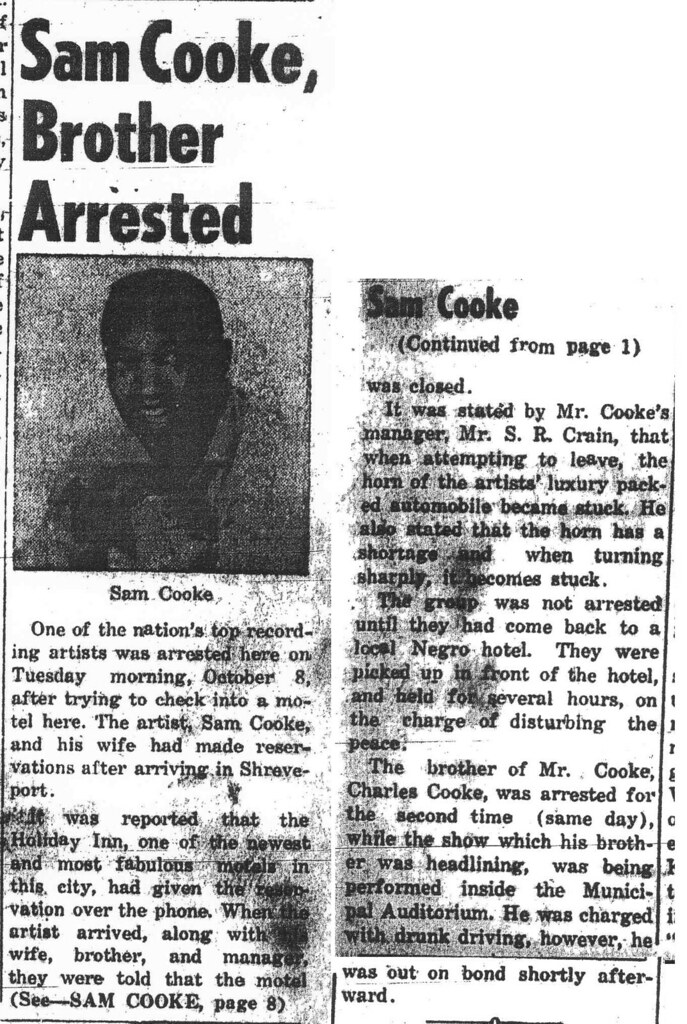
The b-side to a latter-day single in his career, Cooke was moved to write and record it, late 1963 into 1964, after an incident where he had been turned away from a whites only motel in Shreveport, Louisiana. A Holiday Inn. Despite being, arguably, a previously light-weight lyricist, perfect for the pop-soul that endeared him to a largely white audience, he had also been stung by Bob Dylan's emergence, social conscience a'blazing, so he seized the moment. ("Blowin' in the Wind" was a staple in Cooke's live set.) His producers, inevitably warned against the risks of alienating his fans, hence it's appearance on the flip of "Shake." No, me neither. Both "Shake" and the album both the songs appeared on, "Ain't That Good News", actually his last, sold modestly by Cooke's standards. But that has been dwarfed by the legacy and life of the song, voted number 12 in Rolling Stone's 500 Greatest Songs of All Time, as well as being selected for posterity within the Library of Congress, as being "culturally, historically or aesthetically important." All three, say I. But I am ahead of myself. Cooke actually only once played the song live, on TV, the Johnny Carson Tonight show. (I couldn't find any recording thereof to link, sadly.) It was then a full 10 months before the single was ready for release, which eventually took place, over a year after recording, in late December 1964. That release date was already planned, when Cooke was shot dead at another motel, this time in Los Angeles. Colour code uncertain.
There are myriad covers. Although maybe more the metier of the estimable Cover Me Songs, here are my favourite five.
Another radical revision of the arrangement, Herbie Hancock playing his jazz piano around, behind, on top of a conventional soul vocal version, englishman, James Morrison, the two morphing together just right. But only just.
An astonishing and the possibly OTT extravaganza that was Baby Huey. Just euphoric. Makes me, a middle aged white man, channel James Brown. Convincingly. (Maybe.)
Uncertain still whether this works, cello and the never-less-soul man Ben Sollee. On balance, it does.
Finally, an instrumental mix of all the styles shown above. And more. Bill Frisell, an alchemist of electric guitar, able to run with any genre and leave it resolutely unclassifiable beyond exquisite.
What a song, what a tune. Let it give confidence for the changes that will come. After all, it is all in the ear of the beholder.
Anyhow, don't get upset about the what if of politics, go here, cheer yourself up with some Sam.
Posted by Seuras Og at 5:48 PM View Comments
Labels: A Change is Gonna Come, Baby Huey, Ben Sollee, Bill Frisell, Change, Herbie Hancock, James Morrison, Sam Cooke, The Band