





[preorder a biography of Letterman because the only purchasable videos of his show are on VHS]
We did a theme a couple of years ago called “Where I Live,” and I wrote about my favorite small town, Tarrytown. I’m not going to that well again, so you should read that piece if you are interested.
Instead, I’m going to write about the second thing that popped into my head when I heard the theme, “Small Town News,” a segment that was regularly featured on Late Night With David Letterman, and occasionally on Late Show With David Letterman. Let me start by saying how much I miss David Letterman. I didn't start watching Late Night right away, when it started airing on NBC at 12:30 on February 1, 1982, but a couple of years later, I began to record it on my VCR and watch it in the mornings as I got ready for my day. I pretty much stuck with Dave, and followed him to CBS when he moved to the more coveted 11:30 slot (even if he lost the battle to succeed his idol Johnny Carson to the duller, more mainstream Jay Leno). And when Dave signed off in 2015, I tried to watch his successor, Stephen Colbert, but it wasn’t the same and I have gotten out of the habit.
Late Night was considerably stranger than the Late Show. It was as if NBC really didn’t care what happened after midnight, and it seemingly allowed Dave, and his writers, to do what appeared to be anything they wanted to do. Rotating the screen. Dubbing reruns. Involving the backstage staff. Having strange, fake guests. Having strange, real guests. Weird stunts. Letting Andy Kaufman go wild. Which is not to say that what he was doing was unprecedented—Steve Allen’s Tonight Show was definitely an influence, and Ernie Kovacs did some similar stuff, but what made the Late Show so unusual was the way that it seemed to mock the entire genre of late night talk shows without being a parody.
The “Small Town News” segments were a perfect example of the show’s style. Like other segments on the show, like Stupid Pet Tricks, they took something ordinary and pretended that it was appropriate for network television.. As you can see in the video above, from 1988, Dave goes into the segment after what appears to be an improvised bit with a goofy bubble machine and having Paul Shaffer and the band play a cheesy 70's-style “Love Theme.” Throughout the segment, Letterman makes it seem like he has no idea what is going on, he donates $10 per laugh to the United States Olympic Luge Team, for no apparent reason, other than wanting to “just beat those damn Russians at luge once,” he engages in asides about the temperature in the theater, and regularly uses self-deprecating humor.
When Letterman moved an hour earlier, and to CBS, the show changed. Being in an earlier time slot, and competing against the Tonight Show, meant that the network cared more about the show, and many of the odder rough edges were sanded down. Of course, Letterman was also older, and seemed less interested in tweaking authority as much as he had in his younger days. Which was not to say that the Late Show lacked edge, or was slick, dull and mainstream, but it certainly lacked some of the absurdity and anarchy that the earlier show was famous for.
Compare this version of “Small Town News” from the Late Show from 2007—nearly 20 years after the video above.
Putting aside the better production values, including a still silly but more produced theme, nicer cards, etc., you can see that Letterman no longer was pretending that he didn’t know what was going on. No more asking the booth what comes next, or pretending to be confused. In other words, he had gone from being some renegade comedian who somehow found himself with a show that was not completely in his control to a confident TV star. One who still didn’t always seem comfortable with his fame, but was no longer surprised by his good fortune.
The CBS show was still great, and I enjoyed it enormously (because I was older, too), but I guess it is sort of how so often you love a band’s early, sloppier work more than their later, more polished stuff, even as you can appreciate that they have grown and the later material is objectively “better.”
Thursday, February 9, 2017
Small Towns: Small Town News
Posted by Jordan Becker at 8:11 AM View Comments
Labels: Andy Kaufman, David Letterman, Ernie Kovacs, Paul Shaffer, Small Town, Steve Allen
Wednesday, February 8, 2017
Small Towns: My Little Town
purchase [My Little Town]
There is a lot of comfort in a small town: you know everyone/everyone knows you. I speak with limited authority, 'cause I lived in more than one - but for short times. Hamden, CT back in the '60s was a (relatively) small town. Yeah, I only lived there a year or so but the cops knew me pretty soon: I was the kid who set the empty lot on fire and went about deflating all the tires in the golf course parking lot. Small town stuff.
Back at my main place of residence, a couple of 1000 miles away from Hamden and a year or so later, the community was still pretty small. Again, people knew me (and my methods). These were the 60's - no need for Neighborhood Watch or Homeland Security methods. Everything was Small Town. Heck, the world in general was Small Town.
As for music, among the first 33 1/3 albums I acquired was Simon and Garfunkel’s Parsley Sage .... In retrospect I think my parents were pretty OK with this: not rock (but folk protest /Lite). Lots of harmony - kind of like the (parentally -approved) Kingston Trio. Little did my parents realize that the next few albums were to lead down dark alley-ways. ..maybe kinda like soft addictions lead you to hard addictions. First came the early Stones' Between the Buttons, followed by Sargent Peppers, followed shortly thereafter by Are You Experienced. You see? ... an evil path of no return. Classic case of the effects of soft leading to hard.
However, I digress. It's small towns and Paul Simon.
There was (and still is) something re-assuring/comforting about Paul Simon. Like small towns. Yes, he was on the (limited) edge of protest (sort of like Pete Segar). Yes, he skirted 60's rock, but he stayed "family friendly" - home town/small town.... never a real threat. (Ah... for those days...)
<My Little Town> comes after Simon and Garfunkel had parted ways (early 70's). Perhaps in some ways the songs chronicles some of the duo's realities: apparently, Paul Simon wasn’t too keen on relating this to anything personal (..."happy to get out of ..." small town, with Art Garfunkel more inclined to account for and share his past and any autobiographical aspect of the song.
Psychologies aside, the song lyrics lead us (today/without background baggage encumbrances) to see that:
And after it rains
There's a rainbow
And all of the colors are black
It's not that the colors aren't there
It's just imagination they lack
Everything's the same
Good comfort for thems that seek routine. Then again, the lyrics include no real praise for small towns in the end. "Nothin' but the dead and dying in my home town". Funny. I always heard it as "Nothing but the dead of night in my home town" until I looked up the lyrics.
Big cities for me ...
Posted by KKafa at 8:03 AM View Comments
Labels: Simon And Garfunkel, Small Town
Saturday, February 4, 2017
Frozen: Cold, Cold, Cold
purchase [Cold Cold Cold]
Frozen is cold - as in Little Feat's song of the same name.
There are many other Little Feat songs that rank higher for me. Almost too many, in fact: How about Fool Yourself, or Time Loves a Hero, or All That You Dream, but Cold... has a special place in my list. Yes, it is a classic example of Lowell George slide guitar. And the rest of the seminal band's skills (keyboards by Bill Payne and 2nd guitar by Paul Barrere, who took over lead guitar after Lowell George's death)
Other songs may rank higher, but there are few slide players that rank higher. I list Ry Cooder, Bonnie Raitt and Lowell George at the top of the list of slide guitar players from my time (check my previous posts)
I could have sworn that Bonnie Raitt must have had some input on Cold, Cold, Cold: it sounds too much like her style and she and Lowell George seem to have had something going on at one time. However, Bonnie Rait appears to have only joined up about an album later (on the 1973 Dixie Chicken). I didnt know, however, that Nicolette Larson figured in. Should have guessed: tributes to her include everyone in that same orbit (and most of my main favorites from a previous generation). Including Bonnie Raitt.
It may be that I relate most to the lyric line:
<turn your clock back woman when you see me coming around>
This past week, I hit Seattle, WA for 3 days, Princeton, NJ for another 3 and then back home to Istanbul, TR: lots of clock turning, but almost no Frozen.
Posted by KKafa at 11:17 AM View Comments
Labels: Frozen. Cold, little feat
Saturday, January 28, 2017
FROZEN: A Burning Snowman/The Sadies
The Sadies. Some will have heard the name, fewer, possibly, the band. SMM have but one mention for them that I can find, so time to redress the balance.
I was originally going to use another song, 'The Iceberg', as seeming more authentically 'frozen' a song than the presumable lukewarm melt that would result in this choice, but the increasingly common unsmiley face of not available in your territory cropped up. And because the band are so damn prolific, I knew they would have written a slew of songs about the cold. They are from Toronto.
Built around the brothers Dallas and Travis Good, the front line on all things stringed, guitars, fiddles, steel, along with Sean Dean on bass and Mike Belitsky on drums. The line-up has been constant since their 1994 formation, their style with little overt change from a template of surf instrumental, country weepies and electric bluegrass twang. But there is always something a little extra and unexpected in the mix, setting them way above some retrograde revamp of the Byrds meet the Surfaris, though that would not be a bad label to start an acquaintance. I don't quite know how or why, but it seems to me that canadians can do better country than their southern cousins, and the Sadies have me musing likewise on their aplomb with a surfdude vibe. Maybe there are more waves to catch in Saskatchewan than we knew. Their discography alternates between band albums and another tranche of titles where they play backing band, to such diverse artists as R'n'B sleaze man, Andre Williams, to country chanteuse with edge, Neko Case, ex-X man, John Doe, to the british country-punk roots rocker, Jon Langford. (Indeed, the band consider themselves honorary members of Langford's ever evolving Mekons collective.)
I have only crossed the wild atlantic on a handful of occasions, trying always to catch a show or two when I do, surveying the listings ahead of any such trip, scanning the pot-luck of availability. In, I guess, about 2004 or 5, I had a 5 day jaunt to New York and combined 2 bucket list entries, maybe 3, in the one go. Neko Case and the Sadies were playing the Bowery Ballroom! Braving the problem that the cabdriver couldn't find it, we wandered around the somewhat barren locale, in driving rain, I recall, eventually finding a somewhat rundown looking building. Inside a grim concreted bar. I thought this maybe the room they were playing and made light of it to my then wife, who was clearly terrified. After a nervous drink, there was suddenly the opening of big doors, leading up into a fabulously kitsch old style dance hall, with an upstairs verandah spread around the 3 non stage walls. A lacklustre opening band, surely not the Sadies, I prayed, plugged in. O dear, but not for long, as after maybe 20 minutes they let the stage, and the 4 oldstyle wild western characters, much as envisaged in the album sleeve above, trooped on, Travis looking every bit Wyatt Earp's younger and even more tubercular brother. (See if you can guess which one he is!) Yee-bloody-haw, it was terrific! I was hooked as one song banged out after another, harmony vocals wailing into their beer on one song, riptide bendy baritone notes on the following instrumental. 40 minutes and then we got Neko. Consummate. I may have neglected my wife so struck was I by this show. I remember well the row in the taxicab back to our hotel.
Since then I have stayed more loyal to the band than to Neko, hoovering up their catalogue and keeping out an eye for other appearances. One such example is Garth Hudson's exemplary custodianship of his old band, the Band, with his 2010 release, Garth Hudson presents: A Canadian celebration of the Band. Of course, these Canucks like to stick together, so possibly no surprise that this, amongst other tracks, should have them performing not just with Garth, but with Neil Young. That wheel was indubitably on fire. (Sorry, another unsmiley from youtube for me.......)
Their last record was some few years ago and I was worried the trail had gone cold. Maybe the surf had frozen, so it was with some relief I heard this trailer for a forthcoming release, later in the year. A band album, rather than backing band album, but this song features Kurt Vile, who fits their vibe with a natural finesse:
Get some stuff.
Posted by Seuras Og at 9:51 AM View Comments
Labels: Andre Williams, John Doe, Jon Langford, Neko Case, The Sadies
Thursday, January 19, 2017
Change: David Bowie's Changes
purchase [ Changes]
Even as far back as 1970, David Bowie was not considered particularly "normal". He dyed his hair some crazy color(s). He cut it strange - like no one else. Yes .. we had the Beatles's mop cuts and some hippie "let it grow" hair-styles - but Bowie was weird. He wore strange clothes.
That said, to me, David Bowie embodied the right to be and the ability to be different. I place <Space Oddity> at the top of my personal list of Bowie's best songs (and I used it some tie back in a now removed MediaFire blog [but restored here]).
Way back when things like changing the color of your hair, changing your born gender, changing even your appearance were looked down upon (it's still true) -David Bowie was out there doing it all.
Ch ... ch... ch ... changes (one more or one less "ch" in the original) seems to me to be the prime choice for our current theme. It merges <In Memoriam> and the current theme in one.
The lyrics, for example: "turn and face the changes" seems to me to be the most critical part - way out in front of the times, Bowie seemed to know where <changes> were headed. Even when we didn't. I would place him on a per with Mr Dylan for his lyrical ability. Look what else he says: "These children that you spit on/ As they try to change their worlds/ Are immune to your consultations". Please keep in mind that this is the 70s, and you know where the world/youth was at at that time: lots of changes going down.
Known more for his "stagecraft" and songwriting, Bowie also played a few instruments. The credits for <Changes> credit him for vocals and sax. You see him playing the guitar in the clip above. His band included Mick Ronson and Rick Wakeman, both of whom worked with a number of other names you've probably heard of.
Posted by KKafa at 1:18 PM View Comments
Labels: Change, david bowie, In Memoriam
Saturday, January 14, 2017
CHANGE: A CHANGE IS GONNA COME
Well it is, isn't it? And it would have, anyway, because everything changes, that's a fact, to paraphrase Bruce Springsteen. Which is about as philosophical as I am going to get. So I am not going to trump on about politics, probably a relief, because everyone everywhere else will be. But I am going to celebrate this wondrous song, particularly as it later became quite an anthem for civil rights, something we could maybe start storing up in reserve. (Sorry, I said I wouldn't.....)
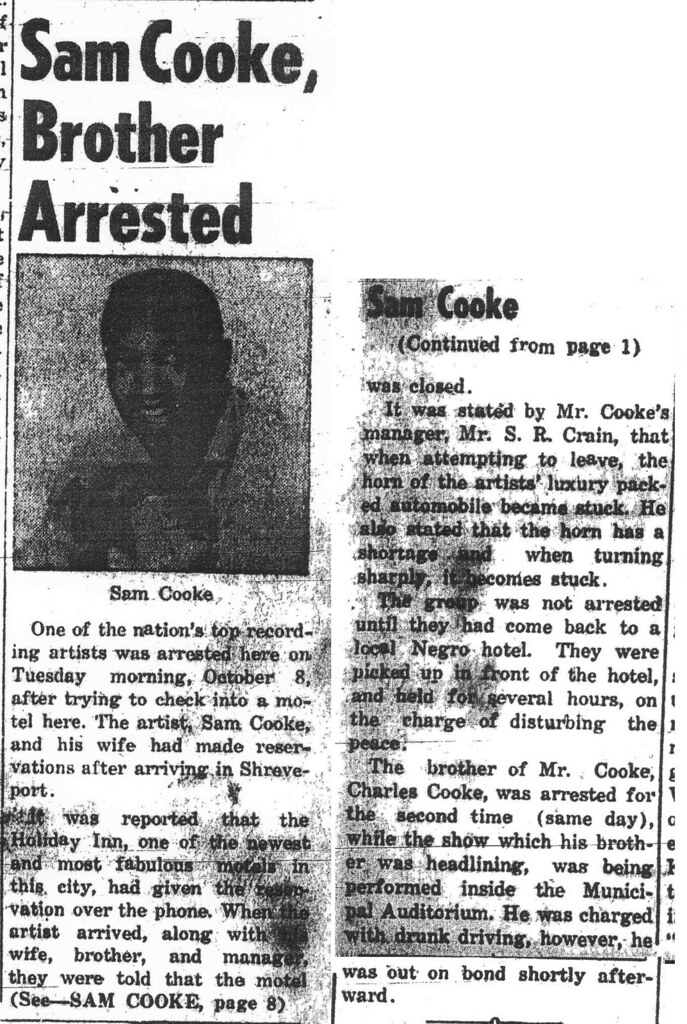
The b-side to a latter-day single in his career, Cooke was moved to write and record it, late 1963 into 1964, after an incident where he had been turned away from a whites only motel in Shreveport, Louisiana. A Holiday Inn. Despite being, arguably, a previously light-weight lyricist, perfect for the pop-soul that endeared him to a largely white audience, he had also been stung by Bob Dylan's emergence, social conscience a'blazing, so he seized the moment. ("Blowin' in the Wind" was a staple in Cooke's live set.) His producers, inevitably warned against the risks of alienating his fans, hence it's appearance on the flip of "Shake." No, me neither. Both "Shake" and the album both the songs appeared on, "Ain't That Good News", actually his last, sold modestly by Cooke's standards. But that has been dwarfed by the legacy and life of the song, voted number 12 in Rolling Stone's 500 Greatest Songs of All Time, as well as being selected for posterity within the Library of Congress, as being "culturally, historically or aesthetically important." All three, say I. But I am ahead of myself. Cooke actually only once played the song live, on TV, the Johnny Carson Tonight show. (I couldn't find any recording thereof to link, sadly.) It was then a full 10 months before the single was ready for release, which eventually took place, over a year after recording, in late December 1964. That release date was already planned, when Cooke was shot dead at another motel, this time in Los Angeles. Colour code uncertain.
There are myriad covers. Although maybe more the metier of the estimable Cover Me Songs, here are my favourite five.
Another radical revision of the arrangement, Herbie Hancock playing his jazz piano around, behind, on top of a conventional soul vocal version, englishman, James Morrison, the two morphing together just right. But only just.
An astonishing and the possibly OTT extravaganza that was Baby Huey. Just euphoric. Makes me, a middle aged white man, channel James Brown. Convincingly. (Maybe.)
Uncertain still whether this works, cello and the never-less-soul man Ben Sollee. On balance, it does.
Finally, an instrumental mix of all the styles shown above. And more. Bill Frisell, an alchemist of electric guitar, able to run with any genre and leave it resolutely unclassifiable beyond exquisite.
What a song, what a tune. Let it give confidence for the changes that will come. After all, it is all in the ear of the beholder.
Anyhow, don't get upset about the what if of politics, go here, cheer yourself up with some Sam.
Posted by Seuras Og at 5:48 PM View Comments
Labels: A Change is Gonna Come, Baby Huey, Ben Sollee, Bill Frisell, Change, Herbie Hancock, James Morrison, Sam Cooke, The Band
Thursday, January 12, 2017
Change-The World Has Changed
The Fleshtones: The World Has Changed
[purchase]
Things are going to change on January 20. In the abstract, as an American citizen, I’m pleased that our country has a long tradition of peaceful transfers of power between incoming and outgoing presidential administration. But in the real world, I really wish that there was some way to prevent the president elect from taking office. As I wrote elsewhere a few days after Election Day:
It made me wonder how this great country could elect someone whose apparent view of appropriate behavior is the exact opposite of how I was raised and how I raised my children. I know that he is a liar, a bully, a sexual predator and a man who had no compunctions mocking a person with a disability, the parents of an American serviceman who died in action, and women who fail to meet his personal standards of beauty, but whether or not the candidate himself is actually a racist, homophobic, antisemitic, misogynistic, white supremacist, that’s the rhetoric that he used to fire up his supporters.
So, yeah, I’m not a fan.
I mean, whether or not the latest Russia blackmail material story is true or not, what amazes me is that it actually seems plausible that someone who bragged about grabbing women's genitals without consent or joked (?) about dating his own daughter would hire Russian hookers to provide a golden shower. Plus, we know how much he loves gold.
It is hard to tell what the lyrics are to The Fleshtones’ “The World Has Changed,” because singer Peter Zaremba has a bit of a mushmouth, and they don’t seem to be available anywhere on the Internet, so I can’t really tell whether the whole song works for my premise, but the chorus, “Don’t you understand the world has changed?” is good enough. The Fleshtones, by the way, formed in Queens, NY, my native borough, in the mid-1970s and their brand of fun, sloppy, supercharged garage rock meshed well with the punk and new wave scene in New York during that period. I remember playing them on the radio, and this song comes from their first full album, Roman Gods, on I.R.S. Records. The Fleshtones, despite a fairly strong cult following, never really hit it big, like their label mates The Go-Go’s or R.E.M., but have continued to record and perform to the present (unlike The Go-Go’s or R.E.M.).
Back to politics. In 2008, Barack Obama ran on a platform that emphasized hope and, yes, change. Hope for a better future, and change from the failed presidency of Dubya. And while President Obama’s eight years weren’t perfect, they were pretty damned good. He brought a thoughtfulness and decency to the office, gave African Americans and other minority group members hope that they could aspire to the Presidency (and by implication, to anything), and extended health care to millions. He helped bring the country out of the massive recession and financial crisis that confronted him when he took office, gave the order to kill Bin Laden, and was a shining example of how to be a husband and father. Among many other things.
Two nights ago, he gave a stirring, inspirational and personal farewell speech that, fittingly, returned to the themes of hope and change that were crucial to his election. Because he, and his speechwriters, are better writers than me, let me quote a bit from that speech, on the issue of change:
This is where I learned that change only happens when ordinary people get involved and they get engaged, and they come together to demand it.
After eight years as your President, I still believe that. And it's not just my belief. It's the beating heart of our American idea — our bold experiment in self-government. It's the conviction that we are all created equal, endowed by our Creator with certain unalienable rights, among them life, liberty, and the pursuit of happiness. It's the insistence that these rights, while self-evident, have never been self-executing; that We, the People, through the instrument of our democracy, can form a more perfect union.
What a radical idea. A great gift that our Founders gave to us: The freedom to chase our individual dreams through our sweat and toil and imagination, and the imperative to strive together, as well, to achieve a common good, a greater good.
For 240 years, our nation's call to citizenship has given work and purpose to each new generation. It's what led patriots to choose republic over tyranny, pioneers to trek west, slaves to brave that makeshift railroad to freedom. It's what pulled immigrants and refugees across oceans and the Rio Grande. (Applause.) It's what pushed women to reach for the ballot. It's what powered workers to organize. It's why GIs gave their lives at Omaha Beach and Iwo Jima, Iraq and Afghanistan. And why men and women from Selma to Stonewall were prepared to give theirs, as well. (Applause.)
So that's what we mean when we say America is exceptional — not that our nation has been flawless from the start, but that we have shown the capacity to change and make life better for those who follow. Yes, our progress has been uneven. The work of democracy has always been hard. It's always been contentious. Sometimes it's been bloody. For every two steps forward, it often feels we take one step back. But the long sweep of America has been defined by forward motion, a constant widening of our founding creed to embrace all and not just some.
The President used the word “change” 19 times in his address, which I don't think is a coincidence. If you want to read a really good speech, check it out here (you can watch it, too).
We don’t know exactly how things are going to change starting on the 20th, but there are bad indications, in what the new guy is saying (or what may be in his heart), what he is doing, and what his nominated appointees have said and are saying. Let’s hope that this is one of President Obama’s “one step[s] back” after his two strides forward. Because otherwise, we’ve got a problem.
Posted by Jordan Becker at 8:30 AM View Comments
Labels: Change, Fleshtones, R.E.M., The Go-Go's
Saturday, January 7, 2017
In Memoriam: Dan Hicks
Above: I Scare Myself
PS: Stick with it until the violin solo
purchase [ Striking It Rich ]
As Andy La Ray Gun said, the stage is (sadly for us down here/ happy for them up there) getting pretty crowded, but I guess they would find a place on that stage for Dan Hicks (d. Feb 6, 2016).
Hicks hit the music scene as far back as the late 50s, worked his way though the 60s and around the 70s gained some recognition.
Striking It Rich is my favorite of his albums (probably because I listened to it the most). It includes a number of tunes that epitomize the man's style and ought to get you to at least tap your foot to the beat. Several of the songs have stuck with me over the 30 or more years:
<I Scare Myself>, <Canned Music> - all essentially of the same Dan Hicks style - a little country,a little jazz, a little folk and ... a little quirky, with an element of humour - of sorts. As in <O'Reilly At the Bar>:
Wasn't that beer there one of mine
Stealin' my beer is a sin
Stealin' my drink has caused me to think
Think about the rat that you are
Whoever you are, you pushed me too far
Now I'm gonna smash your face
Posted by KKafa at 9:19 AM View Comments
Labels: Dan Hicks, In Memoriam
Friday, January 6, 2017
In Memoriam: Some Overshadowed 2016 Losses
In a year in which we lost David Bowie, Prince, Merle Haggard, two thirds of ELP, Paul Kantner, George Michael, Leonard Cohen, Maurice White, George Martin, Glenn Frey, Sharon Jones, and Mose Allison, to name just a very few (most of whom are still available as subjects for this theme, hint, hint), it is not surprising that some deaths during 2016 were overshadowed by bigger names. Here are a few that you may have missed:
Fred Tomlinson: Tomlinson wrote much of the music that added to the lunacy of Monty Python’s Flying Circus and other British shows, and as leader of the Fred Tomlinson singers, performed a good deal of it. If he did nothing else but write the music for “The Lumberjack Song” and lead the Vikings in singing “Spam,” he’d deserve lionization, but he did much more.
[purchase the complete Monty Python series]
Dave Swarbrick and Pete Zorn: I was introduced to both of these musicians due to their connection to Richard Thompson. Swarbrick was best known as a fiddler, and was a member of Fairport Convention, remaining as a member after Thompson left, playing numerous instruments, singing and writing songs. He also contributed to many albums by Thompson and other members of the extended Fairport circle and performed as a solo artist and in various combinations. Check out this footage of him wailing on the fiddle, and singing, with Fairport Convention live in 1970.
Pete Zorn was an American multi-instrumentalist who played with Thompson live and on record, as well as other bands, often in the same English folk world as Swarbrick, and it does seem that they crossed paths. Zorn was Gerry Rafferty’s first choice to play the sax solo in “Baker Street,” but was unavailable; instead Raphael Ravenscroft got the gig. I remember seeing Zorn play with Thompson and handling many stringed and woodwind instruments, including the bass flute. Here he is, singing and playing sax on Thompson’s “Tear Stained Letter.”
[purchase Richard Thompson’s Hand of Kindness, featuring Zorn]
[purchase Fairport Convention’s Liege & Lief]
Gilli Smyth: The co-founder of Gong, with her partner and collaborator Daevid Allen (who died last year), Smyth was a musician, poet, writer and activist. Her contributions to Gong (where she was sometimes billed as Shakti Yoni), and the spin off collections that sprung up over the years, were eccentric, provocative and always interesting. You can get a sense of her "space whispering" performing style, and that of Gong, in this performance from 1973 of “Witch's Song, I Am Your Pussy.”
[purchase Gong’s Flying Teapot]
Bernie Worrell: O.K., enough with the Brits. Worrell, a New Jersey native, was a classically trained pianist who gained fame (and entry to the Rock & Roll Hall of Fame) playing funk with Parliament/Funkadelic in the 1970s. I really began to appreciate Worrell when he joined the expanded Talking Heads. After that, he continued to play with a wide variety of musicians, and as a leader of his own group. Here he is, featured in the introduction and throughout the live performance of “Life During Wartime” from Stop Making Sense.
[purchase the DVD of Stop Making Sense]
Posted by Jordan Becker at 8:30 AM View Comments
Labels: Bernie Worrell, Daevid Allen, Dave Swarbrick, Fairport Convention, Fred Tomlinson, Funkadelic, Gilli Smyth, Gong, In Memoriam, Monty Python, Parliament, Pete Zorn, Richard Thompson, Talking Heads
In Memoriam : Merle Haggard
In Memoriam: Merle Haggard
Purchase: Mama Tried
It’s hard to keep track of all the shitty things that went down in 2016, including remembering all the musical luminaries we lost. Prince, Bowie, Cohen—hard to get past that, but it almost seems like everyone forgot Merle Haggard took the long journey home, too. Haggard passed away right before Prince, so I suppose the news got a little lost.
And, whose casting aspersions? Not me—so much bad went down in 2016 it’s hard to remember it all, let alone remember anything with a light shining on it…
What to say about The Hag? He’s classic country, as responsible for the sound of “real” country as Jennings, Owens, Williams, or Cash. I include Buck Owen’s name in that list of luminaries for two reasons: one, Buck has always been one of my favorites, and two, he and Haggard share equal responsibility for creating the “Bakersfield” sound, otherwise known as honky-tonk.
The meaning of honky tonk is disputed, with lots of disambiguation about the origins of the word, but essentially: it’s chunky, rhythm based hillbilly tunes, spun with a certain verve, rollicking, good time choruses which must be crooned – not sung - and whole lot of dirt and sawdust and love of things run down, of bourbon shot - not sipped - and beer cold and in a can.
I always found Haggard to be kind of square, as before I realized the cultural treasure of country and western music, all I knew of him was “Okie from Muskogee”, which was featured on the Platoon soundtrack and was used as the musical symbol representing the idea of establishment in the platoon itself. There are two great musical scenes in that movie: in the doper’s den, we get a wild party scene accompanied by Smokey Robinson’s “Tracks of My Tears”—sweetness and light, despite the darkness. And Haggard’s anti-hippie screed, “Okie From Muskogee” accompanies the scene where we spend time with the hardcore, non-dope smoking, hippie hating soldiers under Barnse’s command…two versions of hell, made much more tolerable with music, probably both songs inserted as an aural joke…What's ironic about Haggard's straight-laced stance that he took in "Muskogee" is how it directly opposes his own lifestyle, meaning his well-documented drug and alcohol problems. But C&W music is often more about the story and the real life that is reflects than the sterling souls of those who deliver it all. Fiction, or in this case, song, doesn't need to be the truth, at least not so much as it reflects the reality of the one who writes it. It's the emotional truth that matters, not the actual truth that inspires the story...
As I got older, I started to recognize Haggard’s greatness through the influence he had on younger, modern artists. That’s a long list, but his fingerprints can be found everywhere, from Dwight Yoakam to Eric Church, to Reckless Kelly and a lot in between. When he died, the Washington Post wrote how "Respect for the Hag [Haggard] as an icon, both for his musical status and his personal views, is a common theme in country music.” His Wikipedia page goes on to say part of his ubiquity in country songs is the fact that ‘Merle’ rhymes with ‘girl’ and is therefore an easy phonic device to use in four chord, verse-chorus-verse country tunes—you know, the kind you love to sing along to ‘cause they sit so easy in the part of you that feels so good when you hear a pop song…that’s probably a whole post in itself, too.
The Hag—often imitated, rarely equaled (though, I think of all his disciples, Sturgill Simpson, with his grave, beautiful baritone and poet’s soul, is his best successor). There’s a hell of a band up in heaven this year, you know? I don’t want to be there, not yet, but, it bet things sound great right about now. My selection from The Hag is one of my faves, not necessarily his best, but then, that kind of subjectivity could be a whole other post…
I'm using "Mama Tried” for my song to accompany this post, which plays on the best of the outlaw country image that is almost it’s own metaphor with these old troubadours, and never, ever gets old…
Posted by Andy La Raygun at 3:21 AM View Comments
Labels: Buck Owens, Dwight Yoakam, Eric Church, In Memoriam, Merle Haggard, Platoon, Reckless Kelly, Smokey Robinson, Sturgill Simpson
Thursday, January 5, 2017
IN MEMORIAM: BLACK (COLIN VEARNCOMBE)
Again I seek a lesser known name to celebrate, part of the tragedy being the unnatural cause of his death, following a road traffic accident, in which he sustained ultimately fatal head injuries. He was 53.
Posted by Seuras Og at 3:54 AM View Comments
Labels: black, Colin Vearncombe, In Memoriam
Wednesday, January 4, 2017
In memoriam: Paul Kantner
purchase [Jefferson Airplane Volunteers]
By about the time that <Blows Against the Empire> came out, I had moved on. That said, I had a copy of <Takes Off> and <Volunteers> more or less as soon as they came out. Certainly, their Woodstock performance was critical to my appreciation of Jefferson Airplane. The view they espoused or symbolized was equally formative to my perception of music and the world in general. But somehow, about the time of the switch to Starship in place of Airplane, they lost me. Might have been my developing musical tastes, the offer of so much more in that realm than what they were into. But it never took away from my sense and recognition that they were seminal.
When I think Airplane, I call up Kantner, Slick, Balin, Casady, Kaukonen. I likewise call up Hot Tuna.
I cant say that Paul Kantner stood out for me - except that he was in it all along. Co-founder. It's not like I studied his guitar chops or anything. But that is from a perspective somewhat not too focused on who's who - I just knew that he was critical to the band.
There was certainly something unusual about the band at the time of <Takes Off>. Partly it was their sound - kind of raw but still harmonic. Partly it was the message they seemed to represent (singing "Our generation's got soul" - in whatever connotations you wish to ascribe - and the message/vision became even better defined with <Volunteers/We Can Be Together> ... "we are all outlaws in the eyes of America ... to find a better time .. Up against the wall mother fu**er .. tear down the wall". Woah . Hold on a minute (shades of Nixon or someone else), . Part of the West Coast/SF scene but more driven than the Dead in their sound and their message. Friends... we are talking 1969 - that's almost 50 years ago... and look where we are now.
Maybe even more poignant and serendipitous in a sad way: the fact that Signe Anderson (the voice on <Takes Off>) happened to die on exactly the same day that Paul Kantner did. Anniversary coming up in a week or so: Jan 28.
Posted by KKafa at 2:16 PM View Comments
Labels: In Memoriam, Jefferson Airplane, Jefferson Starship, Paul Kantner, Signe Anderson
Sunday, January 1, 2017
IN MEMORIAM: MARTIN STONE
Phew, 2017..... I felt I had to wait for this piece, mindful how sharp the scythe has seemed to be in this year just gone, culling indiscriminately from the ranks of musicians I have chosen to fill my ears with these last 40 odd years. I guess none of this should be a surprise, these are individuals in, usually, late middle age with lives often, um, well lived, shall we say, strangers not to the occasional pick-me-up in their primes. And some not. Indeed, some of the best livers, to follow the metaphor, clearly have superlative livers and still live on, maybe to give us cause for rumination. And copy for future years.....
Spoilt for choice, my subject may not be or ever have been a household name. That is, unless you lived with me in the early 1970s. I was at boarding school, that peculiar english idea of bettering the child by removing the parents, and, stranger still, l was loving it. Clearly, and as stated here before, I was an odd boy, and I enjoyed to distance myself from the Floyd, Sabbath and Purple of my peers, diving, in preference, into the splendour of folk and country influences, Fairport Convention and the Flying Burrito Brothers, studiously devouring the inkies for ever new and arcane bands. So when I heard of Chilli Willi and the Red Hot Peppers, my interest was immediately tickled.
An unwieldy mix of hippy redneck culture, filtered through a peculiarly anglocentric prism, to incorporate 20s pastiche, blues and bluegrass, the Willis were in the frontline of pub-rock, the pre-punk evanescence of a simpler music to the prog and pomp of that time. I was hooked. I think they were perhaps the 2nd band I ever saw live, at Hove Town Hall, mesmerised by the stick-thin guitarist, with what looked like a woollen tea-cosy on his head, peeling off staccato bursts of notes, each droplet lithe and discrete, quite different from the searing screech de rigeur back then, and indeed even now. Retrospectively more of a jazzy stylisation, though the notes were determinably blues in origin. The rest of the band were no slouches either, later Resident "Snakefinger" Phil Lithman, on guitars, fiddle and lap steel, later Attraction Pete Thomas, on drums and the 2 Pauls, "Bassman" Riley on, um, bass, and "Dice Man" Bailey on guitar, sax and banjo.
Bongos over Balham I bought on release, later to discover this was their 2nd album, there being an earlier, nominally duo album, Kings of the Robot Rhythm, featuring just Stone and Lithman and some cameos from assorted guests. Of course I bought it, along with the various compilations that appeared later, the lifespan of the band being distinctly short. Stone continued to drift about the pub-rock circuit, for a time a member of the 101-ers, Joe Strummer's pre-Clash band and, my last live sighting of him, the memorably named Jivebombers. And then zilch. He disappeared.
Being the geek I am I had to look backwards to get my fix, unearthing quite a few of his back pages, starting with Mod group, The Action, later morphing into psychedelic kaftan and yakskin afghan coat botherers, Mighty Baby. I think it was here that he defined and individualised his trademark guitar sound, not least as extended guitar wig-outs were the order of the day. Actually quite a challenging listen, attuned ears always expecting the aforementioned screech of his contemporaries, but worth it. Spells with various other bands, Savoy Brown and famed Ladbroke Grove mavericks/crazies, the Pink Fairies, appear in his c.v., never being quite in the right place at the right time for fame and fortune.
But where did he go to when the music ended? Intriguingly, a 2nd career beckoned and into which he became a far greater legend, disappearing into the little known sub-culture of bookrunning or bookscouting, the apparently cut-throat world of 2nd hand books, whereby fortunes could be made or lost by finding the right first editions in dusty bookshops and library collections. Stone's reputation was of the best, being described as having an uncanny knack of knowing exactly what was there, by smell or intuition, on entry through the door of a bookshop seemingly identical to the one next door. This is described way better here, or by reading White Chapell, Scarlett Tracings, a novel by Iain Sinclair, wherein the chief character, a Nicholas Lane, is unmistakably a thinly disguised Stone. I had become aware of this second life through my purchase of a re-released Mighty Baby LP, with extensive sleevenotes and an interview with Stone, but I always wonder how many of his book people were ever aware of his musical past. And vice versa. Certainly his music fans found it difficult to keep up with him, so it was quite a shock to me to hear and read of his death.
R.I.P. with a burst of their nearly, in my imagination, hit single......
Buy Bongos
Posted by Seuras Og at 7:12 PM View Comments
Labels: Chilli Willi & the Red Hot Peppers, In Memoriam, Martin Stone, Mighty Baby
Top Posts of 2016
We briefly interrupt our annual In Memoriam theme for our second annual highlighting of the 10 most viewed posts of the previous year. This year, 9 of the 10 most viewed pieces are from two themes from last summer, "Roads/Streets" and "The Number 4."
Through our (usually) two-week long themes, our international roster of writers address many different kinds of music, and bring different perspectives to their pieces. In our top 10, there are personal memories, political and social discussions, covers, remembrances of those who have passed, both famous and personally important, and even just posts about songs, music and musicians. This list includes discussions of folk, rock, prog, power pop and other genres.
So, in case you missed them, here are the most viewed posts from the last calendar year. But they are only a small sampling of what you will find in our archives, which we invite you to explore. Also, we invite you to like us on Facebook, so that you won't miss anything.
And there is much more to come in 2017.
Posted by Jordan Becker at 9:56 AM View Comments
Thursday, December 29, 2016
In Memoriam: Naná Vasconcelos
Pat Metheny Group: Are You Going With Me (live)
[purchase]
As we all know, 2016 seems to have been the worst year ever for high profile losses in the musical world (and the acting world, and the writing world….). Chuck Prophet released a song from his forthcoming album called “Bad Year For Rock and Roll,” and who would disagree? Every year here at SMM, we look at some of those who we lost this year, the famous, the lesser known, and some in between.
In March, Naná Vasconcelos died of lung cancer in Brazil. Vasconcelos was an incredible musician, and although he was a vocalist and performed on a number of different Brazilian instruments, including the berimbau, he became renowned as a percussionist. As a bad drummer myself, I recognize that percussion is often where you stick the bad musicians, and in my days in the Princeton Band, we had a large “trash percussion” section, which was the home for a bunch of people who wanted to be in the band, but who didn’t actually play an instrument. But much like how right field is where you put the bad baseball player in Little League, while in the majors, right fielders are often stars (like, you know, Babe Ruth or Hank Aaron), Vasconcelos was an all-star percussionist. (Question—is that metaphor too attenuated?). Vasconcelos played with many great jazz and Brazilian artists, as well as some titans of rock while also releasing a number of albums as a leader.
I first became aware of Vasconcelos when he collaborated with Pat Metheny and Lyle Mays on As Falls Wichita, So Falls Wichita Falls, and then became a member of the Pat Metheny Group. (I know that this is the third Pat Metheny related post that I have written this year (all since September), but I went a whole bunch of years without writing about him, so just bear with me).
As I have previously mentioned, my strongest memory of Vasconcelos was when he deservedly embarrassed me. In 1981, I got to see the Pat Metheny Group, with Vasconcelos, at Princeton, in venerable Alexander Hall. If I recall correctly, the band was to play two sets, and I arranged to interview Metheny between sets for WPRB. Unfortunately, I couldn’t arrange to get in for free, so I paid for the first show, did my interview, and simply never left, allowing me to see the second set.
I remember seeing Vasconcelos playing a strange instrument that appeared to be a gourd, with a long neck and a metal string, played with a bow (see the picture above). I had no clue what it was, and because the Internet wasn’t invented yet, I couldn’t Google it. After the first show, I went into the bowels of Alexander Hall to interview Metheny, who couldn’t have been nicer, and at some point approached Vasconcelos. With the arrogance and ignorance of youth, I asked him, “What was that thing that you were playing?” He looked at me with disgust, and with disdain in his voice, he replied, “that musical instrument is a berimbau.” I immediately realized that I had insulted him, and probably his culture, with my question, mumbled a response and fled. As you can see here, he was truly a master of the berimbau. And I was an idiot.
The lesson that I learned that day, and which I have tried to follow since, is that if you are unprepared, you will get embarrassed. And while that wasn’t the last time that happened to me (unfortunately), it hasn’t happened all that often.
One of the highlights of that show was their performance of “Are You Going With Me,” a song with a strong samba feel which must have been influenced by Vasconcelos. The song, which is often referred to as a “fusion ballad” builds from a quiet start to an intense climax, and the crew had rigged lights so that Alexander Hall’s stained glass windows gradually lit up as the song built, a relatively subtle and clever way of tying the visuals to the sound.
The version above is from Travels, a live album recorded in 1982 at a number of venues, so it is likely be pretty close to what I heard that night in 1981.
Posted by Jordan Becker at 9:00 AM View Comments
Labels: Chuck Prophet, In Memoriam, Nana Vasconcelos, Pat Metheny
Wednesday, December 21, 2016
Strange (Weird) Holidays: John Fahey
purchase [The New Possibilitiy]
I'm not at all sure what constitutes a "Weird/Strange" holiday (holiday most likely = Xmas for this post). My sense of weird/strange, my understanding of holiday could likely be strange to you: I live in a Moslem-predominate environment, where Xmas means little, but the New Year is celebrated more or less the same (big turkey dinner ... gifts all around) We've also got all sorts of other holidays here, like the one where we slaughter sheep.
Regardless of the holiday, there are some givens: we hope to be together with the family (as best as possible); there are often gifts- and at this time of year we aim for green, red and white lights on a tree... Most anything that goes against these given traditions probably constitutes strange or weird.
It was on <The Dance of Death and Other Plantation Favorites> that I first heard the man and his guitar. The year would have been about '73, although the album by then was close to a decade old. It being the 70s, it must have been the droning, repetitious curiously off-note style that captured me.
I confess it has been several decades since I though much about the man and his music, but a pre-holiday post I ran across the other day noted a Christmas album called <The New Possibility> that he did way back in 1968. It is filled with your classic Xmas tunes - in the Fahey style.
As the reviewer/primary source I came across notes: you can almost hum along to his versions. They are certainly recognizable, even if they arent quite right. There's always a note or beat that shouldnt be there, but works just fine all the same. In the Fahey style.
Posted by KKafa at 10:31 AM View Comments
Labels: John Fahey, Strange (Weird) Holidays
Thursday, December 15, 2016
Strange (Weird) Holidays: Light That Menorah
Phofo: Light That Menorah
[Here’s Phofo’s website where you can hire him to write music for your TV show, film or commercial]
We’ve occasionally dipped our toes into the shallow pool that is Hanukkah music here at SMM, in part, because as I noted last year, it hasn’t really inspired much good music. Confronting our new theme of Strange or Weird Holiday music, though, I found a contender, “Light That Menorah,” by Phofo, which fits the theme, even if it still isn’t a great holiday song.
In fact, other than the title, it is kind of difficult to tell that it is a Hanukkah song at all. It starts out as an electronic instrumental tune that sort of chugs along, until about a minute or so in, when some distorted vocals, buried in the mix, may be saying “light that menorah.” Or maybe not. At almost 2 minutes in, we get a bit of klezmer sounding music, and some more of the distorted vocals. A snatch more klezmer follows. It then rocks for a little while and then sort of peters out, like a dreidel before it stops spinning. It is, to my ears, more than a little weird.
But certainly interesting. There’s no “album cover” to use as the featured picture for this post, so, instead, in keeping with our theme, I used a picture of a Strange and Weird Menorah.
The song is credited to Phofo, and using my strong Google skills, I determined that Phofo is a composer who has written the score for Disney's Club Penguin, Sushi Pack (a Saturday morning cartoon on CBS), the animated feature film, Los Campeones de La Lucha Libre and Shep & Tiffany Watch TV (which was on Bravo). He is also a producer, has written for McSweeney’s and was a music consultant to PRI's This American Life.
But who is Phofo? That took a bit more work on the Google Machine. Turns out, he is a lawyer named Adam Weitz. Some of you may know that I, J. David, am also a lawyer, and that I blog as a creative outlet. Weitz also has a creative sidelight to his lawyer work, but he gets paid for it (presumably).
And that makes me jealous.
Posted by Jordan Becker at 8:30 AM View Comments
Labels: Phofo, Strange (Weird) Holidays
Wednesday, December 14, 2016
STRANGE (WEIRD) HOLIDAYS : Santa Claus has got the AIDS this year/Tiny Tim
There, it is done. I have posted perhaps the worst, the least defensible holiday song ever. And, until this piece, I was the lucky one. I had never heard it. Don't get me wrong, it isn't so much the lyric, execrable though it is in its splendour of political incorrectness, or even the tune, macabrely festive, more rather the vocal, grating by even the singers usual standards. And they were usually pretty low. I dare you to get through it all in one go.
In Tim's defence, he claimed it was about Santa eating an Ayds bar, a then available diet snack, becoming unwell thereafter, stating also it was nothing to do with recently outed, subsequently deceased film star Rock Hudson. Yeah, right. As if those 2 sentences might make the one rule out the other, rather than underline each other. (O, and Ayds, at least, had the prescience to change their name soon after.)
Mind you, the thrice married singer proved he was no homophobe, with the hilarious b-side, misogyny being also well within his gift. Bless! But, gallingly, maybe it is his very innocence in how Ds can be STed that is after all the key. Witness the lines about the cat then contracting herpes from the chair he had sat on. (Phew, that's a relief, just a simple misunderstanding then.)
Poor Tim, born Herbert Khoury, in 1932, he was always destined to be on the wrong side of public opinion, his brief window of fame coming more as the audience laughed at, rather than with him. So, by contrast, here is his high water mark. See which you prefer.
Posted by Seuras Og at 10:43 AM View Comments
Thursday, December 8, 2016
LEFTOVERS: STE: STEREOLAB: TRANSIENT RANDOM NOISE OUTBURSTS WITH ANNOUNCEMENTS
Buy (Transient Random Noise Bursts with Announcements)
Posted by Unknown at 1:44 PM View Comments
Labels: Stereolab
Wednesday, December 7, 2016
leftovers: another STE*
purchase [ I'm Losing You]
JDavid's latest post got me thinking: the STE* posts were mostly (Steve***) based. So... what about the *** STE variation. As in Rod STE****.
Being of a certain age, I confess that I wore out the (vinyl) grooves on my legally-purchased copy (there really weren't (m)any other options back then) of the "Every Picture Tells A Story" album - Stewart's best ever? Methinks that '70, '71 and '72 were likely Rod's best years. Every Picture (in the very middle of these years) is likely the best: it includes the songs you know: Maggie May, Reason to Believe and Mandolin Wind.
Stewart's eclectic/convoluted past includes stints in The Jeff Beck Group, followed by the Small Faces, followed by the Faces. In fact, at the time of Every Picture, Stewart was still maintaining a connection to The Faces, and they appear on <I'm Losing You> - one of the better of several solid tracks on the album. It's not the tightest production - pieces of the timing are slightly off, but what matters much, much more is the feeling put into the work: one of their best IMHO: Ronnie Lane & Ronnie Wood! And there's Kenny Jones (later of Who fame) on the drums here as well. Whew! if you make it to the end of the clip - out of breath!
Posted by KKafa at 12:41 PM View Comments
Labels: Leftovers, Rod Stewart