












Showing posts with label Bigger Strings. Show all posts

Saturday, December 4, 2021

LEFTOVERS: BIGGER STRINGS: JOANNA NEWSOM

 Well, if nothing else, a post here about Joanna Newsom has the opportunity to sidestep a similar piece appearing in the FUNNY VOICES theme, should the team ever take that one on. For too long her name has been a cipher for folk to take a potshot at her curious singing style, possibly to the extent that she is known better for that than for any of her music. (How I am helping is arguably not by starting off with this opener, but, hey, I have to find some traction.....) So, here I will do my best to avoid any reference to helium or to alleycats, concentrating more on her music. And her instrument, the harp.
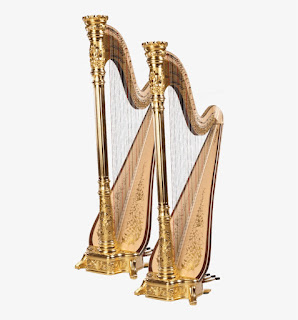
Harps have only a small footprint in popular music, give or take the odd appearance, for texture and effect.    Like here and here. Folk music rather more, if more often the smaller Celtic harp: clarsachs and the like, thinking of the Breton, Alan Stivell, and the Scottish duo, Sileas. Folk then crosses over into classical with the afro-welsh chamber style of classical harp soloist Catrin Finch, in her works with Senegalese kora maestro, Seckou Keita. Jazz is mainly centred on the trance-like meanderings of Alice Coltrane, and then there are the hard to classify new-age ambient noodlings of Mary Lattimore. Newsom fits into none of these categories, although there is the attempt, or intent, to shoe-horn her into wyrd-folk territory, quite whatever that really means. 

Frank vs. Frank/Nervous Cop 

Classically trained in the instrument from an early age, she is proficient to a degree that can sometimes have you wonder how many of her are playing, or whether all that sound comes from just a harp. Just over a month away from her fortieth birthday, it was actually on keyboards the she began her musical career. But, having been drafted in to add her harp to the experimental rock of Nervous Cop. With the reception seeming promising, she self-produced a couple of EPs, which led her to be drawn to the attention of, initially, Will Oldham ( aka Bonnie "Prince" Billy) who then alerted record label, Drag City, who promptly signed her up. 2004 saw her full length debut, The Milk Eyed Mender. All the usual right-on culprits, Pitchfork and that ilk, hailed it amongst the years best, as did the UK's Sunday Times, that level of acclaim lingering into the later end of decade credits, six years later. In 2016, NME, the erstwhile inkie indie bible for counter-cultural teens, voted it 12th best folk album ever. Sales? Less so, it failing to chart, ever the lot of a critic's favourite. 

Bridges and Balloons/The Milk Eyed Mender

Touring with the likes of Devendra Banhart and Vetiver, she was at the forefront of the aforementioned wyrd-folk movement. (Answering my own query, I guess, thus, it means a folk electronica garnished with a hippy dippy ambience.) Festival appearances, many in the UK, underpinned her footprint, with the follow-up, Ys, released in 2006. Heavy duty contributions from along the lines of Van Dyke Parks and Steve Albini added no small gravitas, and she broke into the lower end of the charts. Some backlash, relating to her vocal, also became more overt: "an acquired taste", a "too precious warble that either bewitches or repels." Ouch.

Cosmia/Ys

One can't help but think these criticisms hurt. Although she made occasional guest appearances on other records, it was again two years ahead of her 3rd record. However, rather than reining back in any tendency to the grandiose, this was a triple. Have One On Me extended her appeal to the converted, but was deemed overly ambitious by some early acolytes. This isn't stop it out performing her earlier output apropos sales and charting. Indeed, when her 4th album, Divers, dropped in 2015, this too sold more than its predecessor, this time also recouping any loss of critical sway, it deemed her best yet by many. Any perceived change in her vocal timbre on these last two releases seem down to circumstance than to unappreciative ears; vocal cord nodules required medical attention in 2009. Unlike, let's say, Rod Stewart, this may have worked in her favour.

You and Me, Bess/Have One On Me

I appreciate I have actually made little overt reference to her actual harp playing. This is better stated by listening to the clips above, I believe, and I think and hope that there may be rather more harpists appearing as a result of her putting this instrument into the front line, however much she has also diversified into playing rather more keyboard instruments alongside. It would be good to see why she has been doing, becoming a mother apart, these past six years.

Leaving the City/Divers


Take your pick......

Sunday, September 5, 2021

Bigger Strings: Jack Bruce


purchase [Wheels of Fire]


I confess that I have never given much attention to the bass player. Yeah, I know that the bass and drums are critical to the ryhthm, but the paucity of notes that the bass plays belies the importance of a song's underlying structure. 

A Quora post I read recently asked "why can't you ever hear the bass?" While the question strikes me as a bit "out of it", I fear that there is some truth to the question: the bass (player) rarely gets the spotlight. And I confess it wasn't until I started digging this week, that I paid much attention to Jack Bruce. 

Musically trained as a cello player and then moving to the standing bass, Bruce moved through various groups, including time with John McLaughlin and Ginger Baker in the Graham Bond Quartet, and with John Mayall and the Bluesbreakers with Eric Clapton.

Although I owned a copy of Cream's double album Wheels of Fire as well as one of Fresh Cream, neither, particularly in comparison with Disraeli Gears did much for me. Although we generally think of Cream as a trio (Clapton, Bruce, Baker), a majority of Wheels of Fire is a quartet, with Felix Pappalardi as the fourth member (later to head off and help found Mountain with Leslie West - with whom Bruce later founded West, Bruce & Laing)

Jack Bruce, of course, is the bass player of the original trio, but he also did a lot of the lead vocals as well as writing  quite a few of the songs. He was a multi-intrumentalist and you can find videos of him playing the piano and more. On Wheels of Fire, we get Bruce and Pappalardi playing cellos, violas, bass ... but I bet you wouldn't know it unless you read the credits/liner notes. Pappalardi is playing the viola in "White Room" up top. Here, in "Passing the Time", Bruce is credited with playing the viola.


At one point in his early career, we find him playing with Charlie Watts, among others at the London Blues and Barrelhouse Club.


Tuesday, August 31, 2021

BIGGER STRINGS: DANNY THOMPSON

Well, strings don't  come much bigger than Victoria. Who she? Victoria is the stand-up bass guitar Danny Thompson bought for a fiver (£5) in around 1954, when he was fifteen. And who Danny Thompson? Shame on you for asking, but I guess not all tastes are as rarified as mine. Sir Danny of Thompson, as he has yet become officially recognised as, an MBE having to suffice, is the fella who has gone as far as most in making stand-up bass other than an old fogey associated item. If you are familiar with Pentangle, Nick Drake, John Martyn and Richard Thompson, the chances are that you are familiar with his work. If you have watched the Transatlantic Sessions, live or on TV, the chances are that you have seen him, an avuncular presence, holding all the virtuosi musicians also featured in check, more that likely with a beatific beam on his face, itself usually under a hat of some intrinsic coolness.

With Martin Simpson, 2014

I used to hate the double bass, it encompassing everything old and fuddy-duddy of the pre-rock era. All these bloody b&w jazzers, with the bass perpetually walking up and down in the background, whilst the usual focus of attention showed off in the foreground, besuited drummers tip-tapping away politely alongside. Sometimes they crossed over into my awareness, notably in the Seekers, my father's favourite band, courtesy the comely charms of Judith Durham. They could always be relied upon to turn up on BBC Saturday night variety shows, I finding the grinning buffoon on bass an offence to my pre-pubertal sensitivities. (Apologies thus due, now, to Athol Guy, the player in question, even if I have not the heart to go back and actually check out his playing.) This prejudice took forever, a bit like trumpet, to rid, but, boy, when I did....

With Richard Thompson, 2001

Thompson was the man from the start, even if I was slow to get up to speed. As an RT freak, it was when he first started appearing alongside Richard, his Thompson 'twin', that I got up to speed. You know how it is, when you sometimes 'get' something, the scales fall from your eyes like roof tiles in a hurricane. Suddenly I was hoovering up John Martyn and, even, if a bit later, Nick Drake. (His vocals still alienated for longer than I care admit.) Suddenly big ol' bass was cool, she even when one Gordon Sumner came on board, I was already, o yes, on message.

So, Daniel Henry Edward Thompson..... Like the recently deceased Charlie Watts, he too was an alumnus of Alexis Korner's Blues Incorporated, taking over bass duties from Jack Bruce. Following that four year period, 1664-7, he became a member of Pentangle, that undersung folk-jazz hybrid, ploughing their idiosyncratic acoustic vibe at the same time as Fairport and Steeleye were inventing an electric folk tradition. He and Terry Cox, drums, both crossed the then gulf between traditions, joining nominal folkies Bert Jansch and John Renbourn, with the consummate purity of Jacqui McShee on vocals. 

With Pentangle, 1972

The John Martyn years, which followed, were as famous for their onstage "dynamic" as for the often mercurial music, both not averse to the occasional pre-, per- and post-stage snifter. Thompson was able to take a longer view, and withdrew. Martyn, sadly not, his death as much to do with the ravages of alcohol as anything else, if sober at the time of his death. 

With John Martyn, 1977

A solo career beckoned, or at least as bandleader, his band, 'Whatever' a sonic free for all, genre-wise, with some astonishing material. When this expanded to into an even wider ubiquity, as 'Songhai', featuring flamenco purists, Ketama, alongside Malian kora maestro, Toumani Diabaté, any sense of categorisation became redundant.

Songhai, 1988

Round about the same time he hooked up with kindred spirit, Richard Thompson: each had embraces Islam, possibly, in part, as an escape from the hedonism of the musical life. For several years he was the right hand man to his namesake, whether in a band format or as a duo. An interesting memento of that time comes with 1997's 'Industry', a joint production, encompassing both the songs of RT and the music of Whatever. It's a worthwhile listen.

Industry, 1997

A jovial presence, he was also getting work as an amiable onstage presence at Fairport Convention's Cropredy Festivals, as host and master of ceremonies. I remember my horror, I think in 1998, as it was announced from the stage that Thompson had sustained a stroke. The audience were invited to sing Danny Boy, so that, by phone, he could hear their well wishes. I thought that the end, but he made a decent recovery and was soon playing again, seemingly as well as ever. The couple of times I caught the Transatlantic Sessions tours, in the early 20 teens, he was terrific, the cheer for him, when introduced, as big as for any of the other performers. Grab a look at his website for a list of records he has appeared on, a ridiculously large roster, encompassing jazz, folk, blues, world, everything, including a number of surprises. Did you know he played on Cliff Richards' Eurovison winner, 'Congratulations'? Or with artists as diverse as T.Rex, Kate Bush and David Sylvian, let alone most of Donovan's recordings. Not bad for an old jazzer!

Transatlantic Sessions, 2016
Back with RT, 2019

Here's rather a good interview, from only a year or so ago.

Get this!

Monday, August 30, 2021

Bigger Strings: The Black Angel’s Death Song


Velvet Underground: The Black Angel’s Death Song
[purchase

John Cale is another musician whose work I’m aware of and have enjoyed, but never (until now) spent much time learning about his life and career. I knew he plays the viola, among other instruments, that he was one of the founders of the Velvet Underground, put out some solo albums, at least one of which I played back in my WPRB days, and did an album with Brian Eno a couple of decades ago (gasp!). This turns out to be, somewhat embarrassingly, a pretty pathetic summary. So, in brief (and admittedly, mostly gleaned from Wikipedia), Cale was born in Wales in 1942, adopted the viola as his primary instrument and studied music at Goldsmiths College, University of London. Cale once described the viola as the “saddest instrument of all and, no matter how adept you get at it or no matter how fast you play it, you can’t get away from the character of it.” 

Cale quickly became enamored by the more avant-garde and experimental classical music becoming popular in the 1960s, including organizing a Fluxus concert in 1964 and conducting the first U.K. performance of a John Cage piece. He obtained a scholarship to work with Aaron Copland at Tanglewood, but they “fell out,” and Cale then moved to New York where he participated in an 18 hour performance of an Erik Satie composition and joined La Monte Young’s Theater of Eternal Music. 

OK—enough with the classical music (I mean, really, two posts in a row writing about classical music which I know basically nothing about…. I’m really not trying to pull a Metal Machine Music and alienate you all). 

Cale also liked rock music, and joined up with Lou Reed to found what became the Velvet Underground in 1964. Cale’s taste for the experimental, particularly drones, when combined with Reed’s penchant for rock and poetry (and manager Andy Warhol’s Andy Warhol-ness) resulted in early albums that were kind of all over the place. 

One of the more experimental songs from the debut album, Velvet Underground & Nico is the cheerily named, “The Black Angel’s Death Song,” which, for the most part, features Cale’s droning and dissonant electric viola with Reed and Sterling Morrison each playing away on guitar, while Reed chant/sings wordy lyrics in a style that had to be influenced by Dylan. There’s also what sounds like feedback, but was actually Cale hissing into the mike. I know that description doesn’t make it sound all that appetizing, and the song got the band fired from their residency at Manhattan’s Café Bizarre. But while it isn’t something that I’d listen to regularly, there’s something intriguing about it that made me glad that I checked it out again for this piece. 

So, what’s the song about? It is hard to say. Reed himself has said that “The idea here was to string words together for the sheer fun of their sound, not any particular meaning.” But the imagery is so strong, I find that hard to believe. I’ve seen claims on the Internet that the song is about life’s choices, heroin, suicide, the Holocaust, and Communism. Check it out, and let me know what you think. 

Eventually, Reed and Cale fell out over the direction of the Velvets, and Cale was replaced by Doug Yule (I guess you had to have four letters in your name). Cale went on to a career as a producer (for, among others, the Stooges, Jennifer Warnes, Patti Smith, The Modern Lovers, Squeeze, and Alejandro Escovedo), collaborator (including with Reed on Songs for Drella in 1990), and solo and soundtrack artist.

Monday, August 23, 2021

Bigger Strings: Maya Beiser-Epitaph

Maya Beiser: Epitaph
[purchase

I’m not sure where I first heard about Israel-born, avant-garde classical cellist Maya Beiser, but it might well have been from this piece by Cover Me founder Ray Padgett about her awesome cover of Led Zeppelin’s “Kashmir.” Beiser’s 2014 album Uncovered is a collection of ten rock songs completely reimagined by Beiser and arranger Evan Ziporyn, a fellow member of Bang on a Can All-Stars. The songs run the gamut from Muddy Waters to Janis Joplin, to Hendrix, Led Zeppelin, AC/DC, Nirvana (which I wrote about here), and my favorite of them all, her cover of King Crimson’s elegiac “Epitaph,” from their debut album, In The Court of the Crimson King

“Epitaph” was written by Robert Fripp, Ian McDonald, Greg Lake, and Michael Giles with lyrics written by Peter Sinfield, and those lyrics, were sung beautifully by Lake, who explained that the song “is basically a song about looking with confusion upon a world gone mad.” It features heavy use of Mellotron along with woodwinds and dramatic tympani, giving it a symphonic feel. 

It was this complex, symphonic sound that attracted Beiser, whose classical training did not prevent her from consuming and appreciating popular music throughout her life. In an interview for Classical Voice, Beiser said:

I was very much entrenched in classical music, and none of my teachers knew anything about Genesis, King Crimson, Brian Eno. It was not part of my education. I started to listen to this music and it completely transformed me. Pink Floyd were totally revolutionary, creating a symphonic like piece. King Crimson’s ‘Epitaph’ is one of my favorite songs of all time, and it lends itself to cello because their thinking was symphonic — classical. 

She continued: 

Part of my motivation for doing this album is for people to see how this is great music, how the masters of our time are just as great as but different than Beethoven and Schubert. … All classical music performances are covers. 

Continuing this approach, Beiser recently released a version of David Bowie’s last album, Blackstar, re imagined as a cello concerto. 

To create her cover of “Epitaph,” Beiser overdubbed and processed her cello, and Ziporyn added just a hint of clarinet and bass clarinet. Beiser slows down the tempo a little, and if anything, her instrumental version is even sadder and statelier than the great original. 

As a brief aside, since this is a piece about the cello and King Crimson, about five years after the debut album, a mostly different lineup of King Crimson released Red, one of my favorite albums, and it includes a cellist (and acoustic bass player), who are uncredited, and whose identity appears to still be a mystery

One more aside--the punk record label Epitaph Records, home (at times) of bands such as Rancid, Bad Religion, Descendants, The Distillers and Social Distortion, was named after a lyric from this decidedly not punk song.