

Showing posts with label Humble Pie. Show all posts

Wednesday, May 25, 2022

Only: The Only Ones


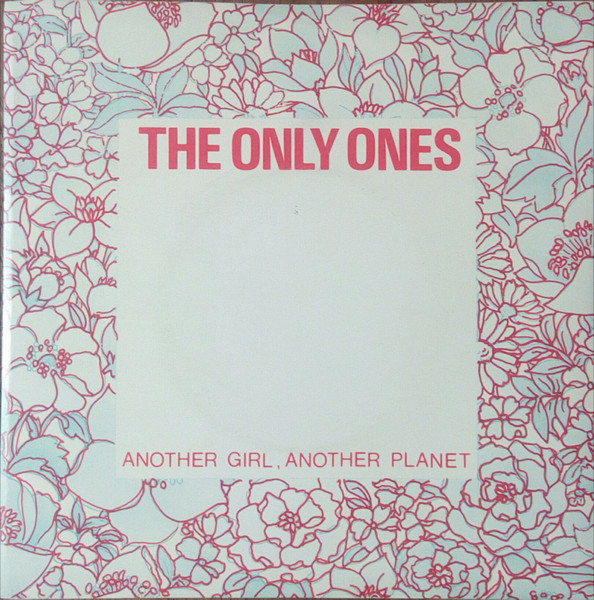
The Only Ones: Another Girl, Another Planet
[purchase] 

If you are a regular, and long-time, reader of Cover Me, this piece may seem a little familiar.  But I don't think that it counts as plagiarism if I steal from myself.  Think of it as an "adaptation," OK?  And this is a song that deserves a post on this blog, too.

It is somewhat ironic that most people know only one song by the Only Ones— “Another Girl, Another Planet.”  Originally released in 1978, it received minimal airplay and attention (but it was pretty regularly played on WPRB during my time there), but its reputation has grown exponentially over the years.  The Allmusic review of the song asserts that it is “arguably, the greatest rock single ever recorded.”  Of course, people will “argue” about anything, and choosing “Another Girl” as the greatest rock single ever is a bit of a reach, but you have to give the reviewer his due for taking a stand.  It is a great song, and it is fitting that it ultimately received the acclaim that it deserved.

The Only Ones formed in London in 1976, led by distinctively anguished vocalist and songwriter Peter Perrett joined by guitarist/keyboard player John Perry, Alan Mair on bass, and drummer Mike Kellie.  Featuring strong songwriting by Perrett and surprisingly (for punks of the era) competent playing by the band, they self-released a single, “Lovers of Today.” It sold well enough that a bidding war broke out among major labels looking for the next big thing.

While the label battles raged, the band took refuge at Escape Studio, run by producer John Burns, to record some tracks.  The unlikely marriage of Burns – who had started in the industry engineering albums by bands like King Crimson, Jethro Tull, and Humble Pie, and who had co-produced three decidedly not-punk Genesis albums – and the Only Ones somehow worked.  They finished their efforts at Escape with three 16-track demos, including “Another Girl, Another Planet.” In fact, after signing with CBS Records, and re-recording “Another Girl” at a bigger, fancier, 24-track studio, it ultimately became clear that the “demo” was the right version, and it is the one that was released (with a bit of additional overdubbing to take advantage of the additional tracks).

Despite the quality of the song, it encountered resistance, in part because it was not punk enough for the purists and too punk for mainstream play, but also because the song was perceived to be about drugs.  It wasn’t.  As Perrett stated in a 2015 interview:

It was inspired by this girl from Yugoslavia. I didn’t go out with her, but she was like a total space cadet, which when I was really young I found interesting. She was just a bit weird – she’d say crazy things, and it just got me thinking that every girl has something different to offer.

As for the drug imagery?  Perrett explains:

I put in drug-related imagery, but it wasn’t about drugs. At that time I was more addicted to sex and infatuation than I was to drugs.

Although the band’s three studio albums were generally well received, and they even opened for the Who, by  1982 the Only Ones had disbanded, in large part due to Perrett’s drug problems.  When Johnny Thunders (who later, sort of, covered the song) suggests that you need to clean your act up, you know you are messed up.  There was a short-lived reunion in 2007, and another in 2014.  Perrett released an album, How The West Was Won, in 2017 to excellent reviews, and is touring (although his US and Canada dates were cancelled due to visa problems).

Despite its lack of chart success, “Another Girl, Another Planet” has become a regular part of Best Of lists, compilation albums, box sets, and soundtracks over the years, and has become an often covered song.  And if you want to here Five Good Covers of the song, and links to a few more, check out the Cover Me link above.

I'll try to write something new for next week.

Tuesday, July 13, 2021

1971: Fillmores

Allman Brothers: Whipping Post
[purchase Don't Fight the Feeling - the Complete Aretha Franklin & King Curtis Live at Fillmore West ]
[purchase Allman Brothers Live at Fillmore East Deluxe Edition]
[purchase Mothers Fillmore East-June 1971]
[purchase Humble Pike Performance Rockin’ The Fillmore] 

1971 saw the closing of both the Fillmore West and the Fillmore East, the legendary venues operated by the equally legendary rock impresario Bill Graham. The original Fillmore Auditorium was located in a San Francisco building originally built in 1912, and Graham began booking shows there in 1965. It eventually became the center of the San Francisco music scene, with incredible musical performances and famous light shows. But in 1968, because of the increasing deterioration of the neighborhood and the insufficient size of the space, Graham moved his focus to the newly christened “Fillmore West.” That venue, formerly the Carousel Ballroom, was briefly run in 1968 as a cooperative venture by the Grateful Dead, Jefferson Airplane, Quicksilver Messenger Service and Big Brother and the Holding Company, before Graham took ownership and began booking shows there. (The original Fillmore was, for a while, operated by a different company as the “New Old Fillmore.”) 

The name “Fillmore West” was chosen because earlier in 1968, Graham had taken over a derelict space in New York City originally built for the Yiddish theater in the mid-1920s, and opened it as the Fillmore East. That venue, like its West Coast sibling(s) became hugely popular and influential, with shows on multiple nights a week, typically triple bills at 8 and 11 pm. The Fillmore East also featured elaborate light shows. 

However, by1971, the economics of the music business was changing in favor of stadium and arena shows (boo!), and Graham decided to shutter both venues. The last concert at the Fillmore East was an invitation-only affair on June 27, 1971, featuring The Allman Brothers Band, The J. Geils Band, Albert King and special surprise guests (Edgar Winter's White Trash, Mountain, The Beach Boys, Country Joe McDonald). The Fillmore West closed on July 4, 1971, after five nights of concerts by 14 bands, mostly from the San Francisco area, including Santana, the Grateful Dead, Hot Tuna, Quicksilver Messenger Service, and the New Riders of the Purple Sage. 

The Fillmore West eventually became a Honda dealership, before becoming a music and event venue called SVN West. The Fillmore East went through a few other iterations as a music venue before becoming The Saint, a gay nightclub in the 1980s. The former lobby of the venue is now a bank, and the auditorium was demolished to build an apartment building. 

The original Fillmore became a punk venue, The Elite Club, before reopening under Graham’s management. It was damaged in an earthquake, and after Graham died in 1991, it was repaired and reopened as The Fillmore. Live Nation operates the venue and has rebranded a number of theaters around the country with the Fillmore name, although in some cases, most notably at New York’s Irving Plaza, it didn’t take. 

Although 1971 was a bad year for the Fillmores West and East, it was a good year for albums recorded at the venues. On May19, 1971, Aretha Live at Fillmore West was released. It had been recorded there in March, and included a number of covers of current popular music. It’s pretty great, featuring, in addition to the amazing Franklin, King Curtis on sax, leading a band that included, among others, Billy Preston, Cornell Dupree, Bernard Purdie, and the Memphis Horns. And there’s a duet with Ray Charles. During the same shows, King Curtis’s band, which was also the opening act, recorded its performances (mostly covers), and they were released as Live at Fillmore West in August. Tragically, a week after its release, Curtis was stabbed to death in New York. 

If there’s one album that rock fans associate with the Fillmore East, it is the Allman Brothers’ At Fillmore East, recorded there in March, 1971 and released on July 6, 1971. I’m not really sure what else to say about this album that hasn’t been said better by others. Suffice to say that it is one of the greatest live rock albums of all time, and probably just one of the best rock albums of all time (which is why when I picked one song to feature above, it was from that album). In 2004, the album was selected for preservation in the Library of Congress, deemed to be "culturally, historically, or aesthetically important" by the National Recording Registry. 

In June, 1971, The Mothers (formerly known as The Mothers of Invention, led by Frank Zappa) recorded performances at the Fillmore East (and some additional performances in May in Michigan), for Fillmore East-June 1971, released in August. It is raunchy and juvenile, and while it has some good music, really hasn’t aged well. 

Humble Pie, which featured Steve Marriott and Peter Frampton, recorded performances at the Fillmore East in May, 1971, and released Performance Rockin’ The Fillmore in November, 1971. I can’t say that I’m at all familiar with it, although I have a vague sense that I’ve heard the single from it, “I Don’t Need No Doctor.” Before the album was released, Frampton left the band for a few years of minimal success before he came alive, briefly.

Friday, October 5, 2018

Leaves: All I Want Is To Be (Is By Your Side)


Peter Frampton: All I Want Is To Be (Is By Your Side)
[purchase]

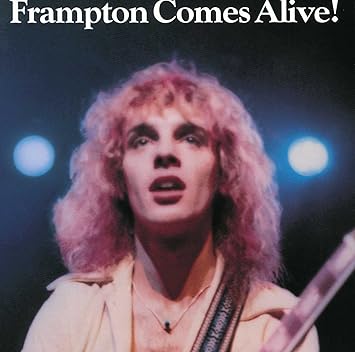
It is far from an original thought to note that Frampton Comes Alive! came out of nowhere. Up until its release, Frampton, a talented guitarist, a passable singer, and a good looking guy with great hair, had experienced some minor fame with various bands, notably The Herd and Humble Pie, and as a sideman, but his pre-Comes Alive! solo career was generally underwhelming. A&M co-founder Jerry Moss had signed Frampton to the label when he was 19, because "He had a cool face, he didn't mind working, and he had a great attitude.” Frampton toured relentlessly and was one of those artists whose songs seem to work better live than on vinyl. And there was the talk-box effect.

So, when he recorded a live album, mostly at the Winterland in San Francisco, but also at the Long Island Arena and SUNY Plattsburgh, there really wasn’t much expected—it was released in January, 1976, after the holiday buying season—and A&M had its collective fingers crossed that it might sell half a million copies and be certified as a gold record. Instead, the album turned into the ultimate “grower.” It charted at No. 51 its second week, then rose to No. 22, No. 6, No. 4 and No. 2, where it stalled throughout March, before hitting No. 1 in April. And it showed staying power, bouncing around the top 10 for the rest of 1976, logging a total of 10 weeks at No. 1, and selling a shocking 6 million copies, which broke Carole King's sales record for Tapestry. Ultimately, it has sold more than 11 million copies worldwide.

Why? I’m not really sure. It is not a great album; much of it is really pretty ordinary (which is why his prior solo albums were not big hits). There are a handful of really good rock songs on the album—songs that rocked hard enough, but not too hard to be offensive—filled with hooks and tight playing. As a high school student in 1976, I can tell you that rock radio played the crap out of the record, and it certainly was a part of the soundtrack of my high school years. Mostly, we heard the singles: "Show Me The Way," "Baby, I Love Your Way," and "Do You Feel Like We Do," but some stations went a couple of tracks deeper than that. So, it might just have been a case of the right album at the right time—a solid product, well promoted, that probably became discussed as one of those things that you had to buy, because everyone was buying it--sort of a pre-Internet version of going viral.

In addition to the rockers, a number of the songs on the live album were acoustic, which were included at Moss’ insistence.  They showcased Frampton’s fine playing and made for a nice contrast from the heavier tracks. One of the best of these is “All I Want To Be (Is By Your Side),” originally from his debut solo album. It’s a nice, bluesy, love song, although I find the lyrics a bit confusing—“I don't care if they cut my hair/All I want to be is by your side.” Huh? But it satisfies the theme by being one of approximately a billion songs that mention four leaf clovers. Yeah, I could have gone with the Old 97’s, but I’m trying to write about artists that I haven’t featured before.

Comes Alive! was, by far, the pinnacle of Frampton’s career. His next album, rushed out to capitalize on his new-found superstardom, was generally substandard, marred by a cheesy, cheesecake album cover and a truly sappy title track. It sold reasonably well, but was generally mocked, including by Frank Zappa. He then starred in the critically panned Sgt. Pepper's Lonely Hearts Club Band film, and was in a serious car accident. A few years later, all his guitars were believed to be destroyed in a cargo plane crash that killed three people, including the black Les Paul Custom that appeared on the cover of Comes Alive! (although it was found years later and returned to him).

Since then, Frampton has released albums, toured with his childhood friend David Bowie (who had been an art student of Frampton's father) and others as a sideman, released an unsuccessful Frampton Comes Alive! II, and has generally stayed active musically, even if most people don’t realize it.  And, like many of us, he no longer has great hair.

I think that it is fair to say that if the universe hadn’t aligned to give Peter Frampton one of the bestselling albums of his era, he’d probably have continued, putting out a series of albums that would have bubbled under the radar of most listeners, maybe occasionally having a radio hit, before being pushed aside from the public consciousness by new generations of musicians, like, say, Foghat, or Pat Travers. That certainly doesn’t mean that they are not good—to the contrary, such artists, including Frampton, are fantastically talented, but still, the incredible, massive,  success of Comes Alive! is an anomaly.

Friday, September 15, 2017

Incompetent/Can't : Can't Stand the Rain


purchase [I Cant Stand the Rain]


Maybe we have had enough of the rain. Maybe some of the news pundits are right about how the main stream media tried to make the most of the Carib weather - to the extent that it has surpassed overload and caused unnecessary fears. And maybe J David is right that we have exceeded the "Can't" threshold when we could have been looking at other aspects of the Incompetence/Can't theme.

If you are a regular here, you likely know I have an enduring affinity for the slide guitar, as embodied in such impresarios as Mr Ry Cooder, Ms Bonnie Raitt, Mr Duane Allman and Mr Lowell George. (There are others, but these are among my main staples)

As JDavid pointed out, there are various avenues one can pursue from a theme of Can't - primarily personal incompetence.  I don't think that <I Cant Stand the Rain> falls into this category - the weather is beyond our control, and most likely the lyrics transcend the weather, rather, here, a metaphor for other aspects of the singer's life. You know ... rain is wet and sad and brings you down, especially if you get caught out in it unprepared like...

In my ignorance, I had assumed that this was a Little Feat original. No small amount of their output was original. However, not this.

The song is credited to someone I had never heard of before: a certain Ann Peebles. And while I was only aware of the Little Feat version, there are all sorts of others who have done theirs and you can find many of them at YouTube.

A few of them: