[purchase]
Thursday, October 20, 2022
Little/Few: Little Eva
Posted by Jordan Becker at 8:30 AM 1 comments
Labels: Carole King, Dee Dee Sharp, Don Kirshner, Gerry Goffin, Kylie Minogue, Little Eva, Little/Few, the Crystals
Wednesday, April 13, 2022
PAUL: TALL PAUL
Another rabbit warren of antique archaicism to fall down today, as we grasp at the few straws offered by Tin Pan Alley to the Pauls of this world. Johns, and Johnnys are, of course, two a penny, and even Williams get more action, if more frequently foreshortened to Billy. So, then, pop pickers, who remembers “Tall Paul”? Don’t worry, I don’t either, but it was 1959 when Annette Funicello took it to the Billboard chart, where it reached number 7.
There’s a nice tale about the song, suggesting it was written for Paul Anka, not least as he and Funicello were briefly an item. Anka responded vigorously to deny this, citing he was not remotely tall, an inescapable truth. Funicello was an erstwhile Mousketeer for the Mickey Mouse club, long before, I should add, any more recent incumbent, and the song was written by the Sherman brothers, Robert B. and Richard M., who specialised in writing for Disney, and penned most of the soundtrack for Mary Poppins. The song? Well. It ain’t up to much, typical fare for the times, but it did provoke a response.
The tradition of a song producing a response, unrelated, from another group or singer is long and celebrated. Possibly the best example would be the songs traded between the star crossed squeezes, Neil Sedaka and Carole King. “Oh, Carol” was a massive hit for the former, and “Oh Neil”, her reply, was not, perhaps explained by her, in the interim, having married Gerry Goffin. More recently there was the somewhat more nuanced bromance between Morrissey and Billy MacKenzie. The Smiths brought out “William, It Was Really Nothing”, the seemingly somewhat a little infatuated Associates singer, with the explosive H bomb of a voice, riposted with “Stephen, You’re Really Something.” Probably more a little bit of celebrity one-upmanship, it makes for a great tale, if largely and likely apocryphal.
Posted by Seuras Og at 4:10 PM View Comments
Labels: Annette Funicello, Carole King, Christine Aguilera, chuck berry, Jimmy Dean, Neil Sedaka, Paper Lace, Paul & Paula, Paul Anka, The Associates, The Smiths
Wednesday, March 10, 2021
Mr./Ms.: Hey Mister, That's Me Up On The Jukebox
James Taylor: Hey Mister, That's Me up on the Jukebox
[purchase]
If you’ve been reading my work on this site since 2011 (!), you might notice that I often discuss why various artists aren’t as famous as I (or others) think they should be. That isn’t the problem this time, since our featured song was written and performed by James Taylor, who was, and still is, pretty famous.
Today, we’re looking at a song written from the perspective of someone who achieved fame, and is maybe not all that happy about it.
Taylor’s path to stardom is pretty well known. Born into a prosperous family, he was a sensitive musical child who eventually struggled with both mental illness and drug abuse. After his first “real” band, the Flying Machine, which also included his longtime friend and future collaborator Danny Kortchmar, failed to take off (sorry—I’m guessing that I’m not the first person to make that joke), he moved to England. Through Kortchmar, Taylor connected with Peter Asher, who at the time was running A&R for Apple Records, and Asher played Taylor’s demo for McCartney and Harrison, who loved it. Taylor was the first non-British act signed to Apple Records.
Taylor’s self-titled debut, despite positive reviews, and a fine single, “Carolina On My Mind,” failed to sell well, in part because Taylor couldn’t promote the album because he was again in rehab. Upon his release, Taylor was unable to maintain the momentum from enthusiastic crowds at live shows, including the 1969 Newport Folk Festival, because he broke his hands and feet in a motorcycle accident.
Signing with Warner Bros. Records, Taylor moved to California and recorded his next album with a big assist from Carole King (and Asher and Kortchmar). That album, Sweet Baby James, was justifiably a smash hit, garnering both critical and popular acclaim. This led to high profile concerts, benefit shows, TV appearances, and Time magazine’s declaration that he was the “face of new rock.” Let’s take a brief digression here to remind our readers who were not alive in 1971 that this was not at all as strange at the time as it sounds today.
As often happens, the followup to the big hit album pales in comparison. That’s not to say that Mud Slide Slim and the Blue Horizon was a bad album—it just wasn’t Sweet Baby James. Despite that, the album did spawn Taylor’s only Billboard No. 1 hit, a cover of King’s “You’ve Got a Friend,” featuring Joni Mitchell on background vocals, as well as Kortchmar and the crack rhythm section of Leland Sklar and Russ Kunkel.
Also on Mud Slide Slim is “Hey Mister, That's Me up on the Jukebox,” in which the singer, presumably Taylor, is pointing out to the titular Mister that it is, in fact, he who is singing the sad song on the jukebox. On the one hand, there has to be some pride in that, but there’s also a little shock, and some sadness about the fact that:
I have wasted too much time just to sing you this sad song
And I've done been this lonesome picker a little too long
Taylor has said that the song “is basically a way of dealing with the shock of being a private person going public.” When asked if he found it jarring, Taylor responded:
Yeah. I found it - you know, of course, it's exactly what I wanted. I wanted to be successful. And I wanted to get people to hear my music. I wanted my music to make a difference to people. But at the same time, you know, making yourself the product, it's very distracting.
Coincidentally, not long before starting to write this, I got to see my daughter experience a small amount of similar weirdness, although without the corresponding ambivalence (or, so far, massive commercial success). I may have mentioned before that she’s a standup comedian in Barcelona, and for a few months has been appearing semi-regularly on a TV show there, The Weekly Mag, designed to help locals practice their English. I stumbled across her IMDB page, listing her one credit, and she was shocked when I sent it to her. No, it’s not the same as what JT went through, but it is a cute story, and it allows me to make this piece a little more personal than just a discussion of the early career of James Taylor.
Anyway, despite decades of fame, Taylor has always seemed to have a certain ambivalence about his place in the public spotlight consistent with “Hey Mister’s” lyrics, even as he has continued to record and perform, be a political and environmental activist, have a high profile marriage and divorce from Carly Simon, and a second marriage to actress Kathryn Walker (and another divorce). However, he seems to have settled into a quieter third marriage, to Kim Smedvig (who my wife, a huge Taylor fan, would point out is a Smithie), a comfortable recording and performing (pre-COVID) career, and maybe, finally, happiness.
Posted by Jordan Becker at 9:29 AM 0 comments
Labels: Carly Simon, Carole King, Danny Kortchmar, George Harrison, James Taylor, joni mitchell, Leland Sklar, Mr./Ms., Paul McCartney, Peter Asher, Russ Kunkel
Thursday, June 18, 2020
Open/Close: Closing Time
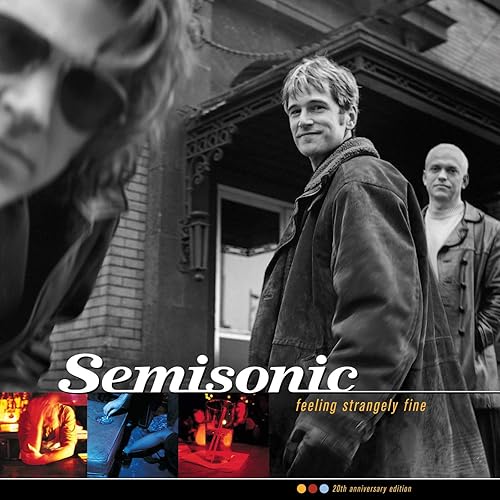
Semisonic: Closing Time
[purchase]
One reason that people love listening to music, particularly older music, is that songs, like smells, can evoke past memories. My wife, for example, regularly talks about how specific songs remind her of camp, or high school, or college, and I’ve written before about this phenomenon. I’ve also written about how certain songs remind me of specific people, often my friend Chris, with whom I explored music in high school and attended many memorable shows. And there are songs that make me think about my kids, which I have also written about. Today’s song, Semisonic’s "Closing Time," is another that reminds me of my son, who introduced me to this song back in 1998, when he was about 8 years old.
Semisonic was a band out of Minneapolis, fronted by Dan Wilson, and featuring John Munson and Jacob Slichter that formed out of the ashes of the band Trip Shakespeare, which included Wilson, Munson and Wilson’s brother Matt, among others. Both Wilsons and Slichter attended Harvard, but despite being a proud Tiger, I won’t hold that against them. I sort of group Semisonic in my mind with bands like Toad the Wet Sprocket and Gin Blossoms, who made melodic, power-poppy albums in the 90s, which were radio friendly (for a slice of radio that still existed back then), although I was a bigger fan of those other two bands. Other reviews compare Semisonic (generally unfavorably) to Ben Folds Five, or even Matthew Sweet.
“Closing Time” is a catchy track that, on its surface, seems to be about the end of the night at a bar, a/k/a last call, and the patrons are being forced to decide whether to go home, and if not, where, and with whom, if anyone. It’s a time of both possibility and disappointment, and the song considers both options. Interestingly, Dan Wilson has said that the song is also about his impending fatherhood. He said:
The guys wanted a new song to close our sets with. I thought 'Closing Time' would be a good title. We had spent seven years of our lives at that point, four nights a week entertaining people. That was our life. Some bouncers yelling things, closing time coming, all that imagery, literally, that's how the song started and then when I was halfway done, I started realizing the whole thing was a pun about being born, so I just made sure that the rest of the thing could ride with that double meaning, but nobody got the joke and I didn't bother to explain. I thought everyone would get it.
The song reached number one on the US Billboard Modern Rock Tracks chart, did well internationally, and got a Grammy nomination for Best Rock Song, losing to Alanis Morissette’s “Uninvited.” It’s been used in TV shows and movies, usually when there’s a scene at bar at closing time. Of course. Although two other singles from the album did OK, the followup album, which wasn’t released until 2001 (and even included a contribution from Carole King), was not successful, and the band went on hiatus, reuniting a few times in recent years for shows in the Twin Cities.
Dan Wilson, who is also apparently an accomplished visual artist, has released a bunch of solo albums, and also has written or co-written songs for others, including the Dixie Chicks’ “Not Ready to Make Nice,” and “Someone Like You,” with Adele. Munson continues to play with bands in the Minneapolis area and teaches, and Slichter wrote a book about being a rock musician and teaches, including in the MFA writing program at Sarah Lawrence College, where my daughter-in-law got her degree. She said she knew Slichter, but never took a course from him. To bring this piece to a satisfying "close," she’s married to the son I wrote about in the "open."
Posted by Jordan Becker at 8:00 AM View Comments
Labels: Alanis Morissette, Ben Folds Five, Carole King, Dan Wilson, Gin Blossoms, Matthew Sweet, Open/Close, Semisonic, Toad the Wet Sprocket, Trip Shakespeare
Friday, October 5, 2018
Leaves: All I Want Is To Be (Is By Your Side)
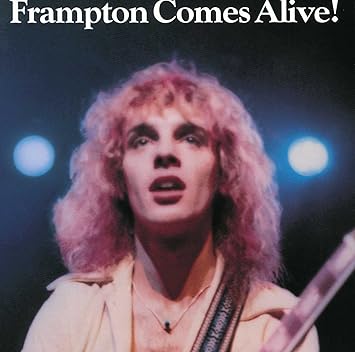
Peter Frampton: All I Want Is To Be (Is By Your Side)
[purchase]
It is far from an original thought to note that Frampton Comes Alive! came out of nowhere. Up until its release, Frampton, a talented guitarist, a passable singer, and a good looking guy with great hair, had experienced some minor fame with various bands, notably The Herd and Humble Pie, and as a sideman, but his pre-Comes Alive! solo career was generally underwhelming. A&M co-founder Jerry Moss had signed Frampton to the label when he was 19, because "He had a cool face, he didn't mind working, and he had a great attitude.” Frampton toured relentlessly and was one of those artists whose songs seem to work better live than on vinyl. And there was the talk-box effect.
So, when he recorded a live album, mostly at the Winterland in San Francisco, but also at the Long Island Arena and SUNY Plattsburgh, there really wasn’t much expected—it was released in January, 1976, after the holiday buying season—and A&M had its collective fingers crossed that it might sell half a million copies and be certified as a gold record. Instead, the album turned into the ultimate “grower.” It charted at No. 51 its second week, then rose to No. 22, No. 6, No. 4 and No. 2, where it stalled throughout March, before hitting No. 1 in April. And it showed staying power, bouncing around the top 10 for the rest of 1976, logging a total of 10 weeks at No. 1, and selling a shocking 6 million copies, which broke Carole King's sales record for Tapestry. Ultimately, it has sold more than 11 million copies worldwide.
Why? I’m not really sure. It is not a great album; much of it is really pretty ordinary (which is why his prior solo albums were not big hits). There are a handful of really good rock songs on the album—songs that rocked hard enough, but not too hard to be offensive—filled with hooks and tight playing. As a high school student in 1976, I can tell you that rock radio played the crap out of the record, and it certainly was a part of the soundtrack of my high school years. Mostly, we heard the singles: "Show Me The Way," "Baby, I Love Your Way," and "Do You Feel Like We Do," but some stations went a couple of tracks deeper than that. So, it might just have been a case of the right album at the right time—a solid product, well promoted, that probably became discussed as one of those things that you had to buy, because everyone was buying it--sort of a pre-Internet version of going viral.
In addition to the rockers, a number of the songs on the live album were acoustic, which were included at Moss’ insistence. They showcased Frampton’s fine playing and made for a nice contrast from the heavier tracks. One of the best of these is “All I Want To Be (Is By Your Side),” originally from his debut solo album. It’s a nice, bluesy, love song, although I find the lyrics a bit confusing—“I don't care if they cut my hair/All I want to be is by your side.” Huh? But it satisfies the theme by being one of approximately a billion songs that mention four leaf clovers. Yeah, I could have gone with the Old 97’s, but I’m trying to write about artists that I haven’t featured before.
Comes Alive! was, by far, the pinnacle of Frampton’s career. His next album, rushed out to capitalize on his new-found superstardom, was generally substandard, marred by a cheesy, cheesecake album cover and a truly sappy title track. It sold reasonably well, but was generally mocked, including by Frank Zappa. He then starred in the critically panned Sgt. Pepper's Lonely Hearts Club Band film, and was in a serious car accident. A few years later, all his guitars were believed to be destroyed in a cargo plane crash that killed three people, including the black Les Paul Custom that appeared on the cover of Comes Alive! (although it was found years later and returned to him).
Since then, Frampton has released albums, toured with his childhood friend David Bowie (who had been an art student of Frampton's father) and others as a sideman, released an unsuccessful Frampton Comes Alive! II, and has generally stayed active musically, even if most people don’t realize it. And, like many of us, he no longer has great hair.
I think that it is fair to say that if the universe hadn’t aligned to give Peter Frampton one of the bestselling albums of his era, he’d probably have continued, putting out a series of albums that would have bubbled under the radar of most listeners, maybe occasionally having a radio hit, before being pushed aside from the public consciousness by new generations of musicians, like, say, Foghat, or Pat Travers. That certainly doesn’t mean that they are not good—to the contrary, such artists, including Frampton, are fantastically talented, but still, the incredible, massive, success of Comes Alive! is an anomaly.
Posted by Jordan Becker at 8:00 AM View Comments
Labels: Carole King, david bowie, Foghat, Frank Zappa, Humble Pie, Leaves, Pat Travers, Peter Frampton, The Herd
Tuesday, November 14, 2017
All the Fixings: Let’s Turkey Trot
Little Eva: Let’s Turkey Trot
[purchase]
Ian & the Zodiacs: Let’s Turkey Trot
[purchase]
Back in the days when I moderated here, I would have defined our new theme as “All the Fixings: post songs about items on the table at Thanksgiving.” So we might get songs about cranberry sauce or pumpkin pie before we are done, but the meal centers around the turkey, so that must be our starting point as well. I will be looking for the ultimate version of Turkey in the Straw for this theme, unless someone else beats me to it, but let’s begin with a look at the state of the music industry in 1963.
It would prove to be a year of major upheaval. Four lads from Liverpool would come to the United States, and begin to change the sound of popular music forever. But the year began innocently enough. In February, Little Eva released her third single, Let’s Turkey Trot. Like The Locomotion, it was written by Carole King and Gerry Goffin. Little Eva got her start by babysitting for the couple, and they thanked her when they heard her voice by writing hits for her. Like The Locomotion, Let’s Turkey Trot was an attempt to launch a dance craze, but that part never happened. The Turkey Trot was a real dance, and, as Little Eva sings, it would have been danced by Little Eva’s grandparents, to ragtime music. The dance was briefly popular in the years leading up to and through World War I, but it was considered risqué. There was eventually a church led campaign to wipe it out, and the fox trot wound up being both more acceptable and more enduring. So I am not sure why Goffin and King thought the turkey trot should live again, but the British invasion halted that idea. Let’s Turkey Trot reached # 20 on the charts, but that was a disappointment after Little Eva’s earlier success.
The song was popular enough to inspire cover versions, however. Jan and Dean’s version was not one of their better moments. But the cover by Ian & the Zodiacs has something to tell us about pop music in 1963.The band was as talented as many of the merseybeat bands who followed in the wake of the Beatles, but they never caught on, except in Germany. One problem was that they were never able to get green cards to perform in the United States, which kept them from gaining traction here. They also may have been hurt by the fact that most of their material consisted of covers. Still, the Beatles did plenty of covers of American hits in the beginning, so I offer this version of Let’s Turkey Trot as a glimpse of what the song might have sounded like if the Beatles had covered it.
Finally, I wondered what the dance itself looked like. For the answer, I had to dig up this clip fromNCIS:
Posted by Darius at 4:13 AM View Comments
Labels: All the Fixings, Carole King, Gerry Goffin, Ian & the Zodiacs, Little Eva, NCIS
Wednesday, November 25, 2015
Carole King Covers: Will You Still Love Me Tomorrow?
[purchase]
You could argue that one of the ways to tell if a song is really well-written is to see whether it holds up when performed in different styles. Some songs would seem to only be effective in a particular style—for example, the Sex Pistols’ great “God Save The Queen” only works as an angry blast of punk, and not, for example, as a folk tune. Although you might be surprised at how good King Crimson’s prog-rock archetype “21st Century Schizoid Man” sounds in Delta blues style.
“Will You Still Love Me Tomorrow” seems to sound great no matter how it is played. Written by King and Gerry Goffin when she was still in her teens, the song was first released by The Shirelles in 1960, in classic girl group style, with tight harmony vocals and lush orchestration. Although apparently banned by some radio stations because of the sexual nature of the lyrics (!), it nevertheless reached #1 on the Billboard Hot 100 chart.
I’m not going to give you a long tour through the many, many covers of this great song, except to point out that it works in Swedish. And when King recorded the song for the great Tapestry album, she did it in a slower, piano-driven, contemplative style with Joni Mitchell and James Taylor contributing background vocals. It was both an artistic and commercial success, getting played regularly on FM radio.
It is sort of a gimmick to take classic rock songs of this, and other, eras, speed them up, and turn them into punk songs. Few artists are as committed to this niche that honors the songs, but with sufficient ironic detachment to retain their punk cred, than Me First and The Gimme Gimmes. A “supergroup” of sorts, with members that include Fat Mike of NOFX, Chris Shiflett of Foo Fighters, and Spike Slawson of Swingin’ Utters and Re-Volts, they have released a bunch of albums, EPs and singles, including their 2001 album, Blow In The Wind, which focuses on pop hits of the 1960s. Their version of “Will You Still Love Me Tomorrow” is, appropriately, loud, fast and surprisingly catchy, like The Shirelles’ version, but still retains some of the melancholy of King’s.
Posted by Jordan Becker at 1:39 PM View Comments
Labels: Carole King, Carole King Covers, Foo Fighters, Gerry Goffin, James Taylor, joni mitchell, king crimson, Me First and the Gimme Gimmes, NOFX, Re-Volts, Swingin' Utters, The Sex Pistols, The Shirelles
Monday, November 23, 2015
Carole King Covers: Going Back
Purchase: The Byrds, The Notorious Byrd Brothers
Listen: Going Back
Posted by Andy La Raygun at 7:42 AM View Comments
Labels: Bon Jovi, Carole King, Carole King Covers, Freddy Mercury, Going Back, Phil Collins, The Byrds, The Pretenders
Friday, November 20, 2015
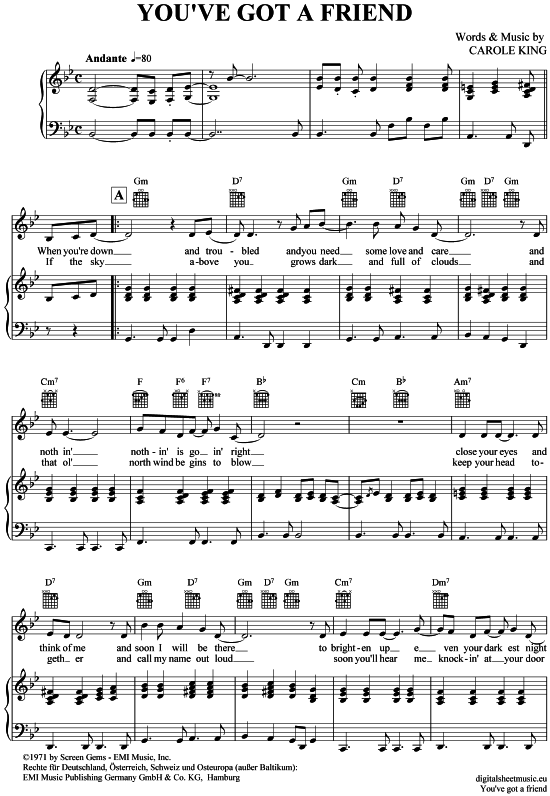
Carole King Covers: You've Got A Friend
It's possibly a fact that Ms King's best known song is in itself best known as a cover, namely the comforting and syrupy balm of James Taylor singing "You've Got a Friend", perhaps also "his" best known song. I don't know whether this can or could be proven as, with someone having a career stretching from being a Brill Building manufactured popsmith in the early 60s, to hippie chick troubador a decade later, to damn right, yes, she's still going with a bit of both and everything in between, it's difficult to work out. I guess it's in part generational, with the hepcats of '66 nodding sagely as the by then far and wigged-out Byrds phase their way through "Goin' Back", or the soulsters grooving to Aretha and "...Natural woman", so my generation picked up on "Tapestry", through her old friend and guitar slinger lifting a song from it as his break through single. But this isn't about sweet baby James, being more a tribute to some of the less well travelled versions. (Or is that so far travelled?)
I remain uncertain whether this is the worst thing I have ever heard or whether it is worse even than that, inescapably making me see the Muppets in my minds eye, so expertly do Bing Crosby and Fred Astaire channel Fozzie and Kermit. From the hideous patronising patronage of "contemporary" to the plodding singalongagramps of the performance, any nostalgic buzz for, say, "The Little Drummer Boy" evaporates.
Let's try something a bit more up-tempo, yeah, a James Brown influence:
Nooooooooo, take it off, take it away. Hideous even more than the old groaning above, is this supper club travesty really that Fred Wesley, those J.B.s? No wonder the album was "The Lost Album". I would.
Let's try again, some UK 80s indie, that'll be something, eh?
The Housemartins were the short-lived first band of Paul Heaton, later of "The Beautiful South" as here, and Norman "Fatboy Slim" Cook. And this version of the song is awful.
I'm beginning to lose faith and falter here. I mean, how difficult can it be? Hell, premium cover version listings site, Second Hand Songs, lists 125 versions. OK, so the list includes everyone from Billy Ray Cyrus to Barry Manilow, and God knows who in between.
One more, some late 90's acid jazz:
Brand New Heavies were/are a UK originally instrumental band forming in the mid 80s, diversifying into a somewhat bland vocal hybrid between jazz, funk and nods toward hip-hop and dance music, with a string of sultry southern US vocal divas passing through their ranks, Carleen Anderson and N'Dea Davenport being perhaps the 2 best known, but with Siedah Garrett on the above, a minor hit in the UK. Tellingly, it was not even on the US copy of its parent album. I have to say it's the best of the lot I have found today, if purely by virtue of comparison.
So what's my point? Is it a good song? Well, I had always thought so, but maybe there is rather more of the Brill Building professional hit maker weave in "Tapestry" and "You've Got A Friend" than first hearing makes believe, hence the ease with which it sheds any credibility into a nylon leisure suit of schmaltz. And thus, maybe it is just the consummate interpretation skill of Taylor that embues it with any subtlety at all, although, to be fair, the original is pretty damn good too. Carole King was trained to write songs that would sell. 125 versions is a lot of versions and, by virtue of the names mentioned, hideous though to my ears, a lot of royalties. Success by any marker.
Finally, by way of a lift to my sorry conclusion, was it a fluke? Has the song got the capability of rising above it's apparent formula? Well, who better to give us that answer than the writer and the singer already mention, both here together, a mere 5 years ago.
Praise be! No fluke. Song good, interpretations vary............
Posted by Seuras Og at 11:05 AM View Comments
Labels: Bing Crosby, Brand New Heavies, Carole King, Carole King Covers, Fred Astaire, Fred Wesley, James Taylor, The Housemartins
Sunday, November 15, 2015
Carole King Covers: Don’t Bring Me Down
[purchase]
Last week, I watched all 10 episodes of Aziz Ansari’s great new Netflix series Master of None. In addition to being very funny, the show deals head on with issues of racism, sexism and ageism, among other “isms.” So, when I thought about suggesting a cover song theme for the next two weeks, I became sensitive to the fact that over the years we have done nine other themes focusing on cover songs, and in each case, but one, the spotlight artists were male. Joni Mitchell was the only featured woman. (And as I write this, I realize that all nine artists are white, something that also needs to be addressed). And that’s how we ended up with a theme highlighting Carole King Covers. (That’s a lot of “K” sounds, so it must be funny.)
Next year is the 45th anniversary of the release of Tapestry, which was King’s second solo release. It established her as a commercial success as a performer, and is still one of the largest selling albums of all time. Pretty much every song on the album is great, and I loved it when I was a kid, but it is, honestly, not an album that I pull out to listen to anymore. I hope that some of the other writers here write about covers of songs from Tapestry, and I might down the road, but not today.
By 1971, when Tapestry was released, King had already had a 20 year long music career, beginning with her appearance on the Horn and Hardart Children’s Hour as an 8 year old, recording demos in high school with her friend Paul Simon, and, while attending Queens College, writing songs for others, mostly with Gerry Goffin, from an office in the famous Brill Building in Times Square. The number of hit songs she turned out is stunning, as is the breadth of styles—artists as diverse as Aretha Franklin, The Monkees, The Shirelles, Herman’s Hermits, The Drifters and even The Beatles recorded covers of her songs. The Broadway show Beautiful does a nice job bringing this to life, as well as discussing King’s later career. It is, of course, a cleaned up, streamlined version of the story, but it is very entertaining.
The Animals, led by singer Eric Burdon, were created in the early 1960s, and featured a gritty, blues based sound. In 1964, they released their signature song, a cover of the traditional blues song, “House of the Rising Sun.” Their producer, Mickie Most, reportedly called into the offices of Screen Gems music, then run by Don Kirshner, looking for songs. A furious competition ensued among the various writers and teams, which ultimately resulted in three hits—“We Gotta Get Out Of This Place,” written by Barry Mann and Cynthia Weil (who were friends and rivals of Goffin and King), “It’s My Life,” written by the team of Roger Atkins and Carl D’Errico, and “Don’t Bring Me Down,” a Goffin/King composition, which was the last hit for the band, before it was renamed “Eric Burdon and The Animals," before breaking up. (Burdon re-formed the band, with new members and a psychedelic style after moving to California in 1966, although the old incarnation also had reunions.)
I had the opportunity to interview David Johansen, I believe in 1981, when he appeared in Trenton at City Gardens. I might even have introduced him. Johansen is one of those musicians who has successfully reinvented himself over the years, from his days fronting the legendary New York Dolls, which was followed by a solo career under his own name, to his partying alter-ego Buster Poindexter and his more recent country-blues work with The Harry Smiths. I was, and continue to be a big fan of the music he released in the early ‘80s, particularly his first three albums, David Johansen, In Style, and Here Comes the Night, all of which received heavy airplay on my radio shows.
Shortly after I graduated from college, and regrettably left the radio world behind, Johansen released a great live record, Live it Up, which capitalized on his justified reputation as a great concert performer. The collection kicks off with an intense medley of the three songs that Mickie Most bought for the Animals from Screen Gems, including a great version of “Don’t Bring Me Down.” Not only is Johansen in total command of the material, his band is tight. It included guitarists Huw Gower, who power pop lovers might know best as the guitarist on The Records’ incredible “Starry Eyes,” and Dave Nelson, who was in Nektar, New Riders of the Purple Sage and The Turtles, as well as keyboard player Charlie Giordano, who now plays with the E Street Band and drummer Tony Machine, who had been in later versions of the New York Dolls.
Posted by Jordan Becker at 3:53 PM View Comments
Labels: Aretha Franklin, Buster Poindexter, Carole King, Carole King Covers, David Johansen, Eric Burdon, Gerry Goffin, Herman's Hermits, New York Dolls, Paul Simon, The Animals, The Beatles, The Drifters, The Monkees
Wednesday, November 4, 2009
Cool Kidsongs: Really Rosie
Carole King: Really Rosie
Carole King: Pierre
[purchase]
Remember when you were younger and wanted to put on a show? - through the combined magical genius of a favorite author of children's books and a famous composer of pop music, Rosie and the Nutshell Kids do exactly that...
A half-hour animated television special aired in 1975, based on Maurice Sendak's books The Nutshell Library and The Sign on Rosie's Door and directed by Sendak, with Carole King (of Tapestry fame) voicing the title character.
The story revolves around a demonstrative little girl who used to sing and dance on the stoop of her building, which Sendak observed while he was a little boy growing up in Brooklyn - the plot follows a hot July Saturday in the life of neighborhood friends Pierre, Alligator, Johnny, and Chicken Soup, who are bored... and Rosie, the self-proclaimed sassiest kid on the block of Brooklyn's Avenue P, who entertains everyone by imagining herself as directing and starring in a movie musical about her exciting, dramatic, funny (and slightly exaggerated) life....
"A kids' album even grown-ups can love. A." ~ Entertainment Weekly
"Captivates taller listeners as well." ~ People
Posted by Susan at 10:15 PM View Comments
Labels: Carole King, Cool Kidsongs
:format(jpeg):mode_rgb():quality(90)/discogs-images/R-597426-1455116282-5215.jpeg.jpg)