












Showing posts with label The Weavers. Show all posts

Thursday, March 10, 2022

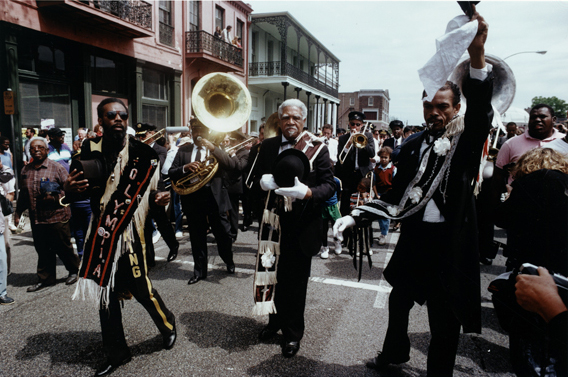
Marching: When The Saints Go Marching In

Although the month of March is named after the Roman god of war, Mars, while the English verb “to march” is derived a different source, the Old French “marcher,” meaning "to stride, march, walk," we here at SMM seem to insist on tying the two together, which is why most of the songs that would have marched into my consciousness for this theme already did so in prior years, leaving me not without options, but without options that I cared to write about. 

But one of the things about being among the last remaining regular writers on this site, which has gone through dozens since it started back in 2008, is that it is important to try to write at least once, if not more, for each theme, so I realized that Mardi Gras was just over a week ago, and therefore a discussion of “When The Saints Go Marching In” would work. And, in a tip of the hat to another of the other remaining regular SMM contributors (and recent birthday boy), Seuras Og, I’m going to model my post on one of his regular formats. 

Like many standards, the origins of the song are unclear. It seems that there were a number of gospel/spiritual songs with similar titles, but in 1923, the Paramount Jubilee Singers recorded a song similar to the one we all know and love, titled, “When All The Saints Go Marching In:”


Other recorded versions of the song, with varying lyrics, were recorded throughout the the 1920s and 30s, often becoming less hymn-like and more uptempo, but the song’s popularity really started when Louis Armstrong recorded a version in 1938, which also cemented the song’s identification with New Orleans:


There are probably thousands of covers of this standard, especially if you include every Dixieland or brass band that does it live (and on video....), but we will look at a few notable ones, in roughly chronological order: Here’s a peppy, folk approach from The Weavers in 1951:


Not surprisingly, Mahalia Jackson returned the song to its gospel roots in 1955:


Elvis Presley, and the rest of the “Million Dollar Quartet (Jerry Lee Lewis, Carl Perkins and Johnny Cash), did a loose rockabilly version that wasn’t released to the public until 1990:


In 1956, Sister Rosetta Tharp started turning “The Saints” into a rock ‘n’ roll song:


And Fats Domino finished the transformation in 1958:


Judy Garland and Liza Minnelli took a more pop approach when they performed the song in 1964:


The following year, Lester Flatt & Earl Scruggs, not surprisingly, took “The Saints” in a bluegrass direction:


Jumping forward a few decades, here’s a traditional take by New Orleans’ Preservation Hall Jazz Band from 1983:


In the mid-2000s, Bruce Springsteen regularly performed the song, in a pretty subdued arrangement, on his Seeger Sessions tour, with this version from 2006 being released on the Live in Dublin album:


Look, I could go on forever, and some of you may think I already have, so I’ll close this out with a version from New Orleans’ great Dirty Dozen Brass Band from 2012 that is pretty traditional (and a bit funky) and loads of fun:

Friday, March 8, 2019

Lion/Lamb: Mbube/The Lion Sleeps Tonight

[purchase]

On the one hand, trying to write about the history of this song seems to be biting off more than I want to chew, and yet, despite the popularity of the song, and the publicity about its twisted backstory, it may not be known to all of the readers of this blog.

If you are interested in more than this summary, check out this, or this, or this.

The song that we know now as “The Lion Sleeps Tonight” was originally written by Solomon Linda, an illiterate black man born in the Zulu lands in South Africa in 1909. He led an a capella band, the Evening Birds, and wrote a song for them called “Mbube,” which means lion in Zulu. It was inspired by Linda’s childhood work as a cattle herder, who had to protect the flock from hungry mbube.

The song, and its style, were so popular that its title became the name for the style. Its release in 1939 by Gallo Records was a success and the song became popular in Europe during the 1940s, ultimately selling over 100,000 copies, despite, you know, World War II, making it the first African record to reach that level of sales. The great ethnomusicologist Allan Lomax played a copy of Linda’s record for his buddy Pete Seeger in 1949. Mishearing the lyrics as “Wimoweh” (a not unreasonable position if you listen to it), ultimately Seeger arranged the song for the Weavers (and a full orchestra).

Linda, poor and likely unaware of the burgeoning popularity of his song, sold the rights for pennies to the studio (and also took a job at the company’s packing plant). And Seeger, who apparently believed the song to be a “traditional” song (note that the label of the 78 in the video above doesn’t credit a writer), credited his version of the song to "Traditional", with arrangement by "Paul Campbell,” a pseudonym that the Weavers used to get writing royalties, thus meaning that Linda (or the company he sold the rights to) got nothing.

“Wimoweh” became a big hit for the Weavers, and a part of their standard repertoire, including in a famous performance at Carnegie Hall. It also became a popular song for other folk groups to record, including the Kingston Trio (who credited the song to the fictional Campbell and the real Linda). South African singer Miriam Makeba recorded the song in 1960 as “Mbube,” and credited it to “J. Linda” (and she sang it at JFK’s birthday party, right before Marilyn Monroe’s more famous performance.)

The next year, George David Weiss was hired to arrange a pop version of “Wimoweh,” and he wrote the lyrics for what became known as “The Lion Sleeps Tonight,” which was released by the Tokens, and became a No. 1 hit. The song was credited to “Albert Stanton,” a pseudonym for Al Brackman, who was the partner of Howie Richmond, Pete Seeger’s music publisher. There have been hundreds of covers of the song, in all of its various guises, over the years--even by Brian Eno--and it has been used in movies and plays, most notably the productions and soundtracks of The Lion King.

In a just world, this money would have gone to Solomon Linda, or his descendants. Of course, this is music publishing, so you know that didn’t happen. It appears that Eric Gallo, who bought the rights to the song from Linda, had cut a (bad) deal with Richmond, exchanging the rights to the song for the right to administer it in South Africa and other small markets. Seeger eventually discovered that Linda was the original writer of the song, and wanted his share of the royalties to go to him. He entered into a contract with Linda for this purpose, and directed his publishers to keep sending Linda his share of any royalties. It appears, though, that this didn’t really happen. Seeger later pleaded ignorance, saying, “I didn’t realize what was going on, and I regret it. I have always left money up to other people. I was kind of stupid.” Not only that, but it appears that Linda and his heirs were basically shut out from royalties from “The Lion Sleeps Tonight.”

In 1991, there was an arbitration among some of the rights holders to the songs, at the end of which, the Linda family is awarded 10% of writers’ performance royalties. So very little of the money generated from the song’s huge Lion King popularity made it to them, and they continued to live in poverty.

But, like the popularity of the song, the story wasn’t over. A South African writer, Rian Malan wrote an article in Rolling Stone, which is linked above, explaining in detail the sordid details summarized above. That article spawned an Emmy winning documentary, A Lion’s Trail. Which led to a lawsuit. That lawsuit, however, was not a sure thing—Linda had sold the rights to “Mbube,” and his wife and daughter each did the same. But Disney, the defendant, decided that it didn’t want the bad publicity, and settled the case, confidentially, as is common in such settlements, but which required them to pay certain royalties, both back and going forward, to the Linda family.

So, while justice was not really served, significant injustice was mitigate.

Friday, January 1, 2016

Top 10 Posts of 2015


We briefly interrupt our annual In Memoriam theme to start a new tradition—highlighting the 10 most viewed posts of 2015.

The variety of music discussed on this site is broad, and our international roster of writers brings different perspectives to their pieces. One of the great things about Star Maker Machine is that it gives our writers a forum to write about anything they want, as long as they can relate it, in some way, to our bi-weekly theme. In our top 10, there are personal memories, political and social discussions, remembrances of those who have passed, brushes with celebrity, and even just posts about songs, music and musicians. This list includes discussions of folk, rock, old-time pop, klezmer, and spoken word.

So, in case you missed them, here are the most viewed posts from the last calendar year. But they are only a small sampling of what you will find in our archives, which we invite you to explore.

1. Where I Live—Tarrytown
2. Self-Reflection—Wilco (The Song) 
3. LightDarkness—From Light to Darkness with Richard & Linda Thompson
4. Songs South—The Southern Thing/The Three Great Alabama Icons 
5. The Future—Somewhere Down The Road 
6. Brush With Celebrity—Jean Shepherd
7. Self-Reflection—You Turn Me On I’m A Radio 
8. Light—Harbor Lights
9. Non-Christmas Holiday Songs—Happy Joyous Hanukkah
10. Water/Wet—California, The Beach Boys

And there is more to come in 2016.

Sunday, March 1, 2015

Where I Live: Tarrytown

[purchase]

I live in Tarrytown, New York, a village in the Town of Greenburgh, in Westchester County. We are located on the eastern bank of the Hudson River by the Tappan Zee Bridge.

I grew up on the other side of the Hudson, in New City, which is in Rockland County. At the time my parents moved there it was the less developed side. Commuting to New York from Rockland was difficult—if you didn’t drive, you either took the bus and dealt with the tight spaces and traffic, or took the train, which had a sporadic schedule and left you in Hoboken, New Jersey, where you then transferred to the PATH train into the city. When it came time for my wife, young son and I to leave Manhattan, I strongly preferred Westchester, where Metro-North trains run regularly and pretty consistently, directly to Grand Central Station. I suggested to my wife that I would be willing to move as far north as Tarrytown, which was the first express stop north of Yonkers.

And that’s where we ended up, and boy, did that turn out to be a lucky break.

Although far from perfect, Tarrytown was at the time, and continues to be, a great little village. It has the river, a nice business district and excellent schools (don’t be fooled by the statistics—for many reasons, they really don’t tell the true story). Most of all, it has great people. Our village has a great mix, including people like me, who moved here to commute to New York, lots of people who were born and grew up here, and a large population of recent immigrants, many from Central and South America, making it a remarkably diverse and interesting town. Sure, we have our moments of conflict, but for the most part, people get along. And while some might disagree, things have even improved over the years—young families who previously might have moved to Brooklyn, or other nearby villages such as Hastings, are discovering the charms of Tarrytown, including a number of excellent restaurants and shops, a great coffee shop, and a relatively new riverwalk. Not to mention, one of the great live music venues around, the Tarrytown Music Hall.

Forbes recently ranked Tarrytown as one of the 10 prettiest towns in America (which is a big country, with lots of pretty towns), and the real estate blog Movato ranked it as the second best place to live in New York State (which is a big state, with lots of good places to live). Now that I work here, I’ve come to appreciate it even more.

We also have some pretty interesting history. Tarrytown is where British spy John André was captured, exposing Benedict Arnold’s plot (yes, I have worked him into this blog again). It was also the home of Washington Irving, whose Legend of Sleepy Hollow takes place in the village just to our north (with which we share a school district and many other things, including a superb AYSO program) has turned our area into the home office for Halloween, and the fictional locale of an entertainingly insane television show (which, while shot in North Carolina, occasionally shows an establishing shot of the real thing).  Abraham Lincoln's funeral train stopped here, and FDR's passed through on its way to Hyde Park.

Until the completion of the Tappan Zee Bridge in 1955, though, the area was pretty quiet (other than the occasional protest and attempted bombings at the nearby homes of John D. Rockefeller and other Standard Oil executives in the early part of the 20th century), and since then has developed like many other New York suburbs, without losing its charm. We are getting a new bridge, which is currently under construction, and the project was used as a backdrop last year by President Obama and Governor Cuomo for speeches about investment in infrastructure. I got to volunteer at the event and shake the President’s hand—although my wife’s picture made it to the front page of the local newspaper (I'm the bald guy in the back reaching out my hand).

So, yeah, we like it here.

Our song is, appropriately, entitled “Tarrytown,” although it is also called “Wild Goose Grasses.” It is based on old English (or Irish) ballads, particularly “The Butcher Boy,” which itself is based on older ballads. You gotta love folk music. It is a song about the tragic results of unrequited love, sometimes sung from the male perspective and sometimes from the female. This song is credited to John Allison, a collector of such ballads, who either wrote the words and music, or just one or the other, or neither, depending on what you read. You gotta love folk music. This version is by the Weavers, and there are others out there, including by Harry Belafonte, the Brothers Four and one from the 1970s by Pete Seeger and Ed Renehan, from an album of songs relating to the Hudson River.