












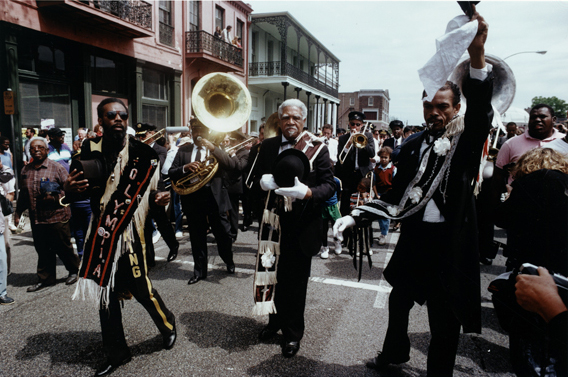
Showing posts with label Dirty Dozen Brass Band. Show all posts

Thursday, March 10, 2022

Marching: When The Saints Go Marching In

Although the month of March is named after the Roman god of war, Mars, while the English verb “to march” is derived a different source, the Old French “marcher,” meaning "to stride, march, walk," we here at SMM seem to insist on tying the two together, which is why most of the songs that would have marched into my consciousness for this theme already did so in prior years, leaving me not without options, but without options that I cared to write about. 

But one of the things about being among the last remaining regular writers on this site, which has gone through dozens since it started back in 2008, is that it is important to try to write at least once, if not more, for each theme, so I realized that Mardi Gras was just over a week ago, and therefore a discussion of “When The Saints Go Marching In” would work. And, in a tip of the hat to another of the other remaining regular SMM contributors (and recent birthday boy), Seuras Og, I’m going to model my post on one of his regular formats. 

Like many standards, the origins of the song are unclear. It seems that there were a number of gospel/spiritual songs with similar titles, but in 1923, the Paramount Jubilee Singers recorded a song similar to the one we all know and love, titled, “When All The Saints Go Marching In:”


Other recorded versions of the song, with varying lyrics, were recorded throughout the the 1920s and 30s, often becoming less hymn-like and more uptempo, but the song’s popularity really started when Louis Armstrong recorded a version in 1938, which also cemented the song’s identification with New Orleans:


There are probably thousands of covers of this standard, especially if you include every Dixieland or brass band that does it live (and on video....), but we will look at a few notable ones, in roughly chronological order: Here’s a peppy, folk approach from The Weavers in 1951:


Not surprisingly, Mahalia Jackson returned the song to its gospel roots in 1955:


Elvis Presley, and the rest of the “Million Dollar Quartet (Jerry Lee Lewis, Carl Perkins and Johnny Cash), did a loose rockabilly version that wasn’t released to the public until 1990:


In 1956, Sister Rosetta Tharp started turning “The Saints” into a rock ‘n’ roll song:


And Fats Domino finished the transformation in 1958:


Judy Garland and Liza Minnelli took a more pop approach when they performed the song in 1964:


The following year, Lester Flatt & Earl Scruggs, not surprisingly, took “The Saints” in a bluegrass direction:


Jumping forward a few decades, here’s a traditional take by New Orleans’ Preservation Hall Jazz Band from 1983:


In the mid-2000s, Bruce Springsteen regularly performed the song, in a pretty subdued arrangement, on his Seeger Sessions tour, with this version from 2006 being released on the Live in Dublin album:


Look, I could go on forever, and some of you may think I already have, so I’ll close this out with a version from New Orleans’ great Dirty Dozen Brass Band from 2012 that is pretty traditional (and a bit funky) and loads of fun:

Saturday, June 29, 2019

(IN)DEPENDENCE: SEVEN DRUNKEN NIGHTS


Summer days, a holiday, time on your hands, so where does that take you? Yup, quite possibly here, happy juice, the water of life, the scourge of society that keeps us loose at the edges. Context clearly is all, so here's my disclaimer, but I'm off to Turkey today, where, so far, the grog is still legal. So some unashamed odes to the results of overdoing it. (Kids: just say no.............)


Why is it always country music that is the first thought for hooch ditties? Probably on account the inescapably deep well of inspiration the drink has offered the singers and writers, from Hank through, well, Hank Jr, Hank III, everyone really. This old staple, 'Drunkard's Dream' comes from the well worn hand of trad.arr. and was popularised in the 1920s, via an initial transit from the folk songs of old england. (Original title 'Husband's Dream', surely casting a slur on the effects of matrimony.) This version comes from an excellent 1972 recording by Gene, not Gram, Parsons, although he too was both a Byrd and a Burrito.  Covering all tropes in the country diaspora, 'Kindling' is a record that still gives me pleasure.


But before I forget, a message from our sponsor. No, don't do that neither, but I make this point, together with an instrumental version of this Stevie Wonder classic to avoid the wisecracks around don't drive blind, inevitably greeting the song as Steveland sung it. O my aching sides. Not. In the N'Awlins marching band tradition, the Dirty Dozen Brass band come over as no strangers to an ice cold pitcher.


A hit for Johnny 'Guitar' Watson before he was Johnny 'Guitar' Watson, this 1953 toe-tapper was billed as being by Young John Watson, only shortly after he ditched playing piano for guitar. With a vast catalogue behind him, in blues and, later, in jazz, he was hitting his 40s as he reinvented himself as a sharp-suited and booted funkateer. Sadly, on the crest of yet a 3rd breakthrough, he died, on tour, in 1996.


It's back to country, this time to the dynasty of Cash/Carter. Actually daughter of June, she was step-daughter to Johnny and step-sister to Rosanne, learning her chops on the road from an early age, in the family band. Arguably a wilder child than her near sibling, she ended up in London after a couple of failed marriages, cutting an album with Graham Parker's Rumour on backing duties. a year or so later saw her hooking up with Rockpile, married to the bass player, Nick Lowe, once of Brinsley Schwarz, producer to Elvis Costello and later (and still) a name in his own right. This track comes from 'Musical Shapes', the album arising out of that relationship, never as much of a success as it deserved to be.


The title of this charming song possibly comes ahead of the last one, as, if you can remember what you failed to accomplish, that implies memory. In the real world, or so I am reliably told, being TDtF, is, however, more often relegated to the wastes of TDtR, few being upstanding enough to joyfully recall such peccadilloes with honesty or candour. Upstanding perhaps the wrong choice of word. I find the original of this song, by the Dead Kennedys, a little too full on for my taste, this gallic take offering a more sophisticated european stance on blotto.
Brewers Droop were a UK blues-rock band in the early 70s.


Well, that's what any self-respecting drunk, if that is not an oxymoron, would say, don'cha think? Actually written by the devoutly teetotal Richard Thompson, apparently his avoidance of alcohol came more through his personal experiences on the road with the famously convivial Fairport Convention*, rather than his later conversion to Islam. (*It's number 4.) Norma Waterson is from the fabled folkie family, the Watersons, mother of Eliza, husband to Martin Carthy. Mean nothing? Go check.......


We're back in N'Awlins again, via Sweden, where this bluesman was born. I suspect he knows here what he was singing about, struggling with his own demons of addiction until a decade ago, now channeling many of his efforts into 'Send Me a Friend', a charity/self-help group to help musicians struggling with similar.


Ha! You know you can't have the above, like the Dubliners who provided the portal for this piece, without some form of payback. Squeeze, themselves no strangers to the odd ditty round the manifestations of a life liquoric , or rather Difford/Tillbrook, the writing team, actually pitched this song to Frank Sinatra, laughably thinking the subject matter might be up his street. Sadly, he declined, but that doesn't matter now.

I hope your heads will be fine after this tribute to Bacchus and his many and varied gifts.
Cheers.
And plink plink fizz.
Imbibe away.......


Tuesday, September 18, 2018

Amaze: Amazing Grace


The Dirty Dozen Brass Band: Amazing Grace
[purchase]

I feel like I need to hurry if I want to write about this song for this theme, because it seems like a pretty obvious choice—and I can’t think of too many other relevant songs to write about. And hey, if other writers want to feature the song, have at it, and I’ve already handled the history for you.

“Amazing Grace” is a hymn, and the lyrics were written by the English poet and Anglican clergyman John Newton, way back in 1772 or 1773. Before Newton had those highfalutin’ gigs, he was a seaman. In fact, in 1743, he was pressed into naval service by the Royal Navy—think, walking down the street, being kidnapped and tossed onto a ship.

During his service, he was flogged, recovered, and was transferred to a slave ship. He was so disliked by the crew that they left him in West Africa, with a slave dealer, who turned Newton over to his wife, a Princess of the Sherbro people, in what is now Sierra Leone. She promptly enslaved Newton. After three years of abuse and servitude, Newton was rescued by a captain who had been asked by Newton’s father to find him.

During his trip back to England, Newton had a “spiritual conversion,” because he believed that his prayers convinced God to save his ship from a storm. From March 10, 1748, Newton “avoided profanity, gambling, and drinking.” However, when he got back on dry land, he quickly returned to sea on a slave ship, apparently not recognizing irony in any form. Newton continued to become more religious, and continued to work in the slave trade until 1754, when, it appears, God intervened by giving him a stroke, keeping him from trading in humans. Although he did invest in slaving ventures.

In the late 1750s, he ecumenically applied to be a minister in the Anglican, Methodist, Independent, and Presbyterian churches, before being ordained as an Anglican priest in 1764. It seems as if he was a pretty good one, too, and not adverse to non-Anglican views. In 1788, he publicly admitted that the whole slave thing was bad, and supported ending the trade, which England finally got around to doing in 1807 (about the same time as the US did, although as we know, that was small comfort to those already in bondage).

Newton’s hymn, based on his own life experiences, "1 Chronicles 17:16–17, Faith's Review and Expectation" led off with the killer opening stanza:

Amazing grace! (how sweet the sound) 
That sav'd a wretch like me! 
I once was lost, but now am found, 
Was blind, but now I see. 

The hymn failed to chart in Britain, but was a smash hit on this side of the pond, especially during the Second Great Awakening in the early 19th Century, and has become a standard African American spiritual song and was a civil rights anthem.

Nobody knows what, if any, music was used when Newton first led his congregation in the hymn, and there were many different tunes that were used over time, before “New Britain” stuck, and has become the standard version. Although “House of the Rising Sun,” works pretty well, too (better than the theme to Gilligan’s Island).

For reasons that are quite boring, today, I’ve been thinking of my father, who for some reason often remarked that he wanted a New Orleans-style funeral when he died. I wonder if that is where I got my love of New Orleans brass band music, although I doubt it, because I never remember him actually listening to any of it.

Not too long before he died, I bought a copy of The Dirty Dozen Brass Band’s album Funeral for A Friend, which includes many of the songs that are played at New Orleans funerals—in fact, the album is dedicated to the memory of founding member Anthony "Tuba Fats" Lacen, who passed away shortly after its completion. To quote Allmusic at length, because reviewer Thom Jurek nails it, stating that the album:

is resolved in the celebratory gratitude for mercy in "Amazing Grace." But this review does nothing, literally, to describe the sheer power of the transference of emotion that Funeral for a Friend does. This is easily the most heartfelt, honestly rendered, and stunningly captured moment of the DDBB's recording career; it belongs in every household where the celebration of life and its transition from the sorrow of death to the eternal afterlife is honored. It is not only a classic in the genre, but will come to be regarded as a jazz classic, period. 

I’d note that the version is instrumental, so it really is “New Britain,” but that’s being picky.

In lieu of the full on procession, we played the album as people entered into the celebration that we had for Dad’s life, and I think he would have been fine with that.

Sunday, August 2, 2015

It’s Elemental --> Big Bands: The Main Event: Tornado Special/Waterfalls/Ooh Nah Nay/Rebirth on Fire


Rebirth Brass Band: The Main Event: Tornado Special/Waterfalls/Ooh Nah Nay/Rebirth on Fire
[purchase]

I’ve often, and probably annoyingly, stated that, in music, everything is better with a horn section. That may well be true in life, too, I mean wouldn’t it be great to go to work, but always have a horn section around?

Starting probably with watching the great HBO series Tremé, I began to learn about New Orleans brass band music, and realized that it was, pretty much, all horn section (and drums, which are also great). What is incredible about this music is that it starts with a base of traditional marching band songs and layers on funk, soul, rock, R&B and rap into an incredible, infectious mix. So, when I went to New Orleans in June, one of my goals was to hear some brass band music in its native environment.

This plan paid off almost immediately, because our first day in the Crescent City included a walking tour of the French Quarter, and while we waited for the guide in Jackson Square, we got to hear a great band playing for tips outside the park. I linked to a video of them in my last New Orleans piece, but here’s a different one. And, as I also previously wrote, as part of the wedding that was the excuse for the trip, we second lined behind the Kinfolk Brass Band, who then played during the cocktail hour at the reception. Then, we went to hear Musical Expression, a group of seven college-age musicians featuring mostly horns, at the Maison on Frenchmen Street, and on the way back to the hotel after their show, in a cab, we passed a large band of young kids, maybe high schoolers or even younger, playing brass band music on the street.

Which brings me to the featured song, or songs, from a live album released in 1999 by the Rebirth Brass Band. Formed in 1983 by brothers Philip (tuba/sousaphone) and Keith Frazier (bass drum), along with trumpeter Kermit Ruffins and other members of the marching band from the Joseph S. Clark Senior High School in the Tremé neighborhood, I’m willing to bet that they started playing on the streets, too. Along with their predecessors, The Dirty Dozen Brass Band, and other like-minded musicians, Rebirth helped to revitalize the brass band genre by updating the sound, and by putting on intense, powerful live performances.

This live album was recorded in 1999 at the Maple Leaf Bar, a venerable New Orleans institution (where Rebirth currently appears to play regularly on Tuesdays), and you can almost feel the heat in the room. Settle in for almost a half hour of continuous music, starting with an original piece, “Tornado Special,” (an Air reference) which then segues into a cover of TLC’s “Waterfalls” (Water), which turns into the Mardi Gras Indian chant “Ooh Nah Nay,” and ends with a revised version of the 1984 Rock Master Scott & the Dynamic Three song, “The Roof Is On Fire” (Fire) You pretty much have all of the “elements” of the style, all in one medley. Playing that night was a pretty big band-- Phil Frazier (sousaphone), Keith Frazier (bass drum), Derek Tabb (snare drum), Shamarr Allan (trumpet), Glen Andrews (trumpet), James Durant (saxophone), and Tyrus Chapman (trombone).

Rebirth’s music was featured in a number of Tremé episodes, including the season 2 finale, which was named after their song, “Do What You Wanna.” In fact, late in the episode, a band of high school students plays the song on Frenchmen Street, maybe right where my wife and I saw the kids playing that night, and a few scenes later in the episode, Rebirth is shown playing at the Maple Leaf. Unfortunately, HBO is very good at taking down illegal videos of the episode, so I can’t link to it, but if you haven’t watched Tremé, you should.

Wednesday, December 21, 2011

Holiday Classics: Mele Kalikimaka


Poi Dog Pondering with The Dirty Dozen Brass Band: Mele Kalikimaka

[purchase]

I must apologize to one of our readers, who sent me an e-mail to request T-Bone Burnett’s version of God Rest Ye Merry Gentlemen during our Offbeat Holiday Music week. I did not post it then because I knew that it would fit this week’s theme better. But I’m not posting it now either, because the album it comes from, Acoustic Christmas, has another song I wanted to post more: Mele Kalikimaka. The song was written by R Alex Anderson in 1949. A year later, it was a hit for Bing Crosby and the Andrews Sisters. Oddly, the notes in the Acoustic Christmas album list the song as traditional. Mele Kalikimaka is an example of a Hawaiian musical genre called Hapa haole, in which Hawaiian phrases or pidgen English ones are sprinkled into mostly English lyrics, and native Hawaiian rhythms are used. The words Mele Kalikimaka are what apparently happens when a native Hawaiian tries to say Merry Christmas.

The version heard here is a collaboration between Poi Dog Pondering and The Dirty Dozen Brass Band. That was either going to be a nightmare or a blast. I’m happy to say that it was the latter.

Saturday, January 30, 2010

Live: Dance Party Edition


I have been to classical music and jazz concerts, and even a performance by Ravi Shankar, where the audience sat and listened. Yes, these were exciting shows, displays of wonderful artistry. Folk and rock shows can be like that too. And I would gladly go. But sometimes, the performance presenter needs to make sure that there are no seats clogging up the hall, because it’s time to dance!

Big Bad Voodoo Daddy: Oh Yeah

[purchase]

Oh Yeah, indeed. The horns are blowing, the rhythm is tight, and no one has to be told to “get on up”. Big Bad Voodoo Daddy show exactly why they were one of the best new swing bands of the 90s.

Delbert McClinton: Standing on Shaky Ground

[purchase different live version]

Standing on Shaky Ground was written by Walker Ickard, but claimed by Delbert McClinton. McClinton started out backing touring blues musicians, before going on to have hits on the country, pop, and R & B charts. He is one of those artists who is best known to other musicians. His Standing on Shaky Ground really cooks.

The Dirty Dozen Brass Band: Don‘t You Feel My Leg

[purchase studio version]

As the night progresses, there is a point in the show where the band takes the pace down a bit. Now is your chance to get closer to the one you’ve been dancing with at such a furious pace. But how close is too close?

The time is Halloween night, 1993. The scene, Tramps in New York City. As the rest of the Dirty Dozens lay down a groove, front man Gregory tells the tale of an encounter with a rabbit. Then the band goes into a slow burn for a tale of intimacy gone awry. This one comes with a rudeness warning for younger ears.

The Uptones: Rude Boy

[purchase different live version]

And then it’s time to ramp it up again, for a dance that leaves them wanting more. As with much of The Uptones’ work, this one straddles the line between reggae and ska. There is even a dub break toward the end. In reggae, dub is an effect usually created in the studio, but here The Uptones manage it from the stage. It’s a nice trick, and they manage it not only without losing the beat, but also without dropping the energy level.

Saturday, August 23, 2008

Horns: It's All Over Now


Dirty Dozen Brass Band: It's All Over Now

[purchase]

Though the brass band sound of the second line originated in the funeral traditions of New Orleans -- the term refers to the line of musicians who followed the "first line" of mourners in traditional procession -- its association with New Orleans culture has long brought the syncopated beat and marching brass band sound to a vast array of cultural events which profess to celebrate the great city. In turn, as the musical form has found its way from the funeral to the stages and parades, and as generations of musicians have grown up absorbing its distinctive patterns as one of many influences, it has intermingled with other sounds, becoming a rich part of the tapestry of popular music.

The Dirty Dozen Brass Band, which fuses traditional second line cadences and instrumentation with the loose energy and tempo of funk, was one of the first and longest running groups to use this second line style as a platform for greatness beyond the confines of Louisiana, and thus is one of the best known; their sound was forged in the late seventies and early eighties, when an ebb in popularity for brass bands in general left them free to experiment with the form. It's All Over Now is from their Columbia Records debut, the hugely popular Voodoo, which featured horn players Dizzy Gillespie and Branford Marsalis, among others; I heard them perform this song at the New Orleans Jazz and Heritage Festival a few years later, with Dr. John sitting in as special guest, just like in the original version, and it was an incredible party.