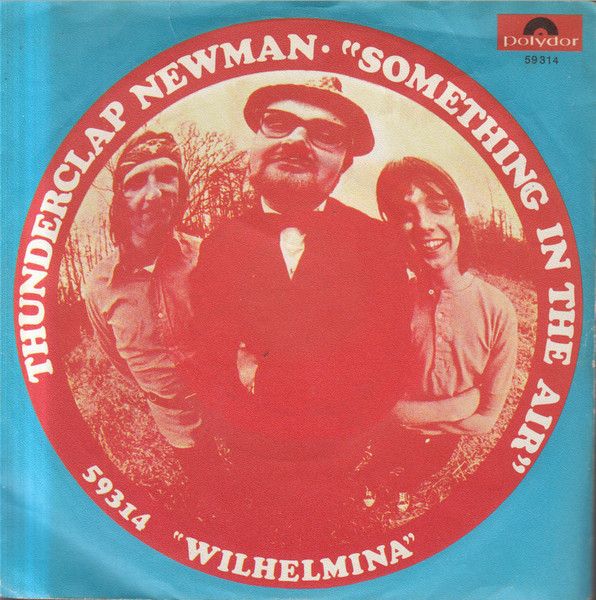
I suggested this theme during a summer thunderstorm, but when I started brainstorming ideas for a post, the band Thunderclap Newman jumped into my brain and wouldn’t leave, so there are no (other) storm references here.
Like most people, I bet, I could name exactly one song by Thunderclap Newman, the wonderful “Something In The Air,” but no others. I’ve mentioned before the “classic rock radio” syndrome (although I’ve never called it that), where bands are remembered only for a handful of songs—or even in this case, for one song—and the rest of their discography gets forgotten. I’m sure you have your favorites, and I’ve even used “Something In The Air” as an example in an earlier post. I also knew that Pete Townshend produced their album, and that he played on it, under a pseudonym, although I didn’t know what that was (Bijou Drains). But that’s pretty much it.
The band was assembled by Townshend in 1969 as a vehicle to support the songwriting and other talents of John “Speedy” Keen, who wrote “Something In The Air.” It was an unlikely crew: Keen, who had been a friend of Townshend's and a driver for the Who, had written “Armenia City in the Sky,” the opening track on The Who Sell Out. Townsend enlisted Andrew “Thunderclap” Newman, a postal worker and piano player, and 15-year-old guitarist Jimmy “No Nickname” McCulloch. They met at Townshend’s home studio, and the four recorded a single, with Townshend producing.
It was a big hit in England, was in a couple of movie soundtracks, and was a minor success in the US, initially. Followup singles were less popular, but the success of “Something” led to the band having to do live performances, augmented by a drummer and bass player who was not Pete Townshend. The band’s album, Hollywood Dream, was released in 1970, to excellent reviews, but only modest sales. After some more touring, the band broke up in the spring of 1971. As Wikipedia noted, “The members of the band had little in common. In a 1972 NME interview, Newman said that he got on with Keen's music but not with Keen personally, while the exact opposite was true with regard to McCulloch.”
Apparently, Hollywood Dreams is now considered a forgotten classic, with Allmusic stating, “So many bands have been hauled out of obscurity to be tagged the greatest secret you've never been told. Thunderclap Newman are one of the few who actually deserve that epithet.” I admit to only sampling a few tracks, and I have trouble getting past Keen’s reedy voice and the excessive music hall influences, but maybe it takes a few solid listens before the genius is revealed. And that’s why I’ve perpetuated the “classic rock radio syndrome” here, focusing on the one song we all know.
McCullough went on to play with John Mayall, Stone the Crows, and, most famously, Wings, but died from heroin-induced cardiac arrest in 1979 at the age of 26. Keen’s solo career went nowhere, and became a producer, helming Johnny Thunders and the Heartbreakers’ debut, L.A.M.F. and Motõrhead’s first album (and appears on one of that band’s live albums) and was a session musician before leaving the music industry. Keen died of a heart attack in 2002 at the age of 56.
Newman recorded an unsuccessful solo album and was a studio musician before retiring until 2002, when he formed the Thunderclap Newman Band, which toured until it disbanded in 2010. Newman formed a new band (which included Pete Townshend’s nephew Josh and the former drummer of Big Country), billed simply as Thunderclap Newman. In 2010 this group released an album, Beyond Hollywood, and toured from 2010-2012, with their last gig at the Isle of Wight Festival.
Newman died in 2016 at the age of 73.
And I’ve made you wait to the end to know why Andy Newman was known as “Thunderclap”—it was a nickname he received in school because of his playing technique.
I've got Spotify, but not seriously. My only "playlist" is the plug-in USB for the car. That said, I would not likely (and haven't) added either of these to that device.
But they are a part of my musical background - and I appreciate them for the foundation they bring (brought, as I grew up). Simon and Garfunkel were how I moved from "folk" to "rock". CSNY solidified that transition.
If I remember correctly, Homeward Bound was a hit in 65-66 when I was in the US during my parents' home leave rotation. I was more or less just starting to 'tune in"/appreciate 'hit" music on AM radio and maybe some TV (Ed Sullivan?) I remember I already had a copy of Parsely,Sage ... and some Kingston Trio- my early forays into "pop" music.
That year - in the US - I began a collection of 45s. Red Rubber Ball... I Fought the Law....
As the 70s rolled ın, my musical awakening/tastes had changed. Among other life-changing events, I had heard <Are You Experienced> and <Electric LadyLand>. Plus Janis Ian. But my LP collection at that tıme also included Smokey Robinson and Aretha. I had also actually seen Blind Faith , Little Stevie Wonder and the Supremes live in Seattle.
At the start of the 70s, I moved out of my parents' house at the age of 15 - to attend boarding school in a foreign land (the US). The Quaker boading school I had chosen was full-on anti-war, and so CSNY fit right in with "our" mindset. The school admin actually pro-actively arranged busses for students to travel to DC to join the protests.
Both <Our House> and <Homeward Bound> are too laid-back to qualify as 70s protest music, but they are emblematic of the times - in my mind. Not least of their qualities that I consider in that aspect are the vocal harmonies.
Again, for me a no-brainer, if again bringing back to these pages a fella I have championed before. But with good reason, like Difford and Tillbrook last week, he has a canon of as quintessentially English songs as has anyone. Which, considering his home has been in the U.S. for most of the last 30 years is quite something. A touch of the "Home thoughts from abroad" tucked away in there, methinks, to which end he resembles that another quintessentially English songwriter, a certain Richard Thompson. (Again, sorry Jordan.....) Whose name will pop up again, here, as you will read, having, at one time, offered gainful employ to Gregson. But first, the song, a glorious song that defines that cliche of home being where you want it to be. It isn't stated whether the protagonist is leaving England or returning there from afar and, indeed, it doesn't matter. The feel of what that home might mean is underlaid by the wonderful brass arrangement, french horn (awkwardly), that mainstay and staple of the brass and silver bands of the north of England, with their rich and evocative tones. Shorthand for old England, the last century, and particularly, the 1950s, as the makers of Hovis bread knew so well.
Gregson has had an interesting time of it, somehow retaining the same slightly bemused air of how did I get here, whether playing to a packed hall with his briefly one to watch band, Any Trouble, to huge acclaim on the folk(ier) circuit in his much loved duo with Christine Collister, or to a handful of punters in his latter-day solo iteration, playing small venues, arts centres and coffee houses. Oddly, it seems in the last he seems most at ease, guaranteed an intent and enthusiastic audience for his vast compendium of songs and self-deprecating patter. But he has seemingly hung up his capos and retired. No huge song and dance about it, a solo farewell tour sufficing. OK, and the special release of no less than 8 albums, month by month, during 2020. Covering the many and varied bases of his output, each of the 8 is themed in way way or another, allowing you to pick and choose the Gregson you prefer. His website explains it better.
RT I mentioned above, this being one of the more inspired moments of the long and illustrious career of the ex-Fairporter. I may even have told this tale before, but, as an early adopter of Clive Gregson and Christine Collister, buying their initial release, a cassette, only available from the pair directly, I had been delighted to learn they would be playing support to Mr Thompson and his band, at a much anticipated pre-Christmas concert at the Birmingham (UK) Odeon, a cinema that doubled as a music venue, and then the best night out in the city. My first capture of Gregson since the demise of Any Trouble, the two put on a great show, captivating the audience with their acoustic charm, however much prompted they were for the more electric oeuvre of the main event. So, imagine my surprise when, after the interval, on trooped the RT band, resplendent with both Gregson and Collister, she on backing vocals and he on second guitar and occasional keyboards. Wow and indeed wow! (No less than Steve Gibbons, also in attendance, was overheard to comment how this wasn't his usual bag, but how astonishing he found it.) I have probably seen Richard Thompson more than about any other performer over my years, as an electric band and also solo, but that band was possibly his strongest, yes, even more so than the arc grade wallop of his current trio. But something happened, at some stage, between Gregson and his employer. After a few years of playing live and appearing on a run of records, their ways seemed to abruptly part. The first I knew of it was a somewhat coruscating review, I think in Q magazine, by Gregson of Thompson's Mirror Blue. Which did not feature him. But the song, 'Put It There, Pal', which was a scathing demolition of an erstwhile friend, on the later You Me Us, may have. In the lyrics. I have always wondered. Collister, by the way, stayed with Richard Thompson, and will often crop up, even now, as a special guest at his shows, perhaps less so now he has married again, and has a wife who can be his vocal foil.)
Rather than linger on this episode, let me concentrate again on the subsequent years, which take in this century. This has seen the rebirth of Any Trouble, on a couple of occasions and a pair of albums, it looking for a time that an annual re-union show might be on the cards. He has toured alone, almost incessantly, or so it seemed, with also a pleasing return to a male/female duo, teaming up for a tour and an album with Liz Simcock. I always hoped it was desire rather than financial necessity that kept him on the road. In truth, probably a bit of both, but, as a Nashville domiciled songwriter for hire, I hope his royalties are, at the least, worthy of his talent.
As I researched this piece I remembered he had also, for a time, been a member of Nanci Griffith's band, as well as, later, a member of Plainsong. Later still he was the musical director for Dennis LaCorriere, the voice of Dr Hook, which makes for a varied set of skills. I haven't mentioned, either, his phenomenal technique on guitar, acoustic and electric, his competitive soloing perhaps another factor in his ejection from Thompson's band. Their extended duelling on Tear Stained Letter was always nothing short of incandescent.
I don't know quite where Gregson's current home is. Or heart for that matter, but hope they are in the same place and that retirement is kind to him. So, thanks, Clive, for all you have given to my pleasure.
Below is the other version of Home, by the CG/CC duo.
This song has nothing to do with baseball, but regular readers of my writing know that I’m a hugeMetsfan. Seriously, though. And like most Mets fans, I hate the Yankees. Not just because of their long history of winning (as compared to the Mets’ shorter, but still long, history of mostly not winning), but because they, and many of their fans, are annoyingly arrogant about it. This season, the Mets appeared to have their strongest team in years, and despite some critical injuries, still are having one of their best seasons.
And the Yankees are having a better season.
So, when the two teams met earlier this week for a brief two game “Subway Series,” the psychological stakes were pretty high (and the competitive stakes for the Mets, who are not running away with their division like the Yankees are, were very high because they need to keep winning to hold off the Braves). The stands were packed with fans of both teams, and you could tell from the TV that CitiField was rocking. Both games were exciting, and while not perfectly played, there were big hits, great fielding, and clutch pitching. And lots of drama.
And the Mets won both games.
So, Yankee(s), Go Home.
The teams will meet again in August for two games in the Bronx, and maybe my excitement will be tempered (although the worst case scenario now is a split of the season series), but when both New York teams are playing well, these games can be fun.
The song, by Richard Thompson, of course has nothing to do with baseball at all. I believe that RT lives in New Jersey these days, so, if he follows local baseball, he could be a Mets or Yankees fan (or possibly even a Phillies fan, depending on where in Jersey he is), but I suspect that he’s more of a football fan (in the British sense of the word). Here’s an article from 2014 in which he claims to have become a Chelsea supporter (boooo!). He also mentions coaching his son, and I actually remember seeing his name in the AYSO coaching database back in my volunteering days.
Instead, the song is an angry attack on American imperialism. Although it was released in 1988 on his excellent album Amnesia, the song is filled with dated references about American soldiers giving out silk stockings and chewing gum, and meeting girls in dance halls, but I don’t think that it is only about World War II, considering its references to burning effigies and gringos. Instead, it’s just a call for Americans to leave other countries alone. For the Yankees to go home.
Neither the first nor, I suspect, the last time for me to feature Squeeze, a band who have given me as much pleasure as many, and continue so to do, over, gulp, their, so far, 48 year, and counting, career. Possibly now more of a heritage act, featuring Glenn Tillbrook and Chris Difford, plus whomsoever available from the rotating door of other members and additional hired hands, they still put on a stocking show, capable of pulling surprises out the hat and even, if not that much in the way of new material, the odd, unexpected and inspired cover version. To be fair, Difford, the deeper voice to Tillbrook's higher and clearer register, often just strumming his rhythm guitar quietly side stage, with a bemused expression on his face, doesn't always bother. No lover of transatlantic plane travel, he has been known to sit out the max of world tours, even to the home of their reliable US fanbase, staying back at home in England. But Tillbrook has always done most the heavy lifting, as the main and lead voice, give or take Cool For Cats and the other episodic showpieces taken by Difford, as well as being a finely inventive lead guitarist. ( I often wonder whether the Difford free band attempt Cool For Cats, with it being one of their more popular songs? I guess I will find out one day.)
No Place like Home (1985): PLAY SECOND
Home was the obvious theme to parade this song, as it is and always has been one of my favourites. Home, and the awkwardnesses often thereof, has been a recurring feature in Difford's lyrics, his writing the epitome of kitchen sink drama, his songs often little soap operas. Cosi Fan Tutti Frutti, the album for which is is drawn, came at a difficult junction for the band. Arguably at the peak of earlier success, maybe just past, the band had broken up following 1982's Sweets From a Stranger, the lure of bangles duo success having proven too strong. And why not? Being the authors of all the songs, why tag along a band to dilute the earning potential, even if the reality was more of internal friction and the "musical differences" that had already seen Jools Holland, very much a live focus of the band, jump ship an album or so before. But Difford/Tillbrook, the duo and the eponymous album, was not the golden egg hoped for, necessitating a return to the golden goose. Squeeze were reborn, and even Jools was back to help celebrate, if but for a while. (It wouldn't be long, sadly, before he again jumped ship, taking avuncular sticksman, Gilson Lavis, off with him to his R&B Orchestra.) In fact, bar the absence of erstwhile bassist, John Bentley, this was nearly the same line up as for Argy Bargy and East Side Story, the twin lodestones of the Squeeze magic, with Keith Wilkinson coming in to replace him, fresh from the Difford-Tillbrook enterprise.
Cosi Fan Tutti Frutti was a muted success as a reincarnation, 32 in the UK album charts. I don't think the US even noticed. The songs were largely a good deal more complicated than previously and struggled with a slightly clunky production, an if in doubt add more textures school of thought. So a lot of kitchen sink. This was very much the house style of producer, Laurie Latham, who also worked for Paul Young, the Stranglers and, notably, Ian Dury: Hit Me With Your Rhythm Stick was one of his. I remember frowning a little at the time I first heard Cosi Fan Tutti Frutti, but the style grew on me. I guess, as someone with always an ear out for the bass guitar, which Latham clearly was too, given the prominence he gave Pino Palladino, JJ Burnel and Norman Watt-Roy elsewhere, I took pleasure in how high in the mix he placed Keith Wilkinson. This was the catnip that made me wonder, with time, whether this is their best album. Or favourite, as we writers mean when we say best. Tillbrook's voice is all over the place in the chorus, as the arrangement lurches about, barely holding together, an orchestra seeming to saw away in a different room and to a different backing track. I love it, and the marriage between it and the preceding track, Last Time Forever, is little short of perfect, the one seeming to lead into the other. (So, a word, play the clip below first, and then the one higher up the page, for full effect.) In fact, it was as these two tracks burst into my ears, more than likely in the car, driving, the result was an epiphany: Squeeze were back, back, back. The fact that the songs that then complete the disc were a little meh mattered not a jot, that was often the Squeeze way, where they tucked the filler and the songs by other than the two front men.
Last Time Forever (1985): PLAY FIRST
I actually got to see this line-up live, at around this time. I think it was at Birmingham's Powerhouse, a venue long gone. Previously the Locarno, it was a tacky dance hall in a the concrete monstrosity that built up around the top of Hurst Street. (Opposite Mr Egg, should anyone familiar be reading or remember, a fabled restaurant, open until the wee hours, and from the wee hours, selling all things egg, usually fried.) It was a terrific show and certainly blew the socks off the show I caught at Birmingham Odeon, a good few years before, between the debut and Cool For Cats, when they were still struggling a bit with image, uncertain if they were punks or new wave, going down the calibre tunesmithery as a result. And, in the times since, whilst good, they have never quite been that good. For good measure, here's how I found them about 6 years ago, within the content of Day 3.
Squeeze have a number of other songs about home in their canon. Indeed, home life, and all the twists and turns associated, form their most prominent feature, Difford possessing almost documentarian skills in evoking the joy and grief of the real grubbiness and shabbiness of suburban family life, of folk making the best of whatever life's allotted. Here's two more from lesser known and latter day releases. They could almost be about the same fella, objective witness and his own subjective interpretation.
The Day I Get Home (1991)
Jolly Comes Home (1993)
Well, I don't know about you, but revising these songs has put me in a truly nostalgic bent. and, like so many other bands I have decided I have seen enough of, I want to see them again. Well, next month I get part of that delivered, with Chris Difford playing a solo show at Wickham Festival, in Hampshire, UK.
I mentioned a few weeks ago that I’d been spending a lot of time preparing for my 40th college reunion, which was a lot of fun. But I want to talk today, a little, about our 25th reunion. At that time, although I was an active alumnus, in the sense that I went to reunions and sporting events and was proud of my college, I did little or no volunteer work for my class or school. In my mind, the reunion just sort of happened, and although I knew that classmates were involved in organizing it, I had no clue as to how much work it takes, and how hard it is to do it. I know now. Trust me, I know now.
When I showed up at our 25th, in addition to receiving a uniquely beautiful garish jacket, I found out that our entertainment for one of the evenings was going to be Southside Johnny and the Asbury Jukes. I had always enjoyed their music, had played them occasionally on the radio during college, and was surprised that they would be appearing at our reunion. Typically, classes hire cover bands of various styles, and to my knowledge it was unusual to have a “name” band, even one whose best years seemed to be behind them, as entertainment. I later discovered that the band was paid for by a wealthy classmate, so that the cost was not passed along to the rest of us, which was nice of him. (This appearance appeared to set off a bit of an arms race among reunions classes, with appearances by acts such as Joan Jett, Duran Duran, Naughty By Nature, some version of the Beach Boys, and others until it seems that the University has discouraged this practice. Also, Phil Lesh played with his son, who was graduating, one year at an off-campus eating club, and Stanley Jordan joined in.)
They were great, if a little loud under our tent, and the picture above is from his performance (and thanks to the classmate who provided me with this and other pictures from that night for our slideshow, because that was 2007, before everyone carried a digital camera in their pocket).
Southside Johnny (John Lyon) and Bruce Springsteen met as young, aspiring musicians in the late 1960s, became close friends, and were both involved in creating the New Jersey/Asbury Park sound. A number of musicians played with both men, including Gary Tallent and Vini Lopez, who went to high school with Lyon, and Steve Van Zandt. But where Springsteen went on to become The Boss, Southside’s success was more limited. There are tons of articles on the Internet discussing their friendship, which continues, but I found one from 2012, an interview with Lyon, that seems to lay it out pretty clearly. According to that article, even in the early days, Lyon knew that among all of the musicians in their group, Springsteen stood out. As Lyon remembered, “He just had that presence where you couldn’t take your eyes off him.” Lyon described the difference between the bands:
“He's got more straight ahead rock 'n' roll roots and I have more rhythm and blues roots. And I have a horn section and he doesn't."
Southside Johnny and the Asbury Jukes’ first album, I Don’t Want to Go Home, is excellent, and the title track, written by Van Zandt (who also produced the record), is maybe the band’s signature track. It’s a blusey, horn-drenched rocker, telling the story of someone who, well, doesn’t want to go home and face the fact that his love has left him. For what it is worth, I’m using a live version of the song, from the 1980 album Reach Up and Touch the Sky, because I like it a little better.
Lyon has continued to perform and record pretty much non-stop with various lineups of the Jukes, solo, and with other side projects, but has generally flown under the radar. But, at least back in 2012, Lyons seemed comfortable with his career. As he said in that interview:
I like where I am. I'm friends with a lot of these guys who have become big rock stars and it's not for me. I treasure my privacy and l like being left alone on the street.
Garry Tallent and I were talking a couple of years ago and realized everybody pretty much got what they wanted. Steven always wanted to be active politically and to play music and now he's an actor as well.
Bruce always wanted to make his music count for people. He carried himself as a person who has something to say, and still does.
And I've always wanted to be as free and odd and eccentric as I wanted, because I'm just naturally that way - and I can. I haven't put on a suit for 40 years.
Back when I was in colllege I had a guitar-playing friend named Dickster whose band focused on Grateful Dead covers. Well before that time, I had already zeroed in on The Dead myself as a band very much worth listening to.
Many years later, as I perused the archive.org repository of live music and noticed that the Grateful Dead were very amenible to free dissemination of their concert recordings (somewhat less so now), my respect for them increased. (16,000 + media here)
There's a lot written about the Dead's <Jack Straw> that I would be theiving to post as original here, but I'll summarize the story:
Apparently Grateful Dead guitarist Bob Weir and lyricist Robert Hunter took the basic story line of Steinbeck's <Of Mice and Men> and worked it over several permutations into a final version that told the story of two outlaws::Shannon and Jack Straw.
The [final] version has Jerry Garcia singing/narrating the role of the outlaw Shannon while Weir relates Jack's version.
David Dodd takes the story on in minute detail with alternative interpretations of who does what to whom (murder, rob, bury...) but what comes across is one of the finest musical stories of both the Grateful Dead's extensive repertoire as well as a song that vies for all-time classic.
Before I read Dodd's in-depth essay, I had simply enjoyed the song on its surface value: somewhat typical Dead: laidback tempo, great collaboration of the band all around. The Dodd article adds so much more depth.
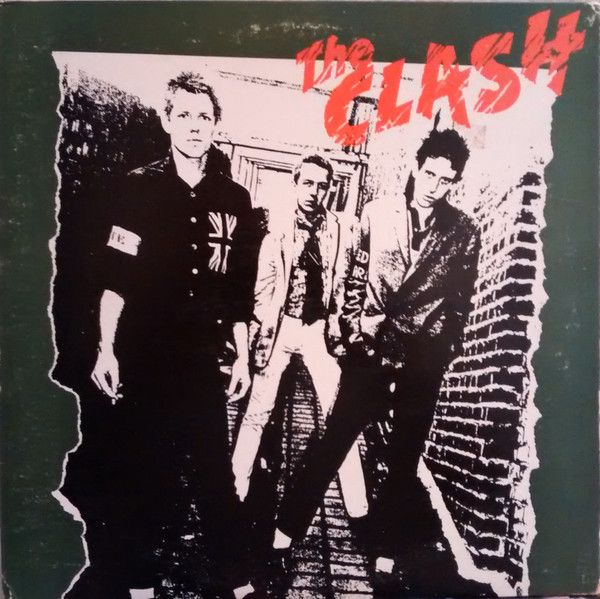
Although my name Begins With A J, I decided not to write (more) about myself, because I do tend to go there on a regular basis. Instead, I hit upon a song that nails the theme at least four times—the title, of course, has two words that start with a J, and it was written by Joe Strummer and Mick Jones, each of whom have a name that begins with the letter. (And Strummer’s real first name is John....) It is a complete coincidence (really) that I’m also writing about a Clash song for a submission for Cover Me that won’t be running for a while, but maybe The Clash are living in my head a little (he said, after promising not to write about himself.)
Being an American, and not being up on all of the British scandals, (although it has been interesting following Boris Johnson’s fall, after many scandals), I had no idea that “Janie Jones” was a real person. Jones (whose real name was a very theme-inappropriate Marion Mitchell) started a career in show business in the late 1950s performing in clubs in London. It was a scene that attracted artists, musicians, performers and members of the aristocracy, and Jones was supported by a sugar daddy known as “The Colonel.”
In 1965, Jones released a song, “Witches Brew,” which hit the British charts (despite being pretty bad), and her house became a center for parties at which, it appears, people actually engaged in sexual acts with people that they were not married to. As Jones said, "It was a kind of private club where they wouldn't be disturbed," explains Janie. "I held parties every two weeks and everybody who was anybody and their friends came. They had a fantastic time. People said they were the greatest parties in London." (This, and other quotes from Jones come from an article written in 1977 by artist/journalist/muse Caroline Coon, who was also briefly The Clash’s manager. The article is behind a paywall, but you might be clever enough to figure out how to read it.)
Future musical releases were unsuccessful, and Jones appeared on TV shows and continued her social life. She moved/fled to Hollywood in the early 1970s, but then became embroiled in a series of scandals, being accused of getting DJs to play songs in exchange for sexual favors, and for running prostitutes. A number of the women testified against Jones, and the wealthy and titled men who attended her parties were allowed anonymity. (There’s a lot more background to these scandals, which you can read about here, here, and here.)
She was convicted and sentenced to seven years in prison and served 4. Jones explained: "I knew too much about too many people and of course, I took the piss out of the Judge in court all the time..." In May, 1977, Jones was released from prison, and turned on the radio, only to hear a song with her name as the title playing.
“Janie Jones,” is one of The Clash’s earliest songs, written not long after Strummer joined the band. Much of it reportedly came to Mick Jones riding on the 31 bus from Harrow Road to Chalk Farm in London (making me wonder how much music would not have been written if people had cell phones to distract them throughout history). It was initially just to be about the boredom of an ordinary working life, but again, reportedly, Jones saw his namesake Janie’s name on a fellow passenger’s newspaper, and her name was added to the song, because it worked, both rhythmically and thematically. Strummer, a fan of Jones, helped to fine tune the lyrics.
The song was the first track on The Clash’s eponymous debut album (the UK, not the US version), and may well have been played at every single Clash show.
Caroline Coon set up a meeting between Jones and the band, and in 1982, Strummer wrote a song for Jones, “House of the Ju Ju Queen,” which was recorded with The Clash, two members of the Blockheads, and Mel Collins as the backup band. The band was billed as the “Lash,” because for contractual reasons, it couldn’t begin with a C.
I started thinking this post, moving on through the pantheon of female names, and it should be Jezebel, and I might yet get round to that. But, as she would, Jezebel put me in mind of Jesus. And, as a perfectly decent and common Latino name, why not? Except, they all to be about the same guy. I jest; of course they are, that being the challenge, how to pick, say, a couple of handfuls of songs about Jesus that aren't, overtly at least, about, you know, God. It isn't that I'm against a touch of religion, except, yes, actually I am, largely by virtue of the dreadful things folk do in the name of their own personal totem. Like churches and mosques, temples and synagogues, often fantastic buildings that can inspire awe in all but what people do and say inside them. But, heck, they sure done wrote a lot of good songs about the guy.
Jesus In Vegas/Chumbawamba
I like this song, as it is, in turns and at the same time, thoroughly disreputable, arguably sacrilegious and also so fully on message, pertaining most the received wisdoms about the boy from Galilee. If there were a modern day equivalent of the money lenders in the temple, Las Vegas is surely that shrine, and, as the song suggests, what would Jesus do? OK, the song doesn't say, but one feels the business taken care of would not include a ten hour sesh on a one-armed bandit. The middle section then goes off on one, about picket lines, possibly, just possibly, comparing Ricky Tomlinson to the middle member of the holy triad. (Ricky Tomlinson? If you don't know Brookside or The Royle Family, it's complicated, but a good example of this no longer extant band in their prime. Find the studio version on WYSIWYG.
The Sexual Loneliness of Jesus Christ/Jackie Leven Quite a title that one. And quite a statement, implying a fair amount of thought going into the lyric. Leven was just the sort of man to trouble his mind with thinking about how Jesus may have had just the same curses and burdens of any other man, struggling, perhaps, therewith, just as do so many who dedicate their lives to him. Of course, also put together consummately, the mix of his organic and pained vocal, alongside the unstoppable drum machine track that permeate so many of his songs. To be fair, as we lambast the church for the failings of its pastors, tempted and all that, what price the decisions made to base anything on celibacy in the first place? If unfamiliar with the works of Leven, which you shouldn't be, should you come here often, go seek out his work. As the anniversaries of his death come and go, slowly, slowly have tributes and retrospectives come forth.
Tulsa Jesus Freak/Lana del Rey
Well, if you can quite work out what Ms. Del Rey is on about here, you are one up on me, but she doesn't make it easy, anyway, beyond the schtick of tortured humanity, wrestling with demons and, often as not, drowning. If her songs ate to be taken autobiographically, my feeling that they shouldn't, she has encountered every bad choice offered, this song seeming to stack the story of a booze addicted preacher present in her bed/life. To be fair, so good a song and on such a good album, who cares if she dives low to raise us up? OK, I do, I wish her well, but a song of her happier encounters might linger less long in the listener's ear. Or the charts. Get it today and you could be only 24 hours from this track.
They Ain't Makin' Jews Like Jesus/Kinky Friedman
You are never far from a Kinky Friedman song in a Jesus thread, or should never be. Offence is oft caused by the Texas politician, author and singer-songwriter, and this is the song that causes the most. Me, I don't hear anything much more than a fairly reasonable exposé of the rampant hypocrisyy that permeates a good deal of religious bigotry, tempered with a slab of good ol' ignorance in the ear of the beholder. I am not sure I could stomach any full performance, but various snippets and songs hit a soundbite to which I fully subscribe. As neither a Jew nor a practicing Christian, a few more balls wouldn't go amiss in many the turn the other cheek expectations out there. This is a live version. All the ones on youtube are, for some reason. The studio one is better.
Jesus Was a Social Drinker/Chuck Prophet
Let's all wish Chuck, the erstwhile Green On Red man, turned profligate commentator of rootsy music, with a hefty roster of 16 solo albums since the demise of that seminal group, all our best. Earlier this year he discovered he had lymphoma, needing thus to suspend his perma-touring and recording schedule. As of recently he has been given permission to return to the road, pending further and ongoing treatment, but that smacks of cautious good news. A favourite from afar, despite regular visits to Blighty, I had always been planning to see him, if never quite managing it. Let's hope he is back on these shores soon. The song here? Well, I think it is sort of a reminder he may have been a normal guy rather than a paragon, if still a bit less than wild and wooly. I think. Good song, mind. From 2017's Bobby Fuller Died For Your Sins. I am not sure if Bobby Fuller was a social drinker, but his death was mighty weird.
Jesus Christ/Brand New
Quite a challenging song, a dialogue between the "singer" and Jesus, asking somewhat leading questions, possibly/seemingly arising from a guilty conscience. The writer, Jesse Lacey, widely known to have had an orthodox Christian upbringing, has/had always used allegory in his songs, this being one of the more overt. The parent album, The Devil and God Are Raging Inside Me smacks of a troubled soul, struggling with faith. An album especially liked by my wife and step-daughter, not least the existential content, each went abruptly off him and the band, as it became aware he may well have taken advantage of younger female fans, such allegations having become apparent in 2017. Never proven as such, Lacey publicly apologised and admitted to an earlier sex addiction. Which sort of makes latter-day sense of the lyrics. Always tricky to remove the man from his alleged actions, his music from his character, I file under unproven and remorseful. Maybe.
Jesus Hates Faggots/John Grant
In a run of fairly deep and dense lyrics during this piece, this perhaps is the most striking. And the most damning. And, last there be doubt, Grant isn't really saying what the title suggests, merely using the phrase to relay the damning comment made to him by, presumably, his parent/s, in association with his gender preference, sexually speaking. A galling song, my own belief mechanism would suggest such a statement to be as anti-Christian in sentiment as can be, and I really feel for Grant, were that what he were brought up with. His sonorous voce and the chamber synth backing gives a gravitas that magnifies the horror. An artist I have always admired, from his days with the Czars, one can understand why he prefers to remain well away from his homeland. It comes from this album.
I Have Forgiven Jesus/Morrissey
Sort of following on from the last song, Morrissey takes it that much further, forgiving Jesus for the, no doubt, similar words put into his teachings, by those around him in his own childhood. It's good, better than the lumpen and heavy handed epithet the singer is increasingly given by his critics. I was a late adopter of the Smiths, never quite getting them until near the end, similarly put off Morrissey's solo work until recently. With the Smiths I just couldn't see the beauty in the songs, probably until others started covering them. With Morrissey I believed the hounding propaganda of the press, more interested in his difficult behaviour, cancelling shows and tours willy nilly. (Yes, I do still baulk at his possible racist tendencies, let me say.) I find these lyrics entirely believable and they endear the author all the more to me, bloody mindedness and all. It comes from You Are the Quarry, in 2004.
He Ain't Jesus/Carrie Rodriguez
Lightening the mood a little, it will prove helpful to know the next line is "I'm not Mary". Coming from the pen of Chip Taylor, erstwhile part of a performing partnership with Ms Rodriguez, and the writer of many a memorable song, from Wild Thing to Angel of the Morning. A song from her first solo release, it uses Jesus, and, later in the song, Buddha, as marks of the prejudices embraced to maintain the inequality of the sexes. I think her a terrific singer and am delighted she has made a career away from being the second string protegé to Taylor, however mutually advantageous the pairing had been and continues to be. Worry not, I am exhausting of all these Jesus songs, wherein the name is invoked merely as a reason or excuse for bad behaviour. As the next song says better.
Jesus Is Just Alright With Me/Shelagh McDonald
Spoilt, just a little, for choice, for this last selection, I decided against the Byrds and the Doobies, going instead for this oft forgotten footnote in UK folk-rock history. So, who Shelagh McDonald? This article, by Ian A. Anderson sets the scene very well, the A separating him from the other one, stating on a single leg, tootling a flute. I came across her about twenty years ago, enchanted. I recommend her work, however much I admire the other aforementioned heavyweight purveyors of the same song. If you want more, here's the link; it ain't an otherwise easy find. I'll bet, however, nobody is familiar with the original, by Art Reynolds, in 1966, as performed by his singers, which is a glorious piece of soul/gospel. And I can live with the idea. Jesus seems to have been a well meaning fella, and certainly braver than most. Son of God, though? Aren't we all?
This old band infrequently get a mention in these pages, usually in conjunction with a mention of Graham Nash, the erstwhile manc turned golden boy of Laurel Canyon. Whilst he left the band a little over 50 years ago, it may surprise some readers that the band play on, never having actually ever stopped. This makes them, along with the Rolling Stones and, arguably, the Searchers, the longest legged beat combos of this sceptred isle. (I'm going to discount Herman's Hermit's seeing as, without Peter Noone gurning at the front, well, they aren't, really, are they?)
I confess I was a big fan of the band in my pre-teens, they having as big a thumbprint on the charts as any of the above and even of the Beatles. In fact, add in that, from Manchester, separated by only 35 miles from Liverpool, yet with accents as impenetrable to one as to the other, they were considered the big local opposition to the Moptops. More so, one might argue than the Stones, London seeming a lifetime, or certainly a day's journey, away. They certainly seemed a perennial on Top of the Pops.
Jennifer Eccles
Started by the aforementioned Nash and Allan Clarke, for years their distinctive frontman and lead singer, in an astonishing 1962, they performed mainly covers, at least for the charts. A couple of Coasters's covers gave them recognition, before hitting the top ten, in the UK, with Stay. Possibly better now known for Jackson Browne's version. this song was originally by Maurice Williams and the Zodiacs, but I'll bet which version Browne heard first. Gradually encroaching on US awareness, via Canada picking up on the band, and their first couple of LPs, as with the Rolling Stones' early work, were released with different songs and running orders, so as to appeal more to the market, eager for the beginnings of the "UK invasion", as the mid 60's assault on the US charts was called. Clarke, Nash and Tony Hicks, the guitarist then and still now, last man left standing, had begun writing songs, using the name L. Ransford, in an echo of the Nanker/Phelge adopted by Mick Jagger and Keith Richards. But it was still with covers they were making their name, with Graham Gouldman behind some of the better known, Look Through Any Window and Bus Stop. Gouldman is a one man hit factory who wrote huge numbers of hit songs in the 60s, for bands as diverse as the Yardbirds and the aforementioned Herman's Hermits. In the 70s, as a member of, and the continuing sole original member and focus of, 10 c.c, he wrote even more, as well as with Andrew Gold, as Wax.
Bus Stop
Bus Stop was their first US top ten breaker, and led to tours across the pond. It is likely that this where and how Nash began first to want to expand his horizons, his mind likely expanded by the smoking materials his new American friends were sharing with him. His bandmates wanted poppier material than Nash's King Midas In Reverse, such as to play the Bob Dylan songbook; Hollies Sing Dylan was an album Nash only distantly engaged with. That, along with the fact the band wouldn't countenance Marrakesh Express, a song he had written and offered them, meant he eventually packed his bags and left, finding more likeminded souls who would.
King Midas In Reverse
The rest of the band, whose line-up had been fluctuating wildly anyway, outside the core three members, were left a little blindsided. Ex-Swinging Blue Jean, Terry Sylvester, replaced him, joining the two residual songwriters, adding his muse to theirs. As the '60s ended and '70s began, they had a further fertile period of success, albeit by relying, once more, on cover versions like He Ain't Heavy (He's My Brother). Ironically, about this time, their follow up to Hollies Sing Dylan, the helpfully entitled Hollie Sing Hollies did not chart in their homeland, attaining 32 in the Billboard chart. Allan Clarke was now developing itchy feet, leaving the band himself in 1971, if the band then having a pretty big hit with Long Cool Woman In a Black Dress, from the album he had last appeared from. An uncharacteristically upbeat and rocky number, he had already left as it was breaking the charts, leading to confusion for subsequent tours. However, he rejoined after a few years, the band now moving into similar territory. They even covered Springsteen, if broadly unsuccessfully, their US management dumping the band shortly thereafter.
Long Cool Woman In a Black Dress
Back home they had become more of a legacy group than a going concern, limping on, with the odd hit scattered along the way. What I hadn't realised or remembered was that Nash returned himself to the fold, in the mid '80's, for a tour and an album. What an opportunity that should or could have been, but, glancing at the requisite Wiki page for What Goes Around, I can perhaps see why it sank without my trace. Not a song by any of the songwriters present, the original triad of Nash, Clark and Hicks, a lot by a Paul Bliss, whomsoever he, and some lack lustre Motown covers. Clearly Messrs Stills and Crosby, Young for that matter, lost little sleep, as back he went to them.
Carrie Ann
The band played on, although the roundabout of members was in full swing, not least when Allan Clarke retired from music altogether, in 2000. (Or nominally, a solo album coming out a year or so back.) Hicks was still bravely hanging on, as was permanently be-hatted drummer, Bobby Elliott, a fixture since 1963. His initial replacement was Carl Wayne, once the lead singer of the Move, and which led to what may have been nostalgia heavy shows, as they would feature songs by both bands during their set. But he died, of cancer, in 2004. It seems the band have had a relatively steady line up in the 18 years hence, lead singer duties now c/o Peter Howarth, the rest of the band made up of Ray Stiles (ex-Mud), Ian Parker (also in Clannad) and Steve Lauri (5000 Volts), present since 1986, 1991 and 2004 respectively. (Which meant, awkwardly, when they were elected to the Rock and Roll Hall of Fame, in 2010, only two of the current six were deemed eligible......)
Hollies at the R&RHoF
I think they definitely classify as survivors. Would I go see them? Whilst I would probably never have deemed it ever something I would think of, actually, now, I think I might, doomed, no doubt, to disappointment. Unlike, say, the Searchers, who, with a similar current cabaret circuit career, I would certainly jump at, they said to put on a corking show, that encompasses not only their mid 60's fame, but their uncanny resurgence in the late 70s/80s on Sire records.
The Air That I Breathe (10 days ago......)
As a footnote, given the song that entitles this piece, here are Eels, Mark E. Everett's band, with their excellent version thereof.
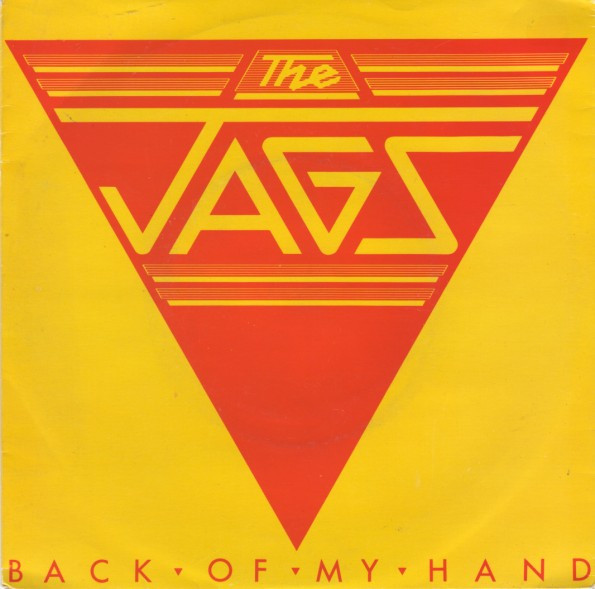
One of the fun things about writing for this blog is that I never really know where the piece is going to go when I start doing my “research.” There are so many songs that have the word “back” in their title (and even more with the word in the lyrics, and even more songs that I could write about, if I took a broad view of the theme). When I saw The Jags’ “Back of My Hand” come up in my search, I thought, “hey, this would be easy—a fun song that I remember from college that has pretty much been forgotten.” And yet, when I started to look into it, it became more interesting.
The Jags were formed in 1978 by the Yorkshire-based songwriting team of singer Nick Watkinson and guitarist John Alder with Steve Prudence on bass and Alex Baird on drums. In July of 1978, they signed to Island Records and released a four-track EP, which included an early mix of “Back of My Hand.” It’s a great song—catchy, fun, but with a little edge. And no, it isn’t about hitting someone—it’s about the excitement of getting a girl to write her phone number on your skin, since the song long pre-dates cellphones.
After dealing with the almost mandatory management issues, the song was remixed by Trevor Horn and Geoff Downes (The Buggles), and the resulting single release became a modest hit in both the US (peaking at 84) and UK (hitting 17), at a time when “new wave” music was not common on the charts. It was, I suspect, more popular on college radio (I definitely played it a few times) and more adventurous commercial stations that were beginning to embrace new wave music. That version was on the US release of their first full album, Evening Standards, although a newly recorded version was on the initial UK pressings. Honestly, I’m not 100% sure which version is embedded above, but I kind of think that it was the original version, not the Buggles remix.
But here’s the rub. When I thought about writing about this song, my first thought was, “The Jags—that band that sounded like Elvis Costello.” And constant comparisons to Mr. MacManus appeared to torpedo the Jags. It’s kind of an interesting phenomenon. I remember that Costello was, initially, compared to Graham Parker, without damaging his career, and early Costello comparisons didn’t prevent Joe Jackson from becoming a star. So, the only conclusion must be that the Jags just weren’t that good.
That conclusion would be wrong.
In researching this piece, I found a number of reviews that call the song “a power pop classic,” their output in general as being of “uniformly high quality,” and having “a range of power pop that few—including Mr. Costello—ever achieved.” And I have to agree—the band was tight, and they wrote clever new wave pop songs that deserved better than just being dismissed as knockoffs. Yes, the Costello influence is hard to miss, but there’s also other things there-Thin Lizzy, maybe the Kinks. It’s a similar situation, I think, to the Knack, who were turned into a punch line despite some excellent songs because of, well, because of a bunch of reasons that I wrote more about here.
After “Back of My Hand,” the Jags had some personnel changes and recorded a second album. While band members insist that they never tried to copy Elvis, as one member noted, for the second album, they tried not to sound like him. The album was unsuccessful, the band members feuded, there were legal and management squabbles, and the band broke up. As far as I can tell, none of the members appeared to join other known bands, it seems that their music is out of print, and some of it never was even released on CD. In fact, the version that I’ve uploaded is from a compilation, and the Amazon purchase link is from the soundtrack for the 2006 Owen Wilson movie, You, Me and Dupree.
Then I found an article from 2013 entitled, Donate to Fund for UK Power Pop Legends The Jags’ Watkinson, in which I discovered that Watkinson had since about 2009, been, as the article put it, “living as a transvestite and performing at select clubs in the greater London area, generally under the name Virginia Plain.” The reason for the funding request was that Watkinson’s home was destroyed by a fire set when a lodger fell asleep with candles burning. And, of course, the flat was not insured, and the culprit fled and never paid a penny. Another article that I found about this situation noted that Watkinson was earning a “living as a gardener.”
It's kind of a shame that such a talented songwriter isn’t writing songs, and that a talented band never really made it. But it shows how everything has to align for an artist to succeed.
"Phew, what a scorcher" is the traditional newspaper headline whenever the UK "swelters" in balmy tropical temperatures of 30 degrees. That's 86 in the transatlantic money, and today, now yesterday, it is supposed to hit that. Already a bit warm and muggy, praise be I am not at work, and can so wallow in it. Part of the process is always to find some applicable and appropriate music to soundtrack the experience. I had even forgot I had this, so it was a delight to rediscover.
It actually hit 32, so try it for size:
Kidjo has become quite the doyenne of so called World music, using her Beninese roots as a template to merge and meld into a melting pot of other styles. Had the political situation in her homeland not been so fractured, who knows whether she would have made her name outside the diaspora of her home, so it is, for us, a blessing she relocated, in 1983, to Paris, the de facto capital of African music worldwide. A bevy of releases have emerged in her name since 1983, ever drawing in bigger names in production and collaboration. Perhaps unfairly, even if I contribute to that, she is better known for her cover versions rather than her own material, or, even, the material of Africa, even if she imbues suchh covers with as authentic a pan-African sheen as can be contrived. Recent years have seen, successively, tributes to the Talking Heads' Remain In Light and to the grande-dame of salsa, Celia Cruz. But her most recent release was a return more to where she started, 2021's Mother Nature, wherein she shares the spotlight with a slew of young African music makers, as well as a few older peers. (O, and Sting?!)
Voodoo Chile (Live)
Omon Oba
But what of the song that defines this piece? Remember it? I certainly do, being especially taken with it, as a small boy devouring the charts on Top of the Pops.
The Equals were an unusual feature back in the mid to late 60s, being multi-racial, part white british and part african-caribbean. Schoolfriends from a North London housing estate, they had a run of singles, none proving quite as successful as this one. Initially released in 1966, as a B side, it became a hit in continental Europe before being flipped in the UK, becoming a 1968 chart topper. Across the atlantic it fared less well, if still a credible 32 on the Billboard chart. The writer and the main focus of the group was one Eddy Grant, who had a later resurgence of fame in the late 1970s and into the 80's as a solo act and a run of successful singles. Only the churlish would point out they all, to some extent, had broadly the same tune.
I Don't Wanna Dance
There have been a fair few cover versions over the years, most of whom offer little than some 'updating' with rap or grime filters, each dating far more swiftly than the simple exuberance of the original. I did, however, dig out a copy that is a little unexpected and, thus, worth the play. I give you, from 1982, Ms. Bonnie Raitt:
It’s been a while since I’ve gone off on a full out political rant here (although, to be fair, it’s been less than a month since my post about the dB’s “Change With the Changing Times” veered off course at the end).
I’ve been watching the January 6 Committee hearings, and the videos that they played of the insurrectionists who attacked the American Capitol and attempted to steal an American election from American voters all seemed to be justifying their actions with some variation of wanting to take America back. Or, at least, that they were operating at the instigation of a man who popularized the slogan, Make America Great Again—which implies, of course, that it was once great, but now isn’t. Which implies that things were better when straight (or closeted) white Christian men ran things, and everyone else knew their place and was supposed to be happy for the crumbs.
After the first night of the hearings, one of my college classmates, a Black woman who is a prominent and successful orthopedic surgeon, posted on Facebook, “What did Trump do for them??? They keep saying they were so grateful for all he had done for them??” And it’s an interesting question. Because the one legislative “accomplishment” of that administration was a tax cut that would likely not have benefited most people at the coup attempt in any significant way. He didn’t improve their health care, or raise the minimum wage, or protect their health or safety. My response was, “Made them feel their white supremacy was supported.”
But it really was more than that. Trump preyed on the fear that his followers have of losing their advantage if the playing field was equalized. As Lyndon Johnson, a president who did many great and terrible things during his administration once noted, “If you can convince the lowest white man he’s better than the best colored man, he won’t notice you’re picking his pocket. Hell, give him somebody to look down on, and he’ll empty his pockets for you.”
And that’s what Trump did, and still does. He fed their fears, their white supremacy, their anti-immigrant hatred and their economic worries, despite doing nothing tangible for them. And then, he picked their pockets, again and again and again. Although I think that part of the reason that Trump attempted a coup was to keep his power, I think that the reason that he wanted the power was to be able to continue the grift. Remarkably, he’s been able to keep the swindle alive, even without the power (and his son-in-law, the dead-eyed Jared Kushner, seems to have learned that lesson, too.)
Back in about 2015, when Rand Paul was running for president on a nationalist platform, Jill Sobule wrote our featured song, asking the all-important question, when these people say that they are going to take America “back” then “What the Fuck Do They Mean?” And I think that the answer is becoming more and more clear. By getting rid of the Voting Rights Act, and by gerrymandering wildly and making it harder for poor people and minorities to vote, they are limiting the power of Black, Latino and other groups to have fair representation in state legislatures and Congress. By increasing income inequality, they are concentrating power in a handful of people and companies. By facilitating the likely end of abortion rights, they are imposing Christian sharia law, and again making it harder for women, particularly poor and minority women, to control their own bodies. And giddy with success, there are increasing calls to attack the right to use birth control, marriage equality, and even the right to interracial marriage. All while doing nothing real to prevent gun violence.
The version of the song above is from Monster Protest Jamz...Volume 1, a compilation of new protest songs that included the work of artists like Tom Morello, Todd Rundgren, Amanda Palmer, Wayne Kramer, Wendy & Lisa, and many others, which was part of Sobule’s “My Song is My Weapon” project. Unfortunately, it appears to be unavailable because it was issued by Pledgemusic, which went bankrupt and was liquidated.
But I’ll also insert this video of Jill singing the song in August, 2016 (before we got the Election Day shock), with my beautiful and talented wife singing backup.
And I still haven't got around to seeing them, either? Them? Human League. (Or is it The Human League, I never quite grasping? A bit like the decade or so earlier arguments about whether it was The Pink Floyd or The Yes, but I digress.) Because, inevitably, it being the 21st century, no band is ever allowed to die, and are doomed to play on eternally, whether they like it or not, a St Vitus' dance of our days. (Witness this one, fr'instance....) The League, neatly sidestepping the above concern, play on and I still haven't seen them.
There was a time, of course, when I desperately did want to, when Don't You Want Me was top of the charts and Dare (the parent album) in my Christmas stocking. But I was too busy, too serious and too earnest for gigs in those days, newly married and employed at the lowest rung of the hospital ladder, freshly minted out of medical school. Blimey, I barely had time for records, hearing more music on the radio than on my pining-for-me stereo. But the recalcitrant muso in me still usually made time for 40 minutes of a Thursday evening, for Top Of The Pops. (Heart attack in casualty? Just wait till the end of this song......)
As the years passed, slowly life settled down. Live music slowly came back into my life, courtesy the wonderful Birmingham Odeon, a cinema in the central drag of the shopping centre, that, then at least, doubled as a the premier live venus for the city. I saw loads of bands there between 1984 and onward, until, unceremoniously, it reverted to films only. Boo, it leaving the city much of a wasteland for bands to play, it being pubs or Wolverhampton, a situation that remained until the refurbishment of the Town Hall allowed its return for concerts, followed, a year or so later, by the famed Symphony Hall, a truly terrific venue for bigger bands, it taking a certain reputation to fill it. Huge bands had always the godawful National Exhibition centre and, later, the National Indoor Arena, but both were/are soulless indoor caverns with extortionate parking and lacklustre and exorbitant bar concessions. But I still didn't manage the League. Dare was followed by Hysteria and Crash, the standard slowly slipping, despite the huge singles from the Jam-Lewis helmed latter album, to some extent discussed here. However, amongst the other dross was one absolute banger, the subject of this piece. Seeming a deliberate, if belated, part 2 to Don't You Want Me. Clearly the "waitress in a cocktail bar" really didn't want him and, with that slowly sinking in, maybe needing this second song to make sure: Are You Ever Coming Back?
The astute amongst you might be popping up your hands to catch my attention. What about, you say, I'm Coming Back on the album between the two, Hysteria. Arguably, extremely, this could be construed as the link between them? OK, so the lyrics are ambivalent and, if you buy into this derisory line of argument, surely Joanne Catherall would be singing the chorus, or at least part of it, she being the waitress from the song I suggest started it all. But, nonetheless. (I am conveniently going to disregard another and more prevalent theory that the "follow-up" to Don't You Want Me was given by the reconciliation through closure of Louise, on Hysteria. Trust me here.)
What came next? The loss of their record contract with Virgin, for one, after the poor showing of album number four. Their star so now out of the firmament, I have to admit I have never heard 1990's Romantic, but wonder if Rebound, one of the songs, might be the next step on our journey. Shall we see? I mean, she's singing, isn't she?
Sorry, now I'm obsessed and have to follow it through.... A long five years before they manage anything new, now on EastWest records. The oldies circuit had sucked them in, still, to this day, a source of lucre for bands of the 1980s. But Octopus, remarkably, garnished a rekindling of their karma, and, for a while it looked as if their may be (eight) legs in the League after all, even if, officially, there were six, it being just Oakey, Catherall and Susan Ann Sulley as the residual band members. Now I did hear this one, and think I even have a copy on the shelf. Anything here to prop up my hypothesis? Well, astonishingly, first track and lead single, Tell Me When, seems to fit neatest into the never say die spirit of the deserted Oakey figure from Don't You Want Me.
Exciting this, isn't it, as we race to the finish, with but two further studio releases to come. Secrets, in 2001, saw them slipping back down the rankings, now on smaller label, Papillon. Again, knowingly unheard to my ears, I'm going to have to guess this one, the description of, again, first track and lead single, All I Ever Wanted as showing, as the UK Times newspaper said: "the playful interplay between Phil Oakey's sonorous baritone and Joanne and Susanne's girly voices are present and correct". And I can fully and confidently state that the more upbeat lyric might represent a feasible next chapter.
Well, the ten year gap between Secrets and Credo, the last official release in 2011, might confirm a dimming of the spotlight, at least commercially, in the world of new releases and chart acclaim. It seems the band had appreciated this, relying more on their continued pull as a live act, by now bouncing between the remember the 80's bandwagon and just being a quirky good time live act with enough cache to appeal to audiences growing up with them and the younger generation inspired by them. I'm not sure I can find the fitting song to bookend the flow of possible consecutiveness I have dreamt up here, but it must be there, I'm sure, having convinced myself of it. So let's just go with this, plcked at random. (And yes, it's true, nearly the only one with a decent available video. Or with a video at all.) If I squint hard enough, it falls and fits within the let me go/have me back nonsense I have tried to convince you of. Never Give Me Up is its name.
So, have I convinced you of this hitherto unexplored continuum across and between the releases of this band, as we witness together the turning of raffish young blade, Phil Oakey, to the somewhat desperate gent of today, his teenage accomplices themselves now somewhat matronly, as befitting their years. Worry not if it has just reminded you of the songs, as they're mostly good. Would I still go see them after this exercise? Well, never say never, but it may be I will just go see this lot again.....
The band named Boston doesnt seem to have been dissected much here and maybe that's not such a surprise. Most folks - if they know the band at all - probably associate them with this, their best-known song.
Like the 17 million other people who purchased Boston's first album, I still love this song. Like an apparently large number of that number, I feel a twang of guilt for loving a song that is almost corny; it has been a staple of FM radio ever since it came out. If you're one of these, rest assured: most music critics note that aside from the song being included in most lists of "bests", they also commend the song on many counts. From Rolling Stone critic Paul Evans: "an uncommonly resonant emotional note", and from Cash Box: "a sophisticated melody that makes good use of minor chords".
There is a lot about the song that seems familiar (and some that actually is more or less picked from other sources - but what music isn't?). But again, there are no pending legal issues related to the song. See Joe Walsh/James Gang and The Left Banke for inspiration.
It's a Tom Scholz composition that took him several years to finalize. Apparently, that is kind of typical of his methodology (it takes him years to get something to the point where he is ready to release it).
Tom Scholz himself is worth a study in and of itself. MIT student who then built his own music studio, tried again and again to get the music inuistry to take him on, eventually succeeded, and then for most every album after had to butt heads. Rarely credited as more or less the sole driving force behind is band and the only remaining original member, his last name ought to be Boston.
Star Maker Machine does not accept music submissions from artists or promoters. However, most of the contributors here do accept submissions for our own blogs, listed below. Please visit our blogs, take the time to listen to what we post, and then feel free to contact us if you feel that your music would be a good fit.