There's something about guitar finger picking for those who play the guitar (as opposed to strumming, "flat picking" or solo-ing). The Travis pick is the first thing I asked to be taught when I picked up guitar playing: the "roll" of the notes and fingers kindles something in me. I know it as a style where you alternate/"roll" between the bass and treble. I always assumed it had something to do with a man names Travis - maybe Merle. But I don't see any Intertube link to the two, so I might be wrong. For some reason it equates in my mind to Peter, Paul and Mary (yes - that far back in my memory).
Fast forward a couple of decades ... well, maybe only one decade - to the date when Quah came out. (So much developed in the framework of rock/pop between 1960 and 1970 that it ought to boggle the music lover's mind!)
Delve back into musical history again, and we have the Jefferson Airplane. JA here because Jorma Kaukonen joined the band pretty early on: he was playing with them back as early as the mid 60s. The record states that it was Jack Casady, the bass player for the band, who brought Jorma to the band and then went on to produce the album whence this song comes.
There are numerous aspects to "I Am the Light ..." that turn me on - not just the finger picking. The entire conceit: I am a light/I light the world ... or however you want to interpret the lyrics ... turns me on (light again?) The finger picking (and it may not be Travis per se) is tight. And the song - overall - is ... er ... classic.
(Heh, heh, heh, esteemed buddy, KK, you can't throw a gauntlet of that size down and expect me to walk away........)
Now, where were we?
Uranium: Uranium Fever by Elton Britt.
Wow, what find! A sassy 50s rap eulogising the joys of this most famous of the radioactive particles, just the sort of song aching to have been revived in the 70s heyday of Commander Cody's gloriously louche Lost Planet Airmen. Hell, I can see 'em playing it right now in my head. Smoke smoke smoke THAT cigarette!! Britt was a fairly successful country singer of his day, famous more for his yodelling than his singing, I learn, oft-covering the King of the Yodel, Jimmie Rodgers.
Lanthanum: Lanthanum by Vain Velocity.
'Haunting tune' speaks a comment on the youtube, and for a moment I bought that too, before it nosedived through the ground into a throat singing implosion of grunge-plated metal. So this is greek heavy metal? I always confuse lanthanum with laudanum, wondering if they did too. Hell, it's the sort of haunting nightmare that might strike if laudanum had been taken.
Dubnium: Haze by Dubnium.
I rather like this. I only searched because of the name, never having heard of the substance, but hoping it may have been similarly noted. Reassuringly heavily dubby, this is the work of a Plymouth, U.K., DJ, Sean, um, Dubnium, possibly not his birth name, mentioned to distinguish from U.S. based Dubnium Soundsystem, whom I didn't investigate. I could easily come down from a Laudanum hit on this.
Iridium: Iridium by Dark Tranquillity.
Shucks, I should have known better, lulled in again by a tasteful intro ahead of stentorian grunting dragging me down out of my demographic. Could be the same fella as the greek above, but they are swedish death metal stalwarts of the Gothenburg scene, it says here. I'd love to sound less grudging of their art but when I say it is nauseous, it's only because I would be if tried to sing like that. But then, what do I know?
Lead: Weights Made of Lead by the Sensational Alex Harvey Band.
Well I never, mere weeks after this and I discover this little nugget somehow earlier having passed me by. Could it be the repetitive nature of the tune or the plodding rhythm, but it certainly seems apt for the subject. 'I've got weights made of lead' sings Harvey but we never learn why. Is it a paean to fishing?
Tin: Tin Soldier by the Small Faces.
At last, cries my reader, at last one I know. A 1967 single that was perhaps their best, blending a pop sensitivity with something instrumentally a bit more inventive. The stop at 1.30, with then repeated keyboard motif predates that later stylisation, common across house music, by decades. Terrible to think that, with the death earlier this year of keyboard player, Ian McLagan, that drummer, Kenney Jones, is last man standing. R.I.P. Mac, along with Ronnie 'Plonk' Lane and Steve Marriott.
Krypton: Kryptonite by 3 Doors Down.
Is kryptonite the same as krypton? Do we know or care? Always and irrespectively associated with Superman, this was a massive hit in 2000 for Escatawpa, Mississippee band, whose singer and, for the first 4 years, drummer, Brad Arnold, seems to be the only permanent. Struggling to say much more as it is so inoffensive.
Mercury: Mercury Poisoning by Graham Parker & the Rumour.
All at once I'm dragged back to the early 70s with this righteous blast. Jeez, I loved this band, GP a much more vitriolic character than the benign old dude revived in Judd Apatow's 'This is 40'. I saw them then and saw them again, last year, touring again on the back of the films exposure, marvelling at the still smoking embers of pre-punk. The song, a thinly disguised jibe at his record label, Mercury, was and is typical of his lyrical spikiness. Wonderful.
Bismuth: Bismuth by Michael Johnson
I know nothing of this new age instrumental beyond a link to this, from where which it comes. And all the tracks are inspired by different elements. Quite how the pastoral tone of this example fits with the active ingredient of 'Pepto-Bismol', a proprietary anti-diarrhoeal, I don't know, apart from perhaps the calm it's apparent efficacy might provoke. The whole album is a free download, if you forgive the use of that term apropos to a discussion around diarrhoea.
Tungsten: Insomnia (Dark Dubstep) by Tungsten
More instrumental gobbledegook cooked up in someone's bedroom, but I like it. As I get older I seem strangely drawn to this sort of stuff, certainly enjoying it way more than the hideous elemental metal cliches the elements seem to bring forth. OK, neither clever, nor art but hey, it made me smile. and who Tungsten? Not a clue.
So, another 10, and like radioactivity, it's nearly killed me.
Part 4? Only when they make polony out of polonium.
Can you buy 'em? Probably. Go search, as the usual might not have then all.
I really thought Retropath was headed down the right path
when he started out to list the entire table of elements. I was seriously
looking forward to the full 118.
Then again, considering the amount of time and energy
involved in his somewhat quixotic endeavor, I was more inclined to simply
complete the table of medieval elements along the lines of what J. David referred to.
Back at the time of the “It's Elemental” theme, I posted
Hot Tuna's "Water Song" (Which I have since learned to play!). Without making
distinction on the theme of the element
of water - since the two songs are in rather different musical categories,
I now realize I might well have posted Talking Heads' “Once In a Lifetime”.
For almost a decade, back in the 90s, I collected and re-re-listened
to David Byrne and the band. I later relished Clap Your Hands Say Yeah, and Arcade Fire (although I haven’t seen anyone else group them with Talking Heads, I
think so) as re-incarnations of the Talking Heads’ genre.
Still, Talking Heads would still take my category prize as
the elemental band of its style. And critical to that catalogue would be “Once
In a Lifetime” – not least for its relevance to “Plato and Aristotle’s”
Elements: there's water running all the way through in its original MTV version
here:
It is a post-Thanksgiving tradition at SMM to have a “Leftovers” theme, which allows our writers to look back and post something on prior themes that, for whatever reason, we couldn’t or didn’t do at the time. As the most prolific writer here recently, I pretty much have posted twice on every theme, although there are a few that I only got around to a single piece. One of those was back in March, when the theme was “Lies/Liars,” and I wrote about a great, rocking blast of Southern rock from Jason and The Scorchers. There are so many songs in the rock canon about liars and lying that it is almost hard to narrow down the choices. But I did, and thus we have today’s feature song, by the great Nick Lowe.
Since this theme is all about looking back, I did write about Lowe back in January, so I won’t repeat what I wrote there, and instead focus on this tune. Lowe has said that the idea came to him while watching, believe it or not, Oprah Winfrey. According to Lowe:
"When I was over here once I was watching an edition of The Oprah Winfrey Show. They had some poor sap sitting there who'd run off with a maid or something like that, and the audience was extremely upset with this guy. I remember this large black lady standing up and shouting at the top of her voice, 'All men are liars! All men are liars! All men are liars!' She just was chanting it. And I thought, 'Yeah, you know what? You've got a point there, darling.' And along came that song."
The song is a fun, bouncy pop tune, with Lowe's typical clever wordplay. The other thing that the song is remembered for, to the extent it is remembered at all, is for its somewhat gratuitous insult of English singer Rick Astley. Astley had a massive, annoying hit with the song “Never Gonna Give You Up,” which led to the phenomenon of “rickrolling,” defined by the Urban Dictionary as:
To post a misleading link with a subject that promises to be exciting or interesting, e.g. "World of Starcraft in-game footage!" or "Paris Hilton blows Busta Rhymes' dick" but actually turns out to be the video for Rick Astley's debut single, "Never Gonna Give You Up". A variant on the duckroll. Allegedly hilarious.
Well, do you remember Rick Astley? He had a big fat hit, it was ghastly. He said I'm never gonna give you up or let you down. Well I'm here to tell ya that Dick's a clown.
Which is more than “allegedly” hilarious, but which Lowe, as time went on, regretted. He has commented:
At the time, he was everywhere. “Never Gonna Give You Up” was just on all the time. It drove me mad. [Impersonates Astley.] That constricted voice. And so I put that rather barbed line in, which I regret now. I hardly ever do the song. I went through a phase of doing it fairly recently, but it sort of went off the boil and I stopped doing it. But when I used to do the Rick Astley line, people used to fall about, rolling in the aisles, clutching their sides laughing, and I thought, “This is rather a shame to do this. Poor old Rick. He’s not exactly in the public eye much anymore. It seems a little unfair to kick him when he’s down.”
One of the many fun things about writing these pieces is that I actually research what I write and learn things about songs that I like. Which is how I found the interview that I have quoted from at length. But it is also interesting to read reviews of the music I post. The album that “All Men Are Liars” comes from, Party of One, is a pretty good one, in my estimation. Lowe, of course, was originally best known as a producer, but also created one of the all-time great albums, Jesus of Cool (and its slightly different American version, Pure Pop For Now People), not to mention the fine follow up, Labour of Lust. After that, he released a bunch of albums, all of which had moments, some more than others, until his recent critically acclaimed reinvention as a crooner.
But, if you read the Allmusic review of Party of One, you might be dissuaded from listening to it—it refers to the album as “stilted,” and “an unwelcome surprise” filled with “forced humor and bland support,” and “stiff, colorless performances.” (I suspect that the reference to “stiff” in that review was not meant as a reference to Lowe’s days producing for the legendary Stiff label).
Instead, I commend you to read Robert Christgau’s review, who hears things quite differently, and more in accord with my opinion:
Nick the Knife is a writer again, every song honed and there for a reason. With the likes of Ry Cooder and Jim Keltner spiking his wry cool, he yearns for yen, makes Boeing a modest proposal, spins off pungent epithets ("Refrigerator White"), nonsense syllables ("Shting-Shtang"), sexual metaphors ("Honeygun"). In a shameless bid for the rockcrit vote, he also finds the perfect rhyme for "ghastly" (starts with "Rick," lest you already forgot). And just like with Labour of Lust in 1979, he makes it sound so easy you expect a reprise a year for the rest of his life. A-
If I were filling out a form that asked me for the first words that come to mind related to "You Make Me Feel ..", it would likely be "soul".
One of the first concerts I ever attended was back in the late 60s. At that time, I had a pretty big (for those times) collection of 33s that included Sgt Peppers, Smokey Robinson, Simon & Garfield, Are You Experienced, and Aretha. Must have been the summer of 69 when I caught "Little" Stevie Wonder in the same venue with the Supremes - would have been@ Seattle. That pretty much convinced me of the power of "soul",
In '68 or '69, Carole King had not hit the big time yet. She and her then husband, Gerry Goffin were writing hits, but she herself hadn't made much of a name. Aretha (and she don't need a last name) turned their song "You Make Me Feel" into a hit. Two years later, Carole King included it on her own album.
Here, the Queen of Soul sings to President Clinton:
It's a default: Tapestry is Carole King's best. There's not a song on the album that isn't good - and the best of SMM agree.
Several of the songs on Tapestry were co-written with Toni Stern. But ...who is Toni Stern? Google says that Toni gets credits for both "Where You Lead" and "It's Too Late" from Tapestry. However, there is incredibly little info about Toni Stern on the Internet, and - as an amateur musician myself - it concerns me that someone could pen some of the best songs of all time and still remain under the radar! (There must be some online source that recognizes your work even if you don't flog it yourself!) The IMDB movie database credits a Toni Stern with work on Gilmore Girls and Karate Kid but those appear to be re-issues of the same Carole King work 30 years earlier. Stern seems to focus on her writing - her web site is about her poetry. The IMDB/movie links are inconclusive in terms of providing much more depth.
Aside from the "Who is Toni Stern" issue, there is the question of who does the best cover of which Carole King song. Time was, when Star Maker posted most anything online ... because we could. Because the Internet allowed it. Because SMM's policies were based on "we provide this temporary (mp3) link in the hopes that you will love it and purchase the legal version". Gone are those days. Adapting to these conditions, I initially reverted to SoundCloud for a freely distributable cover of "Where You Lead" -of which there are several. Sadly, even the free download links aren't easy to embed here.
Like most of the bloggers @ SMM, I ended up @ YouTube. The listed YouTube covers don't include one by the Michael Baker Band - never head of them before - but they've got a decent cover of "Where You Lead." Sadly, I can't locate any info clearly related to the band - there are a couple of Michael Bakers online but none appears to be this one.The lead vocals are very decent. The band is fairly tight. I would have wished the back vocals were a little louder. Hope you enjoy. And if you know more about the band, leave a comment.
You could argue that one of the ways to tell if a song is really well-written is to see whether it holds up when performed in different styles. Some songs would seem to only be effective in a particular style—for example, the Sex Pistols’ great “God Save The Queen” only works as an angry blast of punk, and not, for example, as a folk tune. Although you might be surprised at how good King Crimson’s prog-rock archetype “21st Century Schizoid Man” sounds in Delta blues style.
“Will You Still Love Me Tomorrow” seems to sound great no matter how it is played. Written by King and Gerry Goffin when she was still in her teens, the song was first released by The Shirelles in 1960, in classic girl group style, with tight harmony vocals and lush orchestration. Although apparently banned by some radio stations because of the sexual nature of the lyrics (!), it nevertheless reached #1 on the Billboard Hot 100 chart.
I’m not going to give you a long tour through the many, many covers of this great song, except to point out that it works in Swedish. And when King recorded the song for the great Tapestry album, she did it in a slower, piano-driven, contemplative style with Joni Mitchell and James Taylor contributing background vocals. It was both an artistic and commercial success, getting played regularly on FM radio.
It is sort of a gimmick to take classic rock songs of this, and other, eras, speed them up, and turn them into punk songs. Few artists are as committed to this niche that honors the songs, but with sufficient ironic detachment to retain their punk cred, than Me First and The Gimme Gimmes. A “supergroup” of sorts, with members that include Fat Mike of NOFX, Chris Shiflett of Foo Fighters, and Spike Slawson of Swingin’ Utters and Re-Volts, they have released a bunch of albums, EPs and singles, including their 2001 album, Blow In The Wind, which focuses on pop hits of the 1960s. Their version of “Will You Still Love Me Tomorrow” is, appropriately, loud, fast and surprisingly catchy, like The Shirelles’ version, but still retains some of the melancholy of King’s.
It is one of those almost cliché—yet still astounding—facts
that Carole King is one of the most prolific songwriters in modern history. There
are countless songs you know that she wrote and gave to other artists who then
took the tunes to the top of the charts. She was prolific as she was talented
and her influence has touched on almost every chart in popular music. She is
even the subject of a Broadway play—Beautiful: The Carole King Musical. The tag
line says it all: “The inspiring true
story of how Carole King became the soundtrack of a generation.”
It would take another, separate post, to list the artists
who’ve recorded King’s music, but one of my favorites is the The Byrds. The
Byrd’s unique take on rock—chiming, majestic—was as dependent on the psychedelic sitarspin as it
was on folk and pop. Jangly guitars, phasing sound from one ear to
another, and a straight up reliance on the country and western rhythm made the
Byrds one of the most unique bands of their era. I feel like they are mostly
remembered for “Turn, Turn, Turn” which suffers from the invocation of the sappy,
flower power ethic of the ‘60s. But, as the Byrd’s ranged more towards country
and western and left behind the banalities of the hippie movement, they became
a rich, influential outfit that would pave the way for some of today’s most
seminal bands (at least in my record collection: Son Volt and Wilco, to name just
two.) An early sense of breaking molds and exploring sonic possibilities will
forever set the Byrds at a tier above many of their contemporaries, even if they
are often overlooked as innovators and were sometimes incredibly uneven.
The Carole King penned “Going Back” was the lead single from
The Notorious Byrd Brothers, and
while the album didn’t chart very high, it is cited often as their best album
for its experimental feel. It is a solid album all the way
through, working towards a sonic vision, and unlike other albums, it cleaves to
an idea and presents it to the listener in a gorgeous, shimmery blend of melody
and chiming guitar and vox. The
cohesiveness is interesting in another way: in researching the album, one finds
that it was tumultuous time for the band, and three members, including David
Crosby, left for good during the recordings.
The album has made its way onto various Greatest Albums
lists (171 In Rolling Stones Greatest 500; 32 on NME’s Top 100) lists and
writer, Johnny Rogan, in his book The Byrds: Timeless Flight
Revisited, said: “The
Byrds' greatest accomplishment on the album was in creating a seamless mood
piece from a variety of different sources, bound together by innovative studio
experimentation.”
The song itself has an almost antiquated
chorus, reminiscent of so much of the sound of the day, but the Byrd’s add
those odd, dithering guitars and the song goes from easy listening to something
much more adventurous and exploratory.
“Going Back” has a long history, and while the version I’ve
chosen is the Byrd’s take, the song has been recorded by artists as disparate
as Phil Collins, The Pretenders, Freddy Mercury and Bon Jovi. David Crosby
hated it because it felt it was unserious “fluff”. Indeed, it is pure pop
whimsy, and covers a timeless theme of coming of age and the loss of innocence
that adulthood brings. But, under Roger McGuinn’s harmony and the guitars, it’s
a pure pop masterpiece and demonstration of Carole King’s talent at
literally spinning gold. I think one way to put a definition on the influence
and reach of Carole King is that she’d already written a decades worth of hits
before she released her own album, Tapestry,
which is one of the greatest selling pop records of all time.
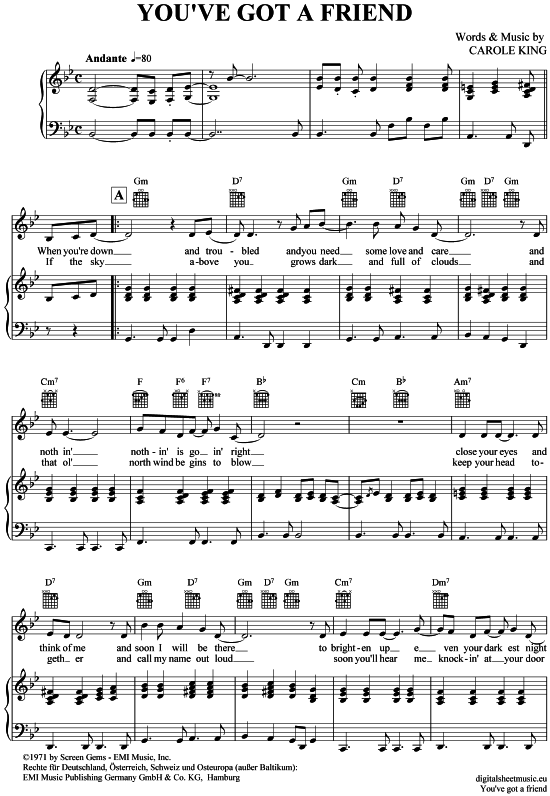
It's possibly a fact that Ms King's best known song is in itself best known as a cover, namely the comforting and syrupy balm of James Taylor singing "You've Got a Friend", perhaps also "his" best known song. I don't know whether this can or could be proven as, with someone having a career stretching from being a Brill Building manufactured popsmith in the early 60s, to hippie chick troubador a decade later, to damn right, yes, she's still going with a bit of both and everything in between, it's difficult to work out. I guess it's in part generational, with the hepcats of '66 nodding sagely as the by then far and wigged-out Byrds phase their way through "Goin' Back", or the soulsters grooving to Aretha and "...Natural woman", so my generation picked up on "Tapestry", through her old friend and guitar slinger lifting a song from it as his break through single. But this isn't about sweet baby James, being more a tribute to some of the less well travelled versions. (Or is that so far travelled?)
I remain uncertain whether this is the worst thing I have ever heard or whether it is worse even than that, inescapably making me see the Muppets in my minds eye, so expertly do Bing Crosby and Fred Astaire channel Fozzie and Kermit. From the hideous patronising patronage of "contemporary" to the plodding singalongagramps of the performance, any nostalgic buzz for, say, "The Little Drummer Boy" evaporates.
Let's try something a bit more up-tempo, yeah, a James Brown influence:
Nooooooooo, take it off, take it away. Hideous even more than the old groaning above, is this supper club travesty really that Fred Wesley, those J.B.s? No wonder the album was "The Lost Album". I would.
Let's try again, some UK 80s indie, that'll be something, eh?
The Housemartins were the short-lived first band of Paul Heaton, later of "The Beautiful South" as here, and Norman "Fatboy Slim" Cook. And this version of the song is awful.
I'm beginning to lose faith and falter here. I mean, how difficult can it be? Hell, premium cover version listings site, Second Hand Songs, lists 125 versions. OK, so the list includes everyone from Billy Ray Cyrus to Barry Manilow, and God knows who in between.
One more, some late 90's acid jazz:
Brand New Heavies were/are a UK originally instrumental band forming in the mid 80s, diversifying into a somewhat bland vocal hybrid between jazz, funk and nods toward hip-hop and dance music, with a string of sultry southern US vocal divas passing through their ranks, Carleen Anderson and N'Dea Davenport being perhaps the 2 best known, but with Siedah Garrett on the above, a minor hit in the UK. Tellingly, it was not even on the US copy of its parent album. I have to say it's the best of the lot I have found today, if purely by virtue of comparison.
So what's my point? Is it a good song? Well, I had always thought so, but maybe there is rather more of the Brill Building professional hit maker weave in "Tapestry" and "You've Got A Friend" than first hearing makes believe, hence the ease with which it sheds any credibility into a nylon leisure suit of schmaltz. And thus, maybe it is just the consummate interpretation skill of Taylor that embues it with any subtlety at all, although, to be fair, the original is pretty damn good too. Carole King was trained to write songs that would sell. 125 versions is a lot of versions and, by virtue of the names mentioned, hideous though to my ears, a lot of royalties. Success by any marker.
Finally, by way of a lift to my sorry conclusion, was it a fluke? Has the song got the capability of rising above it's apparent formula? Well, who better to give us that answer than the writer and the singer already mention, both here together, a mere 5 years ago.
Praise be! No fluke. Song good, interpretations vary............
Last week, I watched all 10 episodes of Aziz Ansari’s great new Netflix series Master of None. In addition to being very funny, the show deals head on with issues of racism, sexism and ageism, among other “isms.” So, when I thought about suggesting a cover song theme for the next two weeks, I became sensitive to the fact that over the years we have done nine other themes focusing on cover songs, and in each case, but one, the spotlight artists were male. Joni Mitchell was the only featured woman. (And as I write this, I realize that all nine artists are white, something that also needs to be addressed). And that’s how we ended up with a theme highlighting Carole King Covers. (That’s a lot of “K” sounds, so it must be funny.)
Next year is the 45th anniversary of the release of Tapestry, which was King’s second solo release. It established her as a commercial success as a performer, and is still one of the largest selling albums of all time. Pretty much every song on the album is great, and I loved it when I was a kid, but it is, honestly, not an album that I pull out to listen to anymore. I hope that some of the other writers here write about covers of songs from Tapestry, and I might down the road, but not today.
By 1971, when Tapestry was released, King had already had a 20 year long music career, beginning with her appearance on the Horn and Hardart Children’s Hour as an 8 year old, recordingdemos in high school with her friend Paul Simon, and, while attending Queens College, writing songs for others, mostly with Gerry Goffin, from an office in the famous Brill Building in Times Square. The number of hit songs she turned out is stunning, as is the breadth of styles—artists as diverse as Aretha Franklin, The Monkees, The Shirelles, Herman’s Hermits, The Drifters and even The Beatles recorded covers of her songs. The Broadway show Beautiful does a nice job bringing this to life, as well as discussing King’s later career. It is, of course, a cleaned up, streamlined version of the story, but it is very entertaining.
The Animals, led by singer Eric Burdon, were created in the early 1960s, and featured a gritty, blues based sound. In 1964, they released their signature song, a cover of the traditional blues song, “House of the Rising Sun.” Their producer, Mickie Most, reportedly called into the offices of Screen Gems music, then run by Don Kirshner, looking for songs. A furious competition ensued among the various writers and teams, which ultimately resulted in three hits—“We Gotta Get Out Of This Place,” written by Barry Mann and Cynthia Weil (who were friends and rivals of Goffin and King), “It’s My Life,” written by the team of Roger Atkins and Carl D’Errico, and “Don’t Bring Me Down,” a Goffin/King composition, which was the last hit for the band, before it was renamed “Eric Burdon and The Animals," before breaking up. (Burdon re-formed the band, with new members and a psychedelic style after moving to California in 1966, although the old incarnation also had reunions.)
I had the opportunity to interview David Johansen, I believe in 1981, when he appeared in Trenton at City Gardens. I might even have introduced him. Johansen is one of those musicians who has successfully reinvented himself over the years, from his days fronting the legendary New York Dolls, which was followed by a solo career under his own name, to his partying alter-ego Buster Poindexter and his more recent country-blues work with The Harry Smiths. I was, and continue to be a big fan of the music he released in the early ‘80s, particularly his first three albums, David Johansen, In Style, and Here Comes the Night, all of which received heavy airplay on my radio shows.
Shortly after I graduated from college, and regrettably left the radio world behind, Johansen released a great live record, Live it Up, which capitalized on his justified reputation as a great concert performer. The collection kicks off with an intense medley of the three songs that Mickie Most bought for the Animals from Screen Gems, including a great version of “Don’t Bring Me Down.” Not only is Johansen in total command of the material, his band is tight. It included guitarists Huw Gower, who power pop lovers might know best as the guitarist on The Records’ incredible “Starry Eyes,” and Dave Nelson, who was in Nektar, New Riders of the Purple Sage and The Turtles, as well as keyboard player Charlie Giordano, who now plays with the E Street Band and drummer Tony Machine, who had been in later versions of the New York Dolls.
Why can't land speeders
fly higher than five meters above the ground? Why does R2D2, despite being a
droid, have feelings and a confidence suggesting the force is in him? How can
anyone possibly say that Superman is stronger than Green Lantern when GL can
simply make a cage of green kryptonite? Why does Prince Adam get tan after
becoming He-Man and why can't anyone recognise him? And in Greek mythology, how
can Atlas hold the world on his shoulders and still preside in that world? If
he sneezes, does his body shake twice? Does he also carry the atmosphere
and space? I did poorly in science and math, but at least I asked the important
questions.
These are questions that
still entertain me as an adult, but I keep them to myself unless I'm lucky to
find another child man who's been dwelling on them. When musicians mention
gods, demi-gods and Titans from myth, I usually take notice. Often it's either
sadly generic or so intensely honorific that it's unsettling. (Dead Can Dance's
"Song of the Sirens" and "Persephone" do well, and of course
Fleetwood Mac's "Rhiannon"). Battle's "Atlas" is more
on the ambiguous side without referring to Atlas himself or the heavens, but
it's a hell of a tune, stomping forward into thunderous hypnosis. A flinging guitar
riff teases, and then a freaky childish taunt leads you to believe the song
will unravel. However, like Atlas, spare a brief time when he passed the world
onto Hercules via a trick, the beat is maintained except for one grisly
breakdown.
Atlas must have been on
the verge of going nuts with all that responsibility, or at least severely
pissed off at times. But he was compassionate enough to never let go. Battles
presents different versions of "Atlas" and its repetitive madness
that could go on for another twenty minutes without tiring you. There are lots
of live versions available. This take at the Fuji Rock Festival is one of the
best.
I’m
a teacher in my real life—or is it the other way around? And one thing
I hate, that makes me squirm with embarrassment is when teachers
try to teach by co-opting popular songs and parodying the lyrics, or the
video,
to bring home their curricular goals in a way the kids “will really
understand.”
It’s just embarrassing, in the same way your parents were
embarrassing when they yelled at you in front of your friends or tried to get
down on your level by dropping a bit of slang. You know, to show you they were
on your level. Ugg…it’s like every mom is Marge Simpson, too clueless to have a
clue, or Homer; too dumb to know how dumb he is acting.
Teachers love parodies, love trying to really reach the
kids in ways they will understand. Hey, why don’t we take Shakespeare and rap
the lines. Shakespeare would approve—after all, he was just using language in
new ways, too…Oh, I know it well: desperate to reach these twitter net numbed
little vacant oxygen abusers, we resort to making horse’s asses of ourselves.
But, for a phenomenal paycheck…ahhhbullshitchoo!
Point is, school and…almost anything else good in my life
never mixed. Strange, in a cosmic way, that I became a teacher. But, I still
get the chills when a teacher ditches their dignity to teach a lesson to kids
in language they can understand…just reminds me too much of that disaffected
little Walkman and MTV numbed oxygen abuser I was not so long ago.
OK, I’m whining…Here’s a case in point, though I have to
admit: If any of my teachers looked like this, I might have given the whole
school thing another chance…
Annnnndddd.....then, there’s this….
Stop…just stop. You might grow up, but you never grow up too
much to not be embarrassed.
Yeah, OK…I’ll stop…
So, this month’s theme is math. Math. The subject I
struggled with the most all the way up until I graduated…from college. Math was
my preeminent anxiety from grade school on—I had tutors, I failed courses, I
did summer school. Once, on the SAT, I did so poorly on my math that my Math
score was 100…this was when the top SAT score was only 1400. I got an 800 total…That’s…pretty
bad.
In high school, I liked music, and writing, precisely
because they were as opposite of mathematics as could get: freedom minus
rigidity, enjoyment divided by anxiety equaled a shitty GPA and lowered expectations.
The last day I ever had to take a math class was one of the happiest days of my
life. I remember walking out of Rawl Hall at East Carolina University,
thinking: I will never take another f#$%ing math class again. It was a great
feeling, like I’d suffered something for longer than I thought I could and
walked out with all parts—limbs and sanity—in tact. I had worked really hard,
to be honest and at the end, I knew I wasn’t going to let my relationship with
mathematics end with my slinking away to nurse my wounds and regret the fight I
hadn’t put up. I worked hard that semester, harder than I’d ever worked and
ended the semester with a B-…the highest grade I’d ever scored in any math
class. F#$k math. I’d won.
What does this have to do with music? Nothing, other than
hating the sciences and the numbers was probably the catalyst for my love of
music, and if it was nothing else, it was a precious escape.
One of the first bands I became truly obsessed with in my
alternate, music-oriented education, was The Doors. It makes sense in many
ways: The Doors are kind of a “gateway” band into serious music for a lot of
teenage boys; Morrison was an incorrigible class clown, in school and out (I
know this—part of the right of passage of being a Doors fan was to read No One Here Gets Out Alive, Danny
Sugarman’s bio); the music was dark enough to be an antidote to a lot
of the classic rock that got spun as voice of the generation stuff; and on a
personal level, Morrison, much like me at the time, wanted to be and considered
himself above all, a poet. I wasn’t a student when I was 16 and 17—I would have
accepted any label other than that. Poet was good—the idea was cool and writing
poetry got me more than a few girls. Playing guitar helped, too. I suppose that
is an equation that still works.
The Doors were a great band to get into—there was plenty of
mythology to dig, a real fabled aura around the shamanistic Morrison, and
musical sound that was often a dark opposite to the flower power, ‘come on
people, smile on your brother’ stuff that was a primer for the 60s rock
explosion. Hendrix did it better, of course, but he was solo artist, in a
sense. The Doors were a group and thus presented a more unified system of
disorder. And while Morrison in particular can be almost cringe-inducing when I
go back and listen (L’America?) some
tracks, like their first hit, Break on
Through, and others— The Whiskey
Song, Love Me Two Times, When the Music’s Over— cook with some kind of
other spirit, blues-influenced, incendiary, dark and magisterial—when the Doors
were on, they were stunningly good—rock n roll dredged through the dirt. I
loved that sound when I was young; it represented a true rebellion, an
antidote, if you will, to all the forces in life working to keep me stifled in a
classroom.
So, in honor to my wayward days, my wasted youth, all the
tests I failed, all the desks I carved “The Doors” into, all the dreams I had
about blowing it up and blowing it out, I choose The Doors, “Five to One.” This
explosive chant and stomp reads like a child’s rhyme, but it burns with a
controlled fury that takes aim at the listener or anyone who might not dig what
Morrison was pushing. I love John Densmore’s pounding, military drums; Robby
Krieger is at his bluesy best when he rips off the solo, and Ray Manzarek’s
fuzzed out keyboard line fills in as a static-infused bass, crackling with
serious mojo, far advanced and way modern for its time. As for Morrison—he says
it all here. Talking about hippies crawling across the floor, flowers in hand,
he sets himself in firm opposition to the flower power ethic of peace and love,
then goes on to engage in what, to me at the time, was as a pure a middle
finger in the face of my teachers, the cops, my folks, as many authority
figures as I could find to be pissed off at:
The old get old
And the young get stronger
May take a week
And it may take longer
They got the guns
But we got the numbers
Gonna win, yeah
We're takin' over
A little light on the true rebellious
capital, I realize, but at the time, that was all I needed: a little stomp, a
lot of anger and either a stepping stone to something better, or just a nice,
fist sized stone through any ready window.
Rock on, Jim…I might make a little fun
of you, but deep down, you’re my first and always rock n roll hero.
As I wracked my brain for another topical track to write about, I discarded a few ideas, mostly because I didn’t have anything personal to write about. I looked at lists of songs, but none called out to me. So I decided to find a song that had an interesting story, and I remembered that Kate Bush had written a song called “Π.” This being a Math & Science theme, I decided to do a little research on the song, to see whether there was anything there.
I remember when the song came out, hearing that it consisted of Bush singing π to some large number of digits. But that’s not all it is. It is actually a song about a mathematician who is obsessed with the number, somewhat irrationally (sorry), and Bush, a notorious musical eccentric with a remarkable voice, does sing many digits of π in a way that is not at all boring.
But if that was all I found, I’d probably be looking for another, meatier topic. Instead, guess what? A couple of math types posted stuff about the song.
Let’s start with the less strange. Chris McEvoy, a self-described “rabble rousing programmer who hates technology but loves people” pointed out in a blog post on November 11, 2005, that Kate got it wrong. As he wrote:
All was well for the first 53 decimal places but then Kate sang "threeeeee oneeeee" when she should have sang "zeeeeeeerooo" instead. She recovered for the next 24 digits but then it went to hell in a handbasket when she missed out the next 22 digits completely before finishing with a precise rendition of her final 37 digits. (Note—McEvoy later amended his statement, agreeing that she said “zeeeeeeerooo" and not "threeeeee oneeeee").
Which led to a bunch of somewhat hostile comments, because apparently π, and Kate Bush, are not to be trifled with. On the other hand, there’s also a positive comment from someone identifying as “Kate Bush,” but it’s the Internet, so you never know.
On March 14, 2006, McEvoy took to the blogosphere to point out that while that day is considered “Pi Day” in the United States, in countries that use a “Month/Day” system, “Pi Day” should be April 31 (31/4), a date that doesn’t exist, so he suggested May Day as the solution. Also, he cited to a number of British newspapers and radio programmes (as he spells it) that referred to his π digit “Gotcha!” Apparently in England, Kate Bush and π are big deals.
Now, let’s discuss Steve Luttrell, who has a degree in “theoretical physics and [a] PhD . . . in quantum chromodynamics (QCD).” Luttrell was convinced that Bush’s “errors” were actually a deliberate creation of a number puzzle. He put together an entire website devoted to this puzzle, A Great Big Circle, which sadly appears to be gone, but discussed his findings in a series of blog posts, here. In essence, he “solved” the puzzle, to find the exact location of an “artefact built out of stones to resemble a steam locomotive.” And, of course, “The locomotive theme is part of an extended metaphor that runs throughout π, consisting of tunnels, columns, chimneys, mine shafts, and generally anything and everything to do with sex.”
Me, I’m more of a fan of Occam’s Razor, but not in the way that Luttrell interprets it. Although I don't have a PhD in quantum chromodynamics, which according to Wikipedia is is the theory of strong interactions, a fundamental
force describing the interactions between quarks and gluons which make
up hadrons such as the proton, neutron and pion. I still don't know what that means, but I did wedge a little more science into this piece.
I hadn't planned this ahead, but - digging around - I recalled that Tom Lehrer (in his total output of 37 songs) not only covered the field of Math, but also got around to Science. No surprise - math ... science ... it's all greek to many of us.
As he says at the end - if you can listen all the way through: "Life was much simpler in those days."
14.
(That's it and I could end it there, but that would save me from sharing with you how this remarkable piece of raw garage punk energy came to be so entitled. Or should that be saving you.......)
I was 9 in 1966 when this song came out. Originally an outtake from earlier recordings it was released as a single ahead of appearing on their 2nd album, 'Da Capo'. How I came to be listening to such arcane thrash at such tender years may sound I am bigging up my supercool but sadly, not so, the truth being more mundane. My big sister, upon whom I blame my musical precocity, had a boyfriend with their 1967 masterwork, 'Forever Changes' in his meagre collection. I loved some of the tracks, 'Andmoreagain' principally, disliking others, especially the noisy ones and the trumpety 'Alone Again Or'. (OK, so sue me, I was 10, I have learnt from that error of judgement.) But the name, the concept and the legend stuck with me as I became a teen. At my school there was a a cult of the obscure: you have to imagine nerdy and spotty brits in the UK, which is why, of course, I add an S to MATH, with each of my peer group endeavouring to out-gun the rest by virtue of claiming a love for ever more unlikely west coast bands. Zappa and the Mothers, Beefheart, the Dead, hell, we were entirely the wrong demographic. Remembering my sisters boyf and Love, my street cred was going to be a cert! Provided you accept the street was a quiet suburban cul-de-sac. So I bought 'Love Revisited', belatedly discovering this song, and now old enough to love it! But that's enough of me.
What of the song? Very few chords, frenzied drumming, shouted and incoherent vocals; what's not to love? But in the research for this piece I was astonished to see the association of the Elektra label legends with a song quite so spare, with it being produced by Jac Holzman and engineered by Bruce Botnick. As a later Doors freak, these men are/were legendary to me, but I guess, Love, as their first "rock" signing to this iconic label, it was probably more that there was nobody else. My second astonishment was to recall one of the best named individuals in modern music, step forward one Mr Snoopy Pfisterer on drums, 2nd only to Lowell 'Banana' Levinger of the Lovin' Spoonful. Debate remains as to whether Snoopy actually managed the drums in this song, Arthur Lee, writer of the song, later claiming he may have taken over as Pfisterer faltered. And the explosion at the end of the song? Sadly the sound of atoms splitting were not the first frazzles of Lee's famously sometimes addled mind but from a sound effects LP. Pity. But the best discovery of all was the b.side! Ladies and gentleman, I give you:
Number 14
So, after all that, how was the song so entitled? I still have absolutely no idea.
As a child of the 50s/60s, I grew up with Tom Lehrer albums (along with Mozart, Bach, The Temptations and Jimi Hendrix).
And like JDavid, I made my way through American college life with the minimal requirements - lots of other interests along the way , only to find myself teaching math 20 years later!
About a year ago, I ran across and article about Tom Lehrer, wherein it noted that the man essentially dis-appeared of his own accord - having made it big and facing a critical request to return to the big time. (He vehemently declines. Worse yet: he wishes that his oeuvres become publicly non-monetary)
Lehrer simply stopped performing. His entire body of work topped out at 37 songs. [source]
Among the things that I never did at Princeton, either as a student or alumnus are:
-I never went by the house where Albert Einstein lived from 1933-1955;
-I never visited the Institute for Advanced Study, where Einstein worked (his Institute office was initially on the Princeton campus and he worked in the physics lab, which is now part of the campus student center, but he never was a member of the Princeton faculty, although, according to University sources, he “often helped students with math problems”);
-I never took a math class or any serious science class (I satisfied my distribution requirement through a Psychology lab and credit for a good AP Chem score from high school, which annoyed my freshman advisor, a chemistry professor, who urged me to take Organic Chemistry, an offer I declined. I also took an intro Astrophysics class which was designed for non-scientists and was an excuse to sit in a dark room and look at pictures of stars).
Math and Science are just not what I was interested in studying, and although, at least at the high school level, I could do reasonably well (I survived AP Calculus BC, but when my kids took calculus, I remembered exactly zero about it—and I still count on my fingers). To this day, I’m curious about science, but I knew that it wasn’t what I wanted to spend my time in college on.
So I’m not going to even attempt to explain what E=mc2, which is also the title of a song by Big Audio Dynamite, means. However, if any of my surprisingly large number of friends and classmates who are, in fact, physicists want to weigh in in the comments, feel free. Which is not to say that I don’t know that it stands for--Energy equals mass times the speed of light squared. But knowing that is far from knowing what it “means.”
Instead, I will talk about the song a bit, a job for which I’m somewhat more qualified.
Big Audio Dynamite was formed by Mick Jones with film director Don Letts in 1984 after Jones was tossed from The Clash. The band’s first album, This Is Big Audio Dynamite, fused The Clash’s post-Sandinista!/Combat Rock punk with dance and rap, and liberally used samples from other songs and movies, something which was pretty audacious in that era. It’s actually a pretty great record.
“E=mc2” is one of the real standout tracks. According to Wikipedia, it was the first song to be created all from samples, which either was a great achievement (particularly in the analog age), or was the first step toward the destruction of music. The song is inspired by the films of Nicolas Roeg, particularly Performance and Insignificance (in which Einstein is a character). Roeg’s films are best known for unusual directorial techniques and non-linear narratives that rearrange the time sequence, requiring the viewer to reassemble the pieces. Which, maybe, relates to the whole relativity thing (although maybe not—remember, I’m not a scientist and I’m not a film critic).
Interspersed in the song, whose lyrics reference those, and other, Roeg films, are quotes from Performance, including one snippet featuring Mick Jagger, who starred in the movie. Controversial on its release in 1970, due to its graphic sexual content, drug use and violence, it became a cult classic, and an influence on music videos and films, notably by Quentin Tarantino and Guy Ritchie (which shouldn’t be a surprise, based on the description).
In addition to being a clever, catchy tune, it was a success, hitting 11 on the UK singles chart and 37 on the US Billboard Hot Dance Club Play chart. Einstein, a violinist who loved Mozart and Bach, and whose musical tastes were described as “conservative,” probably would not have liked it.
I thought this had to be done from the get-go of this theme, and hung back with the expectation that someone else was going to latch on to it. Heading down to the theme expiration deadline, I guess it's up to me.
The song itself, I know well. The Magneto/Titanium Man comic book heroes: only through this song. Of all possible comic book heroes, Mr McCartney .. why this one? There must be some story lurking behind the choice that I can't fathom - even after some Internet research. Guess I'm not much of a Marvel fan.
.
Of the various YouTube versions available, this version seemed the most appropriate: itself a cartoon that helps explain the song. A bit. All said and done, the song is a classic example of the Wings/McCartney genre. All due respect aside, most other YouTube versions show the band for what it's worth (sorry, Linda).
I’m a little obsessed with baseball right now, on the verge of Game 1 of the World Series. As a Mets fan, this has really been an unexpected and exciting playoff run. I’ve already discussed this in my Future post, and I’ve also written about tonight’s Game 1 starter, Matt Harvey, the Dark Knight of Gotham.
Which brings me to today’s discussion of Batman. I was utterly unaware of the Batman comics that predated the TV series that ran from January 12, 1966, to March 14, 1968. I have a pretty strong memory of watching maybe the first episode as a young child, and watching many more episodes, either during the initial run, or after school in syndication. I’m sure I knew that it was silly, even before I understood the concept of “camp.”
I never read any of the later Dark Knight stuff, or any of the later Batman comics, and while I remember seeing the Tim Burton/Michael Keaton Batman movie, I can’t remember whether I’ve seen any of the sequels or reboots (although I’m pretty sure I saw the one with George Clooney). Because I really don’t care all that much.
In fact, after all these years, it is probably the great theme song from the TV series that I remember the most. Written by the great musician, composer and arranger Neil Hefti (who also wrote the Odd Couple theme), the version that played during the credits is faster, and was arranged by the great composer and arranger Nelson Riddle. And I’m obviously not the only one with the song stuck in my brain, because the “Na na na na na na…..Batman!” meme is pretty much ubiquitous on the Internet. (There are, apparently 80 “nas” in the theme.) You can even buy shirts with it.
R.E.M. submitted their reimagining of the theme for inclusion in the soundtrack of Batman Returns, the sequel to the first Burton/Keaton film. It was rejected, and instead became the B-side to the “Drive” single, and has been included in a few box sets and anthologies. It actually hit #11 on the UK charts, and was used by the Weather Channel under local weather updates.
My song choice is a no-brainer for this month’s theme; it’s long
been in any number of my personal faves lists—I have a lot of ‘lists’, that
cover any emotional, historic, or aesthetic and are subject to as many,
probably a lot more, criteria for membership. I know—the whole list thing has
been done, thanks very much Nick Hornby…But, I don’t believe there is a true
music fan who does not naturally gravitate towards list making. It’s almost
instinctual—a way of cataloging the music one loves and justifying the
multiverse of songs, bands and genres we love. No reason one can’t have
favorites in multiple arenas of music, and revel in their love of many sounds.
The song I picked for this month’s theme fits neatly under three—probably
more—categories. One: it’s from a band that is at the top my personal Most Influential
list. Two: it is featured on an album that is on my personal Top Albums of all
Time list. And three: it is one the first songs I played live with a band
(another list—bands I’ve played in), and still one of my favorite songs to
play.
So, I present, in honor of “Cartoons and Comics”: REM’s
“Superman”… an obvious choice. The song is originally a cover by ‘60s band, The Clique. They were from Texas, and honestly: I don’t know much more about them.
REM’s version was recorded for the album Life’s
Rich Pageant, and released in 1986. It received some airplay, but not as
much as their breakthrough, “Fall on Me.”
It is also the first time bassist Mike Mills handled lead
vocals—according to the Wikipedia page, lead signer Michael Stipe did not like
the song and wanted little to do with the recording. He handles backing vocals
only on the cut.
Historically, it might be a silly little single, dashed off
and added to the album to perhaps lift the spirit of the thing, add a little
levity in an otherwise somber, yet still emotional driving set of songs.The originally is garage rock at it’s best: sludgy guitars, churning and ditzy rhythm, and full of hippy, 1960’s bounce and
sunshine.
Lyrically, I like the fact
that it takes an iconic story of a guy we all know (Superman), and puts him in
the place of any average love sick dude, pining for a girl he probably has no
chance of getting. Is it really Superman, or is this guy just bragging? I don’t
know; but I do like the very human quality the speaker shows—a lot of bravado
to cover up the very evident self-doubt. But, no one ever won by sitting back
and letting the race come to them, right…? This guy might be a little full of
himself, but, in the end, I think he definitely got the girl…
I love this song, not only for the sense of fun it still has
and the infectious urge to bob along when the hear it, but also for what it
represents to my own personal heritage of music. REM was one of the first
‘real’ bands I listened to: I graduated from Bon Jovi, Cinderella and a lot of
other hair metal crap to their 1987 release, Document, and I’ve always felt they were my introduction to music
that mattered. And certainly, they set me on a path of amazing musical
discoveries. Life’s Rich Pageant is a
collection of songs so integral to my early education that to go back and
listen to it is an exercise equally nostalgic and educational at the same time.
Nostalgic because those songs still make the same spark in me as when I first
heard them and was instantly hooked. Educationally? Probably for the same
reasons—good music has that ineffable sense of importance that it achieves
almost upon first listen. You hear a great song and it immediately finds a
place in your heart, in your personal favorites list. There is time enough for
explication and analysis, to determine where the music actually fits and on which
list. It’s that initial spark, that beautiful chemistry, that defies numbers
and categorization. It is what, as Kant said, makes music the ‘quickening art’—something
that is alive in you for the first time. Loving music brings that quickening
sensation on a near daily basis. I can’t think of anything else more
exhilarating, save for having a few Superpowers of your own…
Star Maker Machine does not accept music submissions from artists or promoters. However, most of the contributors here do accept submissions for our own blogs, listed below. Please visit our blogs, take the time to listen to what we post, and then feel free to contact us if you feel that your music would be a good fit.