Thursday, October 29, 2020

HIDDEN PLACES: DRIVING SOMEWHERE

I think this sort of meets the theme, even if the hidden place is a destination, if, as yet, unknown and, probably, unimportant. Driving somewhere, arriving nowhere. So, fulfilling, if in a roundabout and reverse way, the old adage that is is the journey that matters, not the getting there. Even when the aim is never quite to arrive. Or the outcome, even. Clear?

I guess both the song and maybe the band are also hidden places, outside most peoples knowledge or hearing. Yet they will have heard Stephen Duffy, if not necessarily of him. More famous for a couple of links rather than in his own right, so if I say Duran Duran and Robbie Williams, you'll have heard of them. Not that he sounds anything like either, perhaps a relief to any regular reader, used more to my parade of motley unknowns and minor league cult favourites.

Duffy was an early member of Duran Duran, but jumped ship ahead of their transition to fame and fortune. Don't get me wrong, I don't dislike Duran Duran, but I can't see his country pop musings fitting in so well with the glitz and glamour of their new romanticism. Starting off as the singer, he moved then to guitar, then to bass and finally to drums, ousted from each position as later members joined. He actually then had a crack at that market, even a hit single, in the UK at least, under the title Stephen 'Tin Tin' Duffy, but it took three different versions before it made its mark. Hasn't really aged well, has it?

A few further false starts and he started the Lilac Time, with elder brother Nick, the two the mainstays as a procession of players rotated through the ranks. The sound, like the featured track, and exemplified further on its parent album, 2007s Runout Groove, is of dreamy meanders down a melodic and country tinged lane. The pedal steel brings a wistful counterpoint to the slightly languid vocal, pinned down, on this record, by the masterful double bass of Danny Thompson, the ex-Pentangle maestro and John Martyn sidekick, who remains the go to bassist for anywhere where folk might meet jazz for a natter. Runout Groove is, for me, the highlight of Duffy's recording history, so far at least, as he still records and plays. The astonishing thing about it is that it came out four years after its predecessor, his career having taken an unexpected side swerve along the way.

Robbie Williams, the effervescent ex-boy bander, the cheeky chappie who exited Take That after mingling more with Oasis and their lifestyle choices than possibly appropriate for a teen heartthrob. He then became much bigger than his old band, but needed assistance with songwriting. This had first been provided by Guy Chambers, who had previously been in World Party. After he parted company, Williams' team asked Duffy, perhaps less for his Lilac Time material, maybe more on account of songs he had written for Canadian band Barenaked Ladies. And an undoubted success it was, Duffy also touring with Williams during some of his stadium sell-out tours, delivering further hits for his new boss. Radio became thus Duffy's first number one.

Then, as if nothing untoward had happened, he dropped straight back into Lilac Time mode, picking right up from where he dropped off. I think that is quite classy. Further albums have followed, sticking to the same formula, the last being released just last year. All well worth looking out for. Here's another track from Runout Groove, Once more it fits the feel of the theme, the lyric showing him back on a figurative road, again with, literally, no direction. But, if the first song was looking for a somewhere never found, this is a happy acceptance of the journey. Spot the namecheck to his erstwhile employer. A parting personal link to the theme is that I more than likely heard the album first in the car, that being where I do most of my listening. Sometimes with no other purpose in particular, just driving somewhere, arriving nowhere. Purely for the sake of the song.

P.S. Those, who have set to wondering how he could have affected the Durannies, might like this, a revision of old tapes, made in those old days, rebuffed and polished up, hand in hand with onetime bandmate and continuing DD keyboardist, Nick Rhodes. Put out in in 2002, they called themselves the Devils, the album called Dark Circles.


Here's the map to somewhere.

Wednesday, October 28, 2020

Hidden Places: Dirty Blvd.


Lou Reed: Dirty Blvd.
[purchase] 

I’m sure that I was listening to some song that mentioned some place that wasn’t in the title when I thought of this theme, but I suggested it so long ago that I can’t remember what song it was. So, when I tried to figure out what to write about, I decided to write about my favorite city. The city that I’ve loved since my father brought me into Manhattan from my birthplace in Queens when I was a little kid, to go to museums, and magic shows, and just to walk around and spend time with him. Where I’d go with him to court, or to hang out in his office. And when I got older, where I’d sometimes come with friends, to go to the theater or museums or restaurants or ball games. Where I went to law school, lived for almost a decade, met my wife and started a family. And where I worked until a few years ago, commuting on the train after moving the suburbs, and loving the excitement and bustle of New York. Except on the night they lit the Rockefeller Center tree, which made my usual 10 minute walk to the train an ordeal. I miss New York, having started working from home back in 2013, and I miss it even more now, when thinking about going to the City raises all sorts of new issues. (Interestingly, in 2013, I wrote about another song from the same album, although strangely as a tribute to my suburban home).

I have a “New York” playlist on iTunes, and the rules, such as they are, are that the song has to mention New York City, or some part of the City, or at least some recognizable location or feature of the City. I’m guessing that I’ve missed a few, but it currently has over 500 songs on it. It’s possible that no artist has more songs on the list than Lou Reed, who was born in Brooklyn and grew up on Long Island, but has long been associated with New York from his move to the City in 1964 to be a songwriter, and especially from his co-founding the Velvet Underground. The Velvet Underground was, of course, part of the New York underground scene around Andy Warhol and his “Factory,” and more than a few of their songs were about the seedy, druggy underbelly of New York, such as “I’m Waiting For The Man,” a tale of scoring drugs on Lexington Avenue and 125th Street in Harlem. 

Reed’s focus on New York continued after he started his solo career, including his biggest hit, “Walk On The Wild Side,” which mentions the city itself, and the Apollo Theater, and also referred to members of Warhol’s clique. Again, Reed focused not on the mainstream, but on the marginalized part of New York, because that was the life he was living and those were the people that he knew. 

For 1989’s New York album, Reed, approaching 50, and thus an elder statesman, put together an entire album of observations of the City. In fact, Reed’s liner notes instructed listeners to listen in one sitting, “as though it were a book or a movie” (although I know few people who read a book in one sitting, but you get the point). It’s a bleak album, about a bleak time in New York. I loved the album, although I have to admit that things for me were the opposite of bleak—I had a high paying job, a nice apartment, and best of all, I had been married to the love of my life for about four months. 

Still, I was able to appreciate Reed’s observations and lyrical wordplay, and the tight, stripped down, music from Reed, guitarist Mike Rathke, bassist Rob Wasserman and drummer Fred Maher (with some guests, including former Velvet Underground drummer Moe Tucker), which was perfect for the songs. The album was critically acclaimed, and the single, and our featured song, “Dirty Blvd.” was a No1. hit on Billboard’s Modern Rock chart. 

“Dirty Blvd.” is not a hopeful song, by any stretch of the imagination, about Pedro, from a poor immigrant family who, because of the city’s (and country's) mistreatment of both those groups was destined to fail. It’s an angry song, contrasting the wealthy at Lincoln Center, only blocks from the rundown hotel where Pedro lives, with the difficulties of his life.  In one of the most memorable passages, Reed sings: 

Give me your hungry, your tired your poor I'll piss on 'em
that's what the Statue of Bigotry says
Your poor huddled masses, let's club 'em to death
and get it over with and just dump 'em on the boulevard 

By the way, guesting on background vocals on the song is another New Yorker, Dion DiMucci. 

Although since 1989 much more of Manhattan, and the other boroughs, are gentrified, and safer than back in the era described in New York, income inequality in the City, and elsewhere, is worse than ever. And the current administration’s anti-immigrant policies even led to one advisor, whose name I will not type, attempt to distance the Statue of Liberty from Emma Lazarus’ iconic verses. The album still holds up, mostly because of the music and lyrics, and also in part as a period piece and in part because of its timelessness. 

New York City has, like most of the country, taken a hit from the coronavirus and the failure of our national “leadership” to take appropriate action in face of the pandemic, but contrary to the recent statement from the liar in chief, it is far from a ghost town. My son and daughter-in-law stood on line for more than two hours the other day to vote, which is a lot of ghosts. In fact, although things are generally not going well, there’s some evidence that New York City is attracting new people, which it always has, from well before the days that my ancestors showed up here from eastern Europe (one, by way of England) before and just after World War I, and whose energy and vitality has always been fed by immigrants from other countries, and from other parts of the United States. 

[I found out late last night that yesterday, October 27, 2020, was the seventh anniversary of Reed's death, which didn't enter into my decision to write this piece.  But if I had known, I would have tried to post it earlier.  Oh, well.]

Saturday, October 24, 2020

Guitar Heroes: Robert "One-Man" Johnson


purchase [Housedog Music Presents]

Robert "One Man" Johnson is a personal guitar hero to me. The first time I took a stage to play guitar for a large group, I had no idea what I was doing. Well, that's not entirely true. I had enough of an idea  that I invited Robert to join me. He ended up doing most of the show, since I had only come prepared to play about 15 minutes' of material. I have been blessed to join him on stage again since then.

Robert was in Istanbul as an English teacher back then. He took advantage of his musical skills by using them to enhance his classroom - incorporating song in his lessons, at times getting his students to help in the writing process. Following his stint in Istanbul, he and his wife headed further east for other teaching jobs and experiences: China, Japan....

He is invested in his playing to the extent that wherever he goes, he finds venues to play and as a result makes contact with other musicians to collaborate with both live and in the studio. His website (and brand), housedogmusic.com give us only a glimpse of his extensive original repertoire and many collaborators, including but not limited to Bonnie Raitt, Muddy Waters .. and well, you just go check it out for yourself.

The "One-Man" moniker comes from the fact that he plays the guitar, harmonica, sings and taps a cymbals with one foot and his personally invented foot piano with the other. At the same time.

Check it out:


Thursday, October 22, 2020

GUITAR HEROES: THIN LIZZY

Well, it's five years since I, grudgingly it reads, gave this band any pentime, but, you know, time has been kind to their memory, a new boxset retrospective, released round about now, raking up a fond nostalgia I am finding infectious. Hindsight further adds to the scallywag, loveable rogue image they allowed to be cultivated around them. For rogues they almost certainly were, or fiends even, certainly in the drug sense. But that is not what I have come to gaze upon, more the realisation that, amidst all the chaos and chutzpah, there band had a fair few rather good guitar slingers. Which, for a band that history famously places largely around the bassist, one Philip Lynott, makes for an interesting tale.

Like most, I first heard of 'em back in the very dim and distant, with a song that is still more likely to appear in compilations of folk music than of rousing rock anthems. But great it is, the guitar part, courtesy Eric Bell, arguably opening the door to any number of celtic rockers, from Big Country to Runrig. Lynott's drawled vocal just the right counterpoint for the crossover smash it became. Possibly the first time trad.arr. looked so good. But Eric Bell was not long for the band, abruptly walking off stage, mid-set, in 1973, "exhaustion" cited as his reason, with nary a regret ever offered, even as the fame of the band eclipsed his own part therein. In truth, his exhaustion was the sort that came in bottles and wraps, as described here, but his later legacy never built on the promise of his work with Lizzy over their first few recordings.

This left Lynott, along with drummer Brian Downie with a predicament, how to replace a guitarist who, in one song, had transformed the image of the band and their place in the market. Answer: if one guitarist let's you down, get two! This response, very much in keeping of the devil may care vagabond hero, as in the (Bell included) song, The Rocker, became their declared image. The two guitarists were Scott Gorham, allegedly hired because of his nationality, American, and his extravagant mane, and Glaswegian street fighter and musical polymath, Brian Robertson. Robertson was very much the lead foil, at least from the basis of his track record and experience, being hired because he could play. And play he could, responsible for defining the twin guitar sound, allegedly telling Gorham what to play, how and when. An accomplished writer too, he contributed to some of the material from this iteration of the band, actually their glory days, if Lynott still wrote the bulk, and most of the hits. However, he was another guitarist with a thirst, having to skip an important US tour on account of a hand injury, sustained in a drunken brawl, defending the honour of fellow Scots toper, Frankie Miller. His place, temporarily at least, was taken by Gary Moore, who clearly made a mark, if dispensed at the end of the tour. The next album was recorded as a three piece, but needing the dual guitar attack, Robertson was taken back, if on probation. But it couldn't and didn't last, as frictions flared, initiated at one point by Robertson's refusal to overdub new guitar parts on live album, Live and Dangerous. Which, at that time they were.

Gary Moore now bounced back in, his shared Irishness perhaps a better foil for Lynott, and, amongst a flurry of further hit singles, came the above, an epic, the title track of 'Roisin Dubh', back in the hinterland of rock and roll with traditional Irish folk. A direction I would have liked them to pursue further, but the swaggering lifestyle choices of powders and poteen probably put paid to that. In 1979, in classic Lizzy style, Moore left the band, mid-tour as ever. Astonishingly he was subbed by, of all people, Midge Ure, the soon to be Ultravox-er, but he had been one of a crew of musicians involved in Lynott's other side-project, the Greedy Bastards, wherein he allied with a number of punk and new-wave musicians to distance himself from being a dinosaur like other rockers of the earlier '70s.

In truth this was heralding the end. Other guitarists came and went, Dave Flett for one, once of Manfred Mann's Earthband, propping up the ship of Lynott, Gorham and the omni-present Downie. Ure hovered around the fringes for some time, sometimes on guitar, sometimes as a keyboard player, but he too didn't last long after the last great Lizzy guitarist was recruited. This was Snowy White, with a track record encompassing both Pink Floyd and Peter Green. A more sober minded individual, his gravitas gave the band a final lift. But he too left, in 1982, frustrated by the ever more confused borderlines between Lynott solo and Lynott Lizzy. Not party to the prodigious opiate enthusiasms of much of the rest of the band left him also somewhat apart. 

I confess I thought that was about it, only discovering whilst researching (ha!) this piece that there was then a further and final guitarist, John Sykes, ex of the NWOBHM stalwarts, Tygers of Pan Tang, very much dragging the ambience in a metallic direction. Thereafter, with both he and Downie having by now had time off for bad behaviour, Gorham had had enough, setting the scene for a farewell tour, as famous for the struggles to score heroin as to keep the band upright. A september festival gig at Monsters of Rock, surely an apt title, in 1983 and it was all over.

Lynott, the focus and frontman, died in 1986 of drug-induced multiple organ failure. Gary Moore died of an alcohol related heart attack in 2011. Eric Bell and Brian Robertson still play and record music sporadically. John Sykes "revived" the band name in 1996, persuading Downie and Gorham to join him, but this didn't last. Scott Gorham held the baton for a while, until Downie also jumped, whereupon Gorham re-branded as Black Star Riders, "out of respect to Phil Lynott". They gig on, with a sound exactly of classic Lizzy. Brian Downie has his own band, 'Alive and Dangerous'. Snowy White has had both his own band and ongoing working links with ex-Pink Floyd man, Roger Waters. Midge Ure has an ongoing solo career. Dave Flett, most ironically, is an addictions counsellor in Florida.

One band, five guitarists, six if you include Ure, seven even with Flett. Makes the boxset seem a whole lot more interesting?

Deep pockets?

Sunday, October 18, 2020

Guitar Heroes: Two from the past


purchase [ Casino / DiMeola ]

purchase [ Electric Dreams / McLaughlin]


They blew me away. That's in the past tense, as in  - I don't listen to them much these days. But they were a major part of my musical formation. So .. this is kind of a trip back down memory lane. Maybe these sounds will reverberate with you.

A search of the SMM blog for a few guitar players that came to mind shows that 2  have not been featured much here. Curious. They are both top of the list for fame and, of course, skill, but SMM writers have not posted much about them.

The two are related - in that they collaborated on a 1981 live album together with Paco De Lucia (who I mentioned in our annual memoriam back in 2015. SMM alumnus Geoviki touched on one of my choices previously, as did I at various times in the past. But they haven't been noted as much as it seems to me they ought.

The common thread here, aside from being sterling guitar players, and the <Friday Night in San Fransisco> collaboration album is jazz-fusion. Blisteringly fast fingers/notes. So many so that both of my choices below have been critiqued as playing too many notes.

Al Dimeola's guitar style mostly caught my attention with its Mediterranean sounds. Mixed with a touch of jazz, the result is ... well... listen for yourself:


John McLaughlin has always come across to me as a little more to the east on the world map in terms of sound. Able to bring that sound back west, in my mind <My Goal's Beyond> and the Mahavishnu period are firmly rooted in a more Asian than Mediterranean sound:


Saturday, October 17, 2020

GUITAR HEROES: HANK

Why does the phrase "Guitar Heroes" always have me thinking the wanton destruction of guitars? I guess it’s my age, as the sure fire way to gain that status in the 60s would be, literally, to fire it up. Or to smash it up. OK, let’s disregard the apocrypha that inform us of the dodgy guitar, just off stage and out of audience view, hurriedly sleighted into use and destroyed, night after night, whilst the more precious gear went back into the mink lined crate. And why always guitars? How come the keyboards or drums never took equivalent bashings? (Alright, well nearly never….)


John Hiatt has famously had
words to say about the practice, rightly decrying it. But he has had oodles of previous posts here, so I have to think harder. The good news is that there are actually a lot of songs about guitars, often by guitarists who are no slouches on the instrument either. There are even a slew of songs about guitarists by guitarists. One I have covered here before, but not this one below.


I am not going to blether ever onward about my love and awe of RT. Partly because I could and partly as I, and others, have already. But the song, not, I agree, his strongest composition, does at least give some faithful insight of who he was trying to emulate,
  in his bedroom all those years ago. But I notice that one of the fellas included in the song always appears in the lists of the favourites of our favourites, that being Hank Marvin, of the Shadows. Those queueing up to pay homage to this mild mannered anti-axe hero are many and varied, including some surprising names: Tony Iommi, Ritchie Blackmore, Neil Young even. (And you thought From Hank to Hendrix was about Mr Williams?!)


I like the video above, if only presenting Hank and the boys in a slightly cooler setting than the usual suits, grins and little dances. Not that they too, in hindsight, don't have their own certain whiff of something unattainable.


There is something slightly thrilling in revisiting these old tunes and these old clips. Remember this is the cusp of the 60s and England. Sure, we had rock and roll over here, but a largely gentler and milder version, nothing too shocking to shift our upper lips. Cliff was as rowdy as it got, the Shadows getting their break as his backing band. The advent of the Beatles so then tilted the universe that Cliff and the Shads seemed forever displaced to light entertainment and TV variety shows. But, listen again: that tone, that tremolo. Magnificent.


He has even had a tribute album created in his honour, Twang!, with an A list of the gurners and shredders, including those mentioned above, along with Mark Knopfler, Brian May and Peter Green, all lining up to play his praises. It’s a good listen, too, in turns surprising, as you realise quite who is on it, as well as realising and remembering quite how good a body or work he produced all those years ago. But who does he rate and who were his inspirations?
Here's a pretty good interview and, unsurprisingly, it lists the icons of the golden age of rock and roll, Scotty Moore and James Burton to name but two. He comes over as a decent fella, too, with feet still firmly on the ground.


So you can keep your long hair, your tapping and your pedals, when I want something simple and sublime, gimme some Hank!

Guitar Heroes , get 'em both!!!!


Thursday, October 15, 2020

Guitar Heroes: Scrap Metal

Gretchen Menn: Scrap Metal
[purchase] 

The guitar, of course, is the signature instrument of rock music, and it should also come as no surprise that over the years, I’ve written about, or at least mentioned, most of my favorite guitarists on this blog and elsewhere. Never Eddie Van Halen, whose untimely loss inspired this theme, but he’s a guitarist whose talent I appreciated, but I never was a big fan of the music he created (and it was nice to see that most serious obituaries of EVH mentioned one of my true favorites, Allan Holdsworth, as a primary influence on him. Which sounds weird--as if I was happy that EVH died. I’m not.) 

So, rather than tread down another well-worn path, I decided to write about a great guitarist, about whom I know very little—Gretchen Menn. I first learned about Menn when my wife showed me something in a Smith College publication about her. Menn, a proud member of the class of ’97 (my wife is ’82; my daughter is ’15), was a music major at Smith, and it led me to check out her music. And it turns out that, in pretty much every way, Menn is a real badass.

According to her website bio, Menn, whose father was the editor in chief of Guitar Player magazine, studied classical guitar before moving on to rock and jazz. At Smith, she “convinced a professor to allow her to launch a special studies project on the music of Frank Zappa. Her analyses of “The Sheik Yerbouti Tango” and “The Girl in the Magnesium Dress” showed an interest in genre-bending composition that would manifest later in her original instrumentals.” 

After college, she went to flight school, flying regional jets before turning to a music career, playing in a few different projects before releasing her debut album, Hale Souls, from which our featured song, “Scrap Metal” comes. It’s a classic guitar shredding showcase, and as a shredder, Menn takes a backseat to no one. But she is much more than just a technical wizard. Again, quoting from her website, “[s]he has studied, in equal parts, the music of Mozart, Beethoven, Steve Morse, Frank Zappa, and Jimmy Page.” 

Speaking of Jimmy Page, Menn is the guitarist, playing Page’s parts, in Zepparella, an all-female Led Zeppelin tribute band. You can see her here channeling Page, bowed guitar and all:

In 2016, Menn released her second solo album, Abandon All Hope, a musical adaptation of Dante’s Inferno. Not surprisingly, it is a little more complex and varied in tone than her debut, and includes strings and other instruments (and a chorus), all orchestrated by Menn. Here’s the first track, “Shadows.”

Saturday, October 10, 2020

Empty: Darkness, Darkness


purchase [Elephant Mountain] 

 Emptiness can be cathartic. It can be debilitating. Kind of like the glass half full or half empty issue. Me? I am by nature a loner. I recall a semester break in my Junior year of college when I headed off into NC's Smokey Mountains for a week of "camping" all by myself - just because. (didn't even take a tent/slept under an overhanging rock) 

 This time around, I searched and dug for a song that might fit. But I kept coming up empty-handed: "songs with emptiness in the title", "songs about emptiness" ... nothing inspiring. About to give up and wait for the next theme, I finally happened on one that meant enough to me that I was willing to write a few lines. 

 Wikipedia says the Youngbloods never reached critical aclaim. A search of our own archives produces 3 posts of relevance, including -surprisingly- one from Seuras Og just two weeks ago with a mention of the Youngbloods' founder Jesse Colin Young. 

 The song, Darkness, Darkness dates from their third album (1969). The list of contributing musicians aside from the band members (Jesse Colin Young, Lowell "Banana" Levinger, Joe Bauer) includes one of my "heroes", David Lindley as well as Charlie Daniels. 

Wikipedia, again, has a list of notable covers such as Mott the Hoople, Eric Burdon, Richie Havens and Robert Plant. There's a short but informative review at AllMusic that I'll leave for you to check out on your own if you wish. 


Thursday, October 8, 2020

EMPTY: GARBAGE

Empty/Strange Little Birds (2016)

I don't think we have ever had much Garbage on this site. That might seem a dangerous place to start, dismissing the usual advice to quit whilst you're ahead, but no, it's true, I can see little or no reference at all. To the band, that is. (What else could I, or even you, possibly mean?) I loved the band on their breakthrough, a fairly rapid state of affairs, if long in the genesis. At the time the brash and somewhat strident decisiveness of the sound seemed a refreshing adjunct to the murkier tones of the grunge movement that begat the band. And I loved the contrast between the "old" guys* and their "young" singer.

Let's retrace some steps. It is 1993. Butch Vig and Steve Marker, both experienced and successful record producers have their own studio. However they weary of their trademark sonic tone, the shockwaves of the Vig produced Nevermind meaning that everybody had and wanted to sound that way. Bringing in old buddy, Duke Erikson, who had been in a couple of bands with Vig, they become engrossed in the art of the remix, their ethos being primarily to alter the direction and focus of the instrumental dynamic, playing tricks with the bass and guitar lines. From there it seems logical to see if that could apply within a live setting, to: 

"take that remix sensibility and somehow translate it into all of the possibilities of a band setup."

Initial false steps with Vig on vocals prove unsatisfactory, with a joint decision it is a female voice the catalyst missing, seeking a forceful character with a powerful voice without too much screech. Marker comes across the band, Angelfish, enjoying the cut of the jib of their striking front woman, and her characterful tones. This is Shirley Manson, and Angelfish are the new name for Goodbye Mr McKenzie, a Scottish group of a relentlessly indie oeuvre. Manson initially not even their lead vocalist, merely sharing that role until the record company get involved, contracts needing a change of name to keep her at the fore. Cue Marker, who draws her to the attention of his cronies. An unsuccessful audition takes place, Manson too much in awe of the reputation of, especially, Vig, and with her impenetrable Edinburgh accent proving indecipherable to the three americans. That seems the end of that. But luckily she seeks another chance, with the dissolution of Angelfish and Garbage are in the can.

Supervixen/Garbage (1995)

I loved those first two albums, Garbage and Version 2.0, 1995 and 98 respectively, the aggressively clean thrust of the songs a potent clarion, with short songs, garlanded both with hooks and the quirks of the three studio boffins, all exuberantly presented with the brash charisma of Manson, transformed from gauche starlet to banshee. With crossover appeal to assuage both the purists and the poppers, for a while they were unassailable.

I Think I'm Paranoid/Version 2.0 (1998)

The traditional difficult third album, Beautiful Garbage, proved as dictated, nearly sinking the band. Frictions were beginning to appear and it didn't fare so well in the charts. A fourth album, Bleed Like Me, only kept them together by performing above expectation, following which they gave themselves some needed time-off.

Bleed Like Me/Bleed Like Me (2005)

As is the way, 2007's greatest hits package, Absolute Garbage, required some new material, with four new tracks produced, a stimulus for again picking up the pieces and reconvening, recording and touring in and from 2010.

As is also the way, no band is ever now allowed to stop entirely, Garbage no different. A final "new" album, Strange Little Birds, appeared in 2016, and it is from this record that 'Empty' comes. Sadly this is not their high-water mark, much of the studio trickery that so lit up their earlier releases seemingly dissipated and, um, empty. But it is still a good enough songs by any other standard, the vocals a mix of Chrissie Hynde and Alanis Morrissette, with a sturdy backing redolent also of the Pretenders.

No Horses/single (2017)

Fast forward a year or three and the band are on tour, celebrating the twentieth anniversary of Version 2.0 with a tour, along with an extended re-release of the album. Part of this shebang included a new single, 2017's No Horses, which suggests a return to form, effecting a glorious trip-hop vibe. I caught the tail end of that tour, as it hit Birmingham, UK, and my thoughts of that night, my sole live exposure to the band are included here. I am uncertain whether that is it; prior to Covid they were said to be planning new material for a release this year and US dates are pencilled in for summer next year. So, indeed, whatever happened to Garbage?

*Erikson hits 70 in January.

Empty? Maybe, but maybe get this or this instead.


Wednesday, October 7, 2020

Empty: Van Halen, Dreams

World turns black and white
Pictures in an empty room,
Your love starts falling down
Better change your tune, 
Reach for that golden ring
Reach for the sky--
Van Halen, Dreams


 Empty. It's a good word, and an interesting choice for a musical theme, for these strange times. I've often felt empty, bereft and without optimism or hope for the future these past months. I'm not alone in that feeling. Not unique in my suffering. There's no such thing as martyrs right now--we all suffer together, only the degree and the wellspring of it might change from person to person, given how 2020 has treated them. I would venture that there's not been a sustained period of despair, fear, and unknowing like this in at least a hundred years. Maybe that's not really true, I don't know: I've only read history. Until now, I don't feel that I've ever lived it. 

But this, our strange days, is history, indeed. And the history we study, that we remember best, isn't usually the kind and gentle eras. I'm sure people around the world, at certain times and in certain circumstances--chosen or forced upon them--might feel like the world at this or that given moment has never been worse, and pray that it doesn't get worse from there on. This is a dark, scary and uncertain time we are living in. There is a dread that hangs over us, a dull unease that this might never end. I will. We have to believe that, and we have to remember, given the past atrocities that have been visited upon us, we can survive this. I live in relative peace, comfort and luxury--writing a music blog is evidence enough that my life, despite the recent upheaval, is pretty easy. But, we all suffer, as I said, despite the form it may take and the effect it has. 

The cure might be different, too, and vary in method and curative properties. I drink--drank--a lot during those first few months of lock down. Something about the buoyancy of a whiskey buzz helped make fear a little more like flying than falling. Booze. And music. Music was a lifeline. Sweet, sweet music. While I didn't read nearly as much as I had planned during the strict lockdown days, I did listen to music. I don't know that I've ever had that much time, sustained and uninterrupted time, to listen to music. I made a long list of bands to explore or revisit, and started ticking them off once I'd made it through their full, respective discographies. Some were relistens, revisiting old favorites, whose studio efforts I hadn't made time for in years (Pearl Jam, Oasis). But, other discography projects were bands I'd never been able to dive all the way into, given whatever reason there always is for me to switch the dial, or pull out the next disc and dig on the new buzz. It was illuminating to go through full careers, highs and lows, without interruption, to track the kind of progress and development that only exists in a band. Especially when a band has been around for a sustained amount of time and weathered the extremes of tastes, trends and technology. The Kinks were a fun listen. The Rolling Stones were an education, a long one. The Beatles, a reiteration of what I already knew to be greatness. The Who had more low, wtf moments than I remembered, but they still exist at both ends of the spectrum, flying from great to blah.  I listened to a lot more than the classics, catching up on modern bands I'd missed out on (LCD Soundsystem, Nada Surf, Soul Coughing), bands I’d never given enough time to (Fugazi, Teenage Fanclub, Blur, Brian Jonestown Massacre ) and bands I wished I hadn't listened to because the full discographies ruined the mystique of loving a few choice singles (Beck, Talking Heads) to bands that I'd been told I was missing out on (Superdrag, Supersuckers, Pavement,) and realized, I hadn't, not really. But, good or bad, confirming or disappointing, music--long sustained loud music--filled an emptiness in a way that little else could. There's a void that opens wide in our psyches during bad times, and closes, leaving a scar that is nonetheless easy to ignore when things get better. And even then, there are scars that don’t heal. Music is a way to scream into that void and fill it, overfill it, cover the scars and find light in the dark. 

The news about Eddie Van Halen's passing was a fresh hurt, a mean pain that felt new and cruel and like a scab being pulled too soon. There’s been enough bad news and when your heroes die, it’s hard not to linger. But,  I went back today to the eponymous 1978 debut, and listened all the way through the discography, fully to the present. It was a long day of listening, and I'm still going as I write this, but I felt I had to get this out, to listen and to write while I'm in the present of this awful news. And, somehow being awash in the phased out, squealing guitar of Eddie Van Halen helped. It felt good to go back, and there was a certainty that it wasn't ‘just awesome' because, I mean, he’s one of the greatest guitar players ever. Period.  It was awesome to hear him again, my original guitar hero, the reason I picked up the guitar to begin with. This wasn't bandwagoning, or getting caught up in the nostalgia that plays out so well to make gods of our once mortal heros. Listening to that guitar, to that pounding, revved out engine and horse-powered screaming, out of this world sound, was a revelatory now as it was when I first heard Van Halen in all their dirty, blazing glory. There are definitely some better than others when it comes to their catalog. Yet, despite the changeovers in stylistics, line ups and interpersonal drama, Van Halen, the band and the man, remained an otherworldly force of great music. Eddie Van Halen's guitar was a signal from another world, and it caught me, transported me, to great places. That's what rock does: moves you, takes you places. 

I'm feeling a little more empty than normal today knowing the EVH is gone. The world feels a little more real, a little less magical, knowing that he was really just one of us, sadly, fraily human, and that the transformative laser beam and lightning sorcery of his fret work is over. Don’t meet your heroes, they say, but that’s silly--most of us never will. But, watch your heroes die? That seems exceptionally cruel, especially now.

 Like some many teenage boys, when I heard “Eruption”, I wanted to play like that, wicked fast fingers sliding over the frets with extraterrestrial finesse. Rock music is magic. EVH was powerful in a way that is incomparable to what almost anyone else did on the guitar. Songs like “Cathedral”, “Panama”, “Everybody Wants Some”--I could listen to that work over and over again and still feel like I was hearing something miraculous. It never felt like a repeat--hearing EVH shred was revelatory and it hit as hard the 1000th time as it did the first time you heard it. EVH made you feel powerful just by listening. You'd never be as good as he was, but listening to him shred, literally, the fabric that separates reality from fantasy, made you grateful to go along for the tripped out ride. 

The world is emptier today than it was yesterday. My heroes are falling, fading and I find myself cursed with an old man's cynicism and certainty that music won't ever sound that way again. There will never be music like that again. Like who? Like any of it, any of those first albums I heard that seduced me and made me fall truly in love with rock and roll. As a sound, as a lifestyle, and way to make sense of a world I know, no matter how old I get, will never really make sense. A world that would be a lot emptier without the sound of these drums and these guitars. 

It helped to sit with EVH's guitar today. His music was a signal from a different place. The spectrum echos, sadness seems to be on a repeating loop, and the world is a darker place lately than it's been in a long time. And, today, it's even worse.  But, music abides. It lasts. It has to. Music sustains, both of its own power and in what it can do for the soul in need of something better than itself to carry it through these rough days.

I know this post is a stretch on our usual editorial principles here at SMM, but I woke up and felt empty. Going back all the way to that 1978 eruption of rock n roll madness helped fill the void. I stretched our theme to include the word "empty" from the lyrics to Van Halen's "Dreams", from 1986's 5150. It's still a controversial album, even today. It was their first outing post-David Lee Roth, and purists think nothing VH did after 1984 was worth listening to. Van Hagar ruined the band for a lot of fans. And “Dreams”, despite the stellar EVH soloing and the instrumentation, is a decidedly 80s power-pop ballad.  But, for me, it fits in a great album. The album was my first foray into rock n roll, and appeared in my life right about the time that I was starting to discover what music meant to me. The tour for 5150 was the second show I ever saw, the summer right before I started high school, and I often wish I could go back to what that felt like, hearing that music for the very first time. It was a blissful time--not at all empty--full of possibility, of exuberance, of curiosity. I may have moved on from VH, but the bliss, pure joyous bliss, that music first created in me, the spark it set off, has never been far from my mind. And EVH played an outsized role in that earthquake-sized shift in me. In fact, I think I keep listening in hopes of getting back to that inception. Today took me back, even if it was painful. And to EVH, I say, thank you for what you, and your preternatural, singularly mystical guitar playing, sparked in me. 

The house band in heaven is going electric tonight, and they're gonna play something like you've never heard before.



Empty: The Void (Filler)


Titus Andronicus: The Void (Filler)
[purchase] 

Titus Andronicus is a frustrating band. (Shakespeare’s Titus Andronicus, a play that I’ve never seen, is also supposed to be pretty frustrating, and for years was considered to be his worst play. But, as it always seems to happen, it appears that this appraisal has changed. End of gratuitous Shakespeare section). They’re frustrating because they have incredibly grand ambitions, but don’t always live up to them. Because some of their music is really great, and some of it is headscratching. Because the band’s leader, Patrick Stickles, can be incredibly open and interesting when interviewed, but sometimes comes off as difficult. Although he suffers from various mental health issues, which may explain some or all of this. And, by some reports, sometimes their live shows are great, and others stink. 

And I need to admit that part of my frustration is that I recognize that Titus Andronicus is a band that requires the kind of attention that I haven’t really been able to focus on music since maybe college. 

Back when I was in high school, it was not uncommon for bands to create “rock operas” or albums that had some sort of overarching narrative. Some of these were and are considered classics, and others were considered silly or pretentious or indecipherable. As punk music began to gain notice, one of the things that you heard regularly was that the simple, stripped down music was a reaction to the excesses of classic rock and prog, and all of the hifalutin’ pretense, particularly the rock opera and its ilk. 

Eventually, though, punks succumbed to the artistic temptation of trying to create a song cycle with a narrative, and the stories that were told often rivaled the prog masters for incomprehensibility. Although the music was, generally, more concise. 

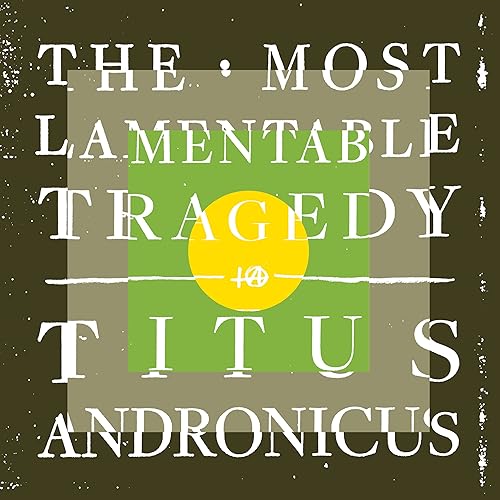
It probably came as no surprise to fans of Titus Andronicus, though, a band that fused punk with large helpings of Springsteen-esqe rock, that Sickles would attempt his own rock opera. As a Civil War buff of sorts, I first became aware of the band in 2010 when they released The Monitor, which used themes from the Civil War to reflect Stickles’ emotional issues. And some of the music really was thrilling. Their next album, Local Business, was more straight-ahead rock, but for 2015’s The Most Lamentable Tragedy, Stickels created a rock opera lasting more than an hour and half, on the topics of mental health and neurodiversity. As Spin explained, 

the rock opera’s plot is roughly as follows: A manic-depressive young man meets a lookalike who shows him, through pharmacology and/or religious awakening, a better way of life. He meets and falls for a girl, but has become drug-dependent and experiences a breakdown. He nearly ends it all, but learns at the last second that life is worth trudging through. It’s basically impossible to track the story just by listening — Stickles’ guttural spitting makes many tracks indecipherable — but Quadrophenia and American Idiot were hardly coherent original screenplays, either.

And have you ever read the liner notes to The Lamb Lies Down on Broadway?

The music is also diverse; while most of it skews punkward, there are also electronic/noise interludes, poppy songs, some clear Springsteen homages, fiddle-heavy Celtic rock, and a version of “Auld Lang Syne.” And it was reviewed in The New York Times. 

Toward the end, is “Into the Void (Filler),” a hard rocker with more than a little bit of Bob Mould/Hüsker Dü influence. I’ve read the lyrics and I’m frankly not at all sure about what it means, but if it is part of a piece about mental illness, maybe it not a surprise that it is hard to decipher. I still don’t know, though, whether the “Filler” in the title refers to filling the titular void, or that the song is filler, but I don’t think so, because it's pretty good (although I've never seen it mentioned in any of the reviews I read in preparing this piece).

I saw Titus Andronicus in 2013 at Terminal 5 in New York with my son, where they were the second act on a bill with The Menzingers opening and Lucero closing. I was excited to see Lucero for the first time since 2006 and to hear Titus Andronicus, but had never heard of The Menzingers. I think that Terminal 5 had really crappy sound, so the loud fast dense sound of Titus Andronicus was hard to listen to or understand (and looking at the setlist now, it appears they played a few songs from the not yet released The Most Lamentable Tragedy). Lucero was fine, although not as good as the first time, although it was maybe because of the bad sound. The Menzingers, though, made a good impression.

Friday, October 2, 2020

EMPTY: ROOMS/GAY & TERRY WOODS

Writing this on a windy, wet and bleak day in Shropshire, exhausted from a ramble around the Wrekin. Exactly the mood to bring on an attack of the folk-rock itch, todays scratch coming from the exquisite store cupboard of Gay and Terry Woods. And it set me a'thinking, not least of the back of the rereleased Richard and Linda Thompson catalogue, what if? OK, don't mistake me, I love RT and all of his oeuvre, but, coming out at much the same time and on the same record label, to say nothing of, broadly, the same musicians, how are we now not celebrating this other couple also? After all, what did they have in common? Talented instrumentalist and songwriter? Yup. Consummate singer of said songs? Yup. A sense of overarching melancholy? Yup, yup, yup. (To be fair, like the Thompsons, both could sing, if Terry, like Richard, was a more acquired taste. Plus their material was decidedly co-written between them.)

Empty Rooms is a classic of the early to mid seventies folk rock style. One of the finest tracks on their second album in their joint name, The Time Is Right, from 1976, I surprised to see it actually came out on the Polydor label and was not produced by John Wood, so indelibly is it stamped with the aura and ambience of the pink Island label. The slow build, the soaring vocals, initially Gay alone, autoharp and harmonium providing a desolate backing over picked guitar. Gay then harmonises with herself, with distinct echoes of, yes, Linda Thompson, but also of the lodestone of this genre, Sandy Denny. Indeed, the melody and mood is very redolent of Denny's own solo work. Finally a coda kicks in, with the Fairport rhythm section, Island records own house band for everyone at that time, the Dave's Pegg and Mattacks, accompanying Terry Wood's guitar, adding plangent chords as it fades to the end. Exquisite. As is the song below, Back to You.

But the time, sadly, wasn't right, they failing to make any great breakthrough, breaking up both as an act and a partnership after a third album. But that wasn't the end of either of them. Mind you, they had paid their dues, neither here today and gone tomorrow flitterbegibbets. Teenage sweethearts, they had grown up, in Dublin, as near neighbours, both drawn by their mutual love of music, performing together as early as 1963, mainly a mix of country, blues and a little Irish. It is hard to believe how unpopular the traditional Irish tradition was at that time. Perhaps the first group to give that tradition a good kicking was Sweeney's Men, as Johnny Moynihan, Andy Irvine and, initially, Joe Dolan transplanted Irish idioms onto a transatlantic hillbilly base. When Dolan left, Terry Woods interrupted the initial iteration of the Woods band, he and Gay, to become an integral part of the line-up. 

Meanwhile, over in England, a certain Ashley Hutchings was tinkering with the formation of a group to take the folkier leanings of his then band, Fairport Convention, further and deeper into that tradition. So having invented folk-rock with Liege and Lief, he left, an original plan being that he and Sweeney's Men would combine, bringing in Gay Woods as a female voice. Neither Irvine nor Moynihan were up for it, so Hutchings pitched the idea to some others in the same field. So, Hutchings and the Woods, in 1970, combined with the duo of Tim Hart and Maddy Pryor, to form Steeleye Span, this grouping responsible for the first record by this band, Hark the Village Wait. Less austere than later line ups, this is almost a transition, bridging the styles of Fairport and the Woods, retaining drums as an integral part of the sound if not officially of the band. But Terry Woods and Tim Hart had distinctly different opinions as to, well, just about everything, and, for the good of the band, Hutchings enlisted Martin Carthy and dumped the Woods.

There then came a brief joint membership with Ireland's answer to the Incredible String Band, Dr Strangely Strange, who were, perhaps unsurprisingly, much as the name might suggest. Even when featuring a young Gary Moore on electric guitar, they couldn't quite ever work out quite who their audience should be, and they ground to a halt, that accelerated by the Woods reviving their duo. Which is where we came in. 

On the dissolution of the duo and their marriage, Gay Woods, somewhat surprisingly and counter-intuitively, became, for a while, the brighter flame, as she applied a more modern varnish to songwriting. For a while the keyboard and synth heavy Auto da Fe were seen as Ireland's next big thing, the presence of Phil Lynott as producer and on bass helping no little. It couldn't last, however, and 1994 had her rejoining Steeleye Span, now a completely different band, with only Maddy Pryor remaining from that first line-up. For a while they were joint front women, with Woods taking over entirely for a while, as Pryor took a sabbatical. Woods left again shortly after, but not before providing the stand out track for 2000's Bedlam Born.


Terry has had a more varied career, dipping in and out of various groupings with artists as varied as (again) Phil Lynott and Ron Kavana. But his moment in the sun came a little later,  when folk-punk mavericks the Pogues needed a little more gravitas to ground their unwieldy, if effective, amalgam of the musicianship of the Dubliners with the attitudes of punk rock. Woods was the perfect bridge between the two opposing styles, his membership giving a boost of credibility to those who couldn't see past the image, and thus failed to see the astonishing songwriting of Shane MacGowan. And, as MacGowan slipped into a drunken self-parody, it was Woods who could provide the glue and keep the band together. Whilst he left in 1993, he became again present in band reunions from a decade later until final performances in 2014, spending the interim and since back with old buddies from his long and varied past. A final iteration of the Woods band, the name revived even if he the only Wood present, provide an apt reminder of his position as a weaver of styles and traditions.


Fill your rooms with this!

Monday, September 28, 2020

Empty: Empty Baseball Park

Whiskeytown: Empty Baseball Park
[purchase] 

When I suggested the Empty theme, it was prompted by watching sports in empty stadiums, and honestly, I had forgotten about this song. If you have read my posts here and elsewhere, you know that I’m a sports fan, mostly New York teams (Mets, who I have written about often, Giants, Knicks, Red Bulls, Sky Blue), plus Arsenal and Princeton sports, the US Women’s and Men’s National Soccer Team, and the Olympics, World Cup, etc. 

As the pandemic closed things down, sports were an early casualty, so that being stuck at home wasn’t tempered by the chance to watch games on TV. Slowly, though, games started to return, beginning with the German Bundesliga, then other European soccer leagues, all of which were played in empty stadiums. In the USA, because our response to the coronavirus was incompetently handled by our incompetent president, the first games that started were played in “bubbles,” where the players and staff were isolated from society to prevent infection. So, both the NWSL and MLS played, as did the NBA and NHL, at various central locations, with reasonable success. 

But summer means baseball, and for me, I love watching Mets games, even when the team is, as usual, not good, in part because it is a long standing tradition, but also because the Mets announcers, Gary Cohen, Keith Hernandez and Ron Darling are the best. (And if you don’t believe me, read this, subscription to The Athletic required, and well worth it.)  Baseball ultimately decided to have a truncated season, with some new on and off-field rules, with the games played in the teams’ parks, not a bubble (although they are moving to a bubble for the playoffs). But again, there were no fans allowed, although some teams allowed fans to buy plastic cutouts of themselves, their families, random other people, and even pets, to make it look like people were in the stands. And like most of the other empty stadium sports, fake crowd sounds were pumped into the stadium and/or played on the broadcasts to lend some degree of normality. 

I watched a good part of the Mets’ season, in the empty baseball parks, and despite the talent on the team, and the fact that the number of teams qualifying for the playoffs was increased, the team fell short—which was a disappointment, because most prognosticators had the team at least making the playoffs. But as the cliché goes, that’s why you play the games. 

So, when I started looking for songs for this theme, “Empty Baseball Park” jumped out at me. Whiskeytown was a band founded by Ryan Adams, and was known for excellent songwriting, inconsistent performances and internal turmoil. The band cycled through members, with only Adams and Caitlin Cary as consistent participants. The band released only three full albums, but their influence can be seen by the fact that there are at least two books about the band. 

Adams is one of those scarily talented songwriters and performers who has probably thrown away more great songs than most people write. He’s also known for being personally difficult, having issues with drugs and alcohol, and, most recently, being accused of sexual harassment. I’ve long appreciated Adams’ talent, and appreciated his part in helping Jason Isbell get sober and supporting his career, but it is hard to ignore the harassment issues, which he has denied, but which appear to have derailed his career, at least for now. And Isbell has distanced himself from his former friend. 

But, back to the song. “Empty Baseball Park” was originally recorded as a demo, along with other songs, called the “Baseball Park Sessions.” Many of the demos later appeared on Whiskeytown’s 1997 Strangers’ Almanac album, but not this one. In 1998, the band reissued its debut album, Faithless Street, and included a slew of bonus tracks, including “Empty Baseball Park.” Now, despite my long discussion of playing sports in front of empty seats, that’s not what the song is about. Rather, it is a reminiscence by Adams of growing up in Raleigh, North Carolina, and his aimless activities, including hanging out in an empty baseball park after the bars closed, with, reportedly, a young woman, and pretending that a game was going on. 

It’s not the best Whiskeytown song, but I’m glad that this theme reintroduced me to it.

Saturday, September 26, 2020

Lessons: musings of a teacher


purchase some Steve Martin [ The Crow ]

purchase some Tommy Emmanuel[ Guitar Mastery of ~ ]

Like at least one other of my associates here at SMM, lessons is what I do. Day in, day out for forty-two years now. But for some reason, this has meant that I have struggled to come up with something to share on this page at this time.

Like most school folk, as trite as it may seem, I am committed to life-long learning. I take this for granted. Until, that is, I run across research that shows that one in four Americans didn't read a single book last year. The good news is that apparently there has been  a slight uptick with the arrival of audiobooks.

The tradition location for a lesson - the classroom - has become a memory. I've been teaching out of a closet at home since March and it continues this fall. As a teacher, it cuts both ways: I've gone a month into the new year without having once met my students IRL. Tough to really know who's learning the lesssons. On the other hand, my double computer Zoom setup and the handy French press offer some mitigation. I record each class and post the video along with a copy of the presentation materials.

The first lesson of the day starts at 7:50. I suppose I could just about roll out of bed 5 feet away and power up the Zoom meeting in 5 minutes. But I need a bit more and figure the kids do, too. So ... this year, I've taken to starting the Zoom 5 minutes before "the bell" and cranking out some music as we wait for all 20 to arrive and pass through the waiting room door.

My selection of music for this use has multiple purposes: learn the kids something they might not have been exposed to in their home culture (we're not in America), as well as set some kind of a tone. At 7:50AM, that's likely to be something to help them get awake, like this:


At 2:20PM. when the students have been through 2 80-minute lessons followed by 3 40-minute lessons and are headed for one last 80 minute session until 3:40, my choice could be another bluegrass bounce, or it could be something along these lines:


Video doesn't stream particularly well through Zoom, so I've been converting YouTubes to mp3s and pumping those out. I've noticed that it is taking considerably more time to manage lessons in the zoom world both in preparations before and in follow up after. The time for downloading, converting and cueing the song seems to be worth it since  feedback from my audience has been positive and has led to learning and discussion beyond the course content: a well-rounded lesson for all, myself included.

Friday, September 25, 2020

LESSONS: FALLING IN LOVE WITH MY TEACHER/DANNY ADLER


Sting was famously a teacher, something the lyrics, and video, of the Police hit Don't Stand So Close make no small reference to, although surely in fantasy, it seeming hard to imagine any teenage girl being enraptured by the gormless looking Gordon. But this is not about him, this is the other side of the coin. This song is the world of crushes and besottedness, and relates more to the phenomenon of the spotty teenage oik, gazing in slack-jawed awe at the woman of his dreams. Add in the scenario of an all boy school, maybe a boarding school, and you can see how it happens, that teach being, perhaps alongside Matron, the only female form for mile, age and comeliness no hurdle for the bubbling surges of testosterone. And it's actually quite a bit creepier than Sting and co.

At least Danny Adler, onetime guitar jockey for pub-rock stalwarts Roogalator, made no bones about it. An unheralded talent who went largely unlauded then or later, he started off a guitar for hire in Cincinnati, getting gigs with some of the local blues scene talent, folk like Bootsy Collins and Slim Harpo. He later moved to San Francisco, hooking up with further bigger blues names, such as John Lee Hooker and T-Bone Walker. Another packed suitcase had him later being part of Frank Zappa and (later) John Lennon acolytes, Elephant's Memory, in New York. So quite how he came to be in London come 1971 is anyone's guess, other than the wanderlust that had led him to study jazz guitar in Paris.

Roogalator were a classic right band in the wrong time, and they shoulda and coulda, were it not for that timing. Part of the fizzing pub rock scene, where any style of music, whether derived from blues, from country, or from soul could make a name and a living of sorts, provided the sounds were held in sway by a tight rhythm section and the songs were short(ish) and catchy. The stirrings of an antidote to prog, more accomplished and more innovative than the later dawn of punk which, in turn, kicked pub rock off the stage and into the footnotes. And, yes, it's true, many of the denizens of that early 70s movement revived and reinvented themselves as new wave dawned, becoming elder statesmen feted to this day, your Nick Lowes, your Elvis Costellos, Graham Parker even. Not quite so was the lot of Adler, although he was, for a time, part of the studio band set up by Dave Edmunds and Nick Lowe, under the names, variously, of the Disco Brothers and the Tartan Horde. Nothing of any great repute came therefrom, but it is interesting to consider what if made the the cut for the band Rockpile, instead than Billy Bremner.


No relation to the similarly London locked harmonica king Larry, or at least I think not, he then retreated to his roots in blues and boogie boogie, next popping up as part of the often Charlie Watts and Jack Bruce helmed collective, Rocket 88. In truth it was probably more the baby of Ian 'Stu' Stewart, the perennial 6th (Rolling) Stone, whose barnstorming piano play was a permanent fixture in their early career, even if his lantern jaw and short hair had him officially sidelined as their roadie. Lured in by the prospect of Watts and Bruce, neither of whom showed, I caught a memorable show by this two pianos and lashings of brass throwback to the 1940s, at Dingwalls Dance Hall, the fabled venue at Camden Lock, London. The nerdy looking guitarist with an astonishing tone was Adler.

After the demise of that project, itself probably accelerated by Stewart's death, Adler became an integral part of another collection of UK jazz and blues veterans, the De Luxe Blues Band, many of whom were seasoned session men from the 60s british blues boom, as indeed was Dick Heckstall-Smith, the ex-Colosseum reedsman, who later joined. Eventually his itchy feet again caught up with him and he returned to the USA. Since that time, the early 1990s, he has been continuing to plough his own idiosyncratic furrow, as well as buffing up his Roogalator and other back catalogues. The featured song for this piece comes from a collection, Hub-cap Heaven, about which I can find little, other than the purchase link below. The song is from 1986, seemingly the album part of a trilogy about early postwar England and America. Maybe. His personal website is intriguingly incomplete, his material, new and archive, seemingly best sourced through Bandcamp, with information via Facebook, as well as sporadic new offerings. Any guess as to whether or how this supplies a living is open to conjecture, but, if it works for him, all power to that.

Hubcap Heaven.


Tuesday, September 22, 2020

Lessons: Rock N Roll High School


Ramones, Rock n Roll High School

A lot of songs about high school are delinquent, party songs, or about hating teachers, rebellion and learning pretty much nothing useful. Ever. Alice Cooper's "School's Out" comes to mind, silly as it is. I never bought into the Beach Boy's "Be Cool to Your School"--in fact, I kind of resented the band for singing any kind of praise at all concerning school. Which, for most of my life, was a prison, rather than a place that should be celebrated with drums and guitars. the songs that spoke to me were the ones that reinforced rebellion. Maybe burning books. The best school songs are the ones about how much school sucks. 

Strange how those anthems speak to both the cliches and the realities of a lot of kids. I'm a teacher now, but I hated school from first grade until the moment I graduated from undergrad. Any song that dealt with rebelling against teachers, their dirty looks, all those pencils and books, spoke to me in a distinct, familiar and sympathetic voice

Songs like "Rock n Roll High School", and the eponymous movie (I believe the song came first and the movie was built as a vehicle around it) were perfect. Aggressive enough to feel good, pump the blood up on test days and my inevitable failing grades that followed, rock music was a saving grace in my angst filled teenage daze. The Ramones were silly punks, inspiring horseplay, girl-chasing, and petty vandalism rather than full on burn-it-down rebellion. I got into more hardcore bands as I got older, and Metallica was putting out their best work when I was in high school, so the kind of music that fed into my growing frustrations certainly played a role in my development, and a loud one. (I got pretty fed up with school for a while there, but somehow, stuck it out. The angrier, louder, meaner music that found its way to me helped me through, as well). But the Ramones hold a special place in my heart for providing the soundtrack to my earliest days of discovering music and the saving grace it would give me--a sustaining power, a joyous and continual discovery, and constant companion, music was the part of my life that made sense, and made sense of the parts I didn't understand. Or particularly enjoy. I can't tell you how many times a teacher confiscated my walkman and my cassettes. When I got in trouble at home, restriction meant my stereo and my guitar got confiscated and stored away in my parent's closet. I always managed to sneak my walkman out without them knowing. The lure of music was too great. 

But, the lessons of rock music remain the best ones I ever learned, my idols my best teachers. Rock music was what made sense. What moved me and what pulled me along with a promise of better things to come. It was a great promise. 

It still is, to be honest. I spend an inordinate amount of time in my life on music. I hated school, but I survived it.  And, I have music to thank for getting me through those odd days of my teenage years, and the odd ones that have followed. My high school days never quite lived up to the promise the Ramones made in their songs, but, I think we made up for it in college...but, those are tales best left untold here...