If you can take the weather with you, why can't you take it away again? I guess it depends who you are, but the idea has no traction with me, as whichsoever bugger delivered three storms on the trot to UK this last week can do one. Thankfully, the weather has now abated and the sun is shining, a wispy sun on an early spring day. Give or take the maelstrom and mayhem of Ukraine, all might seem to be well with world, even if, as a result, it isn't.
Sunday, February 27, 2022
WEATHER: RAINING IN GLASGOW
Posted by Seuras Og at 11:31 AM View Comments
Labels: Calexico, Dean Owens, Smile, The Felsons, Weather
Sunday, February 20, 2022
Love: The Lovin' Spoonful
purchase [ Greatest Hits ]
The Lovin' Spoonful name has an "interesting" provenance - according to some sources. Not quite as the name might appear on the surface. That said, this appears open to interpretation, as yet a different source credits a Mississippi John Hurt song Coffee Blues in which the man is singing about a cup of coffee with just the right spoonsful of what makes it good. In the best tradition of good art, it's best lleft to you to decide which story you prefer to believe. The vocalist for the Lovin' Spoonful apparently intimated in most concerts that it was the first, drawing out the references to loving more than to the coffee he was drinking on stage.
Although the band had broken up by the time the original Woodstock festival rolled around, John Sebastian preformed solo. There are several different recollections as to just when he appeared, but none disputes the fact that he was unscheduled, having arrived as a spectator, but when the rain made an electric performance (probably by Santana) if-fy, he took the stage for an acoustic set.
Considering that - during their rather short mainstream career - they were contemporaries of the Beatles' hottest years, for them to have as many hits as they did is fairly impressive. Their contributions were recognized with a 2000 induction to the Rock Hall of Fame.
To jog your memory/introduce you, depending on your age:
Posted by KKafa at 6:46 AM View Comments
Labels: John Sebastian, Love, Lovin' Spoonful
Friday, February 18, 2022
LOVE : ARE YOU LOVIN' ME MORE, BUT ENJOYIN' IT LESS
'I Had Too Much to Dream (Last Night)' was a prime slice of garage rock, clearly hitting a chord somewhere, as it attained a number 11 and 49 on the US and UK chart of 1966/7 respectively. A heady whiff of psychedelic fuzz guitar, cheesy organ and clattering drums, it is the face of the fella on the right of the video still that gives me most pleasure, the epitome of the lights on yet no-one at home. Yup, thought a thousand and one prototype freaks and hippies, I'll have some of what he's dreaming. That would, could and should have been that, a song and style more destined for cult status and bargain bins, up there with ? and the Mysterians. Indeed, when 'Nuggets', that groundbreaking compilation of all things equivalent, subtitled 'Original Artyfacts From the First Psychedelic Era, 1965-68', came out, in 1972, it was deemed significant enough to open side one. (Incidentally, the compiler of said project was a mild-mannered writer, who also worked at the Village Oldies record shop in New York, a fella by the name of Lenny Kaye. Yup, the one that became, a little later, that Lenny Kaye.)
The band have an interesting and unfortunate story. Formed out of the remains of L.A. surf group, the Sanctions, their core was James Lowe, on vocals, and Mark Tulin, on bass, the aim to provide a form of free form garage rock. With various additional members coming and going, eventually enough buzz was made to catch the ears of one Dave Hassinger, an RCA records producer. He also got them to adopt the name he had come up with, something less than loved by the band at first exposure. After the unsuccessful 'Ain't it Hard', still under Hassinger's supervision, they were signed to Reprise. In much the same way as their own name was dispatched, so too then were their songs, with the songwriting team of Annette Tucker and Nancie Mantz drafted in to write them song new songs. When their debut album dropped, Tucker had had a hand in eight of the songs, including the one at the head of this piece and 'Dream', scuppering the wishes of the actual band members for a greater involvement. Arguably, what impression the actual musicians made was more upon the sound than the content; such was the response to the heavy distortion on IHTMTD(LN), that Vox, the makers of the Continental amplifier, signed them up as ambassadors, with the expectation of even greater sonic distortions built into the future direction plotted on their behalf. A second album did manage some escape from Hassinger's grip, allowing the band to submit more of their own material. However, with yet more changes in the membership, the reliance on effects over melody largely failed to trouble the chart. But a high profile European tour put their name on the map.
Meanwhile, Nuggets had been released, gaining some restored interest in the original iteration. Plus their earliest demos had at last seen the light of day, and, with the trickle out of re-releases of both their initial records and the Axelrod years, they were becoming quite the cult favourite. In 1997, the Stockholm '67 LP was released, 30 years on after the European tour, and the four original members, Lowe, Tulin, Weakley and Ken Williams, the fuzz guitar provider, were available. Reconvening in 1999, after a couple of years they dropped an album of new material, Artifact, the spelling a careful play on the word, a whisper shy of the spelling of the Nuggets subtitle, and of the correct spelling. But an artefact it was, a more balanced and mature take on their psychedelia, and led to tours and further studio work. Of course, as is now the law, the band still play on, even though the aged original core have largely passed on or over; Tulin died in 2011, with Williams and Weakley only intermittent participants anyway. James Lowe remains at the helm, with the rest of the band relative newcomers of between 8 and 18 years standing. Not bad for a band effectively finished in the 1960s.
Posted by Seuras Og at 12:23 PM View Comments
Labels: ? & the Mysterians, David Axelrod, Electric Prunes, Love
Tuesday, February 15, 2022
Love: The Loving Kind
Nanci Griffith: The Loving Kind
[purchase]
Every once in a while, I’m struck when something that seems so incredibly wrong still existed in my lifetime. Like the fact that married women couldn’t get credit cards in their own name until the 1970s, or that people of the same gender couldn’t get married until a few years ago. But it really is incredible that in my lifetime there were places in this country where it was still illegal for blacks and whites to get married, until the Supreme Court unanimously ruled, in 1967, that such laws were unconstitutional in the landmark case of Loving v. Virginia. And yes, that was their last name, which couldn’t have been more perfect. (And no, I haven't seen the movie yet, but it's on my list.)
That it took just over 100 years from the end of the Civil War (and just under that from the ratification of the Fourteenth Amendment which, by its clear and unambiguous terms, prevents states from making or enforcing “any law which shall abridge the privileges or immunities of citizens of the United States;” and which prevented any state from depriving “any person of life, liberty, or property, without due process of law; nor deny to any person within its jurisdiction the equal protection of the laws”) to have the Supreme Court make such a ruling, is incredible, unless you have any knowledge of American history, and its inherent racism. (And whether the Supreme Court, as currently constituted would do the same, unanimously, actually seems unlikely to me.)
Even with the Supreme Court ruling, Alabama continued to enforce a similar law until 1970, when the—wait for it—Nixon administration went to federal court to stop it. And Alabama actually kept the law on its books until 2000, when 60% of its voters approved a constitutional amendment to remove it. Which means that 40% of the voters still wanted to keep it.
In 1958 (a few years before my lifetime), Mildred Jeter, a woman of Native American, European and African American heritage from Central Point, Virginia married Richard Loving, a white man (and descendant of a Confederate soldier), who was a friend of Mildred’s brothers and who reportedly had many close black friends, after Mildred became pregnant. They were married in Washington, D.C. and returned to Virginia, where their marriage was illegal. Remarkably (or, maybe not so remarkably), they were ratted out to the sheriff, who arrested them. They pleaded guilty, were convicted on January 6, 1959 and sentenced to one year in prison, suspended for 25 years on the condition that they leave the state. So, they moved to Washington, DC, but missed their hometown, despite the whole being snitched on and arrested for being married thing.
In 1964, Mildred wrote to Bobby Kennedy, the Attorney General, who referred her to the ACLU, which filed a motion to vacate the conviction and set aside the sentences. When the state court sat on the motion for a year, the ACLU brought suit in federal court, prompting the state court judge to deny the motion, stating, remarkably (or, maybe not so remarkably):
Almighty God created the races white, black, yellow, malay and red, and he placed them on separate continents. And but for the interference with his arrangement there would be no cause for such marriages. The fact that he separated the races shows that he did not intend for the races to mix
In 1966, the Virginia Supreme Court, hearing the appeal of this ignorant and racist decision, upheld the state ban on interracial marriage, using an extremely convoluted interpretation of the Fourteenth Amendment (which had been endorsed previously by the U.S. Supreme Court). It was that decision that was rejected by the United States Supreme Court, which found that the law really, really, really violated the Constitution (and reversed its prior, totally wrong, interpretation of the Fourteenth Amendment).
Mildred and Richard moved back to Virginia and lived there for the rest of their lives. Richard was killed by a drunk driver in 1975; the accident cost Mildred an eye. She lived on until 2008, when she died of pneumonia.
One person who read Mildred’s obituary was Nanci Griffith, who wrote “The Loving Kind,” about the Lovings and their case, and released it in 2009 as the title song of an album. It’s a good story song and does not sound at all like a law school casebook.
Of course, it wasn’t until 2015 that the Supreme Court, in Obergefell v. Hodges, extended the logic and holding of Loving to prevent bans on same-sex marriage. These cases, and others, used to give me hope that our country was making social progress, which the Supreme Court (eventually) caught up to. But that hope does not seem justified at this time.
Posted by Jordan Becker at 8:30 AM 0 comments
Labels: Love, Nanci Griffith
Thursday, February 10, 2022
Love: (Who Wrote) The Book Of Love
The Monotones: (Who Wrote) The Book Of Love
[purchase]
My father loved this song. He grew up in Brooklyn during the heyday of doo-wop, and I remember him singing this song, loudly and badly, when I was a kid. It’s a great song, and a fun song, and it provides a very simple primer for love:
Chapter One says to love her
You love her with all your heart
Chapter Two you tell her
You're never, never, never, never, ever gonna part
In Chapter Three remember the meaning of romance
In Chapter Four you break up
But you give her just one more chance.
As someone who has been in love for decades, I think that it’s pretty good advice, although I’m pretty sure that there are many more chapters in the book that weren’t discussed in the song (and in my case, it was me who was given that extra chance….)
If Ted Lasso, one of my favorite TV shows from the last couple of years, can have been inspired by a series of NBC soccer promos, then why can’t a doo-wop classic be inspired by a Pepsodent jingle? According to Monotone Charles Patrick, he was in a store looking at sheet music for a different song called "Book Of Love" when the jingle, “You'll wonder where the yellow went when you brush your teeth with Pepsodent," came on the radio. He got the idea to combine the title with the melody from the jingle, turning "You'll wonder where the yellow went" into "I wonder, wonder who." Patrick completed the song with his fellow group members, and the rest is music history, with the song hitting No. 5 on the Billboard pop chart and No. 3 on the R&B chart in 1958. That story may be apocryphal.
One of the most memorable parts of the song is the heavy drum beat at the end of the first line, which was a fortuitous mistake—when the band was recording the song, a kid outside the studio threw a ball that hit a window just as they finished singing the line. They liked the way it sounded, so they decided to put a drum hit in that spot. That story also may be apocryphal.
The Monotones were formed in 1955 by seven residents of the Baxter Terrace housing development in Newark, New Jersey: Warren Davis, George Malone, Frank Smith, John Ryanes, and Warren Ryanes, in addition to Patrick (Charles' brother James Patrick, the seventh member, left the group before “Book Of Love” was recorded). All of the future Monotones began singing, presumably not in monotone, with the New Hope Baptist Choir, which included Cissy Houston and Dionne and Dee Dee Warwick, all of whom were related to the Patrick brothers.
Unfortunately, after “Book Of Love” the band’s releases were not successful, although as a resident of Tarrytown, and parent of two proud alumni of Sleepy Hollow High School, I was pleased to discover that they recorded a song called “The Legend of Sleepy Hollow.”
The Monotones disbanded in 1962, although there were reunions to revive “Book Of Love,” and over the years, new members replaced members who had died or retired. For decades, a version of the Monotones were regulars on the oldies circuit.
The song also lives on—it was in the soundtrack to American Graffiti and other movies, was performed by Sha Na Na at Woodstock, used as the theme in a version of The Newlywed Game in the late 1980s, was sung in an episode of Who’s The Boss, and has been used in video games.
Posted by Jordan Becker at 8:30 AM 0 comments
Labels: Cissy Houston, Dee Dee Warwick, Dionne Warwick, Love, Sha Na Na, The Monotones
Wednesday, February 9, 2022
LOVE: HOLY LOVE
You possibly or, more likely, probably don't know the song. It would be great if you do, and there may be some, but I fear the band of aficionados is more select and smaller than I would prefer. And, who knows, this may alert new ears to both the singer and the song, and I hope it can. The singer you may have heard of. Or at least, heard his voice. So who he?
Having failed to set the world alight, Love and Money lurched on to a further couple of albums, bedogged by issues with record companies: their 3rd album was initially rejected, ahead of coming out, substantively altered, on another label, the 4th then being, to all intents and purposes, self-released. Despite all this, that difficult 3rd album, when finally released, as Dogs in the Traffic, was seen fit to gather a number 30 in the Scotsman newspaper's all time top 100 Scottish rock and pop albums. they split up in 1994.
Grant embarked on a solo career. Given he had now hooked up with the husband and wife, Donald Shaw and Karen Matheson, both of Capercaillie, this unsurprisingly is a rootsier effort, with strong country and folk flavours to the anthemic melodies. Sawdust in My Veins came out in 1998, and in the same year he was included as a guest in the prestigious Transatlantic Sessions. My Thrown Glory followed in 2000, with an album of other writer's poetry set to his music, I Shot the Albatross, bridging the gap ahead the album that produced the song that heads this piece. His high water mark, I would say, with the song also the name of the record, a splendid record of truly celtic soul, and well worth searching out. The song itself, despite the title, is neither religious nor sanctimonious, being more a spiritual ode to love, using the analogy of love being a higher force. I think. It uses holy in the same way as is, say, Steve Winwood's evocative Holy Ground, his hymn to the planet.
During these same years he also returned the favour, working on Karen Mathesons's solo albums, writing four songs for her first record, six for her second and two for her third, as well as providing instrumental ballast to the backing throughout. Indeed this has continued to the present, with her most recent album, 2021's Still Time, containing another four.
His own solo career continued with Strange Flowers, in 2009, ahead of a reunion concert of Love and Money, for the yearly Celtic Connections festival, in 2011, led to new work and an album, Devil's Debt, a year later.
If his profile has seemed subsequently low, let's just hope it a hiatus. As the new songs with Karen Matheson have shown, his muse is still within him. He remains a loved figure on the Scottish live scene: a live solo disc of his 2016 Celtic Connections (again) gig showed updated and invigorated songs from throughout both his band and solo career. whilst it did not, sadly, include Holy Love, there is at least this glorious retread of Strange Kind of Love, the second song I featured earlier up the thread. Indeed, whilst I was researching this piece I learnt he has a couple of shows arranged for later in the year, in London and Edinburgh, details through his website. (This also reveals the possible enticing option of having him write a bespoke song with and for you........ )
Posted by Seuras Og at 2:45 AM View Comments
Labels: Holy, James Grant, Karen Mathewson, Love and Money, McCoys, Traffic, Transatlantic Sessions
Saturday, February 5, 2022
Boss: Big Boss Man
purchase [ Jimmy Reed ]
Thinking over the word <boss> and its connotations, it occured to me that the word probably came into the English language via Dutch. A little research and ... voila .. "boss is Dutch in origin"... it comes from base or bass or baas. However, being the polyglot that I am, I can't help surmising that there is more to this than that. The Turkish word for "put pressure on" (as in oppress a worker, or force) is <bas>. I am going to go one step further than Collins and Oxford dictionaries and posit that the root goes back further than the Dutch - back to the Ottomans, in fact. It's just an observation, but it makes an awful lot of sense. (You heard it here first.) bas=baas=boss.
So... who's the boss? Well, even that phrase, popularized in many forms, has a somewhat murkey provenance. A 1914 Oliver Hardy film?
The boss is "the person that other people have to obey". That could also take us down a rabbit hole of what it means "to obey", but it also conveys "authority and expertise", and with this we have a more accessible value to the word as it applies to musicians like Springsteen (known as "the boss" for some reason.)
I'll try to take a cue from our own Jordan Becker (and in the process confess that I too often paste information you can find in your own searches - tho' I generally say as much). This week it''s not Springsteen . although it could have been. Not bossanova (tho, again, I love Carlos' music in any form, and thanks Seuras). And not Blue Cheer who were also on my list of potentials on account of their "Summertime Blues" (wherein we have the <I hate my boss> theme).
Pardon me while I provide some freely accessible Wiki data as I assume you haven't yet been there nor know it. Big Boss Man is a Luther Dixon/Al Smith song first recorded by Jimmy Reed - and you would be excused for not knowing the names. That said, some of Dixon's songs were recorded by the Beatles, the Jackson 5 and more.
Sing "You ain’t so big, you’re just tall, that’s all."[
Above it's the Grateful Dead's version and below we have Jimmy Reed, then B.B. King and Elvis.
Posted by KKafa at 8:27 AM View Comments
Labels: B.B. King, Boss, Elvis Presley, grateful dead, jimmy reed
Monday, January 31, 2022
Boss: Little Johnny Jewel
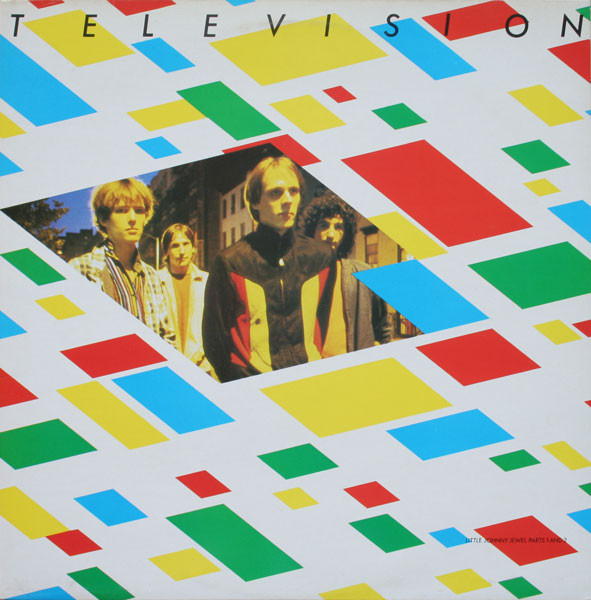
Television: Little Johnny Jewel
[purchase]
I scanned my list of potential subjects for this theme (read my last post if you don’t know what I’m talking about) and decided again to write about a band that I hadn’t discussed before—Television. I’ve written about small-t television many, many times, here and elsewhere (not going to link, since there are too many), because watching TV is probably how I spend more of my leisure time than anything else, but I’ve never written about the band. While Todd Rundgren’s failure to ever be discussed in this space was very surprising, it is almost as surprising that Television has only been discussed twice—back in 2008 and 2009—and both times about the same song, “Marquee Moon.” Which happens to be an excellent song, but we’re going back to Television’s first release, “Little Johnny Jewel,” a single on their manager’s label, released in 1975.
Although Television came up out of the same C.B.G.B. scene as the Ramones, Blondie, Patti Smith, Talking Heads, Richard Hell and the Voidoids and the Heartbreakers, among others, who I often played on the radio back in the 1979-1982 period when I was doing college radio, I had trouble connecting with the band then. As someone who grew up on classic rock and prog, I (eventually) came to understand the hard, fast ethos of punk that those other bands followed (although for some, that changed over time) as a rejection of the older forms of rock. While I still loved what I grew up on, I also learned to love punk (and new wave). But Television’s meandering jams and guitar solos and stream of consciousness lyrics, sung by Tom Verlaine in a yelping voice that, to my ears at least, made David Byrne sound great in comparison, somehow didn’t fit in to the slots that I had in my head at the time. I couldn’t understand how they were in the same category as the Ramones, whose simple two-minute songs done at breakneck speed were nothing like the long songs that Television produced.
Because of their timing, and their identification with the downtown NYC music scene, and because of the rough sound of their music, Television is usually lumped in with the punks, but interestingly, I’ve seen them referred to as both proto-punk and post-punk, which seems impossible without some sort of time machine. And yet, it makes sense, when you look closely. Television presaged punk both temporally and in their attitude, but their sound was not “punk” in the way that word is commonly used, so like “post-punk” bands, they embraced the brashness of punk, but not all of the sound.
In my old(er) age, I’ve come to appreciate Television more and more. Maybe it is my more mature approach to music that is less interested in putting artists and their music in genre slots, so that I enjoy the connections that artists that seem very different actually have. I know, for example, that the first time that I heard “Impossible Germany,” by Wilco, one of my favorites, I was struck by how the intertwined guitar parts played by Nels Cline and Jeff Tweedy reminded me of Television’s Verlaine and Richard Lloyd.
As mentioned above. “Little Johnny Jewel” was the first song released by Television, its 7 plus minutes split into two parts on a 45, and it’s an odd one. Opening with a bass line (from Fred Smith, who had replaced Richard Hell), before Billy Ficca’s drums and the guitars enter, the instrumental eventually resolves into a groove before the vocals begin. The song may be about Iggy Pop, whose real name was James Newell Osterberg, Jr., but his middle name is sometimes listed as “Jewel.” There’s a long instrumental guitar section featuring Verlaine soloing in the middle that sounds closer to psychedelia or even jazz than punk before the groove returns, along with the lyrics:
Oh, Little Johnny Jewel
He's so cool
But if you see him looking lost
You ain't gotta come on so boss
Verlaine recalled in an interview: “Lou Reed asked me, ‘Why’d you put out this song? This is not a hit.’ I said, ‘What band playing a bar in New York, issuing their own single, is gonna have a hit?’” However, the single sold surprisingly well, and arguably kickstarted the New York punk movement.
Posted by Jordan Becker at 8:30 AM 1 comments
Labels: Billy Ficca, blondie, David Byrne, Fred Smith, iggy pop, Lou Reed, patti smith, Ramones, Richard Hell, Richard Lloyd, Talking Heads, Television, Tom Verlaine, wilco
Saturday, January 29, 2022
BOSS:ANOVA
Sorry, guys, going out on a Springsteen free limb here, eager to see if there is any love for the bossa. To folk of a certain age, myself included, that can open up a vista over one of the most over-exposed and ubiquitous songs of the last century, the cloying Girl From Ipanema, but don't go, stick around. It isn't actually a bad song, you've just heard it too many times.
Anyway, this isn't about the song, it's about the style. Arguably no more than a variation on the Brazilian life-source, the samba, it swept in on a wave of innovation in the late 1950's, a condensation of the intrinsic rhythmic shuffle to the minimal, buoyed by off kilter chords and progressions, all syncopated to the max. The splendidly named Milton Banana was probably the originator, the drummer/percussionist for Joao Gilberto. Gilberto's Chega de Saudade (1958) was the first record recognised within this new form, the style then breaking in the film, Black Narcissus, a year later.
That's about as far down that historical alley I want to go, even bypassing the superb contributions to the genre gifted by celebrated saxman Stan Getz, who blows the breathiest whisper that instrument can manage and still be audible. A glorious tone. Because I've got you here to catch what has been happening to the style since the 60s. The enthusiasm actually fell away in the homelands, the breezy music sitting uncomfortably with the political frictions occurring in Brazil, even if every jazzer and his dog in the US was tearing Ipanema to shreds in supper clubs and hotel lobbies across the nation. As latin rhythms determined a more streetwise and funky uplift, courtesy Carlos Santana, so the cool jazz lite of the 'nova was on the fade.
Posted by Seuras Og at 11:41 AM View Comments
Labels: Amy Winehouse, Bebel Gilberto, Boss, Bossacucanova, Elizete Cardoso, Karen Souza, Santana, Stan Getz
Thursday, January 27, 2022
Boss: Bang The Drum All Day
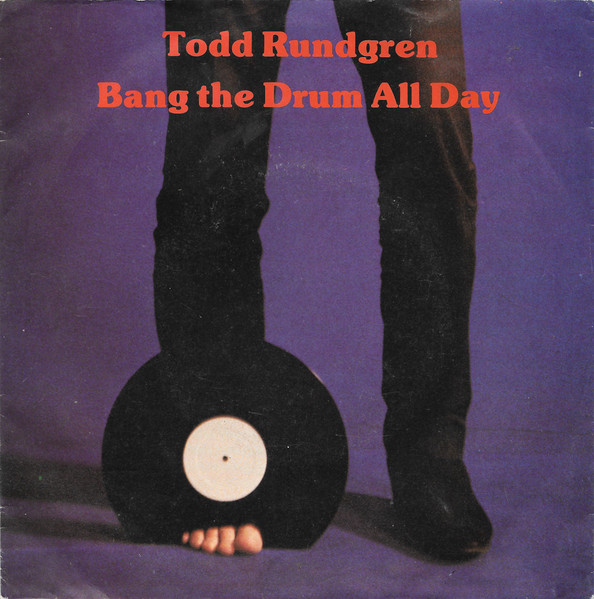
Todd Rundgren: Bang The Drum All Day
[purchase]
Unless a song immediately jumps into my head when our theme is announced (or if I had one in mind when I suggested a theme), my first move is to do searches of my iTunes library. Yes, I’m an owner, not a renter. I was unimpressed by the songs that had the word “Boss” in the title (and didn’t want to write about a Bruuuuuuuuce song). You may know that there’s a site called lyrics.com, where you can search for words in lyrics, and narrow by genre and other filters. It's a godsend for music bloggers, believe me.
I powered through the filtered list (you are welcome to speculate as to what genres I chose, and which I excluded) and came up with a bunch of really good songs to write about. And because in situations like this, I like to write about artists who I haven’t posted about before, one song became the obvious choice—Todd Rundgren’s “Bang The Drum All Day.” Not only is it a great, fun song, but as I’ve mentioned here, I’m a bad drummer, and frankly would prefer to bang on a drum than work, most of the time. Since banging on drums is unlikely to make it possible to pay my bills, sadly I still have to work.
Another thing that made me want to write about this song is that, it appears, since SMM’s founding back in 2008, no one has written a post about one of Rundgren's songs. He’s been mentioned and his production work has been referenced, but despite the fact that the guy has written a bunch of serious classic rock songs in a career that started in the late 1960s and has included more than three dozen solo and band albums, as well as being a true innovator, none of the many former or current SMM writers have written about him.
Now, if you read my stuff, at this point, you’d probably expect the next line to be, “Born in Philadelphia in 1948, Rundgren….” followed by a long discussion of his career mostly pilfered from Wikipedia or Allmusic, with the occasional snarky aside. But I’m not going to go there. If you want to know more about Rundgren’s life and career, click on one of those links. Or both. Because you don’t want to work, either.
It may be that “Bang The Drum All Day” will end up being Rundgren’s most enduring song, although “Hello It’s Me” and “Can We Still Be Friends” might give it a run for its money. ("I Saw The Light," too.) It was, initially, a throwaway song that Rundgren claims came to him mostly in a dream, and since he had a home studio, was able to roll out of bed and record it-he plays all the instruments on the song. Rundgren has said that his record company didn’t see the song as a single from his 1983 album The Ever Popular Tortured Artist Effect, but eventually it was released and topped out at 63 on the Billboard Pop Singles chart, and 39 on the Billboard Mainstream Rock chart.
But it had legs.
What makes the song fit our theme, of course, are the lyrics:
Every day when I get home from work
I feel so frustrated
The boss is a jerk
And I get my sticks and go out to the shed
And I pound on that drum like it was the boss's head
But what made the song popular was its fun message and the catchy music. Rundgren explained:
I like the idea that I've written a song that is well known to a broad segment of the population…and they have no idea why they know it! In the same sense that everybody knows 'Happy Birthday,' but they can't remember the first time they heard it, and they have no idea who wrote it. But you've penetrated the cultural consciousness in a way that transcends the typical pop song, and what it means is that if I never have another hit record on the radio again, that song is still going to be around likely twenty-five years from now.
And although Rundgren also claims that he hates playing the song because it makes him feel “ape-like,” he also considers it his most impactful song, “because I made so much money off of it.” Not only through sales and airplay, but because it has been used in many commercials, TV shows and movies, at football games (most notably Green Bay Packers games) and as a theme song.
Despite making all that money from “Bang,” it still seems that Rundgren still wants to work (or maybe has to.)
Posted by Jordan Becker at 8:30 AM 0 comments
Labels: Boss, The Nazz, Todd Rundgren, Utopia
Saturday, January 22, 2022
Done: All My Life
purchase [ One by One ]
For someone who for many years had one foot in Seattle, I know relatively little about the local music scene. My excuse being that I have only ever been a transitory visitor even though my legal US residence is still WA state. That said, among the handful of live concerts I have attended in the US is Blind Faith and again Eric Clapton about 50 years later - both in Seattle.
But Nirvana? Pearl Jam? Alice in Chains? Sound Garden? Green River? All Seattle bands. The best I can say in my favor on this count is that I have listened to a little of them. And I keep saying it's time I did some more. In the late 60s and early 70s I listened to a fair amount of what then passed for "heavy", such as Led Zeppelin, Mountain, Grand Funk Railroad, Deep Purple .. And for all that, following a little search at SMM archives, I see that I have actually touched on the Foo Fighters more than once. And still don't know much of their music.
This post would be one that our sometime itinerant/irregular writer Andy La Raygun might have chosen, he being much more knowledgable about this sound and style. And considering that they were just inducted to the Rock and Roll Hall of Fame this year (which see), there are a lot of other folk who like their music.
I could become a convert if I listened to more. Maybe. Dave Grohl is a name I am somewhat familiar with, but I know squat about the rest of the band, and that would be yet another trail to follow and improve myself.
Grohl says the song is a little dirty. You can search that one yourself. He also notes that it really isn't that heavy, for his taste. Mmmm. Heavy enough for me but harmonic enough that I can enjoy it more than I do with most of its ilk. No really. I'm not a grunge listener and in spite of my off and on resolutions to widen my horizons, I probably never will be.
But I do appreciate the <drive> incorporated in this piece. Oh, and "done"? It's the lyrics:
Done, done. I'm on to the next one (again and again)
Posted by KKafa at 8:49 AM View Comments
Labels: Done, Foo Fighters
Friday, January 21, 2022
Done: Nothing Can Be Done
purchase [ Night Ride Home]
A tip of the hat to our own Seuras Og, who undoubtedly would have given you a different take on this one, but left it for me while probably wondering by this time if I would ever get around to the task.
A lot of the music I like to listen to comes from the Laurel Canyon crew. Never having delved too deeply into the historic records of that scene, I find myself scrolling through photos taken by Henry Diltz and amazed at the shallowness of my knowledge of that bit of history. There's so much more to learn but the photos provide a lot of fodder for a wandering mind.
I had ended up at that page following a trail about Jackson Browne and Joni Mitchell - and trying to come to grips with my ambivalence about Joni Mitchell. Due to my age and cultural exposures, I certainly heard Joni Mitchell, but always felt her music was a little too Blue for my taste. I certainly have had respect for her unique style - even play my own interpretation of Both Sides Now, just one of her many excellent songs. But, well ... too often melancholy. Even the seemingly ever-present pout carries that same sensibillity to me.
This digging has also lead me to question my lack of interest in female musicians of the type. Yes, Joni is unique, but in my mind she has been associated with Joan Baez for some reason. And much of the above pertains to her as well: gifted but not my bag, whereas Bonnie Raitt, Stevie Nicks, Billie Elish (just to name a few) - I can listen to again and again. So it's not gender related dis-interest.
So ... "done" and Joni Mitchell: When I first heard "Nothing Can Be Done" - yes, just the other day - my ambivalence shriveled a bit. This isn't the Joni Mitchell I thought I knew. Well ... the lyrics fall into the category of stories she might tell. But the music doesn't. At all. But then my aversion means that I haven't listened to all that many Mitchell works.
While the lyrics are Mitchell's, the music is credited to Larry Klein. And again, writing here at SMM takes me to places I should but don't know about as I learn that Klein and Mitchell were married for some time and continued collaborating afterwards. And that Klein also has had a rather eclectic musical background.
It's a song of sadness, growth, skeletons and wisdom gained. It's not "I'm done", but rather, since nothing can be done about the smoking gun of my heart, it's time to learn a lesson and move on wisened by the experience.
Posted by KKafa at 5:41 AM View Comments
Labels: Done, joni mitchell, Larry Klein
Thursday, January 20, 2022
DONE: RUST (WHAT'S DONE IS DONE)
Nothing like a bleak and misty January morn to instil a sense of hopelessness. No, scratch that, not hopelessness, more inevitability. Hopeless is a a state of feeling, an ur-idealism, whereas inevitability carries at least a tint of realism, an acceptance possibly, rather than the blanket sense of fear. Which may have you thinking to skip this one, for fear of contagion. But don’t go, I’m OK and this gets lighter. Well, not the song. Clearly.
Posted by Seuras Og at 10:00 AM View Comments
Labels: Dead Can Dance, Done, Kristin Hersh, Marc Almond, Martin McCarrick, Siouxsie & the Banshees, Skunk Anansie, The McCarricks, Therapy?, This Mortal Coil
Monday, January 17, 2022
Done: The Biggest Thing That Man Has Ever Done
Woody Gurthrie: The Biggest Thing That Man Has Ever Done
[purchase]
I’m staying in the political song area again, but this time something more overt, Woody Guthrie’s “The Biggest Thing That Man Has Ever Done.” The song takes the form of recollections of an “historical bum,” present at great moments in human history (real or imagined), sort of like a folk song version of Zelig.
It turns out that Guthrie borrowed the idea from earlier songwriters—the template (and even some of the lyrics) come from an 1894 song called “I’m A Highly Educated Man,” a version called “When Abraham And Isaac Rushed The Can,” was recorded in 1924 by “Fiddlin’ John Carson,” Grand Old Opry stars Uncle Dave Macon, Charlie Poole and Vernon Dalhart each did a version called “I’m The Man Who Ride The Mule Around The World,” (as has Loudon Wainwright III), and it has been recorded by many others, including Elvis Presley (in 1970), as “I Was Born About Ten Thousand Years Ago.” (And if you look hard, you might be able to find a version of the song by Jerry Garcia and Robert Hunter from 1961, before the Grateful Dead was formed).
Guthrie took the bones of the song and grafted on to it the populist, pro-labor, probably small-c communist politics that he espoused (and yes, I know that the evidence shows that Guthrie was probably a member of the Communist Party at some points, but also that he really wasn’t a “Party” kind of guy.) So, he’s present at the creation, worked in the Garden of Eden (as a member of the apple pickers union), worked on the Pyramids and the Tower of Babel, fought in battles, beat Romans, Turks, and other great powers, helped win the American Revolution and the Civil War before moving on to the issue that was directly on Guthrie’s mind in 1944, when the song was recorded: World War II.
There was a man across the ocean, I guess you knew him well,
His name was Adolf Hitler, goddam his soul to hell;
We kicked him in the panzers and put him on the run,
And that was about the biggest thing that man has ever done.
There's warehouse guys and teamsters and guys that skin the cats
Guys that run my steel mill, my furnace and my blast
We'll stop the Axis rattlesnakes and thieves of old Nippon
And that will be the biggest thing that man has ever done.
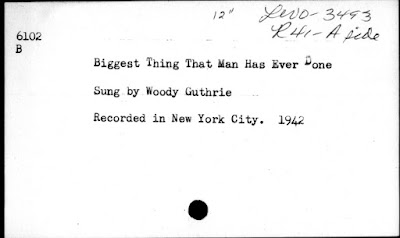
I know that the card that I used as an image indicates that it was recorded in 1942, and it may well have been—the record is vague—but the version above was probably from 1944, which makes sense, because by then, Hitler was more “on the run” than he would have been in 1942. But it is clear that Guthrie is also giving credit for winning the war to the workers, as well as the soldiers.
Guthrie ends this version of the song (and if you’re interested, here’s a set of lyrics that has many more, and different verses, but I haven’t been able to find a recording of this version):
Well I better quit my talking 'cause I told you all I know
But please remember pardner wherever you may go
The world is digging Hitler's grave and when the job is done
This'll be the biggest thing that man has ever done.
And, in 1944, that probably was right (and it still might be right, today.)
I’ll confess that the first time I heard this song, it was being sung by Dan Bern, and I didn’t know that it was a Woody Guthrie song until I did a little poking around. Bern, a family favorite who I’ve written about a few times, and seen even more times, is a folksinger in the Guthrie tradition, mixing politics with nonpolitical songs (and, like Guthrie, writing children’s songs and Hanukkah music). Bern released his version in 2004, and it included a few of the verses from the longer version linked to above (modified a bit). But he also updated it a little, adding a verse about the moon landing, and then the verse that probably was the impetus for the release:
There's one big thing we must do when shove comes to push
Defeat the so-called President by the name of Bush
Vote early and vote often, November 2 not 1
And that will be the biggest thing Man has ever done
That'll be the biggest thing Man has ever done
Now, that didn’t work, sadly, but it is nice to know that the Guthrie tradition of political songwriting carries on (and yes, Bern has written anti-Trump songs).
Dan Bern: The Biggest Thing That Man Has Ever Done
[purchase]
Posted by Jordan Becker at 8:30 AM 0 comments
Labels: Charlie Poole, Dan Bern, Done, Elvis Presley, Fiddlin' John Carson, Jerry Garcia, loudon wainwright III, Robert Hunter, The Grateful Dead, Uncle Dave Macon, Vernon Dalhart, Woody Guthrie
Friday, January 14, 2022
Done: You Haven’t Done Nothin’
Stevie Wonder: You Haven’t Done Nothin’ [purchase]
I’m still trying to wrap my head around this theme—“Done” would have made sense to me at the end of 2021, although the year-end here at SMM is filled with traditional themes, like our post-Thanksgiving “Leftovers,” some holiday-related theme(s) around Christmas, and the post-Christmas “In Memoriam.” So, if we had kicked off 2022 with “Beginning,” which we did in 2016, or “Fresh Starts” (2012), I’d get it. But maybe I protest too much, since our first theme of 2021 was “Over,” but I think that tied into the end of the Trump Error, and not the end of the also crappy 2020.
Anyway, even though, so far, there’s no evidence that 2022 is going to improve on 2021 in any way, my choice of song for this theme is unrelated to the definition of “Done” as an adjective meaning “over,” but rather in its role as the past participle of the verb “do.” (Yes, we here at SMM are grammar nerds). And after the somewhat disappointing view totals of my In Memoriam piece about Larry Harlow, not exactly a household name outside of the Harlow household (and, of course, the salsa world, which doesn’t appear to overlap too much with our readership), I’m going to write about a big hit for a massively famous musician, Stevie Wonder’s “You Haven’t Done Nothin’” which was a No. 1 pop and soul hit for Wonder.
I’ve probably mentioned more than a few times here (and maybe at some of my other blogging homes) that one of the joys of writing these pieces is that I often learn things about the song or artist that I didn’t know, and that’s what happened here. “You Haven’t Done Nothin’” was released as a single in 1974, and I probably heard hundreds of times over the years. But what I did not know, until I began researching this piece, was that it was directed at Richard Nixon, who resigned two weeks after the album it was on, Fulfillingness’ First Finale, was released, and one day after the single was released. Thanks for making that happen, Stevie. (I still remember the joy that my 13-year-old self felt when I heard, while working as a junior day camp counselor, that Nixon had decided to step down, which is maybe why this is my second Watergate related post in recent weeks.)
I also didn’t know that the background vocals on the song were sung by the Jackson 5—despite the fact that Wonder literally sings “Jackson 5 join along with me” during the song. Or that all of the instruments on the song (other than bass) were played by Wonder, including the horn parts on synthesizer.
Wonder is, of course, amazing, which was brought home to me this summer when, during that brief period when we thought COVID was on the ropes, my wife and I went to an actual movie theater to see the brilliant documentary, Summer of Soul, about the mostly forgotten Harlem Cultural Festival that took place in 1969, featuring an incredible roster of talent. Questlove, the director, made the decision to open the film with 19-year-old Stevie Wonder playing an amazing drum solo (!). You can see a bit of it (and hear a little more of it) in this trailer for the film (it’s on Hulu, and you really should just see the whole film because it is mind-blowing)
I also found this interesting essay from the Arkansas Democrat Gazette that discusses Wonder’s performance, including speculation as to why Wonder chose to include the drum solo in a cover of the Isley Brothers’ “It’s Your Thing,” which was considered to be a “kiss-off” to Motown Records, Wonder’s label, and it’s a worthwhile read.
Posted by Jordan Becker at 8:30 AM 0 comments
Labels: Done, Jackson 5, Larry Harlow, Questlove, Stevie Wonder
Thursday, January 13, 2022
DONE: ANOTHER GOOD MAN DONE GONE
I think it probably the garbled syntax that attracted me first to this song, having always a love for the vagaries of language and how it can devolve. (Yes, devolve.) Especially in the southern states of the US, where there seems often gratuitous joy in treading roughshod over any concept of grammatical fluency. But it seems I am wrong to poke fun or criticise, as the good folk of Yale have looked into all of this, and more, in some depth. I give you the Yale Grammatical Diversity Project, which addresses the use of english in north America. Done gone is what is called a "perfective done". Good, innit!? And I refer and recommend you to the whole of the rabbit warren that clicking on that site can open up, but not right now, we have a song to discuss.........
You may know this song from other versions, which may be touched on, but it is hauntingly and stunningly gaunt in this presentation, a lone voice of lamentation that burns through any need for accompaniment. The singer is one Vera Hall, she acknowledged as, if not the author, certainly the owner, via possession being 9/10 of the law. For, when John Avery Lomax, the ethnomusicologist began collating the songs of America in the 1930s, it was Hall he wooed more asiduously than many, recording as many songs as she could sing for him. This is the one that stuck the hardest, with it being recorded for the Library of Congress in posterity. Lomax's son, the slightly better known Alan, who continued in the same stock of trade, later presented her in concert at Columbia University's American music Festival of 1948.
But what of those other versions? Perhaps the most well known is that by Johnny Cash. In a spare call and response with Anita Carter, his sister in law, it remains a striking call to arms, solitary vocal tracks drenched in echo. So what or why was the subject done gone? It seems the song refers to the death of a man, a black man, on a chain gang, the unsaid implication that his presence in said chains was down to some trivial misdemeanour, such as within the context of such times. (Such times? This article opens a not so distant eye to the practice I had thought long since, along with Paul Muni, been confined to history.) Still, my new year resolution is be to avoid outraging myself as much I can, so, rather than progressing this as any diatribe, have another, final version, this time with backing.
In 1974 Jorma Kaukonen was probably still better known as the shit hot electric guitarist in Jefferson Airplane, although he had dropped stellar hints around his fabulous acoustic technique as well, courtesy the Hot Tuna side project he and JA bassman Jack Casady set up five years earlier, and which still survives, if only from time to time. Quah was a solo album he dropped that year, nominally in cahoots with his friend, Tom Hobson on additional guitar and occasional vocals. 45 years on it is a record to which I frequently turn, the pervasive mood of melancholy something I find uplifting. His picking and the spectral hollowness of his voice is just perfect for this song.
And that's all I done got to say.
Done Vera, Done Johnny and Done Jorma (a later live version).
Posted by Seuras Og at 8:15 AM View Comments
Labels: Done, Johnny Cash, Jorma Kaukonen, Vera Hall
Saturday, January 8, 2022
In Memoriam: Phil Spector
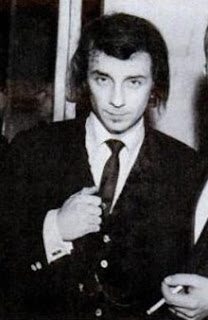
Phil Spector left behind a number of things he'll be remembered for.
For most people who follow music, the first would be the Wall of Sound. The Wall of Sound method is in itself an interesting study. Wikipedia enlightens us: combine and discretely mix acoustic, electric and ninstruments poreviuously unconventional in rock music so they sound as if they are a single instrument to provide a fuller tone: a wall of sound.
There are of course, the many musicians who he produced - despite his mostly unproductive last 30 years. This first 30 years included production credits with Ike and Tina Turner, the Ronettes and the Beatles.
What most of us don't know (or choose not to) is his demise in prison serving a 19 year murder sentence. Maybe a murder conviction is not so outrageous for a man who lived what was essentially an outrageous life: an immigrant family, mother working as a seamstress after his father's suicide, a move to LA where he began to immerse himself in music.
Also known for his in-house Wrecking Crew band of LA session musicians who played on hundreds of hits in the 60s and 70s - backing anything from the Monkees to Cher to Bing Crosby. A side trip into members of the band is an education in itself (Barney Kessel, Dr John, Leon Russell, Jim Keltner, Glen Campbell and many more)
The Lana Clarkson murder in 2003 put him in prion for the rest of his life (he died in prison this past year). The evidence and circumstances were not very clear but the jury convicted him - after several trials- of second degree murder.
As an aside, Spector's Wall of Sound is not to be confused with the Grateful Dead's wall of the same name: a wall created literally by a wall of equipment (amps and speakers) that was devised by Owsley Stanley.
Posted by KKafa at 9:18 AM View Comments
Labels: In Memoriam, Phil Spector, Wall of Sound
Wednesday, January 5, 2022
IN MEMORIAM: GEORGE FRAYNE
George who? Well, you might have known him better as the Commander, Cody, that is, the laconic, cigar chomping leader of his Lost Planet Airmen, that ragggle taggle collective of country memes and influences that beguiled and bemused many an otherwise country music loathing audience across the swathes of the 20th century's last three decades. I loved 'em, but you might have known that.
Posted by Seuras Og at 3:56 AM View Comments
Labels: Commander Cody & his Lost Planet Airmen, Elvis Costello, George Frayne, In Memoriam, The Flying Burrito Brothers
Monday, January 3, 2022
In Memoriam: Larry Harlow
[purchase]
On New Year’s Eve, my wife and I watched Being the Ricardos, the new film about Lucille Ball and Desi Arnaz, directed by Aaron Sorkin, which we enjoyed greatly. At one point, I began to wonder about the popularity in the US of the Latin music that Desi Arnaz (and Ricky Ricardo) performed in the 1950s. And yes, it appears that in the 30s, 40s and 50s, Latin dance music of various styles, including the tango, samba, and rhumba, was popular in dance halls, essentially because it was fun to dance to. And some have ascribed the popularity of Latin music in the United States during the 40s in part as an attempt to escape the horrors of World War II. Arnaz was part of a mambo boom that started in the 40s with, among others, Xavier Cugat and later included Tito Puente, Pérez Prado (the “Mambo King”), and Carmen Miranda.
During this period, the bandleader at the Latin Quarter nightclub in New York was Buddy Harlowe, whose birth name was Nathan Kahn. Nathan’s young son Larry (born in Brooklyn in 1939) often hung around, listening to the music with club owner Lou Walters’ daughter Barbara (yes, that Barbara Walters). Larry, whose mother Rose was an opera singer, was a musical prodigy who could play many instruments at a young age, and he soon focused on the piano. While attending the High School of Music and Arts in Harlem, he became fascinated by the music of Cuba that he heard coming from the buildings he passed walking the streets. Harlow studied music in Cuba in the 1950s but didn’t finish his degree, though, because of the Revolution, so he returned to New York.
Using a truncated version of his father’s stage name, Larry Harlow and his orchestra played the Borscht Belt hotels in the Catskills, where Latin music was extremely popular and other Jewish and actual Latino musicians performed the music. (The number of Jews playing Latin music during this era was surprisingly large). Once the US Government embargoed Cuba, it became impossible for Cuban musicians (and their recordings) to come to the States, so an American label for Latin music was needed. Fania Records was founded by lawyer Jerry Masucci (who Harlow had met in Cuba and bonded with over their common Brooklyn roots and love of the music) and Dominican-born musician Johnny Pacheco. Fania’s first signing was Larry Harlow, and it went on to be referred to as the “Motown of Salsa,” for its influence in the style of Latin music that arose in the 1970s.
Harlow became one of the most prolific artists for Fania, recording more than 200 albums by various artists and 50 of his own, including Hommy, inspired by the Who’s Tommy. He was the first to develop the front line of two trumpets and two trombones that most salsa bands use today and explored Latin music’s African roots. When Arsenio Rodriguez, an influential blind Afro-Cuban musician died in obscurity in 1970, Harlow recorded a tribute album. Rodriquez had been nicknamed “El Ciego Maravilloso,” “The Amazing Blind Man” — and Harlow would soon be known as “El Judio Maravilloso.”—"The Amazing Jew.” As a less amazing Jew, I found that amusing when I learned about it.
In 1974, Harlow was instrumental in collecting over 100,000 signatures for the recognition of Latin music by the Grammy Awards and led a protest at the awards, resulting in the creation of a Latin Grammy Award. Three decades later, in 2008, Harlow would receive the Trustees Lifetime Achievement Award from the Recording Academy, which runs the Grammys. (That category no longer exists, but there's now a whole separate Latin Grammy Awards. You can decide for yourself if that is better or not.) And while constantly affirming his Jewishness, Harlow became a Santeria priest in 1975.
Despite the fact that my parents are basically the same age as Harlow and are also from Brooklyn (and went to high school with another well-known Jewish salsa musician, Harvey Averne, who played and worked with Harlow), I’m not well-versed in Latin music, and was utterly unaware of Harlow until my son became a fan of the Mars Volta, which was made up primarily of Latino musicians, but whose sound, in general, had very little in common with salsa. However, Omar Rodriguez-Lopez, of the Mars Volta, is of Puerto Rican descent, and was a fan of Harlow’s. Through the friendship of Harlow’s son Miles (who now runs a cannabis company named “Buddy’s” in honor of his grandfather) and the lawyer for the Mars Volta’s label, Harlow appeared on two songs on the band's album, Frances the Mute, "L'Via L'Viaquez" and "Cassandra Gemini." I saw Harlow perform “L’Via” with the Mars Volta a bunch of years ago, and you can read about that (and hear the performance) here.
The clip above is from a film, Our Latin Thing, released in 1972, featuring the Fania All-Stars, which, as you probably can guess from their name, was an all-star collection of Fania bandleaders, sidemen and singers. You can see Harlow in the recording studio directing an overdub vocal sweetening session with vocalists Ismael Miranda, Adalberto Santiago and Cheo Feliciano, who sang lead on the tune “Anacaona,” as well as playing an amazing piano solo.
Posted by Jordan Becker at 8:30 AM 0 comments
Labels: Arsenio Rodriguez, Buddy Harlowe, Carmen Miranda, Desi Arnaz, Fania Records, In Memoriam, Johnny Pacheco, Larry Harlow, Pérez Prado, The Mars Volta, Tito Puente, Xavier Cugat