Dylan's <Can't Wait> went through various gestations before appearing on Time Out of Mind. There was a gospel version, a "Pink Floyd" version, and a country version. From SongFacts: Engineer Mark Howard recalled to Mojo Magazine July 2010: "Dan wanted to get back to the gospel version of 'Can't Wait' we cut in Oxnard. We cut three or four different versions and named every take. The 'Pink Floyd' version's quite psychedelic and the 'Rag Doll' version is country rock. Bob's like, 'I don't wanna hear this song any more, we got a version down.' Dan was trying to get to the original. " The Tell Tale Signs album includes 2 unreleased versions of the song.
Myself ... Nashville Skyline was the best of his albums. Maybe Blonde on Blonde rates next. I really liked Slow Train Coming, too. Time Out of Mind? Welp ... I guess I had kind of tired of Dylan by then. Lots to say, but lots of the same. *yawn* . Rolling Stone labels this period starting around the 1980s as Dylan "casting about for a purpose". More recently, he has more purpose: "world-weary ... hard boiled ... talk[ing] about truths in unambiguous terms".
<Can't Wait> is from back before the millenium. Like much about Dylan, the lyrics and more have been dissected both for the greater meaning and for insight into the "bard's" frame of mind. Examined line for line, word for word, because ... he speaks for us all. As he has done since the 60's.
But <Can't Wait> on Time Out of Mind is world-weary. It's blues in a minor key - somewhat uncommon - and the effect enhances the sense of gray desperation that Dylan vocals bring to life:
I left my life with you somewhere back there along the line
I thought somehow that I would be spared this fate
But I don’t know how much longer I can wait
(The version at the top appears to be pretty faithful to the Time Out of Mind version)
<Can't Wait> on Tell Tale Signs carries a different feel. (The version below appears to be rendered in this style)
And if you haven't yet listened to this, you might enjoy the hard boiled commentary of Murder Most Foul this past spring. Lengthy, but filled with references that - to a 60+ person of American heritage - were filled with emotions (not facts?) I could relate to.
Sooooo tired, tired of waiting...... Yes, my macbook has relapsed and I now spend, again, most of my days watching the spinning beachball of death. Something must be done, but, whilst I await funds, something has to give. And what better than a bit of Raymond Douglas. I have had a strange old life with the Kinks and with Ray Davies. (Raymond Douglas Davies, yep?) So brilliant and innovative in the 60s into 70s, yet now so, well, c'mon. And all you return to form critics can just stop wasting my money.
Tired of Waiting For You (1964)
So, since when was rock'n'roll a life long career? Wasn't it always a "when are you going to get a proper job", with, now, all these old age pensioners still trying to prove their parents wrong. Yet still I want them to succeed to produce some latter day lodestone of brilliance. Overlook my insouciance, tho', it a product, also, of the beast that begat the issue. I mean, FFS, what am I doing, at damn near 64, still listening to pop music? And searching for truth in doing so?
Days (1968)
It isn't as if I'm not grateful. Most of my memories are coated in a soundtrack of their time. It is easier to evoke those days through song than substance, a short cut to having to wrack the braincells into any accurate reportage. The sepia tints of nostalgia can then cut through the realities best discarded.
The Village Green Preservation Society (1969)
OK, that probably takes it too far, but, thinking a little longer, maybe not: I can remember this list of archaic and rose-tinted list of disappearing/disappeared onetime every day norms. With wry smiles aplenty. Is it asking too much of a songwriter to do other than reflect of their own experience? And maybe why Ray had to look elsewhere, the constrictions of an olde england, resolutely still in black and white, a barrier to progress. Shock, horror, this song, below, defiantly in the style of his classics, came out in 2017, a paean to his new home. (Sure, the Kinks are long gone, any long promised/hinted/awaited as tenuous as ever.)
Americana (2017)
I feel I have shot myself in the foot, the old bugger still has it after all, against all the odds. Looks like I need to hang on here after all. Cut to predictable end piece.
Purchase "I'm Waiting for the Man," by The Velvet Underground The Velvet Underground have always been a challenging band for me. They seem to be able to run the full spectrum: some songs are amazing, fully realized compositions reflective of musical roots and innovative of a new sound; other efforts sound like a band that is a strange, post-pop, kitchen sink style experiment in style and mode, more aligned to kitsch than actual art. There's no separation for me from the Andy Warhol psuedo-stylistc, anything-can-be-art approach. I'm sure there's more to the VU than sound, and that's probably the point I'm missing. But, experimentation and boundary pushing should still sound consistent. And sometimes it sounds good; at other times, it is experimental, at best. And a bit of a put on. The pretension of it can be baffling. Like people who rhapsodize over Warhol's soup cans or Marilyn Monroe portraits. Not my thing, but then, art is pure subjectivity. That Warhol vibe that colors VU's work runs two ways. It can be bad, just really artless and hard to take. But, it can be sleazy, tainted with something a little baffling and a little leary-making. And that's when it's most enjoyable, and reflective of the actual vibe that grew up around Warhol's New York scene, that of misfits, genderbent oddballs, hustlers and street creatures. It was that dark bohemia that rarely saw the light of day that VU touched on in their sketchy, dirty sound, same as a certain cadre of writers who used theme and subject matter to make a notable shift in post-modern literature. Works like Kerouac's On The Road, Hubert Selby's Last Exit to Brooklyn, or on a visual plane, Robert Frank's The Americans, shifted artistic expression toward a morefocused look at the underbelly of society--that which had always existed but was never really given the spotlight in serious work. The down and out loser was celebrated, and the vivid portrayal of the dark, dirty taboo created a new, dark modernism. The tableau in the works are made from the junkies, trans and cross-dressing street angels, hustlers, thieves, the kind of folks that didn't really exist for most, at least not in the real world. And certainly, none of these types had ever taken on the role of protagonist, or been in a position to earn the reader or viewer's empathy. Transgressive work, very much including the VU's music, was an examination of the darker life, about the edge of experience, the evil things that happened out there, but never touched, nor sullied, most people's lives. The kind of stuff that took place only in godless Gomorrah's like New York City. Listening to it, say in the confines of the neat, clean and safe American suburbs, was akin to sneaking a look at porn: titaliting, dirty and done under cover with the fear of being caught. These are the kind of works that invoke Puritanical reactions in our society, where worry over the perverse leads to outrage. But there is beauty in the brutality and a strange dignity that is earned by the lowlife when the listener and the reader get an insight into their strange and singular humanity. A good summation comes from Hubert Selby's Last Exit to Brooklyn. The book is the literary equivalent of a walk through hell, and the appeal of transgressive art can best summed up as thus: "Sometimes we have the absolute certainty there's something inside us that's so hideous and monstrous that if we ever search it out we won't be able to stand looking at it. But it's when we're willing to come face to face with that demon that we face the angel." While the genius of Kerouac's On the Road was the fact that it was one of the earliest attempts at elevating the lowest kind of folks to exalted position of literary hero, the Velvet Underground is probably among the first pop/rock outfits to celebrate similar deviants in art made for mass consumption. And I'm sure their music was a little shocking, the same way Kerouac and his Beat kin scandalized polite sensibilities with tales of drugs and debauchery. Lou Reed made an entire career out bringing people face to face with the strange demons of the dark side and never more poetically than in "Walk on the Wild Side,"from 1972's Transformer. He also celebrates that bohemian life in another track on the album, "I'm so Free", a gleeful declaration of allegiance to a life lived outside the careful margins. And while "Walk of the Wild Side" and "I'm so Free" are poetic and free-floating, VU's 1967 "Waiting for the Man" is far darker, much more forward and in your face in its theme and subject. Decidedly loose and funky, documentarian rather than metaphorical, the song is the quintessential transgressive poetic experience. The song moves along at a propulsive clip largely due to the barreling piano roll. It's a bit of a barhouse singalong, with the dithering, jangly guitar and simple pound-down drums. An upbeat and oddly celebratory tune, it's certainly not the VU's only song explicitly about drugs, but it's certainly their happiest one. It's got a White Stripes sense of drive and almost anti-rhythm, which speaks to how influential this strange song would go on to become. And more for it's eccentricity than technical value, Rolling Stone ranked it as number 159 out of their 500 greatest rock songs of all times. It's probably helped by the fact that Nico doesn't chomp her vocals over top of it, like she did to ruinous effect on "Femme Fatale" and others...But, that's just an opinion. I'm going to avoid editorializing about the content. It seems a little more fun to look at the trivia of the song.David Bowie loved the song and according to my research, he and his band covered it it before it was even released. The story of the song takes place in Harlem, New York City. And like the Ramones' "53 & 3rd", "I'm Waiting for the Man" has a specific geographical context: Lexington Avenue and 125th Street. You can visit! There's plenty of history to the track; it holds an esteemed place in rock history, as does the band itself. Puzzling out the good from bad, in a lot of ways, makes the song, and the VU themselves, more interesting. The song itself, like any good piece of art, contextualizes experience for the audience, places them close in the experience by delivering the instinct and the visceral sense without the actual danger. It makes sense without having to be real. That's good art, I suppose. Maybe it's a warning when Reed sings that he feels, "Feel sick and dirty/more dead than alive/I'm waiting for my man." He had his share of struggles and came out on the better side. I don't suppose he meant to glorify anything here--just to elevate the experience into something that made sense of it. Good song, regardless. Note: I referenced Keith Rawson's 2013 article for litreactor.com, "There is No Bottom, There is Only the Abyss: A Hubert Selby Jr Primer" researching this post. https://litreactor.com/columns/there-is-no-bottom-there-is-only-the-abyss-a-hubert-selby-jr-primer. The Selby quote from Last Exit to Brooklyn was quoted in his article.
Ron's sweet voice and vulnerable innocent persona has most observers having him better not waiting for anything. Or at least not for anything better, his songs always redolent of disappointment and deprecation. And that's the cheerful ones. So is this lyric a sense of realisation or an acceptance of the inevitable let-down? A bit of both, that sinking realisation that love has gone sour, perhaps just as you were thinking about something else for a moment. As in, take your eye off the ball for a second and, pfff, it's gone, his hope being that, if you wait long enough, somehow it will come back into view. Hmmm, we know that outcome, don't we?
I'm a big fan of ol' Ron, always have been, through the thin and thin of his career. No, that's a tad harsh, but he's never seemed able to get that great big breakthrough, despite the acclaim of many of his peers, on the arrival of theirs. Elvis Costello has always been his biggest yay-sayer, but others have been not slow to sing his praises. Fellow Canadian k.d. lang included him on her tribute to canadian songwriters, Hymns of the 37th Parallel, and how many others ever got to sing with Leonard Cohen? Critics often tumble praise his way but the public have never followed to make him much more than a niche favourite. With his big hangdog face, like a lovelorn potato, his looks may never have catapulted him into stardom, but Elvis C is hardly any oil painting either. He has made no secret of his struggles maintaining a career and the effects on his mood, life and relationships: in the wonderful documentary, Love Shines, made in 2010, this aspect is certainly not brushed away.
His songs have a delightful charm. Deceptively simple, they carry largely on guitar or piano, and often little more, with his yearning voice always shimmering above, sometimes redolent of Roy Orbison, tragedy closer to triumph in minor chord lamentations of love's labours lost. You sense, whatever else, he just has to sing, to keep on singing. If his near twenty recordings aren't enough and, like me, are a covers lover, you could do a whole lot worse than check out his youtube channel. Did I say Roy Orbison?
I first caught him, last century, in a special showcase at Ronnie Scott's Club in Birmingham, UK, now long gone. Part of a tour to promote his first full release, the eponymous Ron Sexsmith, it was a double header with the similarly "new" Dar Williams, taking turns as to who would play first. It was marvellous, each nailing a place in my tastes and on my shelves, each lasting to this day. Like Costello, I would rave about him to friends and family, but to little shared enthusiasm. I think I bought his first few releases until a change of producer skewed his style, to my ears any way. Thereafter I kept an ear out, spotting him mingling with the stars: Chris Martin, Ray Davies, if never quite joining their leagues. Round about the aforementioned doco, made during the making of Long Player Late Bloomer, a then mooted last ditch for world domination, helmed by big money producer Bob Rock, I formally rejoined team Ron. And it was/is a superlative record, if surprisingly using added autotune: surely the point of Ron's famously wobbly voice is that it is famously wobbly? It didn't go platinum, but it did sell a fair few, enabling him to keep going, with another album dropping every other year or so, right up until this years Hermitage. I had been due to revisit my acquaintance with his live show back in April, but, yep, like everything else, C-19 killed that until November. All willing.
No personal story, no long history lesson, no political discussion today. Just a short discussion about a fine song, Guy Clark’s “Desperados Waiting For A Train.” (I mentioned this song a few years ago in a piece on Clark’s “Homegrown Tomatoes," but it’s worth its own post.)
As someone who backed into “country” music through alt-country/Americana/roots/folk music, I first became aware of the great songwriter Guy Clark from covers, particularly this version on Nanci Griffith’s 1998 release, Other Voices, Too (A Trip Back To Bountiful). On that album, Griffith performed the song with Clark, Jerry Jeff Walker, Steve Earle, Rodney Crowell, Jimmie Dale Gilmore, and Eric Taylor. In fact, before Clark released a version, on 1975’s Old No.1, it had already been covered by Walker, Rita Coolidge, David Allan Coe and Tom Rush. And before Griffith’s version was released, it had been covered by Slim Pickens and probably most famously, The Highwaymen (Johnny Cash, Waylon Jennings, Willie Nelson, and Kris Kristofferson, some pretty fine songwriters in their own right). And there have been many other covers released and performed, including by Earle, on his recent tribute to Clark, and Jason Isbell, who performed the song at Guy Clark's induction into the 2015 Austin City Limits hall of fame ceremony. Which is just to say that many, many great musicians and songwriters have felt the song worthy of recognition.
Clark had the ability that some great writers, and not only songwriters, have of being able to economically create an entire world, and entire characters, with no wasted words. (On the same album, Griffith also covered Richard Thompson and Woody Guthrie, who have that same talent.) I’m jealous as hell. In less than five minutes, the song tells the story of the relationship between a boy and an old man, and you can feel the love they felt for each other, and the respect that the boy had for the man, an old school oil worker, who seemed to the boy like he was from an old western. And one day, the boy realizes that the man is old, and dying, and the metaphorical train comes to take him away. Two lives in about four and a half minutes of brilliance. I don’t know if the song is studied in songwriting classes, but it should be.
It’s a true story. Clark wrote it about his grandmother’s boyfriend, who stayed at the hotel that she ran in a small Texas town. You can read more about it here.
In 1998, when Griffith released her album, she appeared with all of the guys (including Guy) who sang with her on David Letterman’s show. And since readers of my work here know I’m a huge Letterman fan, and a huge fan of the song, here’s a video:
It seems fitting that I follow up <Follow the Sun> with <Waiting for the Sun>. Enough of the Beatles for now, and this isn't really about the song of that name, but rather the album. There's so much on the Doors' third album to cover that I'm going for a full album this time around. The song appeared on a later album.
I grew up on the Doors's albums - they were heavy rotation at the pre-teen parties I attended (that would be 7th and 8th grade). Strange Days was a little too strange. More than one critic has noted that Strange Days leaves the impression that it is populated with the leftovers of Morrision's lyrics writings that weren't used on the first album. True. Critics also note that is has more continuity that the first album. Not sure I agree.
But 1968's Waiting for the Sun, much like the first Doors album seems to me to have a lot of organizational continuity to it: for me and my friends, it was easy and natural to let the album play one track after the next without having to pick up the needle and move the arm over an inch or so. (Needle? Arm? Track? We're talking about 33 1/3 RPMs on a turntable at a Junior High dance - not the stuff that did Morrison in at age 27 although the parallels bear some interest.)
You may not take the approach that Morrison's father is said to have done, advising his son to drop aspirations of making a living as a[n untalented] musician. By this third album, the Doors had become mostly all about their lead *singer, although there are several pieces/places where it's more recitation than singing (My Wild Love is knee slapping and Morrison-style poetry chant; Five to One is only slightly more "musical" and The Unknown Soldier starts off with similar style)
Hello, I Love You was the main chart topper, and Spanish Caravan showcases the guitar talents of Robbie Krieger. Being, as I said, an album that I tended to listen to without lifting the tone arm, the rest of the songs are tight displays of the Doors at their studio finest (although it couldn't have been easy work with Morrison in whatever condition he had devolved to). My picks for a song typical of this work:
*yeah, it's not the real thing, but it's pretty good (doors alive)
Looking back or looking forward. There's something about the human condition that goes like : "the grass is always greener on the other side". My co-horts here have referenced both directions: looking forward to a time of live music, looking back to a time before for the guidance and wisdom of those who came before us.
There's a rather extensive "play-by-play" of the history of <I'll Follow the Sun> at beatlesebooks.com and more at their sister site thebeatlessongbysong.com - both of them worth the few minutes you'd spend perusing them.
For my second Beatles post in a month, it need be the theme that carries this: Forward, as in better days ahead (as in 'getting better all the time') or, possibly, moving on. Actually, the song's lyrics appear open to interpretation as to for whom the future looks better and who is moving on. Is it the singer leaving for better days or is it the girl who's going to know in the end that times were better with him. The lengthy beatlesebooks article makes the remark that you probably shouldn't dig too deep for meaning from a song that was, after all, written by a 16-year-old McCartney.
For the final 1964 recording, the original lyrics ‘Well, don’t leave me alone, I need you now hurry and follow me my dear’ were replaced with 'and now the time has come ...'. How does this color our interpretations of the lyric meanings? The words 'I need you' and 'follow me' only seem to muddy the overall message: who's looking forward to a better day for who? As for following the sun, it would seem pretty indisputable that (a) the sun is a symbol for the day ahead/future - especially if you set out to follow it - and (b) sun is better than rain - something to look forward to (when the rain comes ...). Chalk the mud up to the lyrics skills of a 16 year old?
Most Beatles songs at the time were pretty much R&B with little room for a more melodic, more romantic musical style. And that is certainly true of the original version of the song from 4 years before the version you probably know. The tempo of the 1960 recording is much more in keeping with the R&B persona they thought they needed to project to keep their fans. And my two sources note that even a year later, their next "melodic" piece, Yesterday, was initially released in the US before the UK - again aiming not to alienate the R&B-expectent fan base.
The one thing that I’m most looking forward to when it becomes possible again, not surprisingly, is going to see live music. At the end of the year, when I do my family holiday letter, I’m always struck by the number of live shows that I’ve been too, but this year will be different. My last live show was Richard Thompson at Symphony Space in NY in early February, and since then I’ve seen a bunch of live streams, which have their benefits, but there’s nothing like live music.
When I thought about this theme, my first thought was “Let There Be Rock,” by the Drive-By Truckers. But I’ve written about them so much, I thought, enough already. (Although “What It Means,” from American Band really hits home right now, I’m just sayin’). So, I turned to the blogger’s best friend, Google, to find songs about live music, and one that popped up was The Band’s “The W.S. Walcott Medicine Show,” from their Stage Fright album.
Now, to be clear, that song is about a minstrel or medicine show, and although these shows often included live music, I am emphatically not interested in seeing a minstrel show, but stay with me—it will make sense eventually. Minstrelsy was, remarkably, the most popular form of entertainment in the United States during the 1800s and early 1900s, until they were supplanted by vaudeville. Minstrel shows were, initially, white performers, in black face, portraying an exaggerated negative stereotype of blacks, and were undoubtedly racist. Later, black performers themselves pretended to be whites in blackface, but still pandered to the same racist stereotypes. To quote Rhiannon Giddens, “minstrelsy was terrible.” That quote is from one of the live streams I watched recently, sponsored by Carnegie Hall, featuring Giddens and her partner Francesco Turrisi, discussing minstrelsy, its roots, and more, including way too much information about the tambourine, and they performed a few great songs. Watch it here, for the historical background.
“The W.S. Walcott Medicine Show” is based on Levon Helm’s memories of attending minstrel and medicine shows in his youth in Arkansas, and the name is derived from one of the shows, F. S. Wolcott's Original Rabbit's Foot Minstrels. As Giddens mentions in the video, the awful, racist minstrel shows co-opted black string band music (which is what Giddens’ band Carolina Chocolate Drops championed). In fact, the Wolcott troupe was originally Pat Chappelle's Rabbit's Foot Company, formed around the turn of the century. It was owned by a black man, and featured black performers. Chappelle’s Rabbit Foot Company was remarkably successful, played all over the country, and even had its own baseball team. The show included, among others, Ma Rainey, often known as the Mother of the Blues. But, although I’m not 100% certain, I’m pretty sure that this black owned and operated show used blackface—because that was how to make money in those days. And when Chappelle died in 1911 (and I don’t see any connection between him and Dave Chappelle), he was considered one of the wealthiest black residents of Jacksonville, Florida.
Chappelle’s wife remarried and sold the business to a white man, F.S. Wolcott, who eventually renamed the troupe. It appears that the performers remained black, and included Bessie Smith, Louis Jordan and a young Rufus Thomas. Based on this “window card,” it seems pretty clear that the Wolcott show also performed in blackface:
The show was sold again in 1950 and continued to perform until 1959 when changing times and tastes led to the show’s equipment being seized for nonpayment of taxes.
So, why would The Band write a song about a minstrel show that advanced negative stereotypes of blacks? And which refers to a musical ensemble named the “Klondike Klu Klux Steamboat Band?” My guess is simply that they (and the song, as usual, is credited to Robbie Robertson, but who knows who really should have gotten credit?) wanted to write a slice of life story about a particular place and time without making a value judgment—much like “The Night They Drove Old Dixie Down” is a sympathetic song written from the traitor side. You can read some analysis of both songs, and others by The Band, here.
We’re in a time where people are (again) focusing on symbols of racism in the United States, and I admit that I’m delving deeper into issue of race and racism. People are marching. Statues are coming down, and there's actual bipartisan discussion about taking traitors' names off of military bases. White voice actors are stepping away from portraying characters of color. Amusement park rides are being re-themed. People are realizing that the confederate (no capital letter used on purpose) battle flag is a symbol of racism and treason, and even NASCAR and Mississippi have had to banish it. Numerous TV shows have removed episodes containing blackface, and allegations of wearing blackface have caused politicians and others to lose their jobs.
In times like this, mistakes are bound to be made (passive voice use intended), and unfortunately the opponents of change are seizing on the apparent mistakes (toppling a statue of Lincoln, for example) to discredit the movement. But the fact is that we are more openly debating these issues—and things are happening—which is a good thing. I’m sure that there are people who would argue that Pat Chappelle’s Rabbit Foot Company was a positive—a black owned, black run business that made its owner rich and exposed many people of all races to black music and culture. But despite the fact that some of the music was groundbreaking, and ultimately led to the type of music that I want to see live, that version of black culture was a distorted, negative one that helped to oppress black Americans. It was a shame that someone like Chappelle needed to reinforce those stereotypes to succeed. Let’s hope that this moment of reconsideration has a lasting positive effect, and doesn’t fade away, like the last wave of statue toppling and flag lowering in 2015. Or like Reconstruction.
And you thought this would be about me wanting to go to a concert.
Be careful what you wish for, isn't it? Looking forward is bedevilled with risk, the future never quite as cut and dried as the runes. If the past is another country, then the future should be another planet. (Why do my fingers always want to add 'or oblivion'?) This time last year I wonder how many of us were looking forward to what's happening now? But, sticking to the future forward interface, it is always to space our imaginations return, the final frontier even a bankrupting NASA can't take from our imaginations. For, if we are indeed living in interesting times, apropos the proverb/curse, surely we want even more interesting to look forward to. Or even, sometimes, less interesting.
Popular music is rammed with references to rocket filled skies, and there is often a coupling between the schlockier the band, the more garage-y the sounds, so higher still is the sky of their aspirations. I love a good old goofball thrash, always have, loving it all the more when spacesuits are donned over ripped jeans and leathers. Yes, I'm sorta thinking Ramones here, their lo-fi scuzz always a tonic. Now it may be that 3rd album, Rocket to Russia, was weapons grade over any galactic conquest, with Johnny no doubt a fan of nuking the commies, but I prefer to imagine the band sitting disconsolately awaiting blast off on a mission to Mars. (I guess Russia was the clue.....) Plus, they only ever did one overtly clairvoyant song, and that only looked forward a paltry four years. If indicative of many of our issues right about now.
Ramones: Planet Earth 1988
Not musically their finest moment, nor quite the mood I was aiming at, but, let's use that as a vantage point to vault over boring old guitars. Electronica, eh, all high-domed boffins with degrees in circuitry? Um, no, praise be, just as many grade school d.i.y. drop outs with drum machines and programmers as anywhere else. (Forgive my clumsy labelling here, no slights intended, of course I really know education and brains are no prerequisite to the making of music, nor even to each other, and brainlessness is no less common in mensa than densa.)
Apollo 440: Yo, Future
Apollo 440, above, provide a glorious old clatter, as punk a sound as anything on the early scene at CBGBs, let alone the UK year zero, the country from which they hail. One of the early adopters of this amalgam of dance music, rap and anything else lying around the streets, they started life a boggling 30 years ago. With some success, their sound was probably a template for the later hugeness of The Prodigy, who had started off as standard anarcho-squat crusty spiral tribers around the same sort of time, ahead of a cartoonish reinvention that tore the UK singles charts about. And a not so dissimilar sound. The song below less so, but showing their need also to boldly go.
Prodigy: Out of Space
But, returning to Apollo 440, whose pony had way more tricks than video-game garishness alone. Or film soundtracks, for that matter. Centred around brothers Howard and Trevor Gray, along with trusty cohort Noko, they have kept up a profile, whether producing their own music, re-mixing the music of others or just maintaining an episodic, if no less potent presence on the live and club circuit. With last studio output in 2012, I am sure I had recently spotted some live dates, since lost to coronavirus, and that I had been pencilling in. Anyhow, parallel to the clattering techno of Yo, Future, they could also produce much sleeker pieces, blending into styles reminiscent, by virtue of hindsight, of both Air and Alabama 3.
Apollo 440: Electra Glide in Blue
So, looking forward, the future. Where is it and how much, like every show, festival and tour of 2020, is postponed to 2021? God, I'm looking forward to 2021. Or is the future still what it used to be?
There won't ever come a day when I don't look back to Tom Petty for guidance and wisdom through strange days.
He was my first "favorite." My first identifiable idea of what rock n roll cool looked and sounded like; my first brag over the other kids I knew who thought Duran Duran was the shit; my first introduction to the strange forbidden fruits that all great rock songs promise; my first concert. Seriously: The July 1985 stop of the True Confessions tour at RFK Stadium in Washington, DC, with Bob Dylan, the Grateful Dead and Tom Petty and the Heartbreakers was my first concert. Ever. I was in the 8th grade. My mom took me. I'll never feel that wonderful, free and new again.
When he died, the sadness lingered with me in a way that I didn't think was possible--how was I mourning with such a fevered, angry sadness for someone I never knew?
I still can't listen to Tom Petty without feeling something, no matter the song. I suppose that's the artists' ultimate wish--to make the listener quake, and to resonate, like an echo, a same sad echo, on and on. To keep being heard. And felt.
Petty's genius lies in his unique way of looking at the world--he saw the strange in the everyday and told stories that made sense, even when nothing did. His imagery and the language of his poetry were rarefied and steeped in the everyday experience. And the lens he saw the world through made great sense when he turned the view finder back to us to look through. A writer's true gift of the world is to let the reader (listener) see things the way they do. Petty let us listen in on his expansive view on the world, and the melody in that vision is a unique poetic oeuvre that has forever colored my own world.
"Time To Move On," from the enduring and ever newly experienceable album Wildflowers, was resonant, perhaps timeless itself, as soon as it was recorded. "Time To Move On " is an elegiac prayer to belief in the good that comes from moving on. It's a beautiful song that lends comfort in its firm and steadfast belief that something better is always ahead. "...it's time to move on, it's time to get going, what lies ahead, I have no way of knowing, while under my feet, grass is growing, it's time to move on, it's time to get going..." It's a reminder, told in Petty's deceptively simple verse, that the world is wide, and never defined by one simple moment. Great comfort in days such as we are living now..."time to move on."
That's the point of it, of life, wherever you are, the excitement and anticipation of a day yet to unfold, whether a definite day pinned on the calendar, or an arbitrary aspiration of a future different from the now. We call such days Lollo Rosso in my house, when we have had one and while we await one. Why? Italian lettuce, doncha know. Italian red lettuce. Red lettuce/red letters? (I know, I'll give you a moment to repair your sides.)
My i-pod is crammed with songs about shit days; it is the basis, arguably, for the entire genre of music, the blues. So where's the hope, the optimism? If we disregard that happy-go-lucky music is so often a happy clappy pap of little merit, let's, instead, celebrate when it isn't.
Better Days/Bobby Charles
Where better to start than the down-home charm of Bobby Charles? A southern swampy country soul man in the style of Dan Penn, he moved in all the right circles, if never quite making it in his own right. I was alerted to him a couple of decades ago, via a friend pointing me in the direction of his first and eponymous album, a slow burner that first dropped in 1972. An acolyte of the Band, he actually appears in their Scorsese-helmed "farewell" performance, The Last Waltz, if edited out for the cinema cut. Rick Danko, of said band, produced his debut, the rest of the group offering cameos, as did Dr John, whose then band later backed him in the Last Waltz. Here's quite a nice bio. Cut short, the album didn't sell and, though later a cult record to many a current mover and shaker, he quietly ploughed his furrow, with several more popping out of his home studio until his 2010 death. This song, the title song from his chronologically second, and best, album, Better Days, which actually took his death, 36 years later, to give it a formal release. What I hadn't, however, realised is that he was the author, as a much younger man, of both Bill Haley's See You Later, Alligator and almost the signature tune of Fats Domino, Walkin' to New Orleans. So maybe most of his better days were behind him, but the laidback drawl suggests he was never discounting the dream. The royalty checks possibly helped too.
(This is for the)Better Days/Band of Bees
Sticking with funky sounds, you could be mistaken for thinking this, vocal timbres apart, comes also from the Louisiana delta country, such are the distinctive keyboard burbles and understated guitar witterings. But you couldn't be much further wrong, with Band of Bees (or the Bees) coming from the UK's Isle of Wight, yes the festival one, and the record released in 2007. Like the rest of their work, a delightful summery breeze of slightly retro themes, allied with the trippier vocals of a "Madchester" influence, if you will, with more musical chops. Lovely, if with any new songs long overdue.
Better Days/Roseanne Cash (via Guy Clark)
Guy Clark is another wistful reference, maybe his name better known than his music. Certainly any fan of Steve Earle will be familiar with the name, given his recent tribute album thereto. Along with Townes Van Zandt, to whom Earle has also paid reverence, he was part of the nascent Texas scene of dusty troubadours that Earle always aspired to. Indeed, back in 1995, his career on the rise, Van Zandt's on the wane and Clark, well, pretty much where it always was, the three of them played a benefit together, recorded as Together at the Bluebird Cafe. The cause, of all things, was for the dental health of the dustbowl disenfranchised. Clark has always seemed a quiet and unassuming guy, who latterly kept an eye on the increasingly fragile Van Zandt, happier at home with his wife than endlessly promoting his hefty and respected repertoire. In 2011 a host of his friends and admirers put out a terrific two disc tribute, This Songs For Him; A Tribute to Guy Clark, The song above, as performed by Roseanne Cash, comes from that. Here's his own version. He died in 2016.
Better Days/Elliott Murphy
Another? Well, eschewing the Bruce song that this piece invites, have instead something occupying a similar territory. OK, you got me, I'm joshing with you, it IS the Bruce Springsteen song, if in a rootsier and acoustic format that bounces along with some considerable vim. And, rather than expectant of any better future, this celebrates that these are indeed now, already, better days. (Better than glory days? Hmmm..., I wonder.A: yes.) Murphy is another spectre on the sidelines, better name dropped than numbered amongst purchases. But he's well worth a punt, his easy going Long Island lope not a million miles removed from his more famous New Jersey neighbour, with whom he has often appeared and collaborated. Now a dedicated europhile, based in Paris, he has over 35 records to his name. Where to start? You could do a lot worse than his debut, 1973's Aquashow, released in the same week as Springsteen's debut, they both immediately grabbing the new Dylan tag so beloved of rock journalists. Last of the Rockstars gives a taste.
So let's agree, raise a glass, slainte mhor, to Bobby, Elliott, Guy and the Bees! Better days, bring 'em on!!
I memorized the lyrics to Selling England and still have them in my head to this day. I loved Genesis in the early 70s. Gabriel, Collins and Hackett foremost. As Collins moved from progressive to pop, I kind of lost interest. But not respect. Or awe. More for some than for others.
As I listen again to Darktown, the 1999 album that includes Dreaming With Eyes Open, I have to say that I prefer the Hackett of Genesis days. Something about the mix of talents combining to make the whole of the Genesis sound. It's good, but I like Genesis better.
One term that gets batted around about Hackett's musical style is "world music". Another is "classical". Both are in evidence on this album (and in this song), but the overall mood comes across to me as a bit dark. It's progressive and the guitar work and song composing are excellent. "Dreaming" is emblematic of the album as a whole.
Then there's this whole notion of dreaming with eyes open. T.E. Lawrence wrote “All men dream, but not equally. Those who dream by night in the dusty recesses of their minds, wake in the day to find that it was vanity: but the dreams of the day are dangerous mean, for they may act on their dreams with open eyes, to make them possible.” That's from his autobiography <Seven Pillars of Wisdom>. T.E. Lawrence is, of course, better know as Lawrence of Arabia.
Hackett's lyrics include these lines:
You drift away on the night ride
With eyes that dream as much as they see
The wind in the willows winding through the grass
The drawbridge of consciousness is lifted at last
Where are you going?
This isn't daydreaming, and there are dream interpretations of what it all means. Julie R Klein examines Spinoza's critique of Descartes in which she says that dreaming with eyes open is to be deluded ... unable to descriminate true, false and fiction. The line, however, does make for some colorfull lyric imagery.
Steve himself comments: There are some subjects which I have avoided in songs over the years because some of them were too painful to talk about but I got to the point where I felt ready to confront those demons in song.
Well, clearly I had to sneak this in as the shutters pull down, ashtrays empty and lights go out. Prompted by J.David's last post, his call for last orders initiated that strange pavlovian response of suddenly after all needing one more for the road. So let me pretend once more not to have noticed the subtext for this theme is "songs about opening up". (Oops, but it's true, literally not 'til just now. Well, they'll be open again in the morning. Or, as we call it in the UK, the beginning of July, virus willing.)
Much as I love the Semisonic, and I do, having that album, it isn't the first song provoked by Closing Time. The one I default to is the one above, arguably one of the lesser songs by the Bard of Montreal. From his second sorta comeback album The Future, which followed 1988's I'm Your Man, wherein he reinvented himself as being more up to speed with the change of musical styles and instrumentation than his earlier bedroom acoustic might have suggested. This record was positively reeking of modernity, synthesisers drenching the grooves, give or take some gypsy fiddling. But still that voice, that golden voice, the one he was born with. And it is, true, a pretty slim song, the lyric better than the melody, which nonetheless evokes well the blurry, bleary atmosphere of a basement bar, more promise than preferences, the drink subverting sense and senses.
And that would have been that, were it not for a team of of his earlier advocates picking it up, the concept of closing time a more familiar seeming environment for Fairport Convention than Cohen. (The received wisdom would be that Cohen would have long since departed the bar, an uncorked bottle of vintage red in one hand, a sobbing mistress in the other.....) Back in the dim distant, when Fairport were a youthful band in admiration of earnest singer songwriters and yet to invent folk-rock, with Leonard Cohen one of the authors they admired, along with Joni Mitchell, they covered several of his songs. It was good, therefore, in 1995, to see him back in their hands, the lightweight lyric perfect for their "Grateful Dead on real ale" ambience. They play around with the words, echoing and repeating pertinent words. Plus, as a good idea of where they would place the song in their live set (and did), towards the end of the song the backing vocals remind "Matty....Groves...is...coming... up next". That enough endears their version to me, and, simultaneously, raises the game of the original.
Finally, lest the eagle-eared be seeking it, Closing Time by Tom Waits was addressed here, some years ago. Lyle Lovett? A different song altogether, maybe for another day.
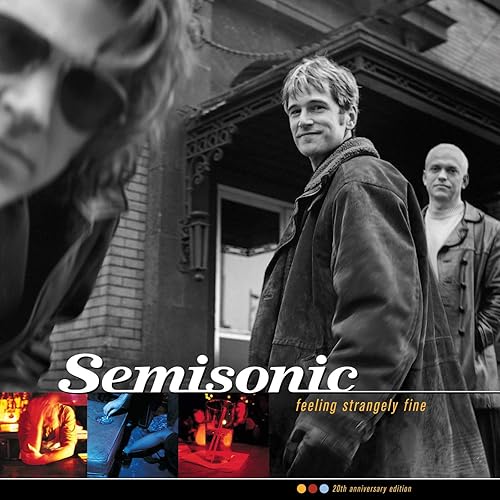
One reason that people love listening to music, particularly older music, is that songs, like smells, can evoke past memories. My wife, for example, regularly talks about how specific songs remind her of camp, or high school, or college, and I’vewrittenbeforeabout this phenomenon. I’ve also written about how certain songs remind me of specific people, oftenmyfriendChris, with whom I explored music in high school and attended many memorable shows. And there are songs that make me think about my kids, which I have alsowrittenabout. Today’s song, Semisonic’s "Closing Time," is another that reminds me of my son, who introduced me to this song back in 1998, when he was about 8 years old.
Semisonic was a band out of Minneapolis, fronted by Dan Wilson, and featuring John Munson and Jacob Slichter that formed out of the ashes of the band Trip Shakespeare, which included Wilson, Munson and Wilson’s brother Matt, among others. Both Wilsons and Slichter attended Harvard, but despite being a proud Tiger, I won’t hold that against them.
I sort of group Semisonic in my mind with bands like Toad the Wet Sprocket and Gin Blossoms, who made melodic, power-poppy albums in the 90s, which were radio friendly (for a slice of radio that still existed back then), although I was a bigger fan of those other two bands. Other reviews compare Semisonic (generally unfavorably) to Ben Folds Five, or even Matthew Sweet.
“Closing Time” is a catchy track that, on its surface, seems to be about the end of the night at a bar, a/k/a last call, and the patrons are being forced to decide whether to go home, and if not, where, and with whom, if anyone. It’s a time of both possibility and disappointment, and the song considers both options.
Interestingly, Dan Wilson has said that the song is also about his impending fatherhood. He said:
The guys wanted a new song to close our sets with. I thought 'Closing Time' would be a good title. We had spent seven years of our lives at that point, four nights a week entertaining people. That was our life. Some bouncers yelling things, closing time coming, all that imagery, literally, that's how the song started and then when I was halfway done, I started realizing the whole thing was a pun about being born, so I just made sure that the rest of the thing could ride with that double meaning, but nobody got the joke and I didn't bother to explain. I thought everyone would get it.
The song reached number one on the US Billboard Modern Rock Tracks chart, did well internationally, and got a Grammy nomination for Best Rock Song, losing to Alanis Morissette’s “Uninvited.” It’s been used in TV shows and movies, usually when there’s a scene at bar at closing time. Of course. Although two other singles from the album did OK, the followup album, which wasn’t released until 2001 (and even included a contribution from Carole King), was not successful, and the band went on hiatus, reuniting a few times in recent years for shows in the Twin Cities.
Dan Wilson, who is also apparently an accomplished visual artist, has released a bunch of solo albums, and also has written or co-written songs for others, including the Dixie Chicks’ “Not Ready to Make Nice,” and “Someone Like You,” with Adele. Munson continues to play with bands in the Minneapolis area and teaches, and Slichter wrote a book about being a rock musician and teaches, including in the MFA writing program at Sarah Lawrence College, where my daughter-in-law got her degree. She said she knew Slichter, but never took a course from him. To bring this piece to a satisfying "close," she’s married to the son I wrote about in the "open."
It's been a while since I've posted on SMM. No excuses--just the unpredictable rhythms of life that sometimes stir a current that takes you in strange directions. Riding the waves hasn't gotten me too far, a few thousand words deep into other projects, but not closer to anyplace special. Missing having a place to talk music with like minded obsessives, and with the permission of the venerable KKafa, who answered the door when I knocked, I'm back.
SMM is a place I always find the kind of unique connection that good writing and great music can make in a life. And I really missed that.
So, hello. Again.
Our theme is “Open/Close.” I looked through my library for songs about openings and closings, and when I came across the 1998 hit, "Closing Time", by Seminsonic, and felt the familiar, shuddery revulsion that ubiquitous, somehow pseudo-anthem always brings up, and used that as impetus to get a little creative on the theme.
I decided to look at great opening and closing tracks from albums. How important is the first introductory burst of sound from the opening of an album, the signal of what is to come? If it's weak, a song you really don't like, the album as a whole might be doomed. It's a great song, an epic introduction, you'll never forget that perfect sensation of hearing it for the first time. Example: REM's "Radio Song", from 1991's Out of Time, was such a grave sonic let down for me that it kind of ruined the band, once my near beatific favorite, for me permanently. Whereas, "Up The Beach", from Jane's Addiction's explosive Nothing's Shocking, was akin to perhaps seeing the Red Sea part under the hand of Moses. Or something similarly miraculous. Oddly, both albums, while wildly different in so many ways it seems silly to compare them, could have been vastly different, even better, had they been tracked differently. Out of Time really should have opened with "Losing My Religion", that strident, minor key pop mediation on anger, played on a very non-top 40 mandolin; Nothing's Shocking would have been even more epic had it opened with "Coming Down the Mountain", an pure avalanche of a song.
The opening, then, is of the utmost importance. As is the ending. And how many albums end as memorably as they started? It's surprisingly few. But, then, that is my opinion and comes from my lament at the seemingly lost art of the full length album, and the collection of songs as a celebration, not just the single. Growing up, the 45, then the cassingle, was always secondary to the whole LP. The best bands put out the single, and the B-side was the 'unreleased' material. Kind of essential to the rest of the album, a completion of the experience as a whole. But, B sides that are better than the A is another topic entirely.
I scrolled through my Spotify feed (Sadly, I don't have a single CD, LP, or cassette in my possession right now), and found what I thought might be a good start to, and by no means exhaustive or exclusive, list of a handful of the greatest pairings of opening and closing tracks to feature on an album.
In no specific order, I posit the following opening and closing tracks to be the GOAT
The Rolling Stones, Goat's Head Soup: Side A, track 1: "Dancing With Mr. D"; Side B, Track 5: "Star, Star". Wicked, naughty, steeped in dark arts, these two songs provide the caps to my favorite Stone’s album ever. 1973's Goat's Head Soup, is a druggy, boogie down trip. There’s a strangely sinister vibe to the whole collection. "Mr. D" concerns death, and possibly meeting the devil to discuss matters related to how the narrator might exit this world for another. "Star, Star" is...well, if you haven't heard it, you've heard about it. It's classic Jagger bravado, and might be the response to Carly Simon's mysterious "You're So Vain." It doesn't really ever make itself clear on that, but it is a celebration of the activity that culminates in the ‘little death’...to draw a connection. If there's a reason people thought rock n roll might be the devil's music, Goat's Head Soup makes for pretty compelling evidence.
AC/DC, Highway to Hell: Side A, track 1: "Highway to Hell:; Side B, Track 5: "Night Prowler" This classic opens with one of rock’s greatest travelogues, an invitation to travel straight to rock n roll hell, set to an instantly iconic guitar riff. The whole album is amazing, but starting with such a striding opening salvo, you are along for the ride, no matter where it takes you--I said it was hell, right? AC/DC proceeds to walk you along the same dark, dirty path as the Stones did, and they distinguish themselves as the only band that makes the Devil seem like a cool guy you want to hang out...The album closes out with the dark, blues dirge"Night Prowler", a sinister soliloquy of a serial killer, delivered by Bon Scott in his signature howl. The song generated a lot of controversy, so it's best just to dig it as AC/DC's unique take on the blues.On a strange note, the last words ever recorded by Bon Scott, as the song and the album fade out are "Shazbot nanu nanu", the famous catchphrase of one Mork, from a place called Ork...it was meant to be funny, but it is perfectly sinister here.
Prince and the Revolution, Purple Rain: Side A, Track 1: "Let's Go Crazy" is about as close to church as one can get. The man in the pulpit is calling the faithful to the ceremony, and it's impossible not to heed the call. Side B, track 4, "Purple Rain" is epically beautiful, achingly sad, and elegiac. And it was somehow transcendent when it was new, a gospel tune over a rock orchestra, and a searing guitar solo to end. The song has never lost that sense of mournful beauty. It's poignant now, more than ever, as Prince's going home hymn. When I get to heaven, I too, hope to hear "Purple Rain" playing me in.
The Who, Who's Next--not a question so much as dare to step up to a fight. Side A, track 1: "Baba O'Riley" is arguably the greatest, most imitated, most triumphant rock anthem. Ever. If you like rock n roll, have ever been moved by the power of simple chords, pumped at high volumes, chances are, "Baba O'Riley" set you down the road to glorious ruin and riot. The name is still a misnomer, even to people who love the song. The lyrics are strange and a bit more like a medieval pastoral than a stadium sing along. But, when Townshend sets the windmill going, and you're invited to scream the words that so aptly sum up so much of our collective youthful glory ("Teenage wasteland!"), you have to believe in the power of three chords and the truth. Side B, Track 4 is "Won't Get Fooled Again", which contains so much legendary greatness it is hard to call it just a song. It's a call to arms and poetic in its anger. The song gives eloquence voice to rail againstyour frustrations and limits, and is a license to break the rules that keep you tied down. It crescendos with the greatest scream ever recorded in modern music. It's the song Whitman might have recorded, had he been born 100 years later. And, in the end it's the greatest 'eff you' ever recorded.
Who's Next, one of rock's great albums, starting and ending with two of the most powerful songs ever recorded , is one the greatest rides you can ever take in the grooves of a vinyl record, and the greatest fulfillment of rock music's transformative promise. And, my obvious vote for greatest opening/closing set in rock history.
I have done a post or two about the Beatles here, here and here before: one of my most felicitous Internet discoveries was the <Beatles Complete on Ukelele> back when their entire archive was free, with new songs appearing more or less weekly over a period of 2 years. And then we lost free download access. The website is still there, but it's not set up for downloading the files for free any longer.
In digging around for this post/searching to see which - if any- Beatles songs had Open/Close in their titles, I ran across another cool Beatles resource that allows you to search their lyrics - in this case necessary if I wanted to continue to persue the Beatles idea, because from among the (officially) 213 songs they recorded, surprisingly not one has either Open or Close in the title.
I was thinking: surely... open heart ... open mind and if not closed heart/mind how about something along the lines of "close to me".
That said, the two words of our current theme show up multiple times in their lyrics. Enough of them that I'll have to pick and choose from among them.
beatlesagain.com lists 4 for "open" and 10 for "close". Across the Universe has open ears. Dear Prudence and Tell Me What You See also include open eyes and Help has open doors.
Looks like the eyes have it. All My Loving has "close your eyes"; Good Night has "I'll close [my eyes]"; Think For Yourself has "if we close our eyes"; Strawberry Fields of course has "living is easy with eyes closed". Five are about close as in near: Do You Want To Know a Secret has "Closer"; Besame Mucho has "Close to me"; Glass Onion has "close as can be"; Twist and Shout has "twist a little closer" and Words of Love has "hold me close".
Good Morning, Good Morning is an outlier with "everything is closed".
Nothin' about hearts open or closed nor about opening your mind. Nothing particularly romantic/mushy here either.
Pat Lewis & Joe Coghlan/Tell Me What You See:
Beatles out-take: Across the Universe
Alanis Morissette: Dear Prudence (and a story about its inception)
Star Maker Machine does not accept music submissions from artists or promoters. However, most of the contributors here do accept submissions for our own blogs, listed below. Please visit our blogs, take the time to listen to what we post, and then feel free to contact us if you feel that your music would be a good fit.



























:format(jpeg):mode_rgb():quality(90)/discogs-images/R-3445322-1330679250.jpeg.jpg)