If no, thanks is the answer, what, I wonder, was the question? For that's the thought that always enters my mind when this song crops up. The lyric casts some broad, if vague, hints. Is this something for consenting adults, for behind closed doors? Or is it something far worse? I'm thinking that both Daryl Hall and John Oates must be fairly broad minded individuals, men of the world even. Yet?
I Can't Go For That (No Can Do)
But let's stack up the evidence, it wasn't the first time they had been caught on the hop and out of their depth. All talk and no trousers is the english phrase for it. Right back at the beginning of their career they were already pushing the envelope further than the price of the stamp, with the evidence here. Did the experience leave some wound, some scar on their collective conscience?
I'm Just a Kid (Don't Make Me Feel Like a Man)
So, Daryl, what's the story? Anything to say, John?
Some Things Are Better Left Unsaid
Oho, the old 5th amendment trick, eh? You don't have to say, but we'll find out. O, yes, and if not the truth, something better. Live with that?
I Don't Think So
Hmm, well, you would say that anyway. With all your fancy vids and prancing about, what do you think you are? Popstars?
(You Know) It Doesn't Matter Any More
That old one! Always the same, string us along, keep us all none the wiser and then, pffsh, nothing, nada, the brush-off.
I Ain't Gonna Take It This Time
Calm down, calm down, keep your shirts on, just a bit of fun.
I really love Hall and Oates, but, y'know, don't you ever wonder who the F was making their wardrobe and coiffure decisions.
As in, yes, if you are asking me whether I won't, no thanks, I will survive. I will, rather than rejecting the alternative option, but this song offers so much that is apt to this theme that I will disregard any earlier appearance, a decade ago. (Even if it uses up my favourite version ever.) But this is where we all, the survivors, or most of us, stand on 2020, defiant and steadfast against the tide of badness, with light beginning to seep through the cracks. Covid 19? The vaccine beckons. Donald aka Agent Orange? The back door is open and waiting. The economy? Hmm, well, we'll have to see on that one. Boris and his chumocracy of cronies? That too.
It's true, the song was originally a sturdy polemic against a returning suitor, or as wiki puts it so neatly: "the narrator's discovery of personal strength following an initially devastating breakup". The assertive lyric, carried by and coupled with an uplifting and anthemic tune, guarantees for a sea of raised hands on the dance floor, and not just by righteous rejectees. I love it.
Gloria Gaynor introduced us all to the song, an astonishing 42 years ago. I was not, it's fair to say, a fan of disco in 1978, but I could see this was one terrific song. Indeed, even the stuffy old Library of Congress put it up, in 2016, for the National Recording Registry, alongside such essentials of every collection as Alan Sherman's Hello Muddah, Hello Faddah and Swanee, by Al Jolson. (I jest: they have a cracking selection!) VH1 gave it the accolade of the Greatest Ever Dance Song in 2000, Rolling Stone only managing it a number two in their 2012 Best Disco Tracks of All Time.
Over the years many have tried to bring their bit of something to the song, many, most, in truth, poor and lucklustre facsimiles, but some have been really rather interesting. A rule I have is that, if it includes the rolling piano intro, I will listen to no more. Here's a few that don't:
Dig a little beneath the initial hit of gruyere, and this, by the Puppini Sisters, is actually a delight. I don't go a whole bundle of the recalibration of songs into a faux-forties Andrews/Beverley Sisters style, but this transcends my prejudice, by playing rather more with the arrangement, some glorious walking bass and aan unexpected choral middle eight and coda.Who the Puppini Sisters? A clue; they ain't, but one actually is Puppini by name and they were doing this sort of thing way ahead of Scott Bradleee, if from downtown London rather than New York. (Has Bradlee tackled the song? Of course he has.......)
Much as I adore R.E.M., I confess to finding their throwaway b side live/impromptu covers a slightly less than intrinsic need, but, against that odd, this one conveys just enough charm to make it, Stipe's stumbling through the lyrics a little haphazardly falls just the right side of endearing.
SMM used to have a gentleman's agreement not to include anything too new, mainly then a naive hope that it would keep the RIAA off our case, from the days we put up mp3s. This is barely a couple of months old, but in the spirit of survival, or its flip, given we may not be here next year, mankind, not the site, I feel I have to place it. A terrific version, a slow chant of faith. Lykke Li is a Swede, one of a bevy of Nordic artists firmly finding their feet in the world of electronica and ambient.
And so finally to Anohni, or, as she still was at the time of this recording, Antony, a song so suited on so many levels, not least the comments on youtube, made to proclaim the ownership of this wracked performance. Some say she overeggs near all she touches. I say bring it on.
So, my new year resolution: survive!
(OK, you want the Cake one too? We all need Cake in these dark days, the darkness potentially deeper ahead the dawn.)
There are so many things not to be thankful for in 2020, which will go down in history as a particularly bad year. Maybe not as bad as during the Civil War, or the Great Depression, or other periods of strife and struggle, but I think that the sheer number of different bad things that have happened during the year is unprecedented. I know that I’ve written a few political pieces on this music blog recently, so I hope that this one is the last for a while, but as I put figurative pen to paper, our political system is being bent to the point that there is real concern about it breaking. I’m confident that it will not snap, but like most things that are stressed to the breaking point, it will be weakened, maybe permanently.
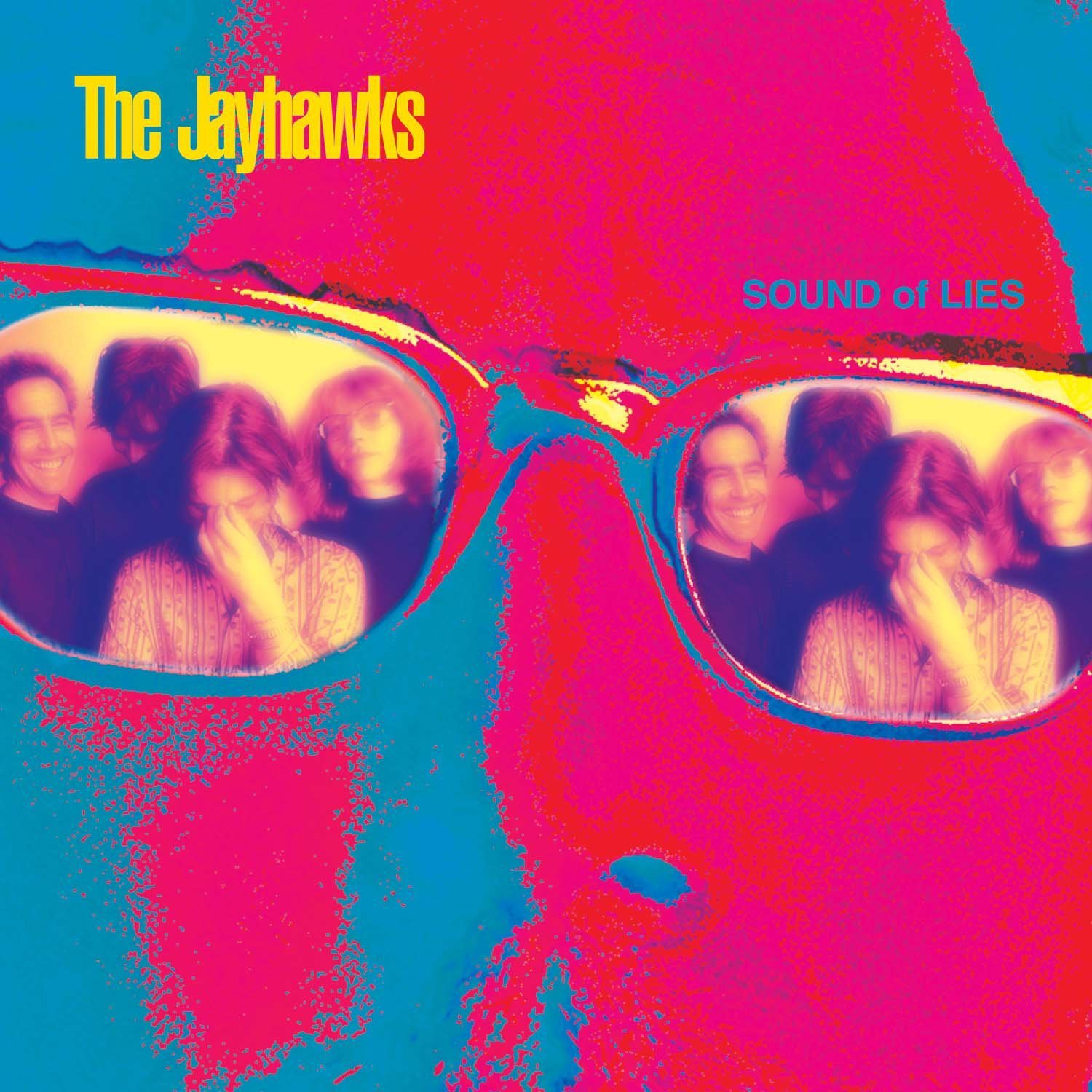
So, why, “Sound of Lies?” Because one of the things that I will not miss from 2020 is worrying that every time I turn on the radio, or TV, or check social media, I will be barraged by a steady stream of lies from the president and his henchpersons, sycophants and enablers. I mean, we all knew that most politicians shaded the truth when expedient, and that some lied, outright. But the sheer volume of dissembling and BS from this crowd has been astonishing and exhausting. I fully expect that, shortly after January 20, 2021, there will be stretches of days where I don’t even think about the President, and don’t have to get angry about his lies, which I expect to improve my mental health.
“Sound of Lies,” the song, is the title track of the Jayhawks’ 1997 album, which followed the departure of co-leader Mark Olson, and the resulting primacy of Gary Louris as singer and songwriter. And the album also marked a shift in the band’s Americana-based sound to include more pop influences, although the twang wasn’t completely eradicated. It’s an album that received mixed reviews at the time—in fact, they were “mixed” not in the sense that reviewers thought the album was mediocre, but in the sense that some reviewers loved it and others hated it. I suspect that many of the “haters” were the folks who object to bands that change and grow over time. And, in fact, many writers, often in pieces discussing the album’s reissue in 2014, noted that it had held up well over the years. In an interview from 2014 about the album, Louris said:
It’s probably our favorite album as well. It is the 'fuck you' record. It really is the fuck everybody record, I really remember Olsen had left, he had quit, I was going through a divorce, I was a mess, I was drinking too much, I was unhappy… I really felt this was the last Jayhawks record, and why not go out with a bang, so fuck it?
The song, though, is not a glossy pop song, but is, instead, a quiet, heartbreaking ballad, which is consistent with the dark place he was in. And while the lyrics to the song don’t really relate to the current political situation, these lines do resonate:
The sound of lies rings funny Against the truth
Despite Louris’ belief, it was far from the Jayhawks’ last album (it wasn’t even their last album with Olsen), and despite the despair and exasperation, they’ve gone on to continued creative success.
Hopefully, next year, at this time, we can all put aside our current despair and exasperation, and move on to be thankful about the truth.
<No, thanks> or <no thanks>. There is a difference. Syntax/punctuation matters.
Actually, I think this SMM theme is more about <no Thanksgiving> and other joys denied us in 2020. Yes, the holiday will come and go, but we are being told not to invite the whole family. I'm usually the host, but if I were invited, I would say "No, thanks. Not this year."
"No, thanks" leads me to think of all sorts of issues that have poppped up in 2020: Another 4 years? Classes in a room with 20 X 14 year olds? Sharing my office with a colleague who has had COVID? Riding a service bus to work with 20 others? No, thanks no thanks to our incompetent "leadership".
Then consider the other version: I have recieved no thanks for my actions related to many of the above. At this point I am expected to be thankful for still being alive?
That aside, let's focus on the music that drills down into the theme. Above Woody, then here his son Arlo: <Dead or Alive>. How appropriate!
the sherrif wants me dead or alive ... no thanks
Arlo sounds a lot better than his old man, but that may be related to recording technologies as much as the way things evolve over time.
I think it's fair to say that Woody Guthrie was re-working a "traditional African-American work song", a tune called <Poor Lazarus>, but the chronology is a bit muddy as far as I could discover.
James Carter is credited as the author of Poor Lazarus, but the Alan Lomax recording from the state pen is dated 1959. setlist.fm lists the first Woody Guthrie performance of <Dead or Alive> recording as dated 1949.
Poor Lazarus and Dead or Alive are pretty much the same story and I would be inclined to leave the provenance as traditional. The Guthrie legacy is managed by grandchild anna canoni and there is an informative dialog here.
The Social Security website shows that naming your child Joe is in decline. Over the last 20 years, it has moved from 315th most popular to 705th. Liam, Noah and Oliver are in the first 3 for 2019. That said, there are a number of musicians named Joe - some by birth, some taken later.
Because ... the theme is Joe, these gentlemen qualify. (I don't know of any girls named Joe, but there are a few named Jo.) And ... Billie Jo Spears and Jo Stafford kinda fit the theme-related bill.
A couple of random Joes here ... no sequence, no relation except that they are all Joe. And there's many more Joes I didn't list, but ...hey ... my list.
Well, at this point half way through the theme, we haven't recieved any flames about our not so subtle topic. Your SMM bloggers each bring their own baggage (Mr LaRaygun: his metal...) and mine: more heavily embued with folk. My father was a choir/orchestra conductor and I sang tenor (for him) in Handel's Messiah and similar
I had a back of the mind recollection that Hair, the musical, had a reference to Joseph. But, not so ... it must have been Jesus Christ Superstar. Both of the same ilk: early Rock Operas. However, further digging on my part (and a revivial of some dead brain cells- synapse links) revealed that my memory was of another Rock opera named >Joseph and the Coat of Many Colors<. There we go: Joe. Finally.
There is in fact a fair amount of similarity - at least in my mind: more or less same time and same style. At least I can see why I had them confused: Andrew Lloyd Webber and Tim Rice.
The biblical story of Joseph is familiar to most: "killed" on account of his brothers' jealousy, Joseph comes back to life in Egypt, this time in control of the situation. The musical rock opera covers this narrative.
The musical is a product of Andrew Lloyd Webber, a budding composer at this time (my confusiuons explained, since he was complicit in Jesus Christ Superstar). And Tim Rice goes beyond Llloyd Webber: collborated with Elton John, Rita Coolidge, Rick Wakeman and Freddie Mercury (and more).
The whole prospect behind rock operas seems to be that [in the modern era] the concept of the classical opera is dated and something "modern/pop/rock" might elicit interest and ticket sales. <Hair> and <Jesus Christ> made limited inroads. So did <Cats> (another Webber piece). Jospeh did not.
That has not killed the rock opera notion. A variation of the idea lives on in animated films (Lion King, which spawned a couple of charting songs, for one) and of course the Who's <Tommy>, Pink Floyd's <The Wall> and more.
One of the things that made Joe Biden a compelling candidate (other than the fact that most people look good by comparison to the lame-duck president) is the way he appears to relate to his family. Clearly, so much of Biden’s life was shaped by the tragic loss of his wife and child, and his attempts to continue to be there for them as a single father trying to make his way in the Senate. And we’ve heard about his second marriage, his support of one son through addiction and other personal issues, and having to watch another child die. . His sister is his closest political advisor, who ran all of his campaigns until this last one. Not to mention his relationship with his grandchildren, who he claims to call or text every day. There’s a genuineness to all of this, which again contrasts with the man he beat handily, whose children seem to be more like junior business associates, and whose third wife regularly slaps his hand away.
Much of this can be explained, I think, by the relationship that the men had with their fathers. Mary Trump has described her grandfather (and the two-time popular vote loser’s father) in very cruel terms, and as a man who forced his children to fight for his affection and money. (He also was charged more than once with racist practices in his business and was arrested outside a Klan rally. We report. You decide).
Biden, on the other hand, had a close, friendly relationship with his namesake father, who appeared to instill in his son respect for others, personal humility, and a resilient personality, but most of all, a belief that family is paramount.
Hearing Biden speak over the past few months, it is clear that he’s no communicator in the way that President Obama was, but he does display an “everyman” charm, and an empathy that has been lacking in our president since the current impeached resident of the White House was sworn in before a small crowd. Biden often refers to his father, and wisdom that Joe, Sr. imparted to him, and he often starts these anecdotes by quoting his father calling him “Joey.” (You knew we’d get there eventually, right?) Which makes sense, in a family with two Joes. In fact, last summer, Jill Biden released a children’s book about her husband’s childhood, called Joey.
The featured song, “Joey” is, for most of us, the only song by Concrete Blonde that we know, and it was released in 1990 on the band’s third album, Bloodletting. Written by singer Johnette Napolitano, it was the group's biggest hit, topping Billboard’s Modern Rock Tracks chart for four weeks and hitting number 19 on the Billboard Hot 100. The song is about being in love with an alcoholic, who Napolitano eventually revealed to be Marc Moreland of Wall of Voodoo.
Formed in 1982 as Dream 6, and renamed at the suggestion of Michael Stipe after signing to IRS Records, the band failed to achieve much success after “Joey,” broke up in 1993, and has had occasional reunions over the years. Napolitano has released albums as a solo act and with other artists, and was even part of the Heads, a project with the members of Talking Heads, without David Byrne, which fizzled out after the requisite litigation.
Joe Biden ran for president in 1998, with little success, dropping out after a series of plagiarism allegations, briefly tried again in 2008, but was overshadowed by Hillary Clinton and Barack Obama, and was asked to join Obama’s ticket in 2008, becoming Vice-President. He chose not to run in 2016, in part because of the death of his son Beau, and in part, I think, because there was a feeling that it was time for a woman to be president (which it was, and should have been). Biden has admitted regretting that decision. I have to admit that I thought that Biden’s dream of becoming President was over, and that someone younger would end up running in 2020. So, I was wrong. As it turned out, Biden’s message of empathy, competence, calmness and bipartisanship struck a nerve, and he won with an enormous margin in the popular vote, and a significant margin in the stupid Electoral College (winning a few states, though, by a slim margin).
So, maybe Concrete Blonde has another comeback in them. Just ask Joey.
Another short post, having me rue on the fact that most "Joe" songs, as alluded to in my last, involve heading down Mexico way, gun in hand, old lady no longer shenanigans. And that will never do, guns seeming more in truck with the current incumbent. (Mind you, "Donald" songs are an even harder nut to track, so, hey, no bright ideas, Boss!)
But, thinking on, let's play on the soubriquet offered him courtesy the wit and wisdom of DRT, given the outcome.
I guess I could have used the Herman's Hermit's Sleepy Joe, as, likely, the better known song. But I then listened to it, possibly for the first time in nigh on half a century. Astonishingly, I could remember it in a Proustian rush, drying in front of the fire after a thursday evening bath and watching Top of the Pops. I liked Herman's Hermits, but I always found it alarming the way Peter Noone mugged directly into the camera, always worried he could see thus the seven year old me, naked in front of the old black and white TV. That would be more than enough to not want to use the song. Plus it is shit. So it is to the glorious playing of Norman Blake. Just his hands and fingers on a single guitar, making a change from the dobro he became better known for. 'Sleepy Eyed Joe' is the first of two tunes. The second is 'Indian Creek', as in Native American rather than Indian Indian, but let's overlook that and assume a timely link to his deputy.
But he ain't so sleepy is he, boys and girls, and the words of Agent Orange hang in the air like the scent of a cheap hairspray. 'Not So Sleepy' is a terrific tune from 1957, from one Oscar Pettiford. Appropriately enough it came out on a record entitled Winner's Circle, and included only contributions from artists coming first or second in the Down Beat critics poll of the year's best. Thus Pettiford, a double bassist of some renown, 3/4 Native American and 1/4 African American, found himself alongside the likes of Joh Coltrane and Donald Byrd, names that have largely outlived his. I think it a great romp, and exudes celebration. Clearly, a Winner's Circle with relation to POTUS can only include outright winners, something as yet to sink into the mindset of the defeated, but we live in hope.
purchase [ Smiley Smile ] - I had totally forgotten they did this and I even once had a copy of the LP
Wikipedia tells us that Smokey Joe refers to a number of people & places. I note that there is an eatery using the name in Istanbul that is not included in their list of links. That makes it an international phenom.
The song itself comes from the extensive Leiber and Stoller music collection from the 1950s. That's Leiber and Stoller - of previous posts by myself, Seuras Og, Any Major Dude and others here at SMM. At least as legendary as Smokey Joe.
Leiber and Stoller shuffled bands and musicians the way you and I shuffle cards. One of the definitive versions of Smokey Joe's Cafe comes from a doo wop group known as the Coasters (so named because they moved from the West to the East Coast), but in LA, were originally named the Robins (one of a number of 50s "bird" groups).
As for Joe, the story goes that back in the days when you could find oil in downtown LA, there was a beans eatery named Smokey Joe's incongruously located in the middle of the derricks. The song is also noted to be one of the signature style that Leiber and Stoller perfected where the "hit" combined a certain humour with the music (see Yakety Yak as another example).
Check out the flippant lyrics for this Leiber piece:
I'd rather eat my chili beans
At Jack's or John's or Jim's or Jean's
Than taking my chances eating down at Smokey Joe's Café
the Robins/Coasters (YouTube videos appearing under both names appear to be identical)
Among the various extant versions of the song is one that is said to be a Buddy Holly home recording that was originally just of him and his guitar and that was later enhanced in studio after his death.
As befits an oldie but goldie, the song has been brought to the modern age by others, for example
No, not, really not a snarky, snidey post at all, but a comment that might not have been out of place even as little as a year ago. And, had the forces of Agent Orange had their way, would be as true in another year. But, for sure, everybody now knows who Joe is. So what if the lyrics, clearly a companion song to Hey, Joe, don't fit the circumstances, never let that get in the way of a great song saluting a greater moment. And, if we disregard the main thrust of the words, and cherry pick the odd phrase, and disregard the new order New Order allegedly might have been celebrating with their name, yeah, it's an OK comment. Who listens to words anyway? And I can't really buy into conspiracy theories about Manchester pop groups. "There's a storm in the sky passing over"
Well done, America. Now how do we get rid of our own World Leader Pretend over here in the UK?
Myself> at a wedding party, perhaps a similar party venue, like a year-end celebration. How about in the streets? Chicago, New Orleans, New York City. Philladelphia, PA, Baltimore, Motor City and D.C.
Aside from their country of location, what relevance to our theme? Well .. they're places and they're not mentioned in the title.That makes them fodder for this <Hidden Places> theme.
These cities, of course, have streets and they were chosen. Chosen to represent a kind of revolution that took hold starting back in 1964. A revolution of abandon? No, that was dancing in the streets when WWII ended. That was the jitterbug craze. But the evil that rock and roll represented was a kind of abandon where the youth danced ... wild. Arms and hands and hips all over the place. Often side by side nearly on top of eachother (definitely no social distancing here). Disgraceful.
Marvin Gaye's song - made famous by Martha and the Vandellas - has been covered by the Kinks, the Dead and Van Halen among others.
Now, 1964 is a bit early for the 'Nam revolts ... More a reaction to LBJ's Civil Rights Act? But it seems to be part of a spark that lead to a more sustained expression: we'll dance in the streets to voice our opinions and our understanding of what it means to be social. And - it doesn't even matter what you wear.
Seems quaint. These days, we'll bring our guns or drive our trucks <to the streets>
So who has listened to the original of this recently? Or seen the film? Decades ago would be my answer, it, West Side Story, being a staple on the sunday afternoon film rota, bought in by my school to entertain the confined pre-teens. Yup, the great old UK tradition of sending kids away to boarding school, at the personal expense of the parents and the psychological expense of their children. Explains how I react so well to the rigours of lockdown. Or would to prison, I gather. Anyway, even in the late 60s, I recall it all seemed desperately dated and I never quite bought the idea of teen hoodlums bursting into either song or dance, let alone both. Especially when so well groomed and clearly in their 30s. But, as it turned out, not such a bad song, and notorious pants-splitter, P.J. Proby took it high in the UK charts. I remember finding his kitschy take astonishingly awful as a boy. Now it just has me howling.
And the theme? Another kinda sorta one, I'm afraid, as I know only too well the sort of "place for us" Tony might have had in mind, very much doubting Maria would find much lasting joy there, her mind thinking more of a whole different setting, of more lasting promise. But I detract from the incisive commentary around the plight of young love in the urban jungle. Maybe. And, yes, I get it that she dies, so rendering my remarks cheap and ignorant, but given the where isn't ever discerned, that makes it, ergo, hidden. Possibly backstage, in a poky dressing room, between scenes.
Being an erudite lot, you'll know the melody isn't an original, nicking parts from both Beethoven and Tschaikovsky, who, together, had designed the New York Subway signature screech. Covered innumerable times, the purpose of this post is to demonstrate some of the less well known versions, a gig I tend more to occupy in another guise, over at Cover Me. Of course there are also innumerable stinkers, every two-a-penny talent show competitor dredging up a version for "show night". Or even their judges....
I'm going to skim over this one, it's the one I'm "expected" to post, Tom Waits being a poster boy for the serious music nerd. To be honest, I find his voice just toooooo much, although, as I get older, I find I can dip my ears in his earlier stuff. Later stuff still defeats me, but the whole grand guignol of this demolition appeals to my sense of the absurd enough to allow it. And the trumpet is really rather good.
Talking of kitsch, as we were earlier, PSB are never afraid to embrace their inner divas, and this is a song ripe for their everything and the kit(s)chen sink OTT overkill, and this is ticking most of their boxes. Sumptiously overproduced, this only lacks the chorus of the Red Army guard. As here.
I hadn't known Aretha had done a version, this stemming from 1978, where she deconstructs most of the additional arrangements, here in background reminder only, as she swoops and soars around the melody, possible accompanying herself on piano, instilling a blast of gospel hued R&B, even as it then morphs into a jazzier vibe altogether, with a glorious walking bass line and some classy sax noodles, before returning, to finish, in the chapel.
Another welcome deconstruction, Hem transferring the song off Broadway to the Catskills, all tinkling mandolin, dreamy steel and the soothing benevolence of a pipe organ and clarinet combo. Touching on tweeness in the middle eight, the vocal charm of Sally Ellyson is sufficient to swiftly dismiss that thought.
Finally, and not without some internal dialogue, an "interesting" duet version between Marianne Faithfull and Jarvis Cocker. As with the commentator who originally put the song up on youtube, I am uncertain if it deeply awful or just plain disturbing. The arrangement is quite something, a sophisticated supper club shuffle. But the singing? Neither orthodox vocalists, rather than playing to their strengths, as, arguably, did Waits, here they seem to be playing their weaknesses. But I still felt drawn to post it. Put me under undecided.
Sorry, no time for Dee Snider, Phil Collins or the Bee Gees, for which you should thank me. Really. In the meantime and in anticipation of your plaudits, I'm off to my somewhere. To hide.........
Four years ago, relying on pretty much every polling expert and pundit, and the clearly misguided belief that there was no chance in hell that my beloved country would elect a racist, sexist, selfish, pathological liar with no empathy, no interest in, or knowledge of, how the government works, and who would spend his time in office doing everything possible to enrich himself and his family, attempt to destroy any sense that the government was fair and cared about its citizens while fanning every sort of division and harping on imagined grievances, I was feeling pretty good as Election Day approached. Sure, I was surprised at the popularity that Trump seemed to be garnering, but I felt secure that we’d be electing a smart, caring woman who had devoted her life to public service. And I was comfortable that under Hillary Clinton, our country would continue bending the arc, if slowly due to the obstructionism of people like Mitch McConnell, toward a more fair and just future.
Boy, was I wrong.
And that’s why today, I sit in front of my computer, days before Election Day, facing the real prospect that Trump will be re-elected, whether fairly, or, more likely, due to the distortion of the Electoral College, or through fraud, and interference by sycophantic judges. Or some combination of them both. I’ve been voting in presidential elections since 1980, and never before have I had to consider that one candidate has refused to admit that he will leave the White House if he loses, or that one candidate has spent months trying to sow confusion by lying about the voting process, or that one candidate’s supporters actually have surrounded a campaign bus to prevent an appearance, or that one party has discussed ways to appoint electors contrary to the popular vote, or that there might be actual violence after the election, and on and on.
I’m worried that even if Trump loses, he and his power hungry minions have created a playbook for future authoritarians to follow, because he’s exposed all of the ways that the Constitution and laws can be ignored, perverted or interpreted to lead to strong-man rule, when some or all of Congress and the Supreme Court is willing to roll over and not protect their prerogatives or perform oversight. And I’m worried that if he wins, with no concern about re-election, and with a compliant court system, that the march toward authoritarianism and kleptocracy and racism will continue unabated.
I’m worried that the damage that Trump has already done will take years, even generations, to fix, and that a second term might be an existential threat to our democracy.
And I’m worried about what I’m going to do in my spare time instead of deleting the hundreds of emails that I’ve been getting daily from Jaime Harrison.
Like many of us, I think, to distract from this, compounded, of course, by the raging pandemic that this administration has failed to seriously try to combat, I’ve turned to television, even more than in the past, and last Friday, my wife and I watched David Byrne’s American Utopia on HBO. It’s a filmed version of the Broadway show, directed by Spike Lee, and it was great. I won’t get into the obvious comparisons between American Utopia and Stop Making Sense, considered by many to be one of the greatest music films of all time (which my then-future wife and I saw in an actual theater, on 57th Street in New York when it came out in 1984), or between it and the filmed version of Hamilton that recently ran on Disney+. If you’re interested in such comparisons, you have the same Google that I have…. (OK, here's one.)
American Utopia is a collection of songs, some from Talking Heads, some from Byrne’s solo and collaborative works, and a couple of covers, all performed by a talented group of musicians, singers and dancers, on a bare stage, all wearing essentially identical gray suits (of normal size) and no shoes, with some personal and political commentary by Byrne. For the most part, the songs are great (the Talking Heads songs tend to get the best reaction from the audience), the performances tight, and the choreography interesting and mesmerizing. And there’s a joy about the performances that is infectious.
One of the older Talking Heads songs in the show is “Don’t Worry About The Government,” from the band’s first album, which is written from the point of view of a person (who some people believe is a government official) discussing his simple, comfortable, happy life. And it fits our “Hidden Places” theme when Byrne sings:
I see the states across this big nation I see the laws made in Washington, D.C
I think of the ones I consider my favorites
I think of the people that are working for me
Some civil servants are just like my loved ones
They work so hard and they try to be strong
I'm a lucky guy to live in my building
They own the buildings to help them along
Almost every article that I read before writing this piece referred to the lyrics of this song as “ironic” or “sarcastic.” But here’s what Byrne himself said about the song, in an interview from 2019, before American Utopia opened on Broadway:
It’s funny. When Talking Heads originally did that song, it was a song about living in a nice condo with modern conveniences and good plumbing and no cockroaches. It became the opposite of what everybody was doing in the folk scene at that moment. Everybody was snarling and angry, and this was a young guy who just wanted to live in a nice apartment! Everybody thought I was being ironic with the song because of the lyrics and the context. But I think people will see a certain truth to it now. It’s not a great virtue living in an apartment filled with cockroaches. You don’t have to have a penthouse, but people want to have a decent life. Everyone can accept that in some way. It’ll be seen and understood in another way with the passage of time.
I’m hoping that, in a short time, I can stop worrying about the government every day, and that we can get back to the days when civil servants do their work, and people in government work for us.
Sometimes what is not stated is as clear as what is. Sometimes a place not mentioned is as obvious as one clearly labelled.
There are songs that list all sorts of cities that are not in the title: my first thought was "Yeah. >Willin'< - the classic Lowell George/Little Feat piece' ". The song IDs cities all over the US West, not a single one of them in the title. And the song has been covered by any number of musicians. But ... it has also been covered here (tho our 2009 post from "Susan" did not include Gregg Allman's 360 studio session video that is fun to check out: good music and the panoramic presentation is kind of cool.)
But.. that song has been covered here. So ... something that appears not to have been brought up here before. That said, Don Henley and Bruce Hornsby have appeared @ SMM previously, but not for this one.
<End of the Innocence> references an un-named "small town" with tall grass untouched by man beneath a deep blue spacious sky. Clearly in the USA (O' beautiful for spacious skies), not in a city, but rather somewhere in the heart of America. It is also a cry for a time lost.
Various music critics note Henley's disallusionment with the state of affairs at the end of the 1980s - the end of the 1960s/70s movements to fight for a better world having fizzled. The song revolves around these sentiments: plowshares into swords ... repeated references to lawyers ... tired old kings ... armchair warriors. A pretty bleak picture.
But - there's a place we can go. It's hidden. It must remain hidden to keep it free of cares, untouched by man and not poisoned by fairy tales.
The clip below has a whole bunch of my guitar heroes, BTW, and tears come to my eyes every time I listen.
I think this sort of meets the theme, even if the hidden place is a destination, if, as yet, unknown and, probably, unimportant. Driving somewhere, arriving nowhere. So, fulfilling, if in a roundabout and reverse way, the old adage that is is the journey that matters, not the getting there. Even when the aim is never quite to arrive. Or the outcome, even. Clear?
I guess both the song and maybe the band are also hidden places, outside most peoples knowledge or hearing. Yet they will have heard Stephen Duffy, if not necessarily of him. More famous for a couple of links rather than in his own right, so if I say Duran Duran and Robbie Williams, you'll have heard of them. Not that he sounds anything like either, perhaps a relief to any regular reader, used more to my parade of motley unknowns and minor league cult favourites.
Duffy was an early member of Duran Duran, but jumped ship ahead of their transition to fame and fortune. Don't get me wrong, I don't dislike Duran Duran, but I can't see his country pop musings fitting in so well with the glitz and glamour of their new romanticism. Starting off as the singer, he moved then to guitar, then to bass and finally to drums, ousted from each position as later members joined. He actually then had a crack at that market, even a hit single, in the UK at least, under the title Stephen 'Tin Tin' Duffy, but it took three different versions before it made its mark. Hasn't really aged well, has it?
A few further false starts and he started the Lilac Time, with elder brother Nick, the two the mainstays as a procession of players rotated through the ranks. The sound, like the featured track, and exemplified further on its parent album, 2007s Runout Groove, is of dreamy meanders down a melodic and country tinged lane. The pedal steel brings a wistful counterpoint to the slightly languid vocal, pinned down, on this record, by the masterful double bass of Danny Thompson, the ex-Pentangle maestro and John Martyn sidekick, who remains the go to bassist for anywhere where folk might meet jazz for a natter. Runout Groove is, for me, the highlight of Duffy's recording history, so far at least, as he still records and plays. The astonishing thing about it is that it came out four years after its predecessor, his career having taken an unexpected side swerve along the way.
Robbie Williams, the effervescent ex-boy bander, the cheeky chappie who exited Take That after mingling more with Oasis and their lifestyle choices than possibly appropriate for a teen heartthrob. He then became much bigger than his old band, but needed assistance with songwriting. This had first been provided by Guy Chambers, who had previously been in World Party. After he parted company, Williams' team asked Duffy, perhaps less for his Lilac Time material, maybe more on account of songs he had written for Canadian band Barenaked Ladies. And an undoubted success it was, Duffy also touring with Williams during some of his stadium sell-out tours, delivering further hits for his new boss. Radio became thus Duffy's first number one.
Then, as if nothing untoward had happened, he dropped straight back into Lilac Time mode, picking right up from where he dropped off. I think that is quite classy. Further albums have followed, sticking to the same formula, the last being released just last year. All well worth looking out for. Here's another track from Runout Groove, Once more it fits the feel of the theme, the lyric showing him back on a figurative road, again with, literally, no direction. But, if the first song was looking for a somewhere never found, this is a happy acceptance of the journey. Spot the namecheck to his erstwhile employer. A parting personal link to the theme is that I more than likely heard the album first in the car, that being where I do most of my listening. Sometimes with no other purpose in particular, just driving somewhere, arriving nowhere. Purely for the sake of the song.
P.S. Those, who have set to wondering how he could have affected the Durannies, might like this, a revision of old tapes, made in those old days, rebuffed and polished up, hand in hand with onetime bandmate and continuing DD keyboardist, Nick Rhodes. Put out in in 2002, they called themselves the Devils, the album called Dark Circles.
I’m sure that I was listening to some song that mentioned some place that wasn’t in the title when I thought of this theme, but I suggested it so long ago that I can’t remember what song it was. So, when I tried to figure out what to write about, I decided to write about my favorite city. The city that I’ve loved since my father brought me into Manhattan from my birthplace in Queens when I was a little kid, to go to museums, and magic shows, and just to walk around and spend time with him. Where I’d go with him to court, or to hang out in his office. And when I got older, where I’d sometimes come with friends, to go to the theater or museums or restaurants or ball games. Where I went to law school, lived for almost a decade, met my wife and started a family. And where I worked until a few years ago, commuting on the train after moving the suburbs, and loving the excitement and bustle of New York. Except on the night they lit the Rockefeller Center tree, which made my usual 10 minute walk to the train an ordeal. I miss New York, having started working from home back in 2013, and I miss it even more now, when thinking about going to the City raises all sorts of new issues. (Interestingly, in 2013, I wrote about another song from the same album, although strangely as a tribute to my suburban home).
I have a “New York” playlist on iTunes, and the rules, such as they are, are that the song has to mention New York City, or some part of the City, or at least some recognizable location or feature of the City. I’m guessing that I’ve missed a few, but it currently has over 500 songs on it. It’s possible that no artist has more songs on the list than Lou Reed, who was born in Brooklyn and grew up on Long Island, but has long been associated with New York from his move to the City in 1964 to be a songwriter, and especially from his co-founding the Velvet Underground. The Velvet Underground was, of course, part of the New York underground scene around Andy Warhol and his “Factory,” and more than a few of their songs were about the seedy, druggy underbelly of New York, such as “I’m Waiting For The Man,” a tale of scoring drugs on Lexington Avenue and 125th Street in Harlem.
Reed’s focus on New York continued after he started his solo career, including his biggest hit, “Walk On The Wild Side,” which mentions the city itself, and the Apollo Theater, and also referred to members of Warhol’s clique. Again, Reed focused not on the mainstream, but on the marginalized part of New York, because that was the life he was living and those were the people that he knew.
For 1989’s New York album, Reed, approaching 50, and thus an elder statesman, put together an entire album of observations of the City. In fact, Reed’s liner notes instructed listeners to listen in one sitting, “as though it were a book or a movie” (although I know few people who read a book in one sitting, but you get the point). It’s a bleak album, about a bleak time in New York. I loved the album, although I have to admit that things for me were the opposite of bleak—I had a high paying job, a nice apartment, and best of all, I had been married to the love of my life for about four months.
Still, I was able to appreciate Reed’s observations and lyrical wordplay, and the tight, stripped down, music from Reed, guitarist Mike Rathke, bassist Rob Wasserman and drummer Fred Maher (with some guests, including former Velvet Underground drummer Moe Tucker), which was perfect for the songs.
The album was critically acclaimed, and the single, and our featured song, “Dirty Blvd.” was a No1. hit on Billboard’s Modern Rock chart.
“Dirty Blvd.” is not a hopeful song, by any stretch of the imagination, about Pedro, from a poor immigrant family who, because of the city’s (and country's) mistreatment of both those groups was destined to fail. It’s an angry song, contrasting the wealthy at Lincoln Center, only blocks from the rundown hotel where Pedro lives, with the difficulties of his life. In one of the most memorable passages, Reed sings:
Give me your hungry, your tired your poor I'll piss on 'em that's what the Statue of Bigotry says
Your poor huddled masses, let's club 'em to death
and get it over with and just dump 'em on the boulevard
By the way, guesting on background vocals on the song is another New Yorker, Dion DiMucci.
Although since 1989 much more of Manhattan, and the other boroughs, are gentrified, and safer than back in the era described in New York, income inequality in the City, and elsewhere, is worse than ever. And the current administration’s anti-immigrant policies even led to one advisor, whose name I will not type, attempt to distance the Statue of Liberty from Emma Lazarus’ iconic verses. The album still holds up, mostly because of the music and lyrics, and also in part as a period piece and in part because of its timelessness.
New York City has, like most of the country, taken a hit from the coronavirus and the failure of our national “leadership” to take appropriate action in face of the pandemic, but contrary to the recent statement from the liar in chief, it is far from a ghost town. My son and daughter-in-law stood on line for more than two hours the other day to vote, which is a lot of ghosts. In fact, although things are generally not going well, there’s some evidence that New York City is attracting new people, which it always has, from well before the days that my ancestors showed up here from eastern Europe (one, by way of England) before and just after World War I, and whose energy and vitality has always been fed by immigrants from other countries, and from other parts of the United States.
[I found out late last night that yesterday, October 27, 2020, was the seventh anniversary of Reed's death, which didn't enter into my decision to write this piece. But if I had known, I would have tried to post it earlier. Oh, well.]
Robert "One Man" Johnson is a personal guitar hero to me. The first time I took a stage to play guitar for a large group, I had no idea what I was doing. Well, that's not entirely true. I had enough of an idea that I invited Robert to join me. He ended up doing most of the show, since I had only come prepared to play about 15 minutes' of material. I have been blessed to join him on stage again since then.
Robert was in Istanbul as an English teacher back then. He took advantage of his musical skills by using them to enhance his classroom - incorporating song in his lessons, at times getting his students to help in the writing process. Following his stint in Istanbul, he and his wife headed further east for other teaching jobs and experiences: China, Japan....
He is invested in his playing to the extent that wherever he goes, he finds venues to play and as a result makes contact with other musicians to collaborate with both live and in the studio. His website (and brand), housedogmusic.com give us only a glimpse of his extensive original repertoire and many collaborators, including but not limited to Bonnie Raitt, Muddy Waters .. and well, you just go check it out for yourself.
The "One-Man" moniker comes from the fact that he plays the guitar, harmonica, sings and taps a cymbals with one foot and his personally invented foot piano with the other. At the same time.
Well, it's five years since I, grudgingly it reads, gave this band any pentime, but, you know, time has been kind to their memory, a new boxset retrospective, released round about now, raking up a fond nostalgia I am finding infectious. Hindsight further adds to the scallywag, loveable rogue image they allowed to be cultivated around them. For rogues they almost certainly were, or fiends even, certainly in the drug sense. But that is not what I have come to gaze upon, more the realisation that, amidst all the chaos and chutzpah, there band had a fair few rather good guitar slingers. Which, for a band that history famously places largely around the bassist, one Philip Lynott, makes for an interesting tale.
Like most, I first heard of 'em back in the very dim and distant, with a song that is still more likely to appear in compilations of folk music than of rousing rock anthems. But great it is, the guitar part, courtesy Eric Bell, arguably opening the door to any number of celtic rockers, from Big Country to Runrig. Lynott's drawled vocal just the right counterpoint for the crossover smash it became. Possibly the first time trad.arr. looked so good. But Eric Bell was not long for the band, abruptly walking off stage, mid-set, in 1973, "exhaustion" cited as his reason, with nary a regret ever offered, even as the fame of the band eclipsed his own part therein. In truth, his exhaustion was the sort that came in bottles and wraps, as described here, but his later legacy never built on the promise of his work with Lizzy over their first few recordings.
This left Lynott, along with drummer Brian Downie with a predicament, how to replace a guitarist who, in one song, had transformed the image of the band and their place in the market. Answer: if one guitarist let's you down, get two! This response, very much in keeping of the devil may care vagabond hero, as in the (Bell included) song, The Rocker, became their declared image. The two guitarists were Scott Gorham, allegedly hired because of his nationality, American, and his extravagant mane, and Glaswegian street fighter and musical polymath, Brian Robertson. Robertson was very much the lead foil, at least from the basis of his track record and experience, being hired because he could play. And play he could, responsible for defining the twin guitar sound, allegedly telling Gorham what to play, how and when. An accomplished writer too, he contributed to some of the material from this iteration of the band, actually their glory days, if Lynott still wrote the bulk, and most of the hits. However, he was another guitarist with a thirst, having to skip an important US tour on account of a hand injury, sustained in a drunken brawl, defending the honour of fellow Scots toper, Frankie Miller. His place, temporarily at least, was taken by Gary Moore, who clearly made a mark, if dispensed at the end of the tour. The next album was recorded as a three piece, but needing the dual guitar attack, Robertson was taken back, if on probation. But it couldn't and didn't last, as frictions flared, initiated at one point by Robertson's refusal to overdub new guitar parts on live album, Live and Dangerous. Which, at that time they were.
Gary Moore now bounced back in, his shared Irishness perhaps a better foil for Lynott, and, amongst a flurry of further hit singles, came the above, an epic, the title track of 'Roisin Dubh', back in the hinterland of rock and roll with traditional Irish folk. A direction I would have liked them to pursue further, but the swaggering lifestyle choices of powders and poteen probably put paid to that. In 1979, in classic Lizzy style, Moore left the band, mid-tour as ever. Astonishingly he was subbed by, of all people, Midge Ure, the soon to be Ultravox-er, but he had been one of a crew of musicians involved in Lynott's other side-project, the Greedy Bastards, wherein he allied with a number of punk and new-wave musicians to distance himself from being a dinosaur like other rockers of the earlier '70s.
In truth this was heralding the end. Other guitarists came and went, Dave Flett for one, once of Manfred Mann's Earthband, propping up the ship of Lynott, Gorham and the omni-present Downie. Ure hovered around the fringes for some time, sometimes on guitar, sometimes as a keyboard player, but he too didn't last long after the last great Lizzy guitarist was recruited. This was Snowy White, with a track record encompassing both Pink Floyd and Peter Green. A more sober minded individual, his gravitas gave the band a final lift. But he too left, in 1982, frustrated by the ever more confused borderlines between Lynott solo and Lynott Lizzy. Not party to the prodigious opiate enthusiasms of much of the rest of the band left him also somewhat apart.
I confess I thought that was about it, only discovering whilst researching (ha!) this piece that there was then a further and final guitarist, John Sykes, ex of the NWOBHM stalwarts, Tygers of Pan Tang, very much dragging the ambience in a metallic direction. Thereafter, with both he and Downie having by now had time off for bad behaviour, Gorham had had enough, setting the scene for a farewell tour, as famous for the struggles to score heroin as to keep the band upright. A september festival gig at Monsters of Rock, surely an apt title, in 1983 and it was all over.
Lynott, the focus and frontman, died in 1986 of drug-induced multiple organ failure. Gary Moore died of an alcohol related heart attack in 2011. Eric Bell and Brian Robertson still play and record music sporadically. John Sykes "revived" the band name in 1996, persuading Downie and Gorham to join him, but this didn't last. Scott Gorham held the baton for a while, until Downie also jumped, whereupon Gorham re-branded as Black Star Riders, "out of respect to Phil Lynott". They gig on, with a sound exactly of classic Lizzy. Brian Downie has his own band, 'Alive and Dangerous'. Snowy White has had both his own band and ongoing working links with ex-Pink Floyd man, Roger Waters. Midge Ure has an ongoing solo career. Dave Flett, most ironically, is an addictions counsellor in Florida.
One band, five guitarists, six if you include Ure, seven even with Flett. Makes the boxset seem a whole lot more interesting?
They blew me away. That's in the past tense, as in - I don't listen to them much these days. But they were a major part of my musical formation. So .. this is kind of a trip back down memory lane. Maybe these sounds will reverberate with you.
A search of the SMM blog for a few guitar players that came to mind shows that 2 have not been featured much here. Curious. They are both top of the list for fame and, of course, skill, but SMM writers have not posted much about them.
The two are related - in that they collaborated on a 1981 live album together with Paco De Lucia (who I mentioned in our annual memoriam back in 2015. SMM alumnus Geoviki touched on one of my choices previously, as did I at various times in the past. But they haven't been noted as much as it seems to me they ought.
The common thread here, aside from being sterling guitar players, and the <Friday Night in San Fransisco> collaboration album is jazz-fusion. Blisteringly fast fingers/notes. So many so that both of my choices below have been critiqued as playing too many notes.
Al Dimeola's guitar style mostly caught my attention with its Mediterranean sounds. Mixed with a touch of jazz, the result is ... well... listen for yourself:
John McLaughlin has always come across to me as a little more to the east on the world map in terms of sound. Able to bring that sound back west, in my mind <My Goal's Beyond> and the Mahavishnu period are firmly rooted in a more Asian than Mediterranean sound:
Why does the phrase "Guitar Heroes" always have me thinking the wanton destruction of guitars? I guess it’s my age, as the sure fire way to gain that status in the 60s would be, literally, to fire it up. Or to smash it up. OK, let’s disregard the apocrypha that inform us of the dodgy guitar, just off stage and out of audience view, hurriedly sleighted into use and destroyed, night after night, whilst the more precious gear went back into the mink lined crate. And why always guitars? How come the keyboards or drums never took equivalent bashings? (Alright, well nearlynever….)
John Hiatt has famously had words to say about the practice, rightly decrying it. But he has had oodles of previous posts here, so I have to think harder. The good news is that there are actually a lot of songs about guitars, often by guitarists who are no slouches on the instrument either. There are even a slew of songs about guitarists by guitarists. One I have covered here before, but not this one below.
I am not going to blether ever onward about my love and awe of RT. Partly because I could and partly as I, and others, have already. But the song, not, I agree, his strongest composition, does at least give some faithful insight of who he was trying to emulate,in his bedroom all those years ago. But I notice that one of the fellas included in the song always appears in the lists of the favourites of our favourites, that being Hank Marvin, of the Shadows. Those queueing up to pay homage to this mild mannered anti-axe hero are many and varied, including some surprising names: Tony Iommi, Ritchie Blackmore, Neil Young even. (And you thought From Hank to Hendrix was about Mr Williams?!)
I like the video above, if only presenting Hank and the boys in a slightly cooler setting than the usual suits, grins and little dances. Not that they too, in hindsight, don't have their own certain whiff of something unattainable.
There is something slightly thrilling in revisiting these old tunes and these old clips. Remember this is the cusp of the 60s and England. Sure, we had rock and roll over here, but a largely gentler and milder version, nothing too shocking to shift our upper lips. Cliff was as rowdy as it got, the Shadows getting their break as his backing band. The advent of the Beatles so then tilted the universe that Cliff and the Shads seemed forever displaced to light entertainment and TV variety shows. But, listen again: that tone, that tremolo. Magnificent.
He has even had a tribute album created in his honour, Twang!, with an A list of the gurners and shredders, including those mentioned above, along with Mark Knopfler, Brian May and Peter Green, all lining up to play his praises. It’s a good listen, too, in turns surprising, as you realise quite who is on it, as well as realising and remembering quite how good a body or work he produced all those years ago. But who does he rate and who were his inspirations? Here's a pretty good interview and, unsurprisingly, it lists the icons of the golden age of rock and roll, Scotty Moore and James Burton to name but two. He comes over as a decent fella, too, with feet still firmly on the ground.
So you can keep your long hair, your tapping and your pedals, when I want something simple and sublime, gimme some Hank!
Star Maker Machine does not accept music submissions from artists or promoters. However, most of the contributors here do accept submissions for our own blogs, listed below. Please visit our blogs, take the time to listen to what we post, and then feel free to contact us if you feel that your music would be a good fit.



























:format(jpeg):mode_rgb():quality(90)/discogs-images/R-677444-1399670948-5951.jpeg.jpg)


:format(jpeg):mode_rgb():quality(90)/discogs-images/R-6133532-1590932855-4312.jpeg.jpg)


