


























The Andrews Sisters w/ Bing Crosby: Pistol Packin‘ Mama
[purchase]
I don’t like crooners. That whole style of music just leaves me cold. So I feel very strange posting Bing Crosby. But man, does this swing!
You might say that Crosby and The Andrews Sisters formed a supergroup during the swing era. They cut enough sides together to see release in these days as a full-length CD. They released Pistol Packin’ Mama in September of 1943. The original version had been a hit on the country charts for Al Dexter earlier that year.
Since then, the song has been covered in almost as many ways as there have been musical styles. Frank Sinatra did it. Gene Vincent recorded an ill-advised rockabilly version. There is an instrumental jazz version by Albert Ammons. But almost nothing compares with this version. So the last thing I would ever have expected was a killer version by John Prine. Mac Wiseman is Prine’s partner in this, and also deserves credit.
John Prine and Mac Wiseman: Pistol Packin‘ Mama
[purchase]
Wednesday, May 6, 2009
Oh, Mama: Pistol Packin’ Mama
Oh Mama : Mama Don't Allow It

Julia Lee and her Boyfriends: Mama Don't Allow It
[purchase]
"Mama Don't Allow It" is a very old dance number found in every genre: jazz, country music (I was told about a fantastic version by Western swing singer Milton Brown but I've never heard it so far), Tin Pan Alley, and the blues. John Lee Hooker's "Boogie Chillen" is a variant, and the subject is common in folk music.
Two French songs for children are very close to it : one about papa who doesn't want me to dance the polka (but I'll dance anyway), and another one, that my mother stills sings to my daughter, about a mother who doesn't let her daughter go to a dance that takes place on a bridge, but she goes anyway, and the bridge collapses.
The Julia Lee version is my favourite, for its great swinging qualities. A pianist and band leader from Kansas City in the thirties and fourties, she was famous for her double-entendre songs, like "King Size Papa" or "Snatch and Grab It". "The ones my mother told me not to sing", as she used to say.
But in spite of her repertoire, Julia Lee was a very good Mama : she never wanted to leave KC for too long and turned down propositions for extended tours that might have kept her away from her family for too long.
Tuesday, May 5, 2009
Oh Mama: Mama Tried

Merle Haggard: Mama Tried
[purchase]
In my book, this is the big mama of all "mama" songs. It's one of the all-time great country songs sung by one of the most legendary voices in the history of country music (second only to Hank, I'd say).
Whether you hear it wafting from the jukebox on Friday night, singing from your a.m. radio on sunny Saturday afternoon, or streaming from that tiny speaker on your laptop on a Tuesday afternoon at work, this is what country music was meant to sound like.
Be sure to check out the comprehensive song review at AMG (which I can only fault for misquoting the lyrics, by calling the singer a "railroad" child).
"One and only rebel child from a family meek and mild..."
Oh Mama : That's All Right (Mama)

Arthur "Big Boy" Crudup : That's All Right (Mama)
[purchase]
Arthur "Big Boy" Crudup (see bio)
was a Mama specialist. One of his first sides in 1942 was the classic "Mama Don't Allow". "Rock Me Mama" (1944), "Love Me Mama", "Hey Mama Everything's All Right", "Love Me Mama" followed, and last but not least, "That's All Right (Mama)" (1946), that Elvis picked for his first single, along with "Blue Moon Of Kentucky", a record which became the physical symbol of both sides of rock 'n' roll roots : blues and country.
The original version is much rawer than the King's : Crudup only started playing guitar at 30, and his playing is primitive, rhythmic. As most Delta bluesmen, he plays the guitar like a percussion instrument, not caring much for chord progression and bar symmetry, but with some innovation : those riffs in the lower frets sound very funky and were pretty unusual at the time. There are barely 2 chords, the third one (the dominant for musicians) is gone, revealing pre-blues, African-like traits, like in John Lee Hooker.
It is said that Elvis came in person at Crudup's house to offer him the gold record plaque for the song. But Big Boy, who couldn't read or write, didn't even claim his due.
Monday, May 4, 2009
Oh Mama: Fujiyama Mama

Wanda Jackson: Fujiyama Mama
[purchase]
If I were a lawyer making the case for Wanda Jackson's place in the pantheon of great rockers, this song would be my closing argument.
It's powerful enough in 2009. Just imagine how it must have sounded to the kiddos back in the staid 1950's. This lady is a powerhouse.
I drink a quart of sake
Smoke dynamite
I chase it with tobaccy
And then shoot out the light
Sunday, May 3, 2009
Oh Mama: Mama's Got A Boyfriend

Eliza Gilkyson: Mama's Got A Boyfriend
[purchase]
Austinite Eliza Gilkyson -- daughter of folksinger and Disney songwriter Terry, who wrote both Memories Are Made Of This and The Bare Necessities, and sister of X guitarist Tony -- was a hardened performer of fifty when she finally hit the big time on folk radio with Hard Times in Babylon, an album which she has aptly described as "a diary of a season of loss." Two years later, she had turned her life around, and though the lighter lyrical tone which resulted wasn't as successful on the circuit, it did lend a strong smile to her increasingly road-weary voice as she continued to tour festivals and coffeehouses.
But though Lost and Found, her follow-up album on recently-featured label Red House Records, sold on the strength of her earlier work, it still contained some powerful tracks, framed by Gilkyson's stellar vocal delivery and some exceptional production. Case in point: the deceptively simple, heavily electrified blues dirge Mama's Got A Boyfriend, which practically begs for a roadhouse movie soundtrack placement.
Oh Mama : Blues For Mama

J.J. Cale: Blues For Mama
[purchase]
For this Mama week, being a roots music fan, I had a great choice. After narrowing down to twenty-some songs, I decided to hit "shuffle" and see what came out.
It was the sad song of the lot. But also one of the most moving songs of JJ Cale, from his come-back 2004 album To Tulsa and Back. I don't know if he lost his mother or any close relative prior to the recording, but you don't do this kind of mourning song for pleasure, I guess...
I've always loved Cale's sense of economy. No endless guitar solos, but a few notes, full of feeling, a few words too. People like Clapton or Mark Knolpfer owe him a lot.
Oh Mama: I'm The Only Hell (Mama Ever Raised)

Johnny Paycheck: I'm The Only Hell (Mama Ever Raised)
[purchase]
A theme about "mama" is a great way to flush out the country-lovin' sometimes-contributors like me.
This one doesn't take a whole lot of analysis. Like the title says, he's the only Hell his mama ever raised. Maybe if his mama had raised a bit more Hell while he was being raised, then he would have come out better, but that wouldn't have made for a very good "myth-making rebel anthem".
Friday, May 1, 2009
This and That: High and Dry

Radiohead: High and Dry
[purchase]
It may seem hard to believe, especially for fans overseas, but after the freshman blip of Creep, American audiences took awhile to truly warm to Radiohead. So, apparently, did lead singer-songwriter Thom Yorke, who has not performed High and Dry in over a decade, and has gone on record as decrying the song -- recorded in the sessions for their first album, rejected by the band as too "Rod Stewart", eventually released in its original form as the first single from their second disc in 1995 -- as "not bad...it's very bad".
To be fair, the song is pretty poppy, nothing like the more experimental, electronic sounds which would emerge in their later work. But I recently rediscovered the simple joys of this tune through a lovely banjo-tinged cover from newcomers Roosevelt Dime, and, coming back to the original recording, find it offers a good antidote to those starting to lose interest in their overplayed late-career canon...and sweet evidence of early genius for popwatchers who are merely curious about Radiohead's origins in the British alt-rock movement of the mid nineties.
PS: If the Roosevelt Dime cover above isn't enough for you coverwatchers, 2004 Oscar-winner Jorge Drexler's acoustic indiefolk cover of this tune is still live over at Cover Me.
This and That: Bought and Sold

Dar Williams: Bought and Sold
[purchase]
From Dar's song-by-song commentary on her End of the Summer (1997) CD:
"...This is my attempt to get banned at Wal-Mart. My fingers are crossed. I love the arrangement of this song, because it sounds like all these different instruments and traditions meeting at the crossroads, or the market center. Hopefully the richness of the instruments offsets the monoculture descibed in the song."
Yet another example of her smart songwriting, as she musically expounds on the concept of monoculture...
This and That: Shame and Scandal

Madness: Shame and Scandal
[purchase]
A guy walks into a bar...
If you want to learn to be a story teller, first learn the elements of an effective joke. One classic structure goes like this: something a little strange happens, it is repeated, and it is repeated a second time, but with a twist and punch line.
Shame and Scandal is an excellent example of this structure. Each occurrence of the incident is followed by the chorus, and the punch line is well worth it.
The version of Shame and Scandal heard here is from 2005, but the song dates back to 1943. It was written by the calypso singer Sir Lancelot for the movie I Walked With a Zombie. Over the years, various performers of the song have added and subtracted verses, but I think Madness got it just right.
This and that : Bonnie and Clyde

Serge Gainsbourg and Brigitte Bardot : Bonnie and Clyde
[purchase]
Another song about a couple, well about 2 couples : Like Bonnie and her lover/associate, Bardot and Gainsbourg were outlaws and runaways, both married or in a relationship during their love affair in 1967
Over one night, that year, , Gainsbourg wrote three of his best songs for BB : “Bonnie and Clyde”, “Harley Davidson” and “Je t’aime, moi non plus”. But his true Bardot-era masterpiece would be “Initials BB”.
See here a decent translation of the lyrics
Serge was one of the first “modern” French pop singers, after the older “classic” cabaret generation (Brel, Piaf, Brassens), and the first one (the only one ?) to have a sound of his own, although he started declinig in the eighties.
There is everything in Serge Gainsbourg : poetry, humor, provocation, despair, love, sex, alcohol. He was like us : both beautiful and ugly.
Thursday, April 30, 2009
This and That: Pumpkin and Daisy

Acoustic Syndicate: Pumpkin and Daisy
[out of print; purchase other Acoustic Syndicate records]
I have a powerful but apparently rare affinity for the ragtag vocal harmonies and bouncy banjo noodling of all-male acoustic bluegrass jambands, which far too often means a life spend falling in love with a particular sound only to watch the band break up after a few years on the road. And for a while there, in the years following the 2000 small-batch release of Crazy Little Life (which includes Pumpkin and Daisy) it looked like Ashville-based Acoustic Syndicate was going to become yet another casualty; as of a few years ago, their website listed their status as "on hiatus", and that's generally a euphemism for "not gonna make it".
But it seems the post-millennial resurgence of organic acoustic jam forms, as driven by the mass popularity of post-Dead bands such as Phish, and the continued survival of festivals such as Farm Aid and Bonnaroo, has saved "North Carolina's best kept secret" from obscurity. Their website only lists local festival dates, and I'm sure they've all got day jobs, but it's a joy to discover they're still playing these catchy, memorable little numbers. Because to listen to this sound is to capture the lazy days of summer jamgrass incarnate, and lord knows, everybody needs more of that.
This and That: Romeo and Juliet
Dire Straits: Romeo and Juliet
[purchase]
Indigo Girls: Romeo and Juliet
[purchase]
So... I was having a discussion with a friend recently about the song Romeo and Juliet - she prefers the Indigo Girls' version and, much as I love them as a songwriting duo, I'm obsessed with the original by Dire Straits. The former is too urgently strident for my taste, while the latter is more achingly plaintive - in either case, whether a wailed Julie or a whispered Juliet, it's a stunningly classic tune I've loved for decades.
Who can resist Mark Knopfler's thinly-veiled brilliant references to girl groups ("hey la, my boyfriend's back"), West Side Story ("there's a place for us, you know the movie song") and the balcony scene in Shakespeare's play ("all I do is kiss you through the bars of a rhyme, I'd do the stars with you anytime"?
Cliff Eberhardt: Romeo and Juliet
[purchase]
Mark Knopfler: Romeo and Juliet
[purchase]
Cliff Eberhardt offers up a folk/Celtic/rock/twang mix (with backing vocals by Patty Larkin) that bridges the gap between the DS and IG renderings - I've also included the amazing live performance of R & J on Mark Knopfler and Emmylou Harris' Real Live Roadrunning CD, which kicks off with a jaw-droppingly gorgeous piano solo and then segues into a 9-minute tour de force, which I tend to listen to on repeat play, loudly and often... :-)
This And That: Soul And Fire

Sebadoh: Soul And Fire
[purchase]
If you decide you need me, I'll be wondering if I care
I think our love is coming to an end..."
This and That: Core and Rind

Andrew Bird: Core and Rind
[purchase]
I've really been jamming on Andrew Bird quite a bit lately. I love to whistle along to his new album Noble Beasts while working on my new house. It's kind of soothing. Turns out The Seven Dwarfs were right.
Anyway, I almost went with "Fitz and Dizzyspells" from the new album for this week's topic. That's before I remembered "Core and Rind" from 2001's The Swimming Hour. No whistling on this one... just an infectious groove with a bit of a retro feel that just burrows its way into your head.
Wednesday, April 29, 2009
This and That: Ronnie and Neil

Drive-By Truckers - Ronnie and Neil
[purchase]
Ahhhh. Star Makers. A long time has passed since I last posted here. It wasn't by design mind you. I've been busy with a ninebullets.net redesign and I picked up a side gig contributing to Creative Loafing's local music blog, Tampa Calling and suddenly was a pressed for time and since nothing was immediately for the themes so SMM started to fall through the cracks. I promised myself I would make a greater effort to get at least 2 posts up a week over here....so let's get started.
When asked, the Drive-By Truckers singer, Patterson Hood, explains his reasons for writing this song as such, "I wrote this song to tell of the misunderstood friendship between Ronnie VanZant and Neil Young, who were widely believed to be bitter adversaries, but were in truth very good friends and mutual admirers..."
In lieu of more commentary I thought I'd post the lyrics to this song cause I think they deserve to be read:
Four little black girls killed for no goddamn good reason
All this hate and violence can't come to no good end
A stain on the good name.
A whole lot of good people dragged threw the blood and glass
Blood stains on their good names and all of us take the blame
Meanwhile in North Alabama, Wilson Pickett comes to town
To record that sweet soul music, to get that Muscle Shoals sound
Meanwhile in North Alabama, Aretha Franklin comes to town
To record that sweet soul music, to get that Muscle Shoals sound
And out in California, a rock star from Canada writes a couple of great songs about the
Bad shit that went down
"Southern Man" and "Alabama" certainly told some truth
But there were a lot of good folks down here and Neil Young wasn't around
Meanwhile in North Alabama, Lynyrd Skynyrd came to town
To record with Jimmy Johnson at Muscle Shoals Sound
And they met some real good people, not racist pieces of shit
And they wrote a song about it and that song became a hit
Ronnie and Neil Ronnie and Neil
Rock stars today ain't half as real
Speaking there minds on how they feel
Let them guitars blast for Ronnie and Neil
Now Ronnie and Neil became good friends their feud was just in song
Skynyrd was a bunch of Neil Young fans and Neil he loved that song
So He wrote "Powderfinger" for Skynyrd to record
But Ronnie ended up singing "Sweet Home Alabama" to the lord
And Neil helped carry Ronnie in his casket to the ground
And to my way of thinking, us southern men need both of them around
Ronnie and Neil Ronnie and Neil
Rock stars today ain't half as real
Speaking their minds on how they feel
Let them guitars blast for Ronnie and Neil
This and That: Sprout and Bean
Joanna Newsom: Sprout and Bean
[purchase]
If you're not yet familiar with Joanna Newsom, you may be annoyed by her at first. Many people are immediately turned off by her childish, quirky mouse-voice. However, it is definitely worth it to get past your initial response and learn to appreciate her delicate, humorous, lyrical, music.
A classically trained harp player, Joanna is a diverse and prolific artist. In addition to her solo work, she plays harp for Nervous Cop and piano for The Pleased. Her two solo albums are also very different from one another, with the first being a collection of short pop-folk songs played on harp or piano, and the second being a massive folk-opera with complete symphony orchestration and no songs shorter than seven minutes.
The featured song is from her first album, The Milk-Eyed Mender, and it's a mystery to me what it's about.

This and That: My Wife and My Dead Wife

Robyn Hitchcock and the Egyptians: My Wife and My Dead Wife
[purchase]
So far this week, all of our posts have been song titles having the format [word] and [word]. But couldn’t the “and” just as easily link two phrases? For example, My Wife and My Dead Wife.
Robyn Hitchcock is an artist who is not afraid to be strange. This gives him the freedom to stretch out, both musically and lyrically. First with the Soft Boys, and then as a solo artist, Hitchcock has created a body of work that sounds somewhat like any number of other people, but never quite. There is always something just a bit off. My Wife and My Dead Wife was my introduction to Hitchcock’s music, and it is still a favorite. The song tells the tale of an unusual love triangle.
Tuesday, April 28, 2009
This and That: Notes and Daisies
Liz and Lisa: Notes and Daisies
[Purchase Lisa]
[Purchase Liz]
I'm sharing a rarity with our readers tonight. This track is off the self-titled demo tape put out by Lisa Loeb and Elizabeth Mitchell when they were roommates at Brown University in the late 80's and working as a folk duo called Liz & Lisa. I think I should get double word points for also having the artist name match the theme, I mean, hey, if this were musical Scattergories that'd be the rules!
I can't tell you how much I love the early work of Lisa Loeb. Her album "Tails" was a huge thing for me when it came out, and it's the album that got me to be more than a casual music listener. The Liz & Lisa tapes remain some of my favorite of her work though. They have all the charm of "Tails" (in fact, a number of the songs from Tails started as Liz & Lisa songs, and Liz sings back-up on Tails as well), but also have the intimacy of folk music and sharing the vocal reins with Elizabeth Mitchell is also a nice treat. Many people have heard of Lisa, but not as many know Liz. She's going by Elizabeth these days, but Liz Mitchell was part of the band Ida before she started releasing children's folk albums as a solo artist a few years ago, the first of which she made with Lisa.
This song features Liz on vocals, but Lisa is easily heard in harmonies. The picture above came up repeatedly in searches for daisies in the search engine, and I love the TV show "Pushing Daisies", from which the photo is a promotional shot, so I thought "why not?!". But then the more I got to thinking about it the more I thought "well, you know, Pushing Daisies started out with musical numbers in each episode, and this song does seem like something I can imagine Olive Snook singing to Ned, her boss, and the man she has a crush on", so yeah, it does sort of fit too since the song is about telling someone the way you feel about them. Two great things that go great together...this and that, indeed.

This and That : Pancho and Lefty

Townes Van Zandt : Pancho and Lefty
[purchase]
Remedial lessons in alt. Country, part 2
I discovered this song 8 years ago in a French book by Gerard Herzhaft, one of the only French country music specialists. Now it's one of my favourite songs ever, for its great melody and the enigmatic story it tells. This minor chord at the end of every verse and chorus, and the way the melodic line drops dramatically at that moment, especially when he says "and now he's growing old" fits the disillusion of the lyrics in a perfect way.
Towne's voice is not technically perfect (he often misses notes) but has a great warmth and moving melancholy.
I was playing in a folk band with a friend and we played the song live as a duet (we even recorded a demo), unaware (at least for my part) that Willie and Merle had scored a huge hit in 1983 by doing the same thing.
I read in Wikipedia that the songs' words imply that Lefty has betrayed Pancho and sold it to the cops. I really doubt that. Has anybody heard about that interpretation ?
To me it is a meditation on how we run after our dreams and forget about the rest, just to realize that we're growing old. Maybe Lefty never left Cleveland and made that trip to Mexico in his own head, with his imaginary friend Pancho.
Anyway, I'm sure, like Townes says, that Lefty is the one we should pray for. Aren't we all Lefties when we reach (or get closer to) our fourties ?
But I'm getting melancholic, so I'd better let Townes explain to us the real meaning of the song here
Monday, April 27, 2009
This and That: Linus and Lucy
George Winston: Linus and Lucy
Vince Guaraldi: Linus and Lucy
[purchase]
From the incomparable library of Vince Guaraldi classics, this is Linus & Lucy. I distinctly remember standing in church once at about the age of 10 when a certain 15-16 year old kid walked up to the church piano, sat down and played this song note for note, including the funky jazz refrains in the middle sections. At the time, at that age, it was one of the most poignant moments of musical ecstasy that I had ever experienced.
I'm now in my early 40's and this song still fills me with a sense of certainty, as if everything is ultimately good and will turn out OK in the end. It's the innocence of childhood, I suppose.
I'm posting both the original, Vince Guaraldi, version of the song and George Winston's cover. Guaraldi's version is the original, and has appeal for that reason alone, but Winston's cover is a little cleaner and reminds me more of that kid at church 30 years ago.

This and That: Beer and Kisses
Amy Rigby: Beer & Kisses
[purchase] (scroll down to Diary of a Mod Housewife)
Yep, I'm still on that Amy Rigby kick - I almost posted Summer of My Wasted Youth for Drugs Week... but I ran out of time!
The backstory comes straight from her introduction of this song at the house concert I presented March 19, 2004:
The next one is one of those marriage songs and this was on my first album, Diary of a Mod Housewife, which came out in 1996. I wanted to make an album about trying to balance being a mother and a wife and still being a rocker at heart. So... the whole marriage thing didn't work out but i'm still a mom and still playing music...
This one was inspired by my daughter. She brought home two drawings from school, portraits of her parents. Her dad was named Beer, and I was called Kisses. That inspired the title for this song. I didn't give her any credit. She's sixteen now and she hates for me to tell this story... but she's not here... so..."
Great Salon article here, which must have been written about the time of the album's release...
This and That: Sand and Water

Beth Nielsen Chapman: Sand and Water
[purchase]
Beth Nielsen Chapman lost her husband to cancer in 1994. As a musician and songwriter, she had many choices of how to respond to this personal tragedy. She could have gone into a cocoon, shunning all contact with her record company and her fans, and then tried to rebuild her career when she felt ready. I wouldn’t have blamed her.
But Chapman chose to do something very brave. That she turned to music to help her through her grief is hardly surprising. But, for her, this process resulted in an album’s worth of music, which she went on to record and release. The album, and the song which is the centerpiece of the album, is Sand and Water. And this is some of the most quietly impassioned music you will ever hear.
I will let Chapman herself have the last word on this. From her dedication to the album: “I hope this music will touch a chord with others who have lost a loved one. In my experience, there is no way around grief - there is only through to the other side.”
************************************************************************
Announcement: If you have tried to play the songs in my older posts lately, you may have encountered problems. If so, I apologize. There was a problem at my file hosting service, which now seems to be fixed. This also affected all of my posts on Oliver di Place. Everything seems to be working now, so please feel free to go back to anything you wanted to hear and couldn’t. And a special thanks goes to Boyhowdy for his help with my Star Maker posts last week.
Sunday, April 26, 2009
This and That: Sex and Candy

Marcy Playground: Sex and Candy
[purchase]
Usually, I spend a day or two making playlists around a theme, and then post the best; this week, I got a song stuck in my head -- the technical term for this is an earworm -- and I had to share it to get it out.
For some reason I thought this was a Foo Fighters song, what with its heavily rhythmic strum-and-drum pattern, its strung out vocalist, and its concrete poetics, but it turns out that it's by post-grunge one hit wonders Marcy Playground, who set out to make noise just like their idols Nirvana, and succeeded in producing a curiously successful yet eminently formulaic combination of 60s psychedelic pop and 90s grunge. It also turns out that I'm really old: this song came out twelve years ago, and it seems like just yesterday.
This and that : Fire and Rain

The Gaylads : Fire and Rain
[purchase]
Boyhowdy's post deefinitely directed me to the Jamaican section of my collection, and this amazing 3-CD set issued by Trojan. 50 songs, 50 reggae covers of singer-songwriter or soft-rock hits from the '70s. "Fire and Rain" is the opening track, and one of the highlights. Take a song that you've heard a billion times on adult oriented radio stations, and make it something totally different and new, although strangely familiar. Like James Taylor with dreadlocks. And a hundred times more danceable, by the way.
Toots Hibbert, on the same compilation delivers a joyful version of "Country Road, Take Me Home" (with West Virginia, of course, becoming "West Jamaica"). There's also a great dub cover of Neil Diamond's "Solitary Man", and dozens of other more or less successful reggae versions of Kris Kristofferson, Carole King, Elton John or Paul Simon songs. As the AMG review says, reggae ryhthms are amazingly cosmopolitan and adaptable.
This box set is both fun to listen to and a great party starter. A good way to end the week end, and my vacations.
This and That: Starfish and Coffee


[purchase]
A great combination, especially when accompanied by maple syrup, jam, butterscotch clouds, a tangerine, and don´t forget that side order of ham. A song that represents the most poppy and whimsical side of Prince, which is a side he should showcase more often methinks. If you set your mind free, baby, maybe you´ll understand...
This and That: Pantyhose and Roses
Echobelly: Pantyhose and Roses
[Purchase]
Echobelly was a female-fronted Britpop band (a la Elastica) that made some great albums in the late 90's. This song is one of my favorites off of their 1995 album "On".
The song is about society's quirks. The hypocracy of humankind for trying to be good when there's a carnal nature that none of us can completely be rid of. We hope to overcome, but some things never change.

He keeps his fingernails neat,
He cleans the car once a week,
He keeps an eye out for resistible bargains,
But every night in his sleep,
He dreams of sex on the street,
He longs for pantyhose and roses.
This and That: Sweet and Dandy

Toots and the Maytals: Sweet and Dandy
[purchase]
Sweet and Dandy was just one of many songs to put Toots and the Maytals on the map -- after all, these are the guys who wrote the Clash classic Pressure Drop -- but the 1969 original of this song, which was the title cut to their second album with vocalist Toots Hibbert, holds a special place in the canon, having won them the popular vote at that year's Jamaica festival.
And despite (or perhaps because of) its relatively frothy vocals, which tell the story of a wedding gone awry, the song gets around. It was featured on the soundtrack to Jimmy Cliff's iconic 1972 crime film The Harder They Come, which brought reggae even further into the mainstream, and was even rerecorded with Phish frontman Trey Anastasio for True Love, a 2005 album on which Toots and the gang revisit their greatest hits songbook with the likes of Ben Harper, The Roots, No Doubt, and Eric Clapton.
It's funky in either form -- and a great jam to kick off a week with plenty of potential. Don't forget to come back early and often for a whole host of tunes with the title form "X and Y".
Toots and the Maytals: Sweet and Dandy (2005)
[purchase]
Saturday, April 25, 2009
Drugs: Sammy Hagar Weekend
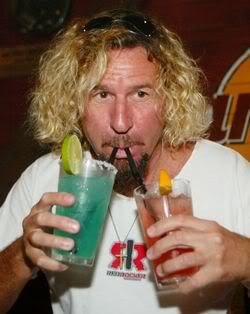 Sammy Hagar, cruisin' and definitely boozin'
Thelonious Monster - Sammy Hagar Weekend [purchase]
"Sammy Hagar Weekend" is autobiography, disguised as satire, and wrapped in parody. Bob Forrest wrote it partly about his experience at a September 1978 über-concert in Anaheim, California ("Summer Fest"), featuring Boston, Black Sabbath, Van Halen, and Sammy Hagar. However, the song also functions as a satire of the Heavy Metal Parking Lot culture. The parody comes at the end of the song, when the Monster transforms into a full-on heavy metal band, with pro gear, pro attitude, sweet licks, and slaytanic backward masking. Enjoy ... but kids, know when to say when.
Well, it's a Sammy Hagar weekend,
It's a Sammy Hagar state of mind,
It's a Sammy Hagar weekend,
It's a Sammy Hagar way of life.
We're gonna drink some beer,
Smoke some pot,
Snort some coke,
And then drive ... drive over 55, yeah.
'Cause it's a Sammy Hagar weekend,
It's a big man's day.
We got a Metallica T-shirt,
Got a little tiny baby mustache,
Got a jacked-up Camaro,
We're sittin' in the parking lot at Anaheim Stadium.
Drinkin' beer,
Smokin' pot,
Snortin' coke,
And then we drive ... drive over 55.
Cuz it's a Sammy Hagar weekend,
Well, it's a big man's day.
[metalriffic solo to finish]
[repeat chorus]
[descent into chaos > back-masking]
[Hagarification complete]
Drugs: Sharing the Stash Edition

Fraternity of Man: Don‘t Bogart Me
[purchase]
I went back and forth with myself over whether to include this song in this post. Susan settled the issue with her last post. Yes, this is Don’t Bogart That Joint, with its original title. The song is an artifact from the sixties, equating drug use with communal experience. Drugs, love, sex, peace, all were things to be shared. Bogarting was “uncool, man”.
Fraternity of Man would themselves be nothing more than the answer to a trivia question, were it not for the inclusion of Don’t Bogart Me in the soundtrack to Easy Rider. The band had no other notable success of their own, and lasted for only two albums. But in that time, former members of The Mothers of Invention, and future members of Captain Beefheart’s Magic Band and Little Feat passed through their ranks. Don’t Bogart Me appears on Fraternity of Man’s self-titled debut, while Lowell George did not become a part of the band until their second album, but George most likely performed the song live with them, prompting his cover of the song later as the leader of Little Feet.
Ramblin‘ Jack Elliott: Cocaine Blues
[purchase]
A quick listen to Cocaine Blues shows no sign of anything being shared. But I cannot think of this song without thinking of Jackson Browne’s cover from his album Running on Empty. In that version, it is clear from the multiple laughing voices at the end, and from the song’s placement on the album, that Browne and his bandmates are sharing some coke during some downtime in a hotel room during a tour. Browne calls the song Cocaine, but it is not the Eric Clapton hit. Rather, Cocaine Blues is a cover of a song by the Reverend Gary Davis. Why then have I chosen Ramblin’ Jack Elliott’s version over the original? I wanted to reflect the feel of the original as much as possible, but the only version I could find by Davis was an old recording with very poor sound quality. This was the cover that I felt best captured the spirit of the original.
Friday, April 24, 2009
Drugs: Willin'

Little Feat: Willin'
[purchase]
Linda Ronstadt: Willin'
[purchase]
Richard Shindell: Willin'
[purchase] (scroll down to Courier)
"And if you give me: weed, whites, and wine
and you show me a sign
I'll be willin', to be movin'..."
Written in 1970, "Willin' " was a mainstay of Little Feat, the band Lowell George had helped to found in 1970 and was a leading member of until his death on June 29, 1979. The song, John Tobler contends in the liner notes of As Time Goes By. The Very Best of Little Feat (1993), "quickly became a favorite among America’s truckdrivers, many of whom continue to regard it as the anthem of their profession . . . although absurdly it never has been a hit."
In George's lifetime, "Willin' " was recorded in three different versions (though more and more have surfaced). On the band’s debut album, Little Feat (1971), George made do with his own raspy voice and guitar, and the sparse accompaniment of Ry Cooder’s terse steel guitar. On Sailin’ Shoes (1972), the song was done by the whole band, the chorus harmonized by four voices, and the piano solo was added by Bill Payne — "eh bill o' pain," as pronounced by George six years later, on the spectacularly successful live double album, Waiting for Columbus (1978). There, "Willin’" became hymnic, and was followed without interruption by "Don’t Bogart That Joint," another classic tune George had a hand in (he was briefly a member of Fraternity of Man, too).
More here...
I just realized/remembered that Don't Bogart That Joint does *not* appear on my Waiting for Columbus CD... and, upon reading the liner notes, discovered this:
The tracks "Don't Bogart That Joint" and "Apolitical Blues" which appear on the double album and cassette have been omitted so as to facilitate a single specially-priced compact disc" - d*mmit!
Hmmm... I just thought of something - wondering if we can have a Truck Driving Songs theme one of these weeks?... :-)
Drugs: Kid Charlemagne

Steely Dan: Kid Charlemagne
[purchase]
Steely Dan, at the height of their powers, had a way of getting the listener to nod their head and tap their feet, without ever noticing the content of the lyrics. Case in point: Kid Charlemagne. Here is one of Steely Dan’s finest grooves, and here too are those jazz harmonies that Becker and Fagan would sneak past the average pop music fan. And here is a song about another “archetypal counterculture icon”, the chemist.
The chemist was the guy who built a home chemistry lab, and created synthetic hallucinogens, most famously LSD. Kid Charlemagne tells the story of the rise and fall of one such chemist. At the peak of his career, “every apron had your number on the wall”. But, all too soon, his fans and customers “joined the human race”, and his career was over. At that point, there was nothing left for him except running from the law.
Sadly, there are some parallels to what has become of Steely Dan. The band broke up after the release of the album Gaucho, and when they regrouped years later, they seemed to no longer have the pulse of the pop music fan. Popular musical styles had moved on in their absence, but I think something else happened as well. The classic Steely Dan albums were musical collaborations between Walter Becker and Donald Fagan, and were produced by Gary Katz. When they reconvened, Becker and Fagan were still there, but Gary Katz was gone. So now, Steely Dan certainly aren’t running from the law, but their name no longer emboldens nearly as many aprons as it once did.
Thursday, April 23, 2009
Drugs: Illegal Smile

John Prine: Illegal Smile
[purchase]
John Prine: Illegal Smile (live '97)
[purchase]
Serena Ryder: Illegal Smile
[purchase]
We've posted plenty of Prine here on Star Maker Machine since our inception, but mere popularity is no reason to ignore the potent works of this prolific singer-songwriter.
Illegal Smile grounds itself in the premise of drugs as escape, much like the previously-posted Prine tune Sam Stone; both originally appeared on his debut self-titled album in 1971. But where Sam Stone's Vietnam vet drowns his future and family in morphine, Illegal Smile is a wry, lighthearted poke at the blues, flavored with more half-baked chagrin than true demons.
It's easy to imagine a man turning to happydrugs for a mere cheerful pick-me-up after losing a staring contest with his oatmeal, and chasing a rainbow into a dead end. Easy to defend, too. Listen to the sing-along he recorded 26 years after releasing the original; you can still hear Prine grinning throughout. And Canadian songstress Serena Ryder's laughing in-studio cover never goes dark, either.
Never heard Prine's "other" drug song? For comparison's sake, check out Ted's take on Sam Stone, including an oddball soul take from Swamp Dogg, Prine's original, and a sweet cover from Laura Cantrell.
Wednesday, April 22, 2009
Drugs: Not An Addict
k's Choice: Not An Addict
[Purchase]
Months ago I posted another song (link no longer available, sorry) by the Belgian sister-brother fronted rock band k's Choice. "Not An Addict" is their single from that same album, and the song that got me into them when I heard it played on the local alternative rock station back in 1997.
The song is a passionate first person song about addiction denial. It takes on the "coolness" of drug culture by taking that first person approach so that you're hearing what it sounds like to hear someone talk about how other people may have addictions, but they don't because they only do it because it feels good and makes them more creative. It's a beautifully powerful rock ballad.

Tuesday, April 21, 2009
Drugs: Down to Seeds and Stems Again Blues

Commander Cody & His Lost Planet Airmen: Down to Seeds & Stems Again Blues (live)
[purchase]
Gotta love the blues: Memphis... Talkin' Seattle Grunge Rock... Statesboro... Me and the Devil... Subterranean Homesick... Folsom Prison... Summertime... Bell Bottom... Steamroller...
Commander Cody & His Lost Planet Airmen take the blues to a whole new low... or high, depending on one's perspective...
The finance company dropped by today and repossessed my home
That's just a drop in the bucket compared to losing you
And I'm down to seeds and stems again, too
Monday, April 20, 2009
Drugs: Henry

New Riders of the Purple Sage: Henry
[purchase]
Do they still use the term “counterculture”?
At some point, in academia, and soon after in the press, someone decided that it was undignified to write about “hippies”. So they came up with the term counterculture. You could read about things like “archetypal countercultural icons”. But, in plain language, surely the dope runner was one of these. This heroic soul dodged narcs and border agents to bring high quality weed from Mexico to the masses. He braved treacherous roads and uncertain weather in his noble quest. And he did all of this after liberally sampling his wares to assure quality.
New Riders of the Purple Sage came up with the best celebration of the noble dope runner I have ever heard. New Riders, or NRPS, as they were known in their heyday, came to modest fame by opening for the Grateful Dead. Perhaps their talent could have carried them farther if they had not been in the Dead’s shadow; certainly, they sang better. But Jerry Garcia in particular championed them, and so they became known as a sort of “Dead lite”. To my ears, they fit right in with the country rock of the mid-70s, and they might have been better off had they been marketed as such.
Henry comes from New Riders’ first album. The vinyl version of the album had a 30 second bit of weirdness on it called House of Wax. As far as I can tell, House of Wax never appeared on any CD version of the album. If anybody has an mp3 of this, please get in touch; I’d love to have it. Thanks.
Drugs: Dock Ellis

Drugs: Codine

Buffy Sainte-Marie: Codine
[purchase]
In 1963, Canadian Cree folksinger Buffy Sainte-Marie became addicted to codeine while recovering from throat surgery. The song she produced from that experience may put the shakes of withdrawal in the voice of a male protagonist, but the avid, apt description of the enslavement and relief the drug produces are a roadmap to her own recovery, and fair warning for a nation of sixties countercultural folkfans playing with chemical fire as they tested the limits of their minds and bodies.
I find much of Buffy Sainte-Marie's music overwrought, but this is a perfect match of subject and slow, raw soul-baring folk blues. No wonder Codine would go on to become one of Sainte-Marie's most covered songs, picked up by the likes of Donovan, Gram Parsons, and the Quicksilver Messenger Service. Here's an early, oddly poppy example from the psycho'lectric end of the spectrum:
The Charlatans: Codine
[purchase]
Sunday, April 19, 2009
Drugs : Junco Partner

James Booker : Junco Partner
[purchase]
Drug songs are older than the music industry. Leadbelly sang Take A Whiff On Me when he was recorded for the first time by John Lomax in Angola in 1933.
In Mexico, of course, they've got La Cucaracha. A great idea for a post by the way, and it goes back to 1818.
And In New Orleans, of course, they've got Junco Partner. It's the first song that came to my mind when I heard about this week's theme.
The first version, Junker Blues, by Champion Jack Dupree (1940) is probably the most explicit lyrically.
The song was brillantly covered by Dr John, Professor Longhair, The Clash, among others, but my favorite rendition is this live solo performance by James Booker from 1976. The lyrics are reduced to a few stanzas, but the essential is said.
I want a whiskey, when i'm thirsty
I want a little water when I'm dry
I want my lover when I'm lonely
And just a little heroin just before I die
And gimme a little cocaine baby on the side
And Booker knows what he's talking about when singing that line about time in Angola : that's exactly what he did for a year in 1967, for possession...
There's nothing sad, nothing plaintive, nothing gloomy in this drug song. It's not a suicidal trip à la Cobain. It's just about burning life while we can.
And Booker's piano playing is just fantastic. What an incredible left hand! There's a legend which says that Rubinstein met Booker when he was 18, heard him playing and said "I could never play THAT, not at that tempo!".
Drugs: America's Favorite Pastime

Todd Snider: America's Favorite Pastime
[purchase]
From Snopes.com
Claim: Pittsburgh Pirates pitcher Dock Ellis hurled a no-hitter while under the influence of LSD.
Status: True.
The rest of the story can be found here...
As noted above, the song appears and can be purchased now on The Homerun EP, featuring various artists performing "five songs to get you back in the baseball spirit"... and the tale is also immortalized on Todd's soon-to-be released (June 9) CD, The Excitement Plan, available for pre-order - in his words, this song "combines the use of hallucenogenic drugs with athleticism, which I wish people would do more in folk music"...
Saturday, April 18, 2009
Rediscovered: Mrs. Robinson

Simon & Garfunkel: Mrs. Robinson
[purchase]
We've all probably heard this song hundreds of times. I know I have. My parents were fans. I've seen the The Graduate. I've had vinyl copies of Bookends and the Greatest Hits laying around in my LP collection since before CDs were invented. If asked, I'd happily admit that Mrs. Robinson is a "great" song, but it usually just flowed in one ear and out the other.
Until I heard it anew.
One night I uploaded a Simon & Garfunkel record to help me fall asleep. The next afternoon, while I was out walking my dog around the neighborhood, Mrs. Robinson shuffled to the surface. I don't know why, but for some reason it was like hearing the song for the first time. And it sounded...great.
What struck me was how many fantastic lyrics Paul Simon had crammed into one song. There were take-away lines hiding in every nook. While I'd heard them all before, and knew them by heart, I hadn't really listened in years.
Without even getting into the iconic chorus, here are some of the lyrics taken from the verses that really stood out to me as being clever, evocative, or especially nice sounding:
- We'd like to know a little bit about you for our files. We'd like to help you learn to help yourself.
- Look around you. All you see are sympathetic eyes. (Classic line.)
- Stroll around the grounds until you feel at home. (Nice internal rhyme.)
- Hide it in a hiding place where no one ever goes. (Nobody talks in such a redundant way, but it sounds great in the song.)
- It's a little secret, just the Robinsons' affair. Most of all, you've got to hide it from the kids.
- Sitting on a sofa on a Sunday afternoon. (Nice alliteration.)
- Going to the candidates' debate. (Nice internal alliteration and rhyme.)
- Laugh about it, shout about it, when you've got to choose, every way you look at this, you lose.
Rediscovered: Something So Strong
Crowded House: Something So Strong
[Purchase]
There was a six month period in my youth where Crowded House's "Something So Strong" was my favorite song. It hit the top 10 rock charts in 1987, which means I was about 8 years old. I thought it was perfect. I loved singing along to it, I remember turning up the volume whenever the video was on Mtv, and I genuinely thought it was brilliant.
Skip ahead ten or twelve years to me in college. I was taking a sociology class and the professor was giving the students extra credit if they wrote a short paper talking about their favorite song and what made it a favorite. Another girl in the class chose a Finn Brothers song. At the time I had never heard of the band and when she read the paper to the class I was surprised to hear it was formed by Neil Finn, the lead singer of Crowded House, whom I hadn't thought of in years. Later that same week their hit song "Don't Dream It's Over" was playing at the grocery store as I was shopping and it was like the album was calling me back to it. All of the sudden "Something So Strong" was back in my consciousness and I had to hear it again.
In the last year, Crowded House has once again emerged in my life as I find friends mentioning them, finding them coming up in music searches, and having heard more of their work elsewhere. All of the sudden I am remembering all the reasons I loved the song and that the band as a whole was a pop band, but singer-songwriters at heart that made really outstanding, fun songs. It was nice that the band found their way back into my collection cosmically.

Thursday, April 16, 2009
Rediscovered: One Good Time

Butch Hancock: One Good Time
[purchase]
First of all, welcome to Nicolas, our newest Star Maker Machine contributor - widening the circle lends a fresh perspective and dynamic!
Also, his second post was just the memory jog I needed to transport me right back to the Kerrville Folk Festival in May of 1999 - I attended the long Memorial Day weekend of the 18-day Texas event, discovering so many new-to-me performers...
One of my absolute favorites was Butch Hancock (pre-reunited-Flatlanders), who had the highest per capita heart-hitters for my love-of-language listening ears - I was sitting next to my friend Bob, who remarked that he could always tell when I liked a song (or a line) because "you mmmmm'ed four times during it" (I do admit to having a visceral and involuntary reflex reaction to music... :-)
What's not to adore about this almost-six-minute tour-de-force of a hurts-so-good crash-and-burn?: "she fought a brutal battle with the bottle and it brought a little hardship to her life" and "in the ashes of passion there were splashes of fashion which her witch's broom had brushed" - mmmmmmmmm!
Rediscovered : Tonight I'm Gonna Go Downtown

The Flatlanders : Tonight I'm Gonna Go Downtown
[purchase]
Being French and a fan of country music or country-rock is not an easy thing. The blues, my other passion, is well documented and supported here. My father has a solid collection of jazz and blues records he bought in the '50s and '60s, but he didn't know anything about country music until I bought him a couple of compilations.
In public libraries, not to mention general record stores, there's no way you can find a George Jones, Merle Haggard or John Prine record, and even less cult bands like The Flatlanders. So the Internet was a blessing for me, and helps me catch up.
I first heard about the Flatlanders about one year ago, and More A Legend Than A Band patiently waited on my wish list until I finally heard it for the first time yesterday night and this morning. Well, at least the first two songs. And it was love at first sight (or first listen). "Dallas" and "Go Downtown" are so great I couldn't listen to the others for the moment.
It's funny because I'm preparing a series of posts on River's Invitation about Mexican American border music, and I can really hear a Spanish accent in their brand of country, in the melody, the vocals, the backing instruments and the romantic tone of it all.
How come these guys didn't get enough attention to release a full-length album in 1972 ? Sometimes you just don't meet the right people at the right moment I guess..
So, fellow bloggers, excuse me if this song is already a long-time companion and an obvious pick for some of you, but I guess late is better than never.
Suggestions about their other records (as a group or in solo) are warmly welcome. I heard they released something new recently.
Tuesday, April 14, 2009
Rediscovered: When the Gates Swing Open

The Mighty Clouds of Joy: When the Gates Swing Open
[purchase]
I‘m working on something for Oliver di Place later this week that reminded me of my onetime exploration of black gospel music. This music is unabashedly Christian, so this was, perhaps, a strange preoccupation for a nice Jewish boy, but I was raised in a non-religious household, and this is music of undeniable power.
In the early 1980s, I found myself living with my father briefly. It was the first time I had ever lived in a city. One of my chores was to walk two blocks every Sunday morning to the nearest bodega, and get the Sunday paper. One block took me to the local black Baptist church. On Sunday mornings, there was this amazing sound coming from the place, and the building fairly shook with it. The whole congregation sang together as one in praise of the Lord, and it was hard to avoid being swept up in it, even from the sidewalk outside.
But my interest goes back further. It was Paul Simon’s fault. When Loves Me Like a Rock came out, I checked the liner notes to see who provided those great background vocals. It was The Dixie Hummingbirds. I was never the sort to stop at checking out just one group. I wanted to know, “Is there any more like this?” So I explored the world of small group black gospel music. And eventually, I found The Mighty Clouds of Joy, among others.
In due time, something else caught me ear, and the next exploration began. And given that I never found anyone else who liked gospel music, it fell by the wayside. But, in thinking about it again, what I remembered was that The Mighty Clouds of Joy best embodied the power of this music, of all the groups I remember. I did not remember any specific songs by them, but I think this one amply shows what I mean.
Monday, April 13, 2009
Rediscovered: Rainy Night Detroit

Denice Franke: Rainy Night Detroit
[purchase] (on the You Don't Know Me CD)
I just presented Texas songwriter Denice Franke in our Labyrinth Cafe concert series this past Saturday night - she was of course amazing and, when she sang the above tune, it brought back vivid memories of the first time I heard it (and her) almost 10 years ago...
I was a preliminary judge for the 2000 South Florida Folk Festival songwriter competition... and it was the job of four of us to listen to two songs each from almost 200 artists and give them a ranking using certain criteria - as one can imagine, in these circumstances, there is more proverbial chaff than wheat...
I will always recall the night one of my fellow judges called me and said: "have you gotten to #72 yet? - this one reminds me why we're doing it". When I did finally get there, I knew immediately what he was talking about - the hair on my arms and neck prickled, a lump in my throat formed and I went straight for the box of tissues...
It was Denice's Rainy Night Detroit - a decade later, the song still wrenches my heart, opens my tear ducts and reminds me how lucky I am, even (or maybe especially) in the dark times...
Rediscovered : Me and Matthew

Martin Stephenson and the Daintees : Me and Matthew
[purchase]
Two years ago, just before moving to the apartment where I live now near Paris, I made a BIG mistake : I listened to my wife and threw away my entire cassette collection. But ever since I've been missing them every now and then. They were all recorded in the eighties and early nineties, especially in 1983-86, the time when I started building a musical world of my own.
I discovered Martin Stephenson when his first album came out in 1986. He played the acoustic guitar. He was romantic. He played every genre that you couldn't hear on the FM stations in France : folk, country, jazzy pop, country-punk. The lyrics were about his friends and family, his lesbian sister, one of his cousin's miscarriage, the sound of a rainstrom outside his window. He was from Northern England, a strange place named Sunderland. He always wore a hat which he said had belonged to James Cagney.
Martin did a handful of albums with Kitchenware records but sales fell short and the group disbanded in 1992 and I lost track of him. Until the other day when I found his second album by chance at the library in my hometown and rediscovered this song, that goes well with the coming of spring and this week's topic. It's about childhood memories, a kid with his grandfather in a greenhouse, there are birds and bees. Bucolic, as we say in France. To be honest, it's probably the only song in the album that I listen to now. The rest hasn't aged very well..
After the band's demise, Martin came back to the Highlands in Scotland and settled there, progressively cutting ties with the record industry, playing in pubs, tiny bars, and still recording solo, often auto- produced albums with a better, rootsy sound. The Daintees came back to life in 2000 and recorded a comback album in 2008, as you will see on Martin's site.
Sunday, April 12, 2009
Rediscovered: Mango Time

Tony Bird: Mango Time
[purchase]
A front row seat at the feet of Malawi-born, Zimbabwe-raised singer and songwriter Tony Bird was my very first introduction into the small coffeehouse scene that defines modern folk music performance -- an anomaly, as the music he plays is both decidedly South African, and ranges far wider and broader into rock and blues than the typical american strands of folk which form the contemporary type.
Tony Bird's poorly designed website suggests he's still making the same music he was back then -- indeed, he'll be appearing at Passim, the very same club where I first saw him, in June. And his short, fragmented Wikipedia entry suggests that I saw him during his comeback tour, after a two record emergence in the seventies, and a short tour with Ladysmith Black Mambazo in the eighties.
I wouldn't have known, except a few weeks ago I spent the week in my father's house, helping him recover from surgery. I found this CD in his collection, spun it for the first time in fifteen years, and was pleased to find how quickly the funky, fruity, percussive world beat took me back to that very first folk concert.


