It wasn't more than about 1 minute into my decision to post about Avicii that I realized I might be in over my head. Well, at least headed for "another chance to learn more than I knew yesterday".
His news-worthy demise back in April caught international media's attention: our somewhat morbid focus on famous deaths? Rolling Stone mag's obit headlines noted "Tim Bergling shaped EDM ..."
And I went: Oh no, what's EDM? Maybe you know the acronym EDM. I did not. It's Electronic Dance Music. Ummm... a lot is EDM, these days, isn't it? Much of what we listen to is electronically adjusted: electronic adjustments such as Auto Sense.
And way back in my Amiga 500 days, I used a piece of software called ProTracker to paste together bits of electronic music (mod files back then) to create music that included copied clips/extracts of other people's music.
So .. we've got the roots of today's Electronic Music going on back in the 80s. But what's the addition of the D? that makes it so so different? How - in 25 years years, could I fall so far behind trends? And what is it about Avicii that sets him apart?
Well, 25 years in IT/Tech is more than a generation: and, if you grew up like I did with the transition to multi-track recording, the possibilities of digital/computerized/ tech enabled sound mixing are hard to keep up with. I've downloaded and configured and tried to figure out various mixers and sound editors, but I haven't got the time to learn them all. It IS a profession all by itself.
And so, a 20 year old with time/energy and focus to put into learning this on his hands already has me beat (I was 20+ back in my ProTracker days)
A much more influential individual than the blank expression that meets the hearing of his name in most circles, O'Flynn was the first uillean pipe player to gain notice to a rock and roll audience, as a core member of the first Irish traditional act to really break through to the same. No, I don't refer to either the Chieftains or to Sweeney's Men, pacesetters though they were. I refer to the mighty and majestic Planxty. The Chieftains were important, for sure, breaking down barriers and bringing the music into respectability outside of otherwise hooleys and bar sessions, latterly also for their work with major names in the fields of folk, country and rock. And Sweeney's Men, who included O'Flynns's later Planxty bandmate, Andy Irvine, took the mainstream safety of the Clancy Brothers into a wilder and more bohemian sensitivity. Go compare the difference between the Chieftains handling of this tune, 'Give Me Your Hand' ('Tabhair Dom Do Lamh') by the blind 17th century Irish harpist Turlough O'Carolan, with the altogether more exuberant Planxty version below, the tune kicking in at 2.27, following the song ahead of it:
I bloody loved them. They were hitting their prime in the early 70s, just as I was hitting mid-teens and expanding my then musical palette from the pop charts to anything and everything I could get my ears on, usually directed by the inkies, the music influential press that governed all the hip from the non hip. Planxty were seriously hip. With a line-up of O'Flynn, Irvine, Donal Lunny and Christy Moore, they played traditional irish jigs and reels, airs and ballads, seamlessly integrating their own material into the same. With two fine singers and an instrumental prowess encompassing guitar, bouzouki, mandolin, bodhran, hurdy-gurdy, whistles and, most importantly, uillean pipes, that irish bellows driven bagpipe, capable of a plaintive wail, swirling and bending notes, like nothing on earth, one part banshee, one part lullaby. Yes, I had heard a little of this instrument before; the aforementioned Chieftains had introduced me to it, and Horslips, the Dublin folk-rockers had deployed it a little. But nothing like O'Flynn, who could make it sing, scream, howl and lilt, sometimes simultaneously. This is his description of the instrument. And I haven't even mentioned his whistle playing, both normal whistle and low, a few blasts thereof instantly evocative of joy or sorrow, dependent on mood.
It would be no hyperbole to say this band revolutionised how the world had previously seen irish music. From a twiddley diddley dee diversion, this was suddenly to be taken with the utmost seriousness, alongside and in the same breath as the Stones and Bowie. But with more fun. O'Flynn was possibly the quiet man of the group, more soberly attired and less hirsute than his compadres, but it was his solos that had the crowds in awe. A number of incarnations of this band took place over the years and the decades, as individual members peeled off and others joined in, Paul Brady and Matt Malloy to name two, the band formally breaking and re-forming twice, the last such being 20 odd years after their debut, in 2003-5. But whenever it was called Planxty, so always there was O'Flynn.
After the final demise, and in the earlier breaks, O'Flynn was never short of work, with a who's who of session work that ranged from the folk circles he began within to Kate Bush, Mark Knopfler, Emmylou Harris and more. With Planxty no more there was a short period as and in LAPD, he, Irvine, Lunny and Paddy Glackin, the title being to represent Liam, Andy, Paddy and Donal. Hell, on past form they could have called it Planxty and got away with it, but they didn't. However, health was beginning to cause concern, and O'Flynn left in 2013. A private man outside music, he died in March after what was called a long illness. Here's a video of the song featured a little above, 'As I Roved Out', in a live and later setting, Planxty at Vicar Street, Dublin, in 2004, the pipes part transposed to whistle.
His legacy lives on through the wave of younger players who have followed him and been inspired by him, with both pipes and whistle commonplace in the repertoire way beyond any silo of trad. arr.
The elephant in the room here is Aretha Franklin, a musical titan who died last year, and who I suspect will not be discussed during this theme on the theory that her passing has gotten its due elsewhere. Franklin, of course, started out in gospel music, before expanding her audience to many styles of secular music. When Franklin, who grew up in Detroit, was a young woman on the gospel circuit, she would often stay in the Chicago home of Pops Staples, where she became friendly with his children, including Mavis and Yvonne who were a few years older. Yvonne Staples passed away in April, at the age of 80.
Like Franklin, the Staple Singers started in gospel before branching out. Yvonne, the third Staples child, was a wonderful singer, but did not seek the limelight, deferring to Mavis’ extraordinary gift. Although Yvonne was always willing to be part of the family act, she often dropped out of performing, focusing on the group’s business matters, or her other interests. However, if Pops called, she returned. As she once said, “When Daddy asked us to do something, we did it. No questions asked.”
Yvonne and younger sister Mavis were very close, and when Pops died in 2000, Mavis became depressed and stopped performing. As Mavis recalled, her big sister let her have it: “Yvonne said, ‘Mavis, your daddy would want you to keep singing. You’ve got to get up. You’re daddy’s legacy.’ … And that’s when she started with the other words: ‘Damn it, Mavis,’ and worse. It woke me up.” Yvonne toured with her sister for years, contributing harmonies and often sitting regally in a chair while Mavis played to the crowd. And apparently, Yvonne was the one who cracked the whip to make sure that the band performed at their best.
According to Mavis, as Franklin’s and the Staples’ careers took off, they grew apart. But when Pops died, Franklin invited Yvonne and Mavis to visit her in the Hamptons, and Yvonne’s death led to Mavis and Aretha reconnecting for some phone calls before Franklin’s death.
In 1987, Franklin released a gospel album, One Lord, One Faith, One Baptism, on which she and Staples performed a version of the hymn “Oh Happy Day,” which became a hit in 1969 in a version by the Edwin Hawkins Singers. Arranged by Hawkins, from an 18th Century hymn originally by Phillip Doddridge, the song was a surprise worldwide hit, and featured the powerhouse vocals of Dorothy Combs Morrison, who also toured with, among others, Van Morrison and Boz Scaggs.
Hawkins, who died just over a year ago at 74, was backing his family’s gospel group on keyboards by the age of 7. He was co-founder of the Northern California State Youth Choir of the Church of God in Christ, which recorded “Oh Happy Day” as a fundraiser, but in early 1969, it came to the attention of Abe “Voco” Keshishian, an influential DJ at underground station KSAN in the Bay Area, who started to play the song. You can see the original album packaging here. Then, Dan Sorkin, a morning DJ at influential AM station, KSFO began pushing the song. It generated enough buzz that a bidding war to release the song broke out, with Buddah Records getting the rights.
Released under the shorter, less gospel sounding name of the Edwin Hawkins Singers, the song became a crossover hit, and won a Grammy for Best Soul Gospel Performance. Apparently, the song's departures from tradition was divisive in the gospel community, but eventually became influential both by opening the door for other gospel musicians to include more pop sounds in their music and by making gospel-based music more palatable to secular music fans. Thus paving the way for both Franklin and the Staples to become successful mainstream artists.
In 1970, the Singers, along with Melanie, had another hit, "Lay Down (Candles in the Rain),” but basically that was in for the pop charts, although Hawkins won a total of four Grammys in gospel categories, the most recent in 1993.
Another "cheat" post for this theme, in honor of the great Marty Balin, one of the founders of Jefferson Airplane, whose blue-eyed soul voice featured in many of the Airplane's greatest songs, as well as probably Jefferson Starship's best. And he got knocked out on stage by Hell's Angels at Altamont. Back in 2016, over at Cover Me, I wrote a long birthday piece about Balin, featuring covers of some of his Airplane, Starship, and solo songs. You can read that here. I was a big Airplane/Starship fan back in high school, as you probably can guess from that Cover Me piece, and thesetwo, not to mention a few things on thissite.
Balin died in September, at the age of 76. Here's his obit from Rolling Stone. Grace Slick, with all of her substance abuse and health issues, lives on--she'll be 80 in October, by the way.
I remember the first time I heard the Cranberries. The musical soundscape was pretty drab and uniform in the early 90s, you could have either grunge or britpop. So this string driven ballad made you falter, first with the sweeping orchestration, secondly with the angular and elfin nature of the vocal, unmistakably of the west of Ireland, like nothing quite else at that moment. Perhaps Sinead O'Connor would be the only, if a lazy, reference, but Dolores was more carefully broken glass than Sinead's crystal. I think I bought the album, 'Everyone Else Is Doing It, So Why Can't We', the same day. I had planned to write how, sadly, the rest of the record carried less punch, but, actually, on listening again this morning, I find I can't. Always a sometimes uncomfortable mix between the Linger-alike ballads and the more jangly group efforts, strangely it is the latter that stand up better. I seem to recall the band were derided as being somewhat pedestrian plodders, stripped of the strings and the never less than remarkable vocal calisthenics. Reflection reveals such opinion to be overly harsh, the backing being actually just right, never flashy, always solid, if a little too enthusiastic on the chorus pedal. (Hell, what do I mean "too enthusiastic"; there's no such thing! I love chorus pedal and, let's face it, it was compulsory in the Irish Republic at the time.) Of course, the public don't listen to the critics, and the band went huge. O'Riordan was 21.
Second album, 'No Need To Argue', was an altogether more muscular effort, again launched by the extraordinariness of the lead single, 'Zombie'. With more than a hint of the prevailing grunginess of the era being absorbed into their singular trademark, I still adore this song. The killjoys who lampoon the lyrics can do so all they like, I happen to think the tanks and the bombs and the bombs and the guns has a naive charm. They're a pop group, she's a pop singer, for chrissakes, anyone one would think she was Bono or something. (Oh.)
I've a confession to make. I have never heard any of the other Cranberries records. And there were five of them. Somehow they fell out of my field of vision. But I was aware of O'Riordan's, um, difficulties, they filtering through into the papers I was reading. Like Sinead, to whom she is so often compared against, she seems to have survived a childhood of abuse, adulthood leavening fame and fortune with an unfair share of post traumatic legacies. This is not the place for this, they are well documented. But I didn't lose all sight of her. Perhaps, as my tastes in music broadened, so the later 90s saw me becoming more immersed in what has become known as World Music, particularly in the hands of and creative mixing pot of artists like Jah Wobble. And, in another nod to Sinead O'Connor, like her so too did Dolores join up with his Invaders of the Heart to add her unmistakable muddy brogue to his rhythmical potpourri.
The tragedy is not only that she died so young, at 46, with 3 youngish children, but that things seemed slowly moving back into her favour. The Cranberries were working again together and laying down new material, after the last of many breaks and hiatuses. The remaining members of the band have said they will complete the album, release it in her memory and break up, for the final time. Here's the story, from Ireland's wonderful 'Hot Press', the 'Rolling Stone' of Dublin.
It seemed to me that there were a lot more choices for the 2017 <In Memoriam> theme than for 2018. The Ranker website seems to prove me wrong: 37 to 35. Wonder why I got that impression.
Looking at the Ranker list, I first thought: Charles Aznavour?
As an expat, I am probably more aware of M. -(that's Monsieur) Aznavour- than your average American, but .. I couldn't claim no affinity, no ties beyond having heard a lot of him as I grew up.
Then, it occurred to me that - considering that I (a) posted once about him [indirectly] this year, and that (b) I performed the same back in November, Ed King might be my best "go to" for this theme.
If you go back a ways in time, you'll find Ed King playing with Strawberry Alarm Clock back in the '60s.
And then he played with Lynyrd until he couldn't hack it no more in the mid '70s [and there is a decent film about the experience called If I Leave Here Tomorrow, preview below], fortuitously leaving before the horrible crash that took the lives of many of the band members.
Howsomever, I confess that I couldn't have named Ed King, or for that matter, any of the Lynyrd Skynyrd band. Knew of them? Sure. Ronnie Van Zant. More than that? Not much. But, once again, for my part ... the value of SMM - another chance to learn a little more than I knew yesterday.
I've a sneaky feeling this possibly unfamiliar name may mean more to the cinephiles out there than to the musos. I'd like to hope I'm wrong, but if you have been to the cinema over the past few years I am sure you will have heard some of his work, probably the most well-known being his soundtracks for sc-fi film 'Arrival' or the Stephen Hawking biopic 'The Theory of Everything'. But he was much more than a composer for films, even if that is where the bigger money lies, as other neo-classical composers like Max Richter and Olafur Arnalds have discovered.
What even is Neo-classical? Or indeed Contemporary Classical? Or even Classictronica as I prefer to call it, the indie mindset progeny of New Age and Ambient, fusing (often) elements of orchestral music with electronica? Here's a good, if a little already outdated article from UK newspaper, the Guardian.
Johannson had a what turns out to be a relatively typical start to his musical career. For Iceland, at least. Iceland, a tiny country of around a third of a million population, has been pushing way above it's weight for the past few decades, in a steady production of premier musicians across a vast gamut of genres. Go look! It seems every other person on the island is in a band. Well, Johannson, like fellow Icelander Arnalds, started off in rock bands, initially the brash postpunk of Daisy Hill Puppy Farm, via proto-(death?)metal with Ham, to the synth pop confectionary of Lhooq. And these are only the better known ones, his finger also in a number of other pies, such as Kitchen Motors, his think tank to bring together collaborations between all schools of musical theory, extending further developments already in his practice. Recognition outside his home was beginning to take place, and in 2001 he was the producer of the Marc Almond (of Soft Cell) album, 'Stranger Things', co-writing much of the material and playing most of the instruments.
Losing Hand/Lhooq
But it is his solo work for which his legacy will be best remembered. Often citing inspiration and building themes based upon arcane and/or doomed enterprises, two of his early works were 'IBM 1401: A Users Manual' (2006), using the actual instruction pamphlet for this early computer system as his source material and the electromagnetic emissions as sound sources, and 'Fordlandia' (2008), a suite developed around Henry Ford and his failed Brazilian rubber manufacturing enterprise. In each of these, and his other work, ambient noise mixes with the orchestral, found sound and spoken word with electronic. Stand alone pieces, unfolding over a perceived sonic narrative, clearly it was only a short step to soundtracking other art forms, stage, television and ultimately film.
Fordlandia: Melodia (Guidelines for a Space Propulsion Device
Working often with film director Denis Villeneuve, he was prolific up until the time of his death, picking up a number of nominations and awards. Runner-up for an Academy Award in 2015 with 'The Theory of Everything', for which he had to make do with a Golden Globe, he was again a runner-up in the following year, with 'Arrival'. Keenly anticipated, certainly by myself, had been his planned score for Bladerunner sequel, 'Bladerunner 2049', but Villeneuve eventually went with the more bombastic gloss of Hans Zimmer.
Sadly, Johannson was found dead, at 48, in a Berlin hotel room, in February of last year, apparently the accidental effect of mixing recreational cocaine with prescribed medication. In death too this emerging talent was seeming to echo his rockstar credential.
Before I send you down the big river, here's a clip from one of my favourites, 'Orphée', an almost orthodox classical composition from 2016. This is the opening sequence. The video apart, there is no film it accompanies. Close your eyes: make the images in your own mind.
My earliest music purchases, I think, were from the Bradlees store in New City, but I soon discovered the record department at Korvette's, with a pretty good selection of new music at reasonable prices, and a big bin of cheap cutout records, which basically satisfied my music buying needs until college. During my time at WPRB, I was often able to get free copies of records that I wanted, or bought things at the embryonic Princeton Record Exchange (or its traveling precursor), and I often frequented used record stores in the Village. And when I wanted new music, I usually went to J&R, down by the courthouses. There was only a brief period in my life that Tower Records, in the Village, near Lincoln Center, and even in Nanuet near where I grew up, was a destination. And by the time that the company closed, in 2006, it was a non-factor in my music buying life.
But you could argue that Tower Records created the music retail industry model that started in the 60s, and continued strongly for a long time, and it was created from the quirky mind of Russ Solomon, who died on March 4, 2018, at the age of 92. Solomon reportedly died from cardiac arrest, while watching the Academy Awards, after insulting someone’s clothing, and asking his wife to refill his whiskey glass. Here's Solomon’s obituary from his hometown Sacramento Bee.
Although Tower’s New York outposts, particularly the Village store, were important in their day, I always thought of the company as more of a West Coast phenomenon. And it was in Sacramento that Solomon started selling used jukebox records in his father’s pharmacy at the age of 16. After service in WWII and an early failure, he opened standalone stores in Sacramento, and then, critically, in San Francisco in 1968, just at the right moment.
Solomon’s genius, for the time, was to hire workers who knew and loved the music, to give them autonomy, and to stock “everything” in huge stores devoted primarily to records. He treated his employees well, provided tons of perks, fostered a party atmosphere, and expanded his concept across the world, while competitors knocked it off to create their own stores and chains.
One famous example of Solomon’s eccentricity was the collection of neckties in the company’s headquarters in Sacramento, confiscated from anyone with the temerity to wear one in his presence, tagged with the (former) owner’s business card.
However, Solomon, and his son Michael, who became CEO in 1998 when his father had open-heart surgery, failed to go public and instead relied on debt to finance expansion, and like so many others, didn’t foresee the effect of music downloading or online retailing, leading to the company’s bankruptcy in 2004, and again in 2006, at which point the company was liquidated.
Six months later, Solomon opened a new record store in Sacramento, but sold it after 3 unsuccessful years.
Much of this, and much, much more, can be seen in the excellent, loving, documentary, All Things Must Pass: The Rise and Fall of Tower Records, directed by the actor Colin Hanks, which was released in 2015.
I needed a song, because this is a music blog and all, so Steve Hackett’s “A Tower Struck Down” seemed appropriate, although that tower is from tarot cards, not music retailing. And I wonder if Russ Solomon would appreciate the irony of discussing Tower Records and offering a free mp3 download, and links to purchase a DVD and music from Amazon.
I'm going to cheat a little here, but about a year and a half ago, I wrote a piece about the opening of Jazz Forum, a jazz club in Tarrytown, and the opening night performer, Roy Hargrove, who died in November, at only 49, from cardiac arrest brought on by kidney disease. Hargrove had been on dialysis for 13 years. The picture above is from Hargrove's opening weekend gig at Jazz Forum.
Check out that post here, for some background on the great trumpet player, and here are obituaries fromThe New York Times, NPR, and Downbeat for even more information.
I will actually write a full post or two for this theme soon, although there may be a few of you who are pleased with the pithiness of this one.
Can you identify a musician's "signature style" just by hearing them play on a particular track? For a vocal artist, it's pretty straight forward - their "instrument" is highly unique. But whaddabout a guitar player or a keyboard player? To the knowledgeable, a Fender sounds different from a Gibson. A country picker sounds different from a rocker and so on ... But what is it about their style, their sound that sets them apart?
In the case of Nicky Hopkins - need I say, one of the most sought after session keyboard artists throughout the 70s and 80s - it appears that it was personality more than keyboard fingering that set him apart. Great work, but could you identify him on a track just by hearing it?
I've been to the Keyboard mag site and an article titled "5 Ways to Play Like Nicky Hopkins" in search of an answer. Among other notes, they report one of his signature techniques involved: " a sus2 embellishing the third scale degree". If that tells you more than your ears tell you ... Wow! Their review of his style only gets more technical as it continues (beyond my ability to follow).
His Rolling Stone obituary said he played "fast, accurate pounding piano lines to flesh out the sound of everything ...", as well as "skill, reliability and cheerful personality ensured he was the sort of session player untutored rockers could relate to". I want to believe that it is this that put him in such demand. When you play with others, how you fit in at the moment is as important as your speed or your technique.
My bad: I hadn't realized that Nicky Hopkins had passed - and it's been 25 years. I knew his name/fame primarily because of his session work with the Stones and the Kinks, but never delved particularly deeper than acknowledging his chops here and there. So ... let's post this under <Nick> but let it lead us into <In Memoriam>, even if he didn't pass this past year. (SMM might have missed him back when he did ... wait: SMM wasn't yet online back then!)
His Wikipedia page reveals so much more: all over the place, he was. The full list is overwhelming:
A taste below:
Art Garfunkel (above)
Jeff Beck (above)
The Rolling Stones - Sympathy (above)
The Grateful Dead/Quicksilver (Edward the Mad Shirt Grinder)
We interrupt the Un-Sainted Nick theme for our fourth annual listing of the most viewed posts of the prior year.
Through our (usually) two-week long themes, our international
roster of writers address many different kinds of music, and bring
different perspectives to their pieces. In our top 10, we have discussions about musicians who left us in the past year, pioneer independent artists, classic Brazilian music, the Vietnam War, fake Beatles, astronauts, the Mets, and the marriage of punk and reggae. Our posts throughout the year included folk,
rock, prog, power pop, country, comedy and other genres.
So, in
case you missed them, here are the most viewed posts from the last
calendar year. But they are only a small sampling of what you will find
in our archives, which we invite you to explore. Also, we invite you to like us on Facebook, so that you won't miss anything.
Fittingly, our number one post of the year honored the death of one of the fathers of rock and roll.
Because so many of the most viewed posts are from early in the year,
which makes sense, since they were available to view on the site for
the longest, below are the top posts for each of our themes not
represented in the total top 10:
Thanks so much for reading our work this year. If you are interested in joining our staff, contact information can be found at the top right of the blog.
And we promise more great music and writing in 2019!!
To nick is to steal in my land. That is, amongst myriad other meanings, including, bizarrely, to arrest someone and put them in THE nick, a prison cell. So St Nick could have been nicked whilst nicking and put in the nick. (You can also nick your finger on something sharp, but I couldn't find a suitable song by this lot, unless you think it's time to make some form of resolution.) This theme initially taxed me a little, I have to say, with only the odd (bad) seed germinating, however high or low(e) I hunted. (I know, it's the way I tell 'em.)
Soooo, the Triffids then. Newcomers to this page and possibly to many ears. Well, apart from the venomous and militant marching plants, they are (were) a great aussie band of the seventies into eighties, usually filed under post-punk and forming part of the then renaissance of cracking guitar bands from the southern hemisphere, all jangle plus plus plus, relentless drums, melodic bass with added organ, fiddle or steel when needed. Did I mention the jangle? Comparisons can be invidious but think other aussie shouldabeens like the Church and the Go-Betweens would be closest. The brainchild of mainstay and multi-instrumentalist David McComb, they came together in Perth during 1978. Prolific as a songwriter, he and the nascent band produced 6 cassettes of material and built up a small local following ahead of a first record deal and a single in 1981. A fairly fluid line-up in those early years saw a parade of members and a variety of instruments come and go, always based about McComb, although his elder brother, Robert, became nearly as constant upon being drawn in.
Did they ever amount to much? Maybe not, other than in the ears of music journos and authors, maybe most in those of feted UK writer David Cavanagh, stalwart of Sounds and Select, latterly the trio of Q, Mojo and Uncut (and who tragically died last week at the age of 54.) Here's his say.
Arriving in London in the early 80s, there they almost remained, stranded possibly, echoing yet another antipodean band in their peer group. The UK and northern europe, scandinavia, proved a more viable market for their brand of guitar based angst. Perhaps the best introduction would be 1986's 'Born Sandy Devotional', from which the featured song comes. Reaching a mid 20s chart position in Britain, for both the album and the featured single, it barely scraped the australian top 70. However, the with the help of the great god hindsight, nearly 25 years later had it ranked number 5 in the 2010 book, The 100 Best Australian Albums, itself a list well worth perusing. (Now revised and updated, last year, as 110 Best Australian Albums.) This recording gave them the credentials to get back into the studio, becoming, as the gated drum and synth sounds of the 80s receded, gradually more folk and country drawn. The lo-fi home recorded 'In The Pines' was followed by two further records, the band now on the inspirational Island label, 'Calenture' and 'The Black Swan'. Calenture is that sickly feeling homesick sailors get on long voyages, a maritime version of cabin fever, and gives body to the mood of the songs. The final and following album was more a mish-mash of styles and ideas, never intended, no pun intended, to be their swan song. But exhaustion and, yes, calenture together combined to enforce a hiatus that just stuck.
1990 had McComb back in London, dogged by crushed vertebrae and, arguably, concomitant escalating substance abuse, the latter contributing to heart failure and a 1996 heart transplant. Despite a prodigious programme of writing, a solo career never quite kicked off and he died, aged 36, in 1999, precipitated by a car accident shortly before. It is ironic that he only found real fame in his homeland thereafter. For more, there's even a book, a compilation of essays and tributes: Vagabond Holes-David McComb and the Triffids.
I’m sort of doctrinaire about the creeping expansion of holidays. I’ve accepted President’s Day in lieu of Lincoln and Washington’s Birthdays but reject the concept of “Presidents’ Month,” which seems to be the creation of car companies. Seeing Halloween candy in the stores in August is wrong. Christmas decorating and the like should start after Thanksgiving, and your decorations should be stored away not too long after New Year’s Day. And although I am happy to listen to holiday music in December, after the gifts are opened, it is basically time to move back to secular tunes.
But Un-Sainted Nicks is our holiday theme, so I’m going to ask you to disregard my guidelines, and listen to one more Christmas song, the amusing, original “Christmas At The Airport” by Nick Lowe.
If any musical Nick should be considered for sainthood, I’d suggest that Mr. Lowe could be the one. He’s already performed a number of miracles—writing “(What’s So Funny ‘Bout) Peace, Love and Understanding,” which has been magically transformed into an Elvis Costello song, producing, among other things, said Costello’s first five albums and Graham Parker’s first three, being part of Rockpile, whose best work was released without their name on the albums, and still became legendary, and having a late-career transmogrification into a pop crooner. And if that isn’t enough, his first, incredible, solo album was named Jesus of Cool. At least in England, originally.
“Christmas At The Airport” was inspired by Lowe’s experience, waiting in an airport in Geneva, nursing a hangover from a long night drinking with Mavis Staples’ staff and band—not the American treasure herself, as Lowe is quick to declare. He thought that a jaunty pop song about someone snowed into the airport at the holidays would be interesting. You can hear him discuss this story here.
The video for the song, above, is also a gift. It tells the story of an elf’s thwarted attempts to get to the North Pole in time for Christmas, and includes most of the typical indignities that air travelers must endure, including the forced removal of shoes, having your bags rifled through, and sitting on the floor to charge your phone, along with a few particular to magical creatures. But it ends with the promise of an airport romance. And a snowman being decapitated.
Although the animation styles (and studios) are different, the video reminded me of Bojack Horseman, which as you may know, Ilove. Not only does the video include humans with elves, snowmen, and what may or not be human/animal hybrids, the airport stores have amusing names that would not be out of place in Bojack’s Hollywoo, such as Snakes For Your Plane Petshop, or Downward Spinal Massage.
Well ... here's a new word for you that you probably won't ever need, but if you were to remember to pull it out at the right time, it might impress someone. hypocorism: a nickname that shows affection that can include both major alterations to the original (calling your sweetie "possum") or abbreviating Nicholas to "Nick". Ever wonder if they called Khrushchev "Niki"?
A search of the Intertubes will provide the dedicated researcher with lists of musicians with the first name Nick, and a deeper search can call up others that have some form of Nick somewhere in their full names, and that's all well and good. And then there are songs or albums that incorporate those four letters in that order somewhere within, as in <Nick of Time>.
If you have followed my posts over the years, you already know my lasting affinity for Ms Bonnie Raitt. About Raitt, I've posted, Seuras has posted, Darius has posted ...
Nick of Time was her 10th album and it includes a number of collaborators you'd be likely to recognize in their various roles. Among the better known: Herbie Hancock Michael Landau Don Was (who also produced) David Crosby Graham Nash It's a pretty long list of credits, and you might well know more of them than those I chose to list from my own limited experience.
The album got a ton of awards: Grammy's Album of the Year, inclusion in Rolling Stone's 500 greatest, but for some reason, never in my list of favorite Raitt works (I think that'd be <Give It Up>).
Although John Hiatt doesn't play on the album, one of his songs is included, and I choose that, in part because I included a Hiatt song back in out Spring <Steps & Stairs> theme
So ... this, partly for the purpose of comparisons of sorts: Hiatt in different hands sounds like this ...?
Christmas is so often a time of extras when it might be better looking for less. I'm looking at your plates and your glasses. (OK, you can insert a smiley face emoji there, I may be Marley but I ain't Scrooge.)The problem with extras is that they lead so often to left-overs. Esteemed colleague KKhafa records that so well with his post immediately below, as I find myself wondering how often those paper panties and giant size cards were used. (And don't get me started on hidden tracks.) But it automatically, as I mused, had me humming this early 80s hit, nearly the sole output of one Carmel McCourt. So why have we heard so little subsequently? Why has More, More, More begat less, less, less?
I absolutely loved this when it came out. I think I saw her play it on one of the late night friday night TV shows I used to like, aimed at the young and feckless on the return from pubs that then still closed at 11pm. Of course, I was already the wrong demographic, too old, too married and my first child barely a year old. I may have even been watching it on near silent, desperately rocking her into some semblance of sleep. But I remember being hooked, the retro organ and the resolutely unhip cheerfulness of the rhythm section. Lets's not forget the music of that day was often quite austere and clinical, an indubitably serious business, so to see this was fun, fun, fun. I was just beginning to wean myself into jazz, songs like this acting as a catalyst. But then what?
I have looked through my i-pod and discover I bought an album, 1990's 'Collected', clearly a greatest hits package for those without hits. (I have a number of such albums.) It's going to get a play, today even, but the track listing doesn't worm into my ear like the featured song, which is, I guess, why I bought it.
That's enough of that, says Monsieur Malheureuse of Marseille, for what I need to know is that just because my little tinpot country may not have kept Ms McCourt in riches and royalties all these years, that doesn't mean she isn't huuuuuuge in France. Cos she is. My near neighbours love a bit of bebop on the boulevards and have christened her the new Edith Piaf even, praise indeed, a compliment returned by her later producing an album of Piaf standards and deep cuts. In fact, since 1984 she has put out 10 records, including one this very summer.
New Years Resolution? Look out for more (more, more) Carmel.
I veer from the standard "post a song with extra" because I just couldn't get into my original idea. It's not that Lou Reed's Claim to Fame has no claim to fame, but ... it *is* just one more of a few hundred songs that happen to have the word "extra" in the lyrics. I wanted something a little more entertaining at this time of year.
There must have been like a million albums produced since the invention of the phonograph, and it must be a perennial quandary for the artist and the producer to come up with something that makes yours stand out. Sometimes good music in and of itself isn't enough. I think of my copy of Dave Mason's Alone Together, which was pressed onto somewhat psychedelic multi colored swirling vinyl - kind of unique. I've seen albums with funky shapes.
One album with something "extra" that sticks in my mind is Sticky Fingers, with its actual zipper "sewn" into the album cover. You can't help but pull it down to see what's ...
And aside from this kind of attraction, lots of albums have included band-related posters.
But going to a more extreme additional form of entertainment for the fans ... (and these - for the most part - are generally verified hearsay. Sue me if I'm wrong)
Cheech and Chong's Big Bambu included a huge rolling paper. No surprise there.
Sgt. Pepper's included a a cardboard page of cutouts - epaulettes, moustache, badges ....
ELO's Out of the Blue included a cardboard cutout of their iconic spaceship.
Three Dog Nights' Seven Separate Fools album came with seven oversize playing cards.
Alice Cooper's Schools Out came with paper panties as a wrapper.
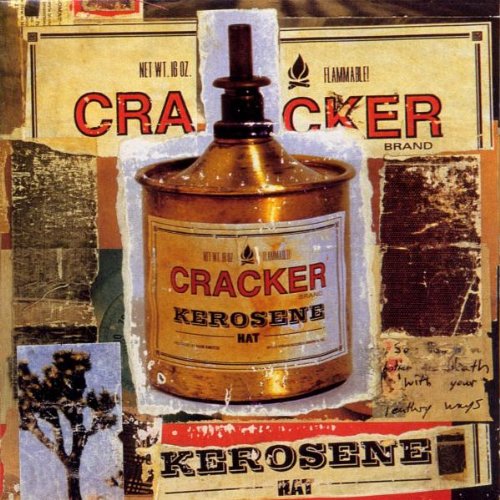
If you purchased Cracker’s 1993 CD Kerosene Hat and looked at the track listing on the back, you would see 12 songs listed (including track 12, a cover of the Grateful Dead’s “Loser”), followed by a statement that 13 & 14 were “No Songs,” and number 15 was a :40 track called “Hi-Desert Biker Meth Lab." But if you put the disc into your CD player (I’m sure this sounds to some readers like, “if you put the wax cylinder onto your phonograph…), it registered 99 tracks. Hmmmm.
Now, the first 12 songs on Kerosene Hat are, for the most part, excellent—it really is a fine album, by a band that put out a bunch of good ones. So, even after “Loser” was over, you probably felt pretty good about your purchase. But you needed to hear "Hi-Desert Biker Meth Lab," so you let it run. And frankly, that “song” is just a bunch of random sound. So what about tracks 16-99? Let it run, right?
17, 18, 19, 20, 21, 22, 23, 24…nothing…nothing....nothing…60, 61, 62, 63, 64, 65, 66, 67, 68……hey, it’s an extra song (at 69, designed to get a laugh from all teenage boys, and teenage boys at heart, or, as we call them, most men)! And it turns out to be a good one, “Eurotrash Girl.” An 8 minutes plus wistful travelogue of misfortune experienced by the singer as he searched the world over (actually, it seems, just Europe), for a “Eurotrash Girl.” I understand that the song was a popular part of Cracker’s live show, and it in many ways typifies their music—a somewhat skewed Americana sound with clever/funny lyrics and a catchy chorus. I’d note that at the time I first heard the song, back in 1993, my daughter was not quite born yet, and now she lives in Barcelona. She has no car, so hasn’t suffered the same fate as the singer, who had his car broken into, but she has had her wallet and phone stolen a few times.
Now, I’m sure that you are asking yourself, OK, Mr. J. David, that’s track 69 (yuk, yuk), but there are 99 on the CD. What gives?
More extra music. Track 88 is “I Ride My Bike,” a perfectly fine song, and the last song is a demo/outtake of the title track.
Cracker guitarist Johnny Hickman explained how and why they put this extra music on the disc, and in such an unusual way:
The story behind that was at that time we had a lot of songs. We’d been playing “Eurotrash Girl” live for awhile and fans were really reacting to it. There were even a few radio stations playing live bootlegs of it. The word got out amongst the fans, “Hey, check out “Eurotrash Girl.” They were talking about it and it developed its own bit of momentum. We told our record company, Virgin Records at the time, we gotta put this one on here too. They said, “But your record is already too long. People only have so much of an attention span. Save it for the next one. Blah blah blah.” We just snuck it on there anyway. We went to the mastering lab and just put that song and “I Ride My Bike” on there.
[Virgin] had no idea. We just went in and put it on anyway. We just snuck in the tape and said, “Just put it deep in there.” It was [producer] Don [Smith]’s idea to make it track 69 with his perverted sense of humor, which was fine with us. It was frustrating to some people with the song because they had things on shuffle. We basically just gave them another song. You only get paid for so many songs. We just said, “Well, the fans obviously like this one. We’re just going to put it on there.” So we did.
Apparently, it also helped them catch bootleggers, who manufactured discs without the extra songs.
In the spirit of extra, here’s some more information—the album title, Kerosene Hat, refers to a hat that singer David Lowery wore when he bought kerosene for the heater in the crappy house in Richmond, VA where they were living while recording demos.
And here’s a bonus track—Son Volt’s “Medicine Hat,” because I always think of that song when I think of Kerosene Hat, and because it is also a good song from the 1990s.
I
believe it was Darius who once noted that even a short post was better
than none. I'm going to add "better late than never" to his remark.
We've moved on to our next theme, but since it hasn't yet been touched,
it looks like I might get away with this cheat.
<Spill the Wine> is a classic - first published by Eric Burdon and the Animals - no wait ... Eric Burdon and War.
The
conceit of <spilling wine> is neither new nor unique to this song
nor The Animals (has something to do with the properties of wine itself
perhaps?)
But this song is a narrative that might best be
relegated to the frame of mind of some of us who came of age in the
early 70s, even if it is a classic example of that compus mentus, with
lyrics like:
just a dream/all in my head.. mountain kings and long-haired leaping gnomes
Last week’s Leftovers post was inspired by the I’m With Her concert my wife and I recently saw. Nine days later, we went to Symphony Space in NYC to see the final night of a Rhiannon Giddens residency week, a show billed as “Sisters Present.” All we knew was that the concert would include Giddens, Toshi Reagon, Amythyst Kiah, a young banjo and guitar player and singer, Birds of Chicago's Allison Russell, and Giddens’ sister, Lalenja Harrington, a singer, poet and, in her day job, Director of Academic Programming Development & Evaluation for Beyond Academics, a four-year certificate program supporting students with intellectual and developmental disabilities at the University of North Carolina Greensboro (and a Princeton alumna). Giddens herself has quite the bio, which you can read about here.
Giddens had already provided me with my favorite musical moment of 2018-her intimate solo workshop performance at the Clearwater Festival, followed by her full-band show on the main stage, and knowing the work of some of the other performers, the question was not whether it would be good, but how good. At the end of the night, it was clear that Giddens has now provided me with my two favorite musical memories of 2018. It really was an amazing night of music, and that includes the rhythm section of Jason Sypher on bass and Attis Clopton on drums, with Francesco Turrisi on accordion and piano. And beyond the basic quality of the singing, playing, songwriting and arranging, it was wonderful seeing how much the women appreciated each other’s work.
I’ve found two reviews online of the show, one from the New York City Music Daily blog, which referred to the performances as “riveting” and “intense,” and No Depression described the concert as one “where the power of music and the spirit of togetherness gave off a light so bright and true it is hard to find the words to describe it.” But finding words, the reviewer called it “two sets of highlight after highlight, with Giddens leading a stage full of immense talent.”
For the most part, the concert consisted of new or recent songs (or poems), all of which were informed by the past musical styles and history that influences the performers (many of which were the subject of an earlier show in the residency, “Sisters Past” which focused on covers of older songs). They played together, and individually, with some emphasis on music written by Giddens, Russell and Kiah for a forthcoming Smithsonian Folkways album, Songs of our Native Daughters.
While I agree with No Depression that it is hard to pick a single highlight, certainly, Giddens’ performance of “At The Purchaser’s Option,” is a strong candidate. An original song inspired by a slavery-era advertisement for a “remarkably smart, healthy Negro wench,” who is described as having “a child 9 months old, which will be at the purchaser’s option,” Giddens sings the heartbreaking song from the woman’s perspective, describing the hardship and oppression of slavery—particularly being a female slave—overlaid by the additional fear of knowing that she could be separated from her baby, by forces utterly out of her control. And yet, she recognizes that her master, and the system, can take everything from her, except her soul. It is a remarkably powerful song, in the studio version that you can see in the video above. Despite its roots in the 19th Century, NPR voted it the 30th greatest song by a 21st Century woman or non-binary writer.
And it was incredible in the live version performed at the “Sisters Present” concert. Luckily, someone named David Adler, who had seats very close to the stage, recorded it, so you can see it.
It was also great from my seat in the balcony, by the way.
Finally, if you think that the lyrics are just a bit too much, and just want to hear the music, as interpreted by the Kronos Quartet, go here.
Let's get this straight, tea is so not my cup of tea. I can't stand the stuff, being an avowedly (instant) coffee man. Yet it is an enduring image in the world of popular song, often used to evoke a peculiar englishness that has, bar the drinking of it, gone. But it gives me the opportunity for a list post, which, in the leftovers pile, will at least avoid any flak for using up "all the ideas" Thus, in time honoured, please warm your pots.......
Cup of Tea/Shack. Lovely peaceful vibes, with a hint of ye olde psychedelia which belies its youth, the song being barely a decade old. Given that it stems from the never more aptly named Head brothers, arguments might exist as to whether this song is about assam or darjeeling. Or indeed anything more exotic, but it has a timeless, restful quality I can drown in.
Penny Royal Tea/Kristin Hersh. I know, I know, it's a Kurt song, but I prefer this version to the original, excepting the Unplugged performance. I wondered quite what Penny Royal tea was, thinking it may even be a brand of teabags available in Walmart or some such, then that the song may have been a play of words, bemoaning the pitiful returns on his song publication rights: royal tea/royalty, right? As ever, wiki is my friend, and it is apparently an often unsuccessful chinese abortifacient...
Tea and Sympathy/Janis Ian. Beautiful string arrangement with typically understated Ian vocals, a wry reflection on loss. And at last a song about tea tea. I would politely endure a cup of tea under the circumstances described, and traditionally have about one cup a year, usually with aged relatives. And similar references, no doubt.
Tea For One/Led Zeppelin. Not an entirely dissimilar concept as above, portrayed and presented a little differently, it's true. Percy missing his missus, tea for one being the metaphor for alone. Whilst I can't imagine vintage Zeppelin drinking anything but (vintage) champagne, OK, maybe brown ale for Bonzo, strangely the idea of the current Plant drinking a mug of tea, probably in a Wolverhampton Wanderers mug, seems entirely apposite.
Tea Leaf Prophecy/Herbie Hancock featuring Joni Mitchell. Her song, mind, but this version has always appealed more, the original still displaying residual vestiges of a folk tendency within this, as we later learnt, decidedly jazz singer. It is also good to have a salient reminder of the erstwhile bonus in every olden days cuppa, that of having your fortune made available courtesy the leaves left in the base of the cup. Try doing that with a teabag, Mr Lipton!
Tea Stain/Tindersticks. Cripes, I love(d) this band. As an instrumental this isn't perhaps the most representative of their output, but does give the european arthouse soundtrack quality they inhabit so well. It's a pity as I can picture their lugubrious singer, Stuart Staples, finding it only too easy to imagine him with old tea stains down the front of a crumpled white shirt. (You wanna hear him sing? Sadly I can find no further tea references, Will coffee do?)
Tea For The Tillerman/Cat Stevens. Bit of vintage Cat when he was still Cat, rather than Yusuf realising he didn't sell so well without a bracketed reminder. This album and the follow up, Teaser and the Firecat, soundtracked my miserable teens, the angst and ennui of his vocals hitting a chord with lonely adolescents everywhere. There seem to be a lot of websites arguing the meaning of the phrase, but I think the picture says it well enough, whether the jovial beardy is the man who tills the soil or pulls the tiller. Personally I think the 1 minute version on the album is probably better.
Tea Leaves/The Snails. I'll be honest. This isn't the song I wanted to include, hoping that a song of equally little-known band UK The Scaremongers might be available on YouTube. It wasn't, but I encourage you look for the song, part of the Sound of Mature Huddersfield as they style themselves.
This song? It OK.
So, that's yer lot. Eight, as anything more might be seen as hogging it, seeking vaingloriously too wide a demographic where at least one song might appeal. (Memo to self, what do they drink in Tarrytown?) No room even for this......
Star Maker Machine does not accept music submissions from artists or promoters. However, most of the contributors here do accept submissions for our own blogs, listed below. Please visit our blogs, take the time to listen to what we post, and then feel free to contact us if you feel that your music would be a good fit.