Monday, November 24, 2008

The Bountiful Feast: Johnny Saucep'n


Moxy Fruvous: Johnny Saucep’n

[purchase]

I’m thinking my two-fer of songs here is a perfect segue from Ramone666’s serving… of food and… um… Bill…

Ten 10 years ago, a friend (who at the time was a record store manager) enticed me with the “if you like Barenaked Ladies, you’ll love Moxy Fruvous" philosophy – he was, of course, absolutely right and Live Noise was my first purchase, which remains in my car and is an Absolute Must for any more-than-two-hours road trip my family and I undertake. My children were raised to chime in on “don’t mention Lisa”… and even my husband, Neil Young/James Taylor devotee that he is, appreciates the a cappella version of Gotta Get a Message to You…

Boyhowdy waxed most poetically about the group a few weeks ago during our Aristocrats theme – since we’re both Falcon Ridge attendees, wondering if he, like me, secretly wished to hear Johnny Saucep’n performed at the festival. Every song on every stage is signed by ASL interpreters – this fast-paced ditty would have been quite the challenge even for Jody, the most experienced!

My aforementioned friend was devastated when the group announced a split… and still thinks they’re “on hiatus” – as with Santa, I’d prefer to continue believing as well…

~~~~~~~~~~~~~~~~~~~~~~~~~~~~~~~~~~~~

And... as a ginsu knife/bamboo steamer bonus, I’d like to offer up a tune written by Maggi, Pierce and E.J., a delightfully talented and eclectic group from the Philadelphia area I hosted in house concerts a few times, and booked gigs for – they wrote this song (not available on any official recording) as an homage to Fruvous... about a different sort of cooking (shades of Joni’s “sittin’ on my groceries”, eh?)…

Maggi, Pierce and E.J.: Saucy Johnny

P.S. BH, check out their Live Covers CD...

The Bountiful Feast: Senegal Fast Food


Amadou & Mariam: Senegal Fast Food

[purchase]

After starting the week with three square meals, I thought we could all use a snack.

“Senegal Fast Food” fits our theme because of its title. The song is mostly in French, with a few lines in Amadou and Mariam’s native language, Bamako. So I have no idea what the song is about. I did find a bad translation, posted by a fan who apparently spoke English as a second or third language, but I really couldn’t make sense of it.

Amadou and Mariam are a blind couple, originally from Mali, who moved to the Ivory Coast to take advantage of that country’s superior recording facilities. Their blindness is more than just a marketing point; they met at an institute in Mali that helps blind people, in part by encouraging musical expression. Their musical style is Malian blues, thought by musicologists to be the African precursor of blues as we think of it in the United States. On this track, the traditional style is melded with musical influences from other cultures by producer Manu Chao, resulting in a fine example of what is called World Beat. World Beat is a strategy used by many traditional artists who seek to introduce their music to a global audience. And in this case, the introduction is most welcome.

I have been posting a lot of world music lately. I’m not planning any more for the rest of this week, but, if anybody thinks it’s too much, let me know in the comments.

The Bountiful Feast: Weinerschnitzel


[purchase]

Welcome to Der Weinerschnitzel
May I take your order please?

Yeah, I want:
Two large Cokes, two large fries,
chili-cheese dog, large Dr. Pepper,
Super Deluxe with cheese and tomato...

You want Bill sperm with that?

NO!

13 seconds of lipsmackin´ fun. It should spell wienerschnitzel of course, but the Descendents were probably afraid of a lawsuit by the fastfood chain of the same name. And now, for the million dollar question... what on earth is Bill sperm? Answers on a postcard please.

Sunday, November 23, 2008

The Bountiful Feast: Lunch


Muckafurgason: Lunch

[Purchase]

It seems like most songs about food are pretty silly, and this song is certainly no different. Muckafurgason is a band of comedians, or at least, they appeared on a Friday Night Comedy show at one point and are definitely funny. In fact, one of the guys dated Janeane Garafalo for quite a while and even wrote a song about her for one of their albums.

They opened for They Might Be Giants back in 2002, which is how I know of them. As soon as they started playing I loved them. Their brand of humor comes in the form of singing songs that sound serious and rockin', but are also about absurd things, like being afraid of bees, your favorite childhood video game systems, and in this case, singing a white boy rap about your favorite meal of the day.

The Bountiful Feast: Fish For Supper


Bob Dorough: Fish For Supper

[purchase]

The name may not ring a bell, but children of the seventies and eighties know both the songs and the voice of bebop and cool jazzman Bob Dorough through Schoolhouse Rock, a series of shorts which ran on network television throughout my childhood and theirs. But there's much more to Dorough than Three is a Magic Number -- the inaugural song for what would become a seminal childhood experience for an entire generation -- and the fifty other tunes he penned and performed during the twelve-year run of the "Schoolhouse" series.

In the jazzworld, Dorough is known for his influence on (and work with) over a half century of pianists and other jazzmen from Blossom Dearie to Mose Allison. His early gigs included tap dancer accompanist, mid-set performer for genre-stretching comedian Lenny Bruce, and musical director for the song and dance revue of boxer Sugar Ray Robinson, and any jazzfan with even a basic familiarity with his work can hear the influence of all three -- tap trope, comedy timing, and song-and-dance -- in his later work. As co-writer of Comin' Home Baby, he was responsible for Mel Torme's Grammy nominations; he is especially noteworthy, in fact, for being the only "halfway decent singer" to appear on a Miles Davis album.

Dorough's solo work is often overlooked amidst his influence, but I find it delicious and delightful. Here, Dorough turns his distinctively pinched half-scat vocalese and playful sense of humor to Fish for Supper, one of my favorite tunes from my absolute favorite Bob Dorough album, Too Much Coffee Man. The song, like the album overall, features bouncy sax and hi-hat, cool bebop piano, and wryly inane lyrics sung practically in tune, and in homophonic parallel with the lead instrument. If you only introduce yourself to one new jazz musician before the century is over, make Bob Dorough the one...and start with Too Much Coffee Man, purchasable above.

The Bountiful Feast: Breakfast Blues


Trout Fishing in America: Breakfast Blues

[purchase]

Good morning! – let’s start our Food Week with the most important meal of the day, shall we?

“Trout Fishing in America is the long-standing musical partnership of Keith Grimwood and Ezra Idlet. The name, taken from a Richard Brautigan novel, seems almost as incongruent and intriguing as a picture of this musical duo - Ezra Idlet (guitar) stands six feet nine inches and Keith Grimwood (bass), five feet five and one half inches. What is more intriguing is the musical career these two have carved out in nearly three decades of writing, recording and performing together.”

More here…

I’ve heard the song covered by Zoe Lewis and Mindy Simmons… but I always thought it was written by Ezra and/or Keith - upon googling for the lyrics, I see it was penned by Ronnie Levine, a Pensacola, Florida singer-songwriter (the tune is on his songlist… so it must be the same guy!)...

If you’re craving sticky puns, this tune-uh is chocolate full of them – orange you glad I’m finished with this gruel and honey-usual punishment? (groan)…

Saturday, November 22, 2008

Tricky Beats: Polyrhythm, Part 3


Alhaji Bai Konte: Alla L‘aa Ke

[purchase]

When I finished Polyrhythm, Part 2, I wasn’t intending to do a part 3. But, since then, a thought has nagged at me. I left out what may be the most remarkable example of polyrhythmic music in all of Africa. And that is the music of the kora.

The kora is often described as an African harp because of its sound, but it is played differently. The player uses the thumb and forefinger of each hand to pluck the strings, while the other fingers adjust the tuning by moving iron rings up or down the strings. There are traditionally twenty-one strings, with ten played by the right hand and eleven played by the left. What makes kora music a remarkable example of polyrhythmic music is the fact that each hand plays a different rhythm. So, unlike the Yoruba music we heard in part 1, in kora music, the overlapping rhythms are played by only one musician, with no overdubs.

The example heard here is by Alhaji Bai Konte, a griot of the Mandinka tribe. A griot is a traditional praise singer, analogous to the minstrel in medieval Europe. The role of the griot is passed on from father to son. Alhaji Bai Konte died in 1983, but his son Dembe Konte follows in his footsteps to this day.

Tricky Beats: Shake Your Rump


Beastie Boys - Shake Your Rump [purchase]

I couldn't begin to tell you how many different time signatures are in this song, but I do know this ... it's a trip, it's got a funky beat, and I can bug out to it. The second track on the Beastie Boys' landmark frankenrecording, Paul's Boutique, "Rump" is so sonically dense, there's still a handful of samples hiding in the underbrush, waiting for archaeologists to flush them out. For a great analysis of this song, head over to Ear Fuzz and read, "Anatomy of a Sample Part 2 - Shake Your Rump," a wicked breakdown of this mind-boggling collage. Fans of The Adios Lounge may remember my own "Anatomy of a Classic" featuring Sam Cooke's song, "Bring It On Home To Me." Well, this Ear Fuzz post was my inspiration. Fans of Paul's Boutique also owe it to themselves to check out the Paul's Boutique Samples and References List and their "Shake Your Rump" entry specifically. While I am prone to occasional overstatement, there is no question in my mind that this is one of the best songs on one of the best albums ever made.

As an added bonus, here's the Beasties/Dust Brothers with the demo version of "Rump," entitled "Full Clout." The fidelity isn't spectacular, but given the song's immense historical value, I'm hoping you'll cut me some slack. And in the event I'm still bloggifying next year, I may celebrate the 20th anniversary of Paul's Boutique with some sort of retrospective. Luckily, I have a little time. Until then, let's rock a house party at the drop of a hat.

Beastie Boys - Full Clout [Shake Your Rump demo]

Friday, November 21, 2008

Tricky Beats: Happiness Is A Warm Gun


The Beatles: Happiness Is A Warm Gun

[purchase]


According to John Lennon, the title for Happiness Is a Warm Gun came from the cover of a gun magazine that producer George Martin handed him: "I think he showed me a cover of a magazine that said 'Happiness Is a Warm Gun.' It was a gun magazine. I just thought it was a fantastic, insane thing to say. A warm gun means you just shot something."

A complicated song, it took took 15 hours and over 100 takes to complete because of the various different time signatures; beginning in 4/4 time, the song shifts to a 3/4 time for the guitar solo in the "I need a fix... " section. This gives way to 6/8, 3/4, and 4/4 measures in the "Mother Superior... " section before returning to 4/4 for the majority of the doo-wop style ending. During Lennon's spoken-word intro, the song briefly switches into 6/4.

Lennon said the song was "sort of a history of rock and roll," as it features numerous different sections but is less than 3 minutes long. Though not particularly getting along well at the time, the band collaborated as a close unit to work out the complex rhythms and meters, which caused it to be considered one of the few true Beatles songs on the White Album. Considering the cause of Lennon's death, it has to be one of the most ironic tunes of all time.

Tricky Beats: Captain Beefheart & The Magic Band


Captain Beefheart & the Magic Band: The Blimp (Mousetrapreplica)

[purchase]


When it comes to tricky beats, the king has to be Captain Beefheart, who feels 4/4 time is "mother's heartbeat music" - the guy absolutely loathes even time signatures.

"I don't believe in time, you know, 4/4 and all that stuff. Frank Zappa believes in time and we could never get it together. He writes all his music and gets sentimental about good old rock 'n' roll, but that's appeasement music." - Captain Beefheart

Based on a newsreel of the Hindenburg airship crash, The Blimp (Mousetrapreplica) comes from the amazing Trout Mask Replica, the Captain's third studio album, which was produced by former schoolmate Frank Zappa. The vocal is performed by Jeff Cotton and recorded over a telephone.

Recorded in 1969, all the music for Trout Mask Replica was written in about 3 days, but it took over 8 months of practice to get it down. During this time, the band lived in a communal house, which one member described as having a "cult-like" atmosphere. Combining Blues, free Jazz and other apparently disparate genres of American music, Trout Mask Replica is regarded as an important work of experimental music and appears at number 58 on the List of Rolling Stone's 500 Greatest Albums of All Time.


Captain Beefheart & the Magic Band: Lick My Decals Off, Baby

[purchase]


Lick My Decals Off, Baby comes from the 1970 album of the same name - it spent 11 weeks in the British Top 50 and surprisingly reached #20.

In the March 1971 edition of Creem, legendary critic, Lester Bangs, wrote:
Gazing across pop music's stale horizons, past all the cynical ineptitude, pseudo-intellectual solemnity, neurotic regression and dismal deadends for great bands, there is one figure who stands above the murk forging an art at once adventurous and human: Don Van Vliet, known to a culture he's making anachronistic as Captain Beefheart.

In Lick My Decals Off, Baby this vision is extended, and even though the sonic textures are sometimes even more complex and angular than on Trout Mask, the lyrics have taken an added universality, many of them stepping back a stride from the kaleidoscopic image-clusters of last year's songs. "Lick My Decals Off, Baby" is just great bawdy music, as sanguinely sexual as a tale out of Boccaccio: "Rather than I wanna hold your hand/I wanna swallow you whole/'n' I wanna lick you everywhere it's pink/'n' everywhere you think/Whole kit 'n' kaboodle 'n' the kitchen sink..."

Captain Beefheart takes some getting used to at first, just like Ornette and Ayler and the Velvets and even the Stooges (and didn't Dylan sound pretty strange the first time we heard him?). But if it does sometimes require some patience and close attention, is also one of the most rewarding musical experiences available today. The fact is that this man's music, probably more than that of anybody else working in rock now, is breaking ground for an awesome superhighway leading us away from the decadent era of Superstars into a future where every man shall have ears to hear music beyond our wildest dreams, music like nobody's heard on earth before. I don't want to get into apocalyptic statements, but I think the time is rapidly approaching when almost all styles but free music, music encompassing everything in our traditions (even harmony and lush lyricism - dig Pharoah Sanders' new stuff) and transcending it, will begin to exhaust themselves. The same old song can keep grinding outa the AM tubes and FM tuners from here to Alhaville, but more people are getting restless to move on all the time. So I'm gonna go not so very far at all out on a limb and say that Captain Beefheart is the most important musician to rise in the Sixties, far more significant and far-reaching than the Beatles, who only made pretty collages with material from the public domain, when you get right down to it; as important, as I said, for all music as Ornette Coleman was for jazz ten years ago and Charlie Parker 15 years before that, as important as Leadbelly was for the blues Cap teethed on. His music is a harbinger of tomorrow, but his messages are universal and warm as the hearth of the America we once dreamed of. That's a combination that's hard to beat.

Pretty awesome review - pretty awesome music.

Tricky Beats: The Crunge


Led Zeppelin: The Crunge

[purchase]

Every once in a while it is essential to get the Led out, even on a blog like this.

According to Wikipedia this song resulted from a jam session where the band was trying to play James Brown-like funk. The famous line "Where's that confounded bridge" at the end of the song is a reference to James Brown, who often called out to the band, "Take it to the bridge".

The time signature on this song shifts and turns, lurches and bumps. It is class-five funky, but still coherent and interesting to listen to (although quite impossible to dance to). It is also a testament to Bonham and Page's technical brilliance. Here are the time signatures as they are listed at Wikipedia:

Intro measure:
1 x 5/8

Part 1:
7 x 9/8 (or 4/8 + 5/8)
1 x 8/8 (or 4/8 + 4/8)
Part 2:
3 x 8/8
1 x 5/8
1 x 4/8
3 x 8/8
1 x 5/8
1 x 4/8
3 x 8/8
1 x 4/8
1 x 2/8

Thursday, November 20, 2008

Tricky Beats: Whipping Post


The Allman Brothers Band: Whipping Post

[purchase]

Unless you have quite literally been sequestered in some radioless juror's motel for the last forty years, you know the Allman Brothers Band, even if you don't know the various guest spots (Duane Allman made Layla what it is), side-projects (see, for example, both Gov't Mule and the Derek Trucks Band) and incarnations (aka the infamous 1978 - 1982 years) which the various members have undergone since death began tugging at their core. Rock and Roll Hall of Fame inductees for their role as "principal architects" of the Southern Rock tradition, these guys may not have cracked the top half of Rolling Stones top 100 acts of all time, but after almost forty years as a touring band and over a dozen albums turned gold, their high recognition factor speaks to their double-A rating as mainstays of classic rock radio, not to mention their roles as partial forefathers to a variety of more modern musical forms, from alt-country to jamband.

But though Southern Rock isn't known for any particularly innovative musical envelope-pushing, the Allman's ability to innovate within the confines of the powerful, typically 4/4 guitar-laden tropes of barroom bluesrock often go without notice. Case in point: familiar anthem Whipping Post, which owes its driving, overpresent pulse to the unusual choice of an 11/4 metric for the intro and verses. When the song swings into a set of pulsing triplets for the chorus, nominally framed around a twelve-beat 4/4, the transformation of odd meter into something familiar brings with it an overwhelming release and relief, making mincemeat of our hearts and souls. Bring a lighter, not a cellphone, for the encore; prepare to scream yourself hoarse, and enjoy.

Tricky Beats: Untitled 11th Track

R.E.M.: Untitled

[purchase]

I should preface this post by saying that I don't play any instruments, can't read music, and know nothing of time signatures or any other technical musical jargon. That's why most of my writing here and at my own site tends to deal more with the story behind the music, the history of the artist, or some personal connection I have to the music itself.

I must apologize then if this song is in 4/4 time. I really don't know if it is or if it isn't. I just know it has what I consider to be a tricky beat... or at least a strange one. At least one member of R.E.M agrees with me.

Peter Buck does not play drums. Not usually anyway. He's the guitar slinger... the axe man. But on this song... the untitled hidden track on 1988's Green... R.E.M.'s usual drummer Bill Berry relinquished the reigns of the drum kit to his friend Buck.

The story goes that Buck was messing around on the drums and somehow came up with the beat for this song. When it came time to record the song for Green, Berry attempted to duplicate Buck's beat, but couldn't get it quite right.

Buck explained the track to music reporter Julie Panebianco thusly. "I don't think you can listen to the record without realizing which song it is that I play drums on. Bill is still amazed. He says it's impossible to play that drum part, not that it's hard, it's just so bad, no one can play it perfectly all the way through. It's one thing to make a mistake like that, but it's another thing to do it on purpose."

So that's it. The story of one of the more unique beats in the R.E.M. discography. As for why the song itself doesn't have a title? I have no idea.

Tuesday, November 18, 2008

Tricky Beats: That's What You Get With People Like That On Cruises Like These

Solex

Solex: That's What You Get With People Like That On Cruises Like These

[purchase]

I'll be the first to admit that I'm not adept at formally deciphering the time signatures of songs. Of course, I can tell if something sounds unique, or possesses a strange composition. But to be sure of a specific time signature just isn't my forte. Perhaps I need more training. Knowing this, I thought my approach at choosing a song which utilized them was going to be a challenge.

Ultimately, I went with Solex's "That's What You Get With People Like That On Cruises Like These," from her 1999 album, Pick Up. To be certain that my selection fit within this week's theme, I consulted Boyhowdy, who confirmed that this song uses a 7/8 rhythm. Although he also mentioned that the song overlays a couple more time signatures which adds to the songs overall tensity.

The woman behind Solex is Holland's Elisabeth Esselink. Her brand of music began while working at her own music store where she would sift through the bargain bins and sample bits and pieces from various albums and create her own musical collages. And that's just one of the reasons Solex's music is so wonderfully bizarre. It's as if she chooses some of the most unattractive sounds, but stirs them together to create some truly remarkable tracks, both surreal and exposive. Organized chaos, perhaps?

Tricky Beats: Polyrhythm, Part 2


In part 1 of this post, I discussed the polyrhythmic music of the Yoruba people of west Africa. Here, I will reveal what led me to seek out that music in the first place.

By 1980, I was sold on the music of Talking Heads. Three albums into their career, they had shown me enough that I wanted to know what was going to happen next. And at that point, the band seemingly broke up. Officially, they were on hiatus, with the promise to return, but we’ve all heard that before. So, I was nervous.

The band broke into three parts at that point. I dutifully bought the Tom Tom Club album. I sought out Jerry Harrison’s solo album. And I enjoyed them thoroughly. But nothing prepared me for My Life in the Bush of Ghosts, by David Byrne and Brian Eno.

David Byrne/ Brian Eno: Help Me Somebody

[purchase]

Well, not quite nothing. I did read about the making of the album in the New York Times, and in Musician magazine. And, in those sources, I heard the term polyrhthm for the first time. I learned that Byrne and Eno had been listening to African music, and had become inspired by it. I have shared with you some of what they were listening to.

For My Life in the Bush of Ghosts, Byrne and Eno created instrumental tracks inspired by the polyrhthms of African music. For vocals, they used found sounds, which in the case of “Help Me Somebody”, was a preacher recorded off the radio.

Talking Heads: The Great Curve

[purchase]

In 1981, I breathed a sigh of relief. Talking Heads were getting back together. Byrne and Eno brought the results of there musical explorations back to the band, and the result was Remain in Light.

To my ears, Remain in Light represents polyrhythmic music taken to its ultimate level. The song I have chosen perfectly illustrates this. King Sunny Ade took the job of some of the drums, and gave it to guitars, keyboards, and slide guitar. “The Great Curve” further spreads the rhythms to the horns, and to three overlapping vocal parts. Amazingly, despite the complexity of this music, Talking Heads did have a charting single off this album with “Once in a Lifetime”. Such was the power of music video and MTV at the time.

So, from something in part 1 of this post that I would imagine was unfamiliar to many readers, we have come to something I would imagine many of you have heard before. I hope you can hear it now with new ears. And thank you all for listening.


My personal journey into the music of Africa began a longer exploration of world music which continues to this day. If anyone else would like to pursue this further, I have provided some resources below to help you on your way.

- By far the best magazine I have found is Songlines. Each issue comes with a sampler cd of new world music releases. Songlines is published in England, and unfortunately, the exchange rates have driven up the price lately, but it’s well worth it if you can afford it.

- Afropop Worldwide is an invaluable online resource for all things pertaining to African music.

- Luaka Bop is the world music label founded by David Byrne after the breakup of Talking Heads.

- The other “pop“ musician who founded his own world music label is Peter Gabriel, with Real World Records.

And finally, a pair of blogs to check out:

- Benn loxox du taccu is Matt Yanchyshyn's
world music blog. It hasn’t been updated since he announced his engagement on Sept. 27, but the older links are still working as of this writing.

- Awesome Tapes from Africa is just what it sounds like. The sound quality varies, and not all of the music is great, but this music is not available otherwise, and the good stuff makes it worth it.

So that’s it for now. Enjoy your journey!

Monday, November 17, 2008

Tricky Beats: Larks' Tongues In Aspic, Part II


King Crimson: Larks' Tongues In Aspic, Part II

[purchase]


When I'd heard this week's theme was tricky beats, the first song that came to mind was King Crimson's Larks' Tongues In Aspic, Part II. Try and count the many different time signature shifts; I come up with 11/8, 10/8, 7/8, 5/8, 5/4 - even 4/4 gets the once over.

Larks' Tongues In Aspic, Part II is a blueprint for later King Crimson works - Fracture, Red, Starless and Bible Black, among others. You don't have to understand music theory to hear the beauty of guitarist/composer Robert Fripp's organized chaos at work. It's a delicate balance of tension and release in this tricky instrumental voyage - don't try and follow it yourself, just jump aboard and let the music take you there.

Tricky Beats: Polyrhythm, Part 1


Yoruba musicians with talking drums

I’ve been waiting a long time for the right theme, so I could share some world music with everyone. Now, the time has come.

In western music, notes are layered with other notes to form harmony. Over time, we have developed counter melodies and other levels of complexity in our harmony techniques. In Western Africa, the native music features simple melodies and almost no harmony at all. But the rhythm is quite another matter.

Where we layer notes and melodic lines, the musicians of western Africa layer rhythms. Many drums and rhythm instruments are needed, and sometimes each one plays in a different time signature, all at the same time. It sounds like it should be chaotic, but, once you get used to hearing it, the results are amazing. This is polyrhythm. Some of the finest practitioners of polyrhythmic music in Africa are the Yoruba people of Nigeria and nearby countries.

Babatunde Olatunji: Jin-Go-Lo-Bah

[purchase]

In the 1950s, Harry Belefonte traveled all over the world, and brought his musical discoveries to American audiences. One of these was Babatunde Olatunji. Olatunji brought the sounds of traditional Yoruban drumming to the United States, and released a series of albums here. “Jin-Go-Lo-Bah” comes from the first of these American releases, Drums of Passion Many jazz musicians have cited Olatunji’s music as an inspiration.

King Sunny Ade: Ja Funmi

[purchase]

Fast forward thirty years, and music has changed. On American radio, “Heartbreak Hotel” has been replaced by “Rapture”. In Nigeria, there have also been changes. Western popular music has reached all over the world, and native musicians have incorporated these sounds into there work. And so, the traditional Yoruban music has evolved.

This evolution took two main forms. The leading figure in the afro-beat style was Fela Kuti. And the leading figure in juju music was and is King Sunny Ade. Of the two styles, juju music is the one that best preserves the polyrhythmic features of the traditional material. In juju, some of the drums from a traditional ensemble are replaced with electric guitar, synthesizer, even slide guitar. The resulting music has a more delicate sound, but is just as rhythmically complex.


I hope everyone enjoyed part 1 of my look at polyrhythm. In part 2 later this week, we’ll see what happened when polyrhythm came to America.

Sunday, November 16, 2008

Tricky Beats: Everything In Its Right Place


Radiohead: Everything In It's Right Place

[purchase]

I don't know much about time signatures, but I know that this ain't 4/4, and I know I can't dance to it. I would actually like to hear from someone who knows exactly how one would classify the time signature of this song. I hear four beats followed by six (or maybe by two groups of three). So, I'm guessing it's 10/4? Or is it just 5/4, but divided up in an odd way or with an unusual emphasis?

I honestly don't have a clue. If you know, please pass on your wisdom. I'd like to learn more about how to identify such things.

Tricky Beats: Solsbury Hill


Peter Gabriel: Solsbury Hill

[purchase]

I spent some time with this song a number of years back, nominally in order to arrange it for an a capella group I had formed from a few fellow fellows and mid-level program coordinators at the Boston Museum of Science. If I remember correctly, we actually performed it at the museum staff holiday party that year, complete with awkward choreography and lab coat uniforms, for a cumulative total of seven quadrillion geek points.

The anecdotal research on Gabriel's first solo hit often claims it's a commentary on his experience leaving long-standing prog rock forefathers Genesis; if so, it isn't a subtle one. The lyrics are clunky and graceless upon close examination, especially towards the middle of the song -- "liberty she pirouette" and "I will show another me" are the classic examples, and you can hear some pretty silly rhymes in there, too -- but Gabriel deserves the benefit of the doubt: perhaps the awkwardness is deliberate, a companion to the seven beats per measure time signature, taken together a paired statement on the band tensions alluded to in the lyrics, and the stumblestep hesitancy of leaving the group that made you famous.

That said, Solsbury Hill is one of the most natural uses of the 7/4 time signature that I've experienced. Where Manic Depression lurches through its relatively common trimeter, calling attention to itself in spades, the arrangement of beat stresses here run in pairs (4, 2, 4, 4), rather than taking the much more typical approach of wobbling back and forth between measures of four and three; the pair of 4/4 measures at the end of each chorus hardly stand out against such an even keel. The result is a song which seems perfectly danceable in the radio background, and only confronts the listener as a song of unusual metrics in cases of overanalysis.

It's so natural, in fact, that Erasure's 2003 attempt to turn the song into flat post-disco-tronic 4/4 comes off as a drag, more than slightly less natural than the original. Or maybe that's just the eighties synthbeat. Check it out:

Erasure: Solsbury Hill

[purchase]

Tricky Beats: Manic Depression


The Jimi Hendrix Experience: Manic Depression

[purchase]


Manic Depression comes from The Jimi Hendrix Experience's debut album, Are You Experienced. It's an apropos choice for this week's theme, given that the man behind the tricky beat, drummer Mitch Mitchell, passed away earlier this week.

Manic Depression finds Mitchell in explosive form, the 12/8 drum gallop showcases the strong Elvin Jones influence on Mitch's style, a perfect foil to Jimi's psychotic psychedelic fret work. I'm pretty sure it's easier to dance to architecture than to this tune - I've a couple more fine examples of Mitchell's playing with The Jimi Hendrix Experience over in comments at my latest snuhthing/anything post: connive to thrive friday five.

Tricky Beats: Unsquare Dance


Dave Brubeck: Unsquare Dance

[purchase]

One of my earliest memories is being with my father, listening to Harry Belafonte’s Matilda, Rimsky-Korsakov’s Scheherazade and anything by Johnny Cash (I still know all the words to his songs) – I was born in 1954 and we had a hi-fi for the early years of my life. I will never forget the momentous occasion when my dad brought home a *stereo*… took great delight in setting it up… had me sit down on the couch, at the apex where the speakers joined to make “the sweet spot”... and played Dave Brubeck’s Take Five (on Time Out) – magic!

A song on Time Further Out was also one of Dad’s favorites – as Brubeck points out in his liner notes:

Unsquare Dance, in 7/4 time, is a challenge to the foot-tappers, finger-snappers and hand-clappers. Deceitfully simple, it refuses to be squared. And the laugh you hear at the end is Joe Morello’s guffaw of surprise and relief that we had managed to get through the difficult last chorus.

Every time Dad played the album, which was frequently, he encouraged me to attempt to clap along... quite fun and challenging for a seven-year-old child – even though the tune was only two minutes, I never could keep the rhythm all the way through… but he always did...

[ Just as I was getting ready to post this, I saw the picture of Morello (Brubeck's drummer) on the Star Maker Machine home page sidebar for this week’s theme – wah! Here I thought I was being unique and clever – well, I’m sending it on anyway, just in case someone out there hasn’t heard (or heard of) it… ]

Saturday, November 15, 2008

The Aristocrats: The Princess and the Frog


Michael Smith: The Princess and the Frog

[purchase]

As I was chopping carrots (murderess!) for vegetable soup earlier today, I had a royal epiphany – I realized we’ve showcased plenty of Kings and Queens this week, and my Prince needed a companion as well…

Who better than the Princess in Michael Smith’s song, which I briefly mentioned in my Zippy post for our Silly Songs theme – like Darius, I have no intention of repeating artists, but I’m never one to stand in the way of a love connection (although, now that I think about it, my so-many-frogs-so-little-time princess is a bit too self-absorbed and my dark-eyed prince entirely too melancholy)…

The Aristocrats: Sun King


The Beatles: Sun King

[purchase]


Originally titled Here Comes the Sun King, but shortened to avoid confusion with George Harrison's Here Comes the Sun. It's probably best remembered by John Lennon's mixing of faux Italian, Spanish and Portuguese:

Quando paramucho mi amore defelice corazon
Mundo pararazzi mi amore chicka ferdy parasol
Cuesto obrigado tanta mucho que can eat it carousel

From an 1969 interview:

"We just started joking, you know, singing 'quando para mucho.' So we just made up... Paul knew a few Spanish words from school, you know. So we just strung any Spanish words that sounded vaguely like something. And of course we got 'chicka ferdy' in. That's a Liverpool expression. Just like sort of - it doesn't mean anything to me but 'na-na, na-na-na!' 'Cake and eat it' is another nice line too, because they have that in Spanish - 'Que' or something can eat it. One we missed - we could have had 'para noya,' but we forgot all about it." - John Lennon

The Aristocrats: King of Bohemia


Linda Ronstadt and Ann Savoy


Linda Ronstadt: King of Bohemia

[purchase]

Linda Ronstadt became a pop star in the 1970s, and mined her pop-country rock sound until the early 80s. But popular tastes veered in other directions, and Ronstadt began to see her commercial appeal recede. So, in 1983, she took a risk, and recorded an album of standards with Nelson Riddle, who had made his name thirty years earlier, as Frank Sinatra’s arranger. Surprisingly, Ronstadt’s risk payed off, resulting in her most popular album in five years. From that point on, Ronstadt’s career has consisted of periodic attempts to record another hit, mixed with albums that she recorded for the shear joy of the music. While she has never had another huge hit with any of the material of the sort that first made her famous, her “shear joy” albums have resulted in some of her finest artistic achievements. It’s just a shame that more people aren’t listening.

The most recent of these “shear joy” albums was Adieu False Heart, recorded with the wonderful Cajun musician, Ann Savoy. “King of Bohemia” is the only song on the album that features Ronstadt without Savoy, but its approach is consistent with the rest of the album. The song is a cover of a Richard Thompson tune, and Ronstadt preserves in her version the one line that is gender-specific, (“With your rich girl rags and all.”) It’s not at all clear to me where the title comes from, and without it, it’s pretty hard to shoehorn this song into this week’s theme, but I really wanted present this.

Richard Thompson: King of Bohemia

[purchase]

It’s not usually my habit to present two songs by the same artist in different posts in the same week, but I wanted to make a case for Linda Ronstadt’s artistry. To my ears, Thompson’s original version sounds like an unfinished demo. The rhythm is choppy, the spare arrangement sounds like it needs the rest of the band, even the vocal seems uncertain, as if Thompson wanted to go back later and finish it, but never got the chance.

Linda Ronstadt took this “demo”, and found the rest of the song. Her arrangement and vocal found a perfect match for the emotion of Thompson’s words. And the result is a thing of beauty.

Friday, November 14, 2008

The Aristocrats: Dark-Eyed Prince


Danny Schmidt: Dark-Eyed Prince

[purchase]

I won’t regale you with a laundry list of songwriter competition wins/runners-up… or glowing reviews of his 5 (soon to be 6) CDs… plus a songbook (which, even though I am the furthest thing from a singer/performer, I bought because I love his writing style so much) – I will, however, tell you one of Danny Schmidt's songs, Company of Friends, was quoted in Rob Brezsny’s Free Will Astrology horoscopes (scroll down to Leo, which I am, by the way)… high praise indeed…

Touring musician friend/Waterbug Records founder/president Andrew Calhoun (who I used to book gigs for) is my personal E. F. Hutton of the folk world - when Andrew speaks (Jonathan Byrd, Anais Mitchell, Jack Harris, etc.), I listen! He told me about Danny Schmidt four years ago and I've been enjoying ever since - in fact, soon after, I took part of my commission in DS CDs!

There’s just something about Danny’s rough-yet-tender voice, his incisive guitar-playing and his insightful lyrics that invoke a lump-in-the-throat effect on me… not to mention his penchant for the pun - to borrow a word from the aforementioned Company of Friends, I am smitten...

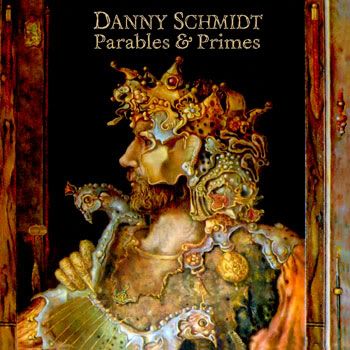
Parables & Primes remains my favorite, maybe because it was my first… perfectly produced, equally rich and tasteful. In Danny’s own words, about the songs on that CD in general, and Dark-Eyed Prince specifically:

1) They're written metaphorically and symbolically and in allegory and in parable. There are very few moments on this album that, if you can take them literally at all, don't represent something else, also. They're not all story songs, but I think they all pay homage, at least, to the sneaky power of story telling -- that a sharp-fanged truth might better sneak into the house wearing a pretty red hood.

2) They deal with deep-down-in-your-marrow sort of primal themes. They, for the most part, speak to love and loneliness and mortality and health and hunger and the dirty and the divine. These aren't toaster oven songs. These are more fire circle songs. More dirt floor than linoleum. The topics are really pretty basic. Indivisible level kinds of things. Primes, in my mind -- late at night, anyway.

Dark-Eyed Prince: This is a character sketch, basically -- of a poor conflicted soul who keeps trying to reach out and then keeps retreating back into his castle. The painting on the cover sorta struck me as reminiscent of the Dark-Eyed Prince.

Interestingly, when I first saw the cover of the CD, it reminded me of Giuseppe Arcimboldo’s work… as I’ve had his Winter, Spring, Summer and Autumn portraits (“the vegetable gents”, as my friend Laurie says) in my kitchen for decades – yet one more reason to love Danny…

The Aristocrats: King of the Road


Teddy Thompson & Rufus Wainwright: King of the Road

[Purchase]

No week full of kings and queens would be complete without the "King of the Road". Unfortunately, at the moment the Roger Miller original eludes me, but this cover is pretty great, and it definitely fills the void.

This version of the song was featured on the Brokeback Mountain soundtrack, and you can't go wrong with such a classic song when you get artists like Rufus and Teddy with their excellent music pedigrees (Teddy being the son of Richard and Linda Thompson, and Rufus being the son of Loudon Wainwright III and Kate McGarrigle) to give their own take on such a great song. This song, the original and the cover, always makes me smile.

The Aristocrats: When We Were Kings


Have Gun, Will Travel - When We Were Kings

[purchase]

Have Gun, Will Travel is Matthew Burke (voice, acoustic guitar, banjo, harmonica), Daniel Burke (bass guitar, voice), Jean-Paul Beaubien (drums, percussion), Nathaniel Oliver (elec. guitar, lap steel, voice), and Joshua Hernandez (viola). It began as the solo acoustic side project of Matt Burke, releasing an EP that managed to produce a few national ripples. Somewhere between that EP and Casting Shadows Tall as Giants, Burke dropped the “solo” and (I believe) the “side”, making HGWT a full-fledged effort. The result is a solid debut of 12 seemingly death-obsessed tracks.

The Aristocrats: The Lady of Shalott


Loreena McKennitt: The Lady of Shalott

[purchase]

No week of songs about aristocrats could be complete without a tale from the Arthurian legends. Here, after all, we have a set of tales in which almost no common folk appear.

I’m sure that most readers are familiar with the main outline of the story of King Arthur and his knights of the round table. But the Arthurian legends also encompass a large number of side stories. In particular, when the knights scatter throughout the countryside in search of the Holy Grail, each knight has his own adventures. “The Lady of Shalott” is the tale of what happens to Sir Lancelot during this time. The telling used here is by Alfred Lord Tennyson.

Loreena McKennitt is a Canadian artist with a beautiful, almost operatic, soprano voice which she knows how to use to best affect. She plays harp, piano, and other keyboards. Her music can be found under new age or Celtic or world music; all of those labels have some validity, but none do justice to her music.

Thursday, November 13, 2008

The Aristocrats: The Jungle King


Cab Calloway & His Orchestra: The Jungle King

[purchase]


I bought my first Cab Calloway album when I was thirteen - his energy, flamboyant stage presence and style equated to Rock And Roll before it even had a name. I was enamored by his powerful voice, he claimed his full throated style came from listening to cantors sing in neighboring synagogues during his in Baltimore childhood. I was lucky enough to catch him perform in a small Hollywood Jazz club during the eighties, he seldom used a microphone, that legendary voice still filled the air.

The Jungle King is one of Cab's better numbers, it's based on The Signifyin' Monkey, which is older than the hills - from Wikipedia:

There are numerous stock songs and narratives concerning the Signifying Monkey and his interactions with his friends, the Lion and the Elephant. In general the stories see the Signifying Monkey insulting the Lion, but claiming that he is only repeating the Elephant’s words. The Lion then confronts the Elephant, who soundly beats the Lion. The Lion later comes to realize that the Monkey has been signifyin(g) and has duped him and returns angrily.


Enjoy Cab Calloway sing how the King of the Jungle was reduced to tears by a wise monkey - a lesson wrapped in Jazzy Jive from the Hepcat King himself.

The Aristocrats: Sultans of Swing


Dire Straits: Sultans of Swing

[purchase]

So many king and queen songs yet to come, not to mention all those folk songs about Lord This and Sir That, but I thought I'd break up the folk and the trend toward western royalty a bit more by sending forth a relatively common but no less poignant or potent poptune from the Sultans of Swing themselves, as led by mastermind lyricist and distinctive guitarrock wizard Mark Knopfler.

You probably know this as ubiquitous and easily dismissable, despite its great hooks and masterful guitar solo (#22 on Guitar World's list of the greatest ever), but the tune has relevance, I think. The song emerged in the midst of the late disco era as an anomaly -- a daringly straightforward rock tune in the midst of a disco and pre-punk era; it took a few months to take off, given the BBC reluctance to play the song due to its "high lyrical content", but eventually reached top ten in the UK and the US; the tune, a first single, originally recorded as a demo and later re-recorded, truly put Dire Straits on the map, driving their self-titled album double platinum, and setting the stage for a long and fruitful career.

The song also holds an unusual place in the musical pantheon: to wit, most bands don't write a song about failed bar bands just happy to be playing the songs until at least their third album (see, for example, The Late Greats, which closes Wilco's fifth release), when they start to miss their roots a bit. Look past the cultural familiarity, and listen with 1978's ears; I think you'll find this song remains a powerful statement for the ages, even as it masquerades as classic rock fluff in an indie world.

Wednesday, November 12, 2008

The Aristocrats: King And Caroline


Guided By Voices - King And Caroline [purchase]

The drunken jesters of the Indie Rock Empire wax rhapsodic about the aristocracy. One of GBV's many perfect vignettes, it has several appealing elements: A killer bass line, the wobbly harmony between the bass and guitar, Bob Pollard's keening voice, especially at the "Overrun by the rank/Roll over like an egg" line, and Tobin Sprout's vocal harmonies coming in at the coda. 94 seconds of perfectly skewed pop economy.

And the wisdom they will sell ...

The Aristocrats: A Pair of Kings from Martin Carthy


Martin Carthy is one of the key figures in English folk music. He was one of the founding members of Steeleye Span. He later was part of the Albion Band. And, by marriage to Norma, he became part of the first family of English folk, the Watersons. But it is his solo work that really makes the case for his importance. Carthy is a tireless researcher who is devoted to preserving English folk traditions, and the versions of many songs that he pieced together from song fragments he found in his studies have become the definitive versions of these songs. Carthy is also a fine singer and instrumentalist. He often plays guitar, but can also be heard on dulcimer and other strings.

Martin Carthy: King Henry

[purchase]

In addition to the version heard here, Carthy also recorded King Henry with Steeleye Span. And yes, this is another of those English folk songs with pre-Christian elements. King Henry goes hunting, and kills the finest deer anyone has ever seen. After a great feast, he and his court retire for the evening. At midnight, a howling wind, followed immediately by the shaking of the earth, announce the imminent arrival of a supernatural being. This proves to be an impossibly ugly female giant. She demands that King Henry kill and feed her his best horse, his hunting hounds, and his hunting falcons. Finally she demands that he “lie with her” until morning. When they awaken, she has been magically transformed into a beautiful woman who presumably becomes his queen.

Tales of human nobles encountering extremely ugly females who transform into beautiful women abound in English folklore, particularly in the earliest forms of the Arthurian tales. A famous example is Sir Gawain and the Loathly Lady. The ugly woman is the goddess of sovereignty, and the noble must mate with her to truly become king. In King Henry, it seems clear that the deer that the king hunted was one of hers. In addition, the first food she demands involves the sacrifice of a horse. In pre-Christian times, the sacrifice of a horse was an essential part of the rituals a new king would perform upon assuming the throne.

Martin Carthy: King Knapperty

[purchase]

King Knapperty is an entirely different matter. The tale of maiden who must wed an impossibly ugly king, it is played purely for laughs. It is possible that this song originated as a kind of spoof of tales like King Henry; it turns everything about King Henry completely on its head, and has no ritual significance that I can recognize.

Tuesday, November 11, 2008

The Aristocrats: Royal Blues


Rachel Bissex: Royal Blues

[purchase]

Long story short: musician Rachel Bissex passed away the morning of February 20, 2005 from complications of breast cancer at the age of 48.

Short story longer: I was honored to call Rachel friend throughout the almost-ten-years I knew her – she was kind, she was generous in spirit, she was witty, she was life-embracing, she was a true musician and a “harmony whore” (her words), her beautiful voice tastefully adding to anyone else’s song, even if she was hearing it for the first time.

Upon finding out I was a Dar Williams fan, Rachel told me that, in addition to Dar singing additional vocals, Royal Blues contained many Dar references (diminutive in size, February, footprints in the snow)… and that, one day, she’d tell me the full story, over a glass (or three) of pinot grigio, our wine of choice – I will always regret that day never came…

In April 2005, plans began for Remembering Rachel and in July 2005, a 2-CD set of Rachel's songs sung by her friends and colleagues, including some of the top folk performers, was released, with 100% of all performance, mixing, mastering, distribution, graphic design, hosting and advertising costs donated. This labor of love was dedicated to raising funds to fulfill Rachel's final wish to pay for the college education of her children, Emma Goldberg and Matt Cosgrove…

Long story longer can be found here…

The Aristocrats: Queen of Hearts


Juice Newton: Queen of Hearts

[Purchase]

This song is one I loved when I was little. It came out in 1981, I was only a few years old at the time. The song has just such a fun beat and her voice is just so clear and fresh sounding, how could a little girl not dance around her room with this record playing?

As far as Juice Newton goes, she's best known for her version of the song "Angel of the Morning", the ballad about being someone's one-night-stand. But "Queen of Hearts" came from the same album, and it certainly has a much different feel. Juice left the pop mainstream for a country music career (something you can somewhat hear in this song) and did quite well, but her debut pop album is how most people will remember her.

Monday, November 10, 2008

The Aristocrats: King of Spain


Moxy Fruvous: King of Spain

[purchase]

Royalty, lord it looked good on me
Buried in silk in the royal boudoir or going nuclear free
Or playing Crokinole with the Princess of Monaco
Telling my jokes to the OPEC leaders, getting it all on video


Like so many folkies, I once considered Canadian ex-folkrockers Moxy Fruvous "our" rock band, though looking back, I find that such ownership was primarily endemic to a particular New England ruralfolk mindset -- one extraordinarily provincial, in fact, as evidenced by in-joke C-side Beware The Killer Tents, which name-drops a good several dozen older folk musicians who were in attendance at the Falcon Ridge Folk Festival the year that the winds were so heavy that at least one camper's tent took to the air, soaring above the festival mainstage like a bright and tiny hot air balloon, to live forever in infamy and song among a tiny slice of those who were there, and care.

But no matter the in-crowd, and no matter the unplugged geekrock sound, the folk connection is obvious, as is the glee with which they present it. As a general case, though their mid-career work got a bit folksappy, Moxy Fruvous at their best present a particularly ecosensitive mindset mapped in vocal-heavy madness; here, on one of several catchy numbers from their indie label debut Bargainville, they apply this winning solution to a delightful tale of an honest royal's rise and fall a la the same bait and switch that made the classic tale of the Prince and Pauper so memorable, with the abdication of the throne in favor of socialized foodstuffs and good honest work in the northernmost lands of the American continent, where royalty is still celebrated at a distance via coinage and faint-praise tribute, but the people truly rule.

I considered this silly ditty for our previous theme, but it belongs here, too, and I'm happy to have a second chance to share it. Though the band remains on indefinite hiatus after a mere decade of existence (circa 1989 to 2000), I'd encourage those charmed by the Fruvous sound to pursue the Fruhead archives.

The Aristocrats: Pharaoh


Richard Thompson: Pharaoh

[purchase]

In starting to plan my posts for this week, I started thinking about kings and queens, dukes and earls, even viscounts. Then it hit me: why do they have to be English aristocrats? After all there were aristocrats long before there was England. And as soon as I had that thought, this song came to mind.

Pharaoh is actually an old favorite of mine. My first acquaintance with Richard Thompson came through reading about him in the music press of the 1980s. He sounded like the sort of artist I should like, so I went out and got his current album at the time, Amnesia. Over all, I was disappointed. I was told to expect a masterful guitar player, but many of the tracks just sounded to me like noise. But the album ended with Pharaoh, and this was more like it! A slow song with very little guitar at all, and not anything like what I had read about, this was the song that grabbed me and has held me ever since.

Over the years, I have had occasion to reassess the music I liked and disliked in the 80s. Much of what I thought sounded great has aged badly, although a surprising amount has held up. But Richard Thompson’s music sounds better to me with each passing year. And Pharaoh still stands as one of my favorites.

Sunday, November 9, 2008

The Aristocrats: King Of Carrot Flowers


Neutral Milk Hotel: King of Carrot Flowers Pt. 1

[purchase]


From one of the weirdest, most endearing, and at times most disturbing albums in my library, King Of Carrot Flowers is not a tale of vegetable royalty, but of childhood angst and discovery. This, the opening track of the album, sets the stage for a frantic and wild ride through Jeff Mangum's fevered mind.  As the folks at AMG wrote, this album is either the work of a genius or of a crackpot.  I'd definitely recommend checking it out.


Saturday, November 8, 2008

Silly Songs: Carrot Juice is Murder


The Arrogant Worms: Carrot Juice is Murder

[purchase]

I can’t imagine getting through a Silly Songs Week without including one of the “boy bands”, Canadian (Fruvous, BNL) or otherwise (DaVinci’s Notebook) – The Arrogant Worms, from Ontario, fit the bill… and then some, as much of their humor depends on sight gags as well…

My first Folk Alliance (an annual folk conference, oxymoron-ish as that sounds) was in February 1999 in Albuquerque, New Mexico – it’s the only business gathering where, when one is told of a 2 o’clock performance, the first question is: p.m. or a.m.? It’s round-the-clock music, official and guerilla, highlighting everything under the broad folk umbrella (think festival-in-a-hotel) - we don’t need no stinkin’ sleep, right?

The Arrogant Worms were the last showcase I attended, on the cusp of Saturday night/Sunday morning – afterwards, side-splitting, knee-slapping and cheekbone-aching were no longer just clichés…

What with their extensive comedy catalog (Jesus’ Brother Bob, The Mounted Animal Nature Trail, History is Made by Stupid People), this was a tough choice – however, the “V8’s genocide” line gets me every time…

Submitted by Susan

Silly Songs: The Donner Party


Rasputina: The Donner Party

[Purchase]

What could possibly be funny about the horrendous situation that befell the Donner Party in the winter of 1846? Well, if anyone can find humor in historical events, especially American events of the 1800s, it's the cello-rock band Rasputina. Front-woman and songwriter Melora Creager has the band dress in Victorian era undergarments to perform and the content of the songs is often historical in nature, and even more often a bit silly.

Though this song isn't even really a song per say, it is off an album and does contain music and DOES make me smirk with laughter whenever I hear it. As interludes on their first album, they included tracks where cello music plays in the background as members of the band recite things. One may sound like a diary entry or poetry, or something else entirely, but they always are humorous. In the case of "The Donner Party" a girl gives a school presentation comparing The Donner Party to the Colonial Pilgrims. She takes her presentation quite seriously despite the nonsensical nature of the subject she's chosen.

Friday, November 7, 2008

Silly Songs: You Can't Roller Skate In A Buffalo Herd


Roger Miller - You Can't Roller Skate In A Buffalo Herd [purchase box set]

According to the absurdist laureate of country music, you can't do the following:

  • Roller skate in a buffalo herd
  • Take a shower in a parakeet cage
  • Swim in a baseball pool
  • Change film with a kid on your back
  • Drive around with a tiger in your car
  • Fish in a watermelon patch
But, you know what you can do?
  • Be happy if you've a mind to.

Silly Songs: The Pirates Who Don't Do Anything


Relient K: The Pirates Who Don't Do Anything

[purchase]

This song is a coverlover's dream: a cycle of genre parodies flailing through a perfectly ridiculous ditty originally performed by those tiny, delicious Jesus freaks the Veggie Tales, presented here by Christian Rock band Relient K, who originally covered the song for 2002 sproutflick Jonah: A Veggie Tales Movie. Not my usual fare, I admit, and it's coming in over the heads of some exceptionally solid also-rans for the week, but it's hard not to love this perfect Friday afternoon party tune, chock full of pirates and puns.

The tongue in cheek take on kidsong is one of my favorite subcollections, in fact, and this is one of the best and most gleeful in the collection. Kidsong being, of course, a whole 'nother theme, I'll merely mention the plethora of silliness available in my carefully collected set-to-come, and leave you dreamin'.

(On a more personal note, as a long-time and determined iconoclast, I've only recently gotten over my fear of all things "Christian rock", and highly recommend...some of it. Yeah, Jars of Clay, I'm talking to you.)

Silly Songs: Cynically Yours


Amy Rigby: Cynically Yours

[purchase]

I recall buying Amy Rigby’s Diary of a Mod Housewife when it came out in 1996, totally loving it but not understanding why – I’m optimistic, she’s jaded; I’m light, she’s more than a bit darker; I am comfortable in a long-term relationship, and she sings of a variety of not-so-great choices. Then I realized… I might be a Tigger personality… but I definitely have an Eeyore alter-ego – Amy Rigby appealed to the fragile, vulnerable, insecure me… on those days when “I’ve lost my tail”… i.e., my sanity, my self-esteem, my memory, my car keys (need I go on?)…

I back-burnered Amy for a while but, when she appeared on Jules Shear’s Between Us CD (definitely in my Top Ten), I tracked down what I’d missed, as well as kept her in my radar from that point on – it was a wonderfully worlds-colliding moment when she asked Todd Snider to duet on ‘Til the Wheels Fall Off…

She’s recently moved to France and married Wreckless Eric – they just returned from a U.S. tour, and her blog retains the Beer and Kisses sensibility of her bent-but-not-broken songwriting…

Cynically Yours is the meeting place of ennui and desire – insert name here…

Submitted by Susan

Thursday, November 6, 2008

Silly Songs: Shoehorn With Teeth


They Might Be Giants: Shoehorn With Teeth

[purchase]

Geekrockers and modern TV theme song geniuses They Might Be Giants have a reputation for the odd and surreal, but under most of their songbook is at least some semblance of narrative, or at least a mindset which frames their oddities as metaphor for something slightly more normal, and often surprisingly deep and pithy. Not so this short ditty, off 1989 sophomore album Lincoln; near as I can tell, the scattered impossibilities and earworm tune are merely a framework for a series of silly images that come straight out of the fevered dreams of Salvador Dali, from the titual toothed shoehorn to the heavy metal tourplane that runs out of gas in the air and thus can never land. Bonus points for wildly blaring homophonic sax and accordion, which reflect perfectly the nasal voices of Giants John and John, and lend a sense of lightheartedness and glee to untethered lyrics already on the verge of floating away.

Silly Songs: Hello Muddah, Hello Faddah


Allan Sherman: Hello Muddah, Hello Faddah

[purchase]

I actually am quite surprised that Allan Sherman's classic hasn't made an appearance yet this week. To me, this is the quintessential funny song. It's not often that a purely humorous song can make its way all the way up the charts to #2 and get a Grammy to boot.

This song was based off letters Sherman's son wrote to his parents while he was away at camp. It has since spawned Sherman's own sequel song as well as a game, a musical and a children's book.

Wednesday, November 5, 2008

Silly Songs: Yellow Submarine


The Beatles: Yellow Submarine

[purchase]


In comments, someone requested this and it's not a bad choice at all. When it came to silliness in the recording studio, The Beatles were up there with the best of 'em. On Yellow Submarine, drummer Ringo Starr sings lead on a tune Paul McCartney wrote as a children's story. It climbed to #1 on the UK charts, #2 in the US.

The special effects included chains, a ship's bell, tap dancing mats, whistles, hooters, a tin bath filled with water, wind, thunderstorm machines, as well as a cash register that was later used on Pink Floyd's "Money". John Lennon blew through a straw into a pan of water to create a bubbling effect, he and McCartney talked through tin cans to create the sound of the captain's orders and Abbey Road assistant engineers John Skinner and Terry Condon twirled chains in a tin bath to create water sounds. After the line, "and the band begins to play", main engineer, Geoffrey Emerick, found a recording of a brass band and slightly changed it so it couldn't be identified, though it is thought to be a recording of Georges Krier and Charles Helmer's 1906 composition, Le Reve Passe. When the overdubs were finished, road manager Mal Evans strapped on a marching bass drum and led everybody in a line around the studio doing the conga dance while banging on a bass drum. The original recording had a spoken word intro by Starr, but later was edited out.

"I was laying in bed in the Jane Asher's garret... I was thinking of it as a song for Ringo, which it eventually turned out to be, so I wrote it as not too rangey in the vocal, then started making a story, sort of an ancient mariner, telling the young kids where he'd lived. It was pretty much my song as I recall... I think John helped out. The lyrics got more and more obscure as it goes on, but the chorus, melody and verses are mine. It's a happy place, that's all. You know, it was just... We were trying to write a children's song. That was the basic idea. And there's nothing more to be read into it than there is in the lyrics of any children's song." - Paul McCartney

Here's a remix that emphasizes the special effects along with a restoration of Ringo's spoken introduction:

The Beatles: Yellow Submarine

[purchase]


The other requested Beatle silly song, Ob-La-Di, Ob-La-Da, can be found as part of my recently posted collection of hand clapping songs: put your hands together...

Tuesday, November 4, 2008

Silly Songs: The Piano Has Been Drinking


Tom Waits: The Piano Has Been Drinking

[purchase]

Because of our rule about only one song per album, I could not do a double post with “Step Right Up”. It was a tough choice. Definitely check that one out as well.

But as to the matter at hand. I imagine a young piano bar player comes into this place for a month-long gig. He is young in the business, and every gig is the greatest gift he has ever received. His rose colored glasses are fully functional. By the end of the gig, his theme song is Billy Joel’s “Piano Man”.

The month ends, and the next week a grizzled piano-bar veteran comes in for his turn. A very different man, he said goodbye to his dreams long ago. He’s seen it all, and not cared for much of it.. For him, this gig is a way to finance his drinking, nothing more. And this song is his theme song.

So two men experience the same place in very different ways.

Silly Songs: I'm a Bear


Flotation Walls: I'm a Bear

I'm Amelia Earhart!
Just kidding...I'm a bear.

This song is so hilarious to me, but then again, I love absurd humor. It's definitely one of those song where you hear it and your first reaction is "What the...?". But as far as songs that literally make me laugh out loud go, this song takes the cake. It's so bizarre, it's most certainly not something I've heard anything like before.

Unfortunately, other than their MySpace page there is little information on this band, let alone this song. The band is from Columbus, OH, that much is for certain, but beyond that they seem to have taken on many forms over the years and this song is probably almost 10 years old by now. I've known about it since at least 2001 through a friend who included it on a mix who got it from a friend who included it on a mix, who heard it through someone who knew the drummer or some such.

All I know is that this song is priceless as far as the content. Whether or not they were even intending on this song being so funny, I don't know. But any indie rock song that is from the perspective of rather sarcastic hungry bear can't be too serious, I mean, come on!

Silly Songs: The President's Penis Is Missing


Drive-By Truckers - The President's Penis Is Missing

[purchase]

May as well make today's post topical. This song appeared on the Trucker's 1999 effort, Pizza Deliverance. The album went out of print a long time ago but was recently re-mastered and re-issued but this song no longer appears on the official track listing so I dunno if it's still on it or not.

The official lyrics sheet set the song as a play more so than a song so I decided to post them here as Patterson wrote them:

The President's Penis is Missing

(NEWS FLASH!!!) (scene: the press corps have descended upon the White House, a spokesperson begins to speak:)
“They looked in the White House and Capitol Hill
They looked everywhere for Buffalo Bill
We called every scholar, reporter, and genius
Has anyone seen the President’s penis?”

“It ain’t in the Congress or Judiciary
It ain’t in the Smithsonian or that big ole library
an astronomer claims it was sighted on Venus
Has anyone seen the President’s penis?”

(now the entire press corp. erupts in song:)
“THE PRESIDENT’S PENIS IS MISSING OLE’!!!
WE SEARCHED HIGH AND LOW, EVERY NIGHT EVERYDAY
LORD, WON’T YOU COME DOWN AND REDEEM US
HAS ANYONE SEEN THE PRESIDENT’S PENIS?”

(at this point, legendary news man Walter Cronkite returns from the moon to add his commentary:)
“Now Presidents have goofed up in all kinds of ways
in the 80’s we elected one missing his brain
George Washington caught a cold he couldn’t explain
and we all know the truth about Thomas Jefferson’s name”

(suddenly William Randolph Hurst rises from the grave and bellows out in an Orson Welles type voice:)
“Franklin D. Roosevelt wasn’t no square
with that raging Woodrow in his wheelchair
and all the lesbians snickered that Elenor didn’t care
and John Kennedy’s penis was seen everywhere”

(once again everyone breaks out in gleeful song:)
“THE PRESIDENT’S PENIS IS MISSING OLE’!!!
WE SEARCHED HIGH AND LOW EVERY NIGHT EVERY DAY
LORD WON’T YOU COME DOWN AND REDEEM US
HAS ANYONE SEEN THE PRESIDENT’S PENIS?”

(the scene shifts to Sen. John Glenn, wandering pensively, somewhere in space:)
“Them outer space people would laugh if they’d seen us
all this talk about cum-stains and oral coitus
meanwhile the whole world suffers from hunger and meanness
but we’re more concerned with the President’s penis”

THE END?

Silly Songs: Ain't Got No Home


Clarence "Frogman" Henry: Ain't Got No Home

[purchase]


In Ain't Got No Home, longtime New Orleans resident, Clarence "Frogman" Henry, is pretty straightforward - he tells us he can sing like a girl and a frog (hence the nickname). Listen to the hilarity ensue as Frogman croaks like an amphibian after he squeezes out a falsetto - a very silly song, indeed. In his own words:

I was working at a service station in New Orleans and when I got off work, I would pass a club called the Brass Rail where Paul Gayten played. I admired him playing, I'd stand on the sidewalk lookin' inside the club. Paul was the A&R man for Leonard Chess and I would relieve Paul on Monday at the Brass Rail. I started singin' a song called Ain't Got No Home in the Old Joy Lounge in Gretna. I played it for Paul and Paul sent it up to Leonard Chess, and Leonard Chess came down to hear it. When Leonard heard it he told Paul to break it up into different parts with the girl and the frog. I had written Lonely Tramp before Ain't Got No Home. What happened, Shirley and Lee were from New Orleans and were hot during that time. I didn't have a female singer in the band, so I had to switch my voice like a girl, but how I do the frog I don't know. On the West Bank, Algiers, you had the alligators and frogs and I used to imitate the frog in school, to scare the girls! Leonard Chess put my record in the garbage, he wanted to keep it in mind, but I wouldn't be the artist. It was "make it or break it", that's what they called it. A disc jockey called Poppa Stoppa here in New Orleans was pushin' Troubles Troubles for the A-side and he flipped it over to Ain't Got No Home and the people was crazy over it. They didn't know the title of the song or who was singin' it so they said - "Play the Frog song by the Frogman". I happened to be in the studio and he said, "From now on your name is Frogman." - Clarence "Frogman" Henry

Monday, November 3, 2008

Silly Songs: Viagra in the Water


Four Bitchin‘ Babes: Viagra in the Water

[purchase]

Four Bitchin’ Babes are a folk-comedy-revue, whose members have included Christine Lavin, Patty Larkin, and Julie Gold, among others. The lineup heard here consists of Camille West, Debi Smith, Megon McDonough, and Sally Fingerett. All are also solo artists whose work is well worth seeking out.

As for the song, I thought that, in these, er, hard times, we could all use a good laugh.